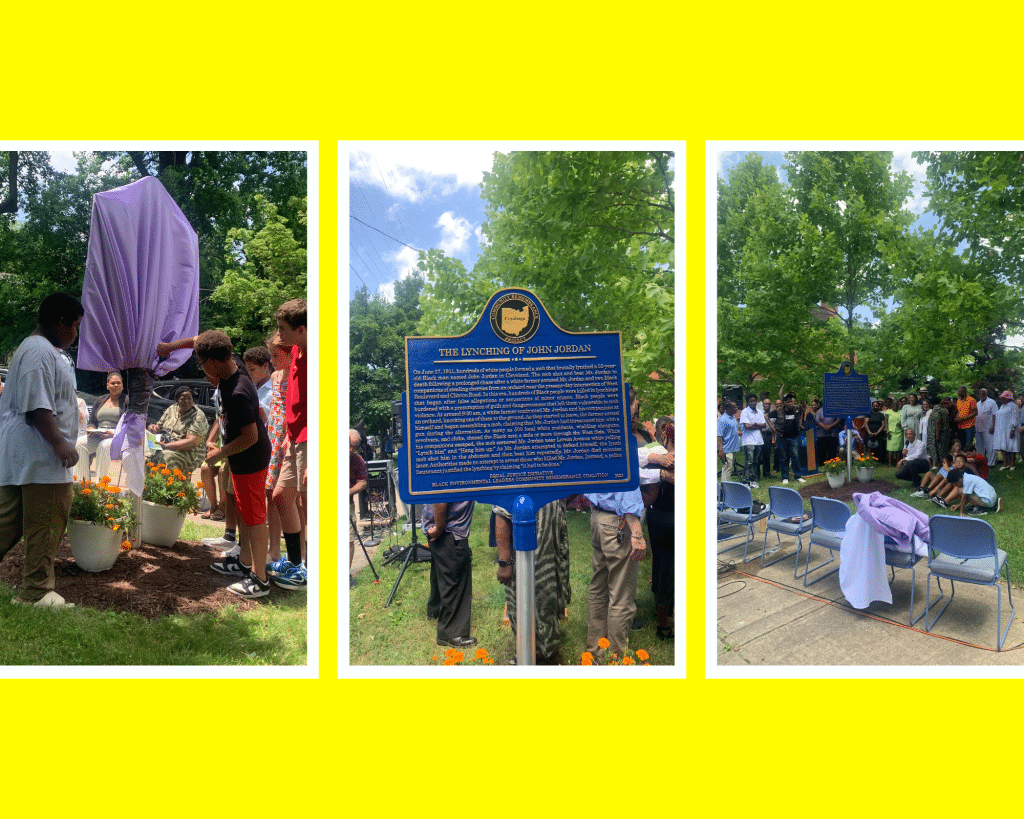
In 1911, John Jordan, a 19-year-old African American, was lynched by a white mob after being accused of stealing cherries off a tree on a white farmer’s orchard – making it one of the only documented lynchings in Cuyahoga County.
Now over 100 years later, Cleveland’s Black community is making sure the story is being told and remembered.
Members of the Slavic Village community gathered at Elizabeth Baptist Church on Sunday, June 22 to unveil a historical marker to memorialize Jordan in hopes of bringing healing and salvation against racial violence in America.

“Lasting progress is possible when communities build power, speak truth to power and create coalitions that shift the balance of power,” said SeMia Bray, co-executive director of the Black Environmental Leaders (BEL).
BEL is a nonprofit organization which advocates for environmental and economic justice in Ohio with a mission to advocate, incubate and inform.
The marker comes after five years of collaboration between BEL and the Equal Justice Initiative (EJI) for its Community Remembrance Project, a nationwide effort that has brought more than 80 historical markers to local communities to commemorate documented victims of racial violence throughout American history.
EJI is an Alabama-based nonprofit organization that advocates for the end of mass incarceration in the United States through providing legal representation to individuals who have been wrongly convicted and abused in state jails and prisons.
“The lynchings of people like John Jordan were devastating to the rule of law, to the Black community and to the justice quotion in America,” said Mia Taylor, EJI’s project manager. “In too many places in our country, for far too long, Black people were pulled from their homes, from jails, from places of work and beaten tortured and lynched by white mobs. The violence was made worse by the failure to hold anyone accountable for denigrating the rule of law.”
Lynching is the extrajudicial, public killing of an indivudal by a group or mob. Lynchings, which involved mostly Black men and women victims, were used to traumatize, torture and intimidate African Americans. According to EJI’s report Lynching in America, there are over 4,000 documented lynchings in the United States. The organization also reported that there were 15 reported lynchings in Ohio in Athens, Butler, Cuyahoga, and Erie counties, among others.
Elizabeth Baptist Church, where the historical marker now stands, is 6 miles from the original location of where Jordan was lynched, which reportedly took place on Cleveland’s West Side at the corner of Lorain Avenue and West 98th Street. Despite the church not being the exact location where the incident took place, community members felt it was important for Jordan’s memorial to represent the truth of Cleveland and America’s historic yet grim past.
“John Jordan was a young man with a future, a story, a family, [and] friends,” said BEL’s special project manager David Wilson. “And though he was denied justice in life, we are here today to affirm his dignity. We are here to confront a painful chapter of our past. Not to dwell in that pain but to bring it to light where it can no longer be ignored.”
Keep our local journalism accessible to all
Reader support is crucial as we continue to shed light on underreported neighborhoods in Cleveland. Will you become a monthly member to help us continue to produce news by, for, and with the community?
P.S. Did you like this story? Take our reader survey!