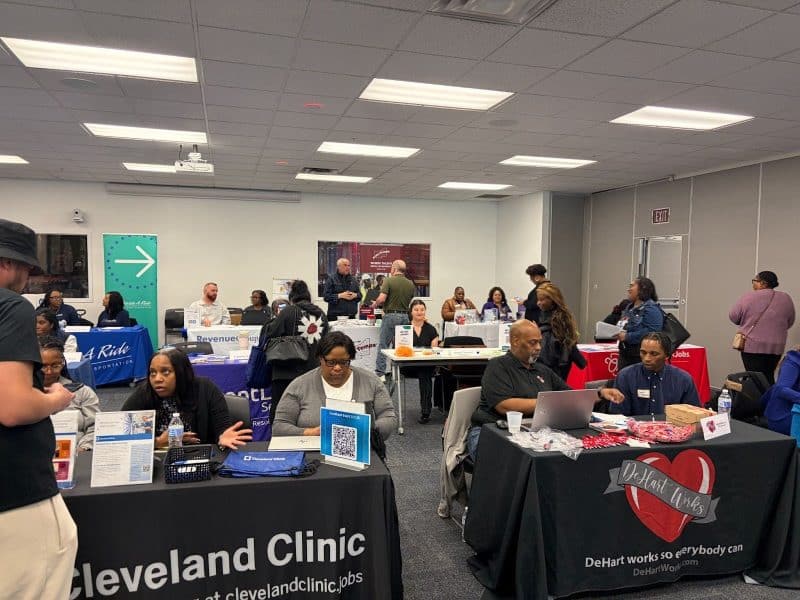
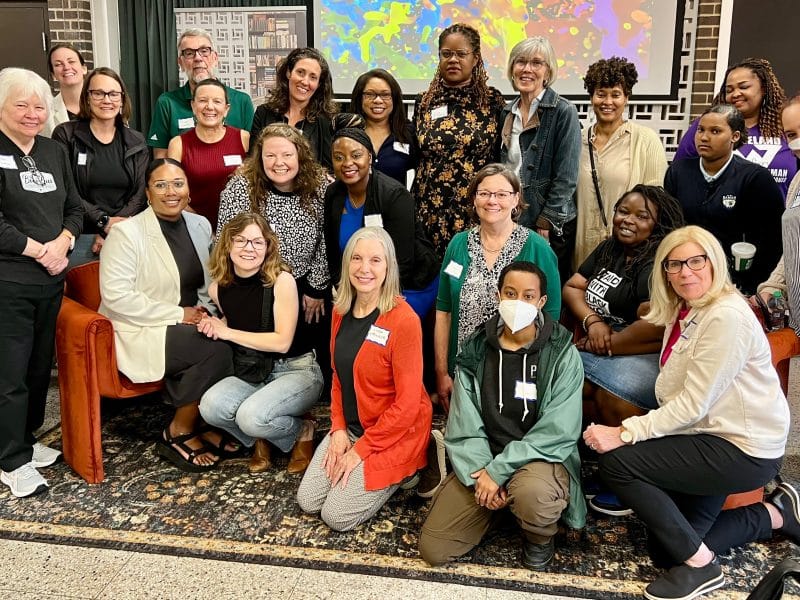
A crowd of about 40 people gathered in an empty storefront on Fleet Avenue in Slavic Village on a recent January afternoon to talk about the growing problem of drugs in the neighborhood. After sharing a lunch of pizza, salad, and soda, the group of social workers, health care professionals, residents, police, and city officials shared what they knew. It wasn’t good – over the past two years, overdose deaths have risen dramatically, and the problem is acute in Slavic Village.
“In the last year and a half, things have definitely become much more extreme,” shared Becca Britton of Neighborhood Pets, a nonprofit on Fleet that provides affordable pet care services. “What I see all day long is many, many addicts, people scoring and leaving, people sitting cross-legged on the sidewalk smoking crack pipes.”
She said she leaves “care packages of condoms and NARCAN” (a medication used for emergency treatment of a suspected opioid overdose) outside her building, and “all of it is taken pretty much right away.”


A Slavic Village resident named Rainbow, who is in recovery from substance use disorder, said she has also seen an increase in overdoses on the streets. “People are overdosing for no reason – because they don’t know or don’t have the tools to use NARCAN,” said Rainbow. (NARCAN, or its generic version naloxone, can be administered by anyone – no medical training is required – and does no harm if the patient is not actually overdosing.)
Another panelist, Odetta Fields, a lifelong Slavic Village resident, told the crowd, “Drugs have always been here, but they’ve escalated. It’s a bad epidemic that has hit Slavic Village hard.”
The forum, which was called Slavic Village Drug Data Day, was organized by the organizations University Settlement, Thrive for Change, Project White Butterfly, and Southeast Cleveland Resource Center. The agenda included speakers from the Cuyahoga County Medical Examiner’s Office, Cleveland Department of Public Health, and the Cleveland Police narcotics unit. The atmosphere was decidedly casual and collaborative despite the sensitive issues being discussed. One thing all speakers shared was a desire to reduce the stigma around drug use and to treat it as a healthcare issue rather than a personal or criminal issue.
Fields is a member of the Community Yahoos group which gave away free food, masks and blankets during the Covid-19 pandemic. She founded the Southeast Cleveland Resource Center because she saw soaring need in her neighborhood, where more than half the residents fall below the poverty line, and wanted to help bridge the gap between people who needed help and programs designed to serve them.

“We’re trying to come back,” she said of Slavic Village. “To come back, we have to help our people. That’s the only way we’re going to come back.”
The Southeast Cleveland Resource Center, located in the heart of the community in a first-floor storefront at 5211 Fleet Ave., offers a gathering space where people can get help accessing basic services, Fields said. The center also offers meeting space for community members, and local police can warm up or use the restrooms here when they’re on patrol. Fields serves as director and Troy Simmons, who also works at University Settlement, serves as assistant director.
“We are basically resource brokers,” said Fields. “People come in here and need help with utilities, housing, basically anything that people need help with, and we point them in the right direction.”
As examples, Fields pointed to weekly giveaways of snack packs to Cleveland school children; a woman who was able to come into the center and get a warm hat, scarf, and gloves; and people who have applied for the Home Energy Assistance Program (HEAP). Although the Southeast Cleveland Neighborhood Resource Center is in Slavic Village, it’s open to all.
“We don’t care where people come from, if they walk through the door, they’re getting help,” said Fields, adding that she recently helped a woman who lives off of St. Clair Ave. and one of her goals is to create stronger communication between Slavic Village and the nearby suburb of Newburgh Heights.
Fields said the Southeast Cleveland Resource Center exists because many people don’t know how to navigate help from the city of Cleveland, nonprofits, and public agencies. “The average person going down the street doesn’t have connections like we do,” she said. “If someone needs a hot water tank or a furnace, we have a direct connection to somebody who can help them.”
The Slavic Village resident has also helped organize events that bring people to Fleet Ave., including a music event this past September called the Walter Hyde Fleet Jamboree, which was named after the iconic Daisy’s Ice Cream owner who died in 2021.
Fields, who has undergone many challenges in her life, including being a victim of domestic violence and serving time in prison, said her personal experiences have motivated her to try to help others in similar situations. “I’m one of those people who believes you can’t help people with a problem unless you’ve experienced it yourself,” she said.

Melissa Khoury of Saucisson, a butcher shop that moved to Fleet in 2017, praised the effort. “It’s neighbors helping neighbors on a grassroots level, and that can only be a good thing,” she said. Khoury wants to see more local retail businesses like hers on Fleet, which underwent a $9 million streetscape re-do in 2016, and says the area has an unfair negative reputation, especially in the local media.
Ward 12 council member Rebecca Maurer, who attended the Drug Data Day event, also expressed support for the new resource center. Chris Alvarado, executive director of Slavic Village Development, said his organization is supportive of the effort and hopes to work with them more closely in the future.
“I love what they’re doing,” said Earl Pike, executive director of University Settlement, which is developing 5115 The Rising, an affordable housing development on Broadway Ave. in Slavic Village, in partnership with the NRP Group. “It’s been really fascinating to me to watch over the last few years and see more grassroots energy and activism in Slavic Village. When people think of Slavic Village, they think of the large organizations, but these small organizations are important. I honestly think that’s how change happens.”
Fields and other volunteers are currently funding the resource center out of their own pockets, but they hope to become a 501(c)(3) nonprofit organization and raise $50,000 this year. Fields said the purpose of the resource center is not to compete with other agencies, but to complement what they’re doing and work with them to help people. “We can connect people to Slavic Village Development, University Settlement, CHN Housing Partners, just different services that are needed,” she said. “That’s what we’re doing. We want to work with everybody.”
So far, she’s been encouraged by the response. “Everybody is so welcoming,” she said of her neighbors on Fleet and other nonprofit and city partners throughout the neighborhood.
For more information about the Southeast Cleveland Resource Center, visit 5211 Fleet Ave. or call 216/266-0278. The website is www.southeastclevelandrc.org. For more information about Slavic Village’s comeback, read Mike McIntyre’s 2019 Cleveland.com story here: Slavic Village: ‘Richest poor neighborhood in Cleveland’ is fighting its way back – cleveland.com.
Keep our local journalism accessible to all
Reader support is crucial as we continue to shed light on underreported neighborhoods in Cleveland. Will you become a monthly member to help us continue to produce news by, for, and with the community?
P.S. Did you like this story? Take our reader survey!