In the summer of 1962, I worked as a painter in the building maintenance department at Warner & Swasey. One day, three of us were assigned to reseal the panes of glass with a gooey black substance. As luck would have it, I lost control of my can of goo, and it cracked a panel of glass. The only thing worse than the look on my boss’s face when he came up on the roof to order me down to clean the goo that was dripping on a machine on the floor below, was the look on the face of the machinist as he yelled at me.
This is an ongoing series. To read Part I, click here.
While Warner was the precise designer and strategist, Swasey was the inventive problem-solver and machine-development expert. Their careers illustrate the pivotal role that 19th-century apprenticeships and early industrial experience played in creating America’s machine-tool industry. Their time at Exeter and at Pratt & Whitney did not just teach trades, it shaped creative, precision-oriented engineers who would go on to industrial prominence. Through the Warner & Swasey Company, they helped define American excellence in machine tools and precision instrumentation, setting standards that would influence manufacturing and scientific research for generations.
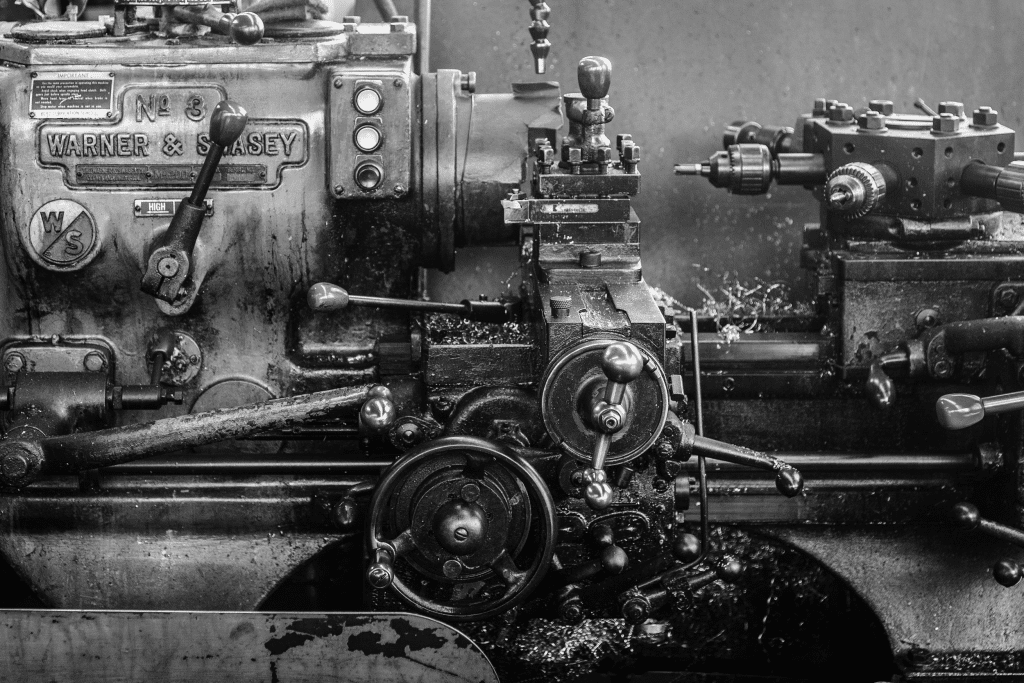
Among historians of machine tools, the single most important Warner & Swasey machine, globally, was the revolutionary No. 1 Turret Lathe, introduced in 1888. A turret lathe differs from a conventional engine lathe by the replacement of the tailstock (the part of the machine that either holds the workpiece so that a tool can cut in from the side or holds a tool to cut in to the workpiece from the end) with a hexagonal rotating turret that holds multiple cutting tools. Instead of removing and resetting tools after each operation, the machinist simply rotates the turret to bring the next tool into position. Simply stated, the benefit of the turret lathe was that it made modern mass production possible. The No. 1 is widely regarded as the first truly practical, production-ready turret lathe, and it dramatically changed how the industrial world manufactured precision metal parts. Later Warner & Swasey machines like the No. 3, No. 4, and No. 6 turret lathes, were extremely successful, but they were evolutionary, while the No. 1 was truly revolutionary. It defined modern production machining and enabled mass industrialization. It directly supported and became indispensable in the rise of the automobile, arms, and aircraft industries in World Wars I and II.

Warner and Swasey built their first Cleveland factory, a three-story, 13,500-square-foot brick building, measuring 100 by 45 feet in a matter of months in 1881, at 5701 Carnegie Avenue. Although there are few details, it is said that the footprint of the building was expanded in 1890 to keep up with incoming orders. By 1900 it was clear that far more space was necessary to meet the company’s rapid growth.
Architect Arnold Brunner was engaged to develop a plan, including a strategy for uninterrupted production. The design was for a five-story brick building measuring approximately 400 x 58 feet. The strategy began with the relocation of office functions, including management, administration and design, and were relocated to the Caxton building, on Huron Avenue, west of East 9th Street in 1903, allowing those functions to continue uninterrupted, while providing more space for manufacturing in the 1881 building. Construction of the new building began to the west of the original structure in 1904.
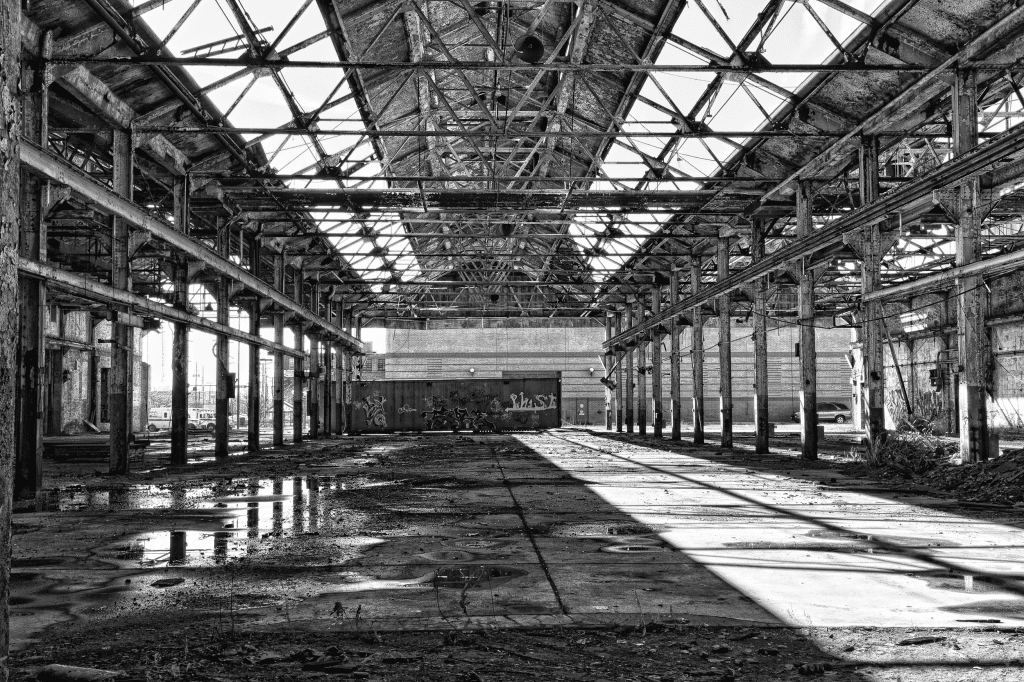
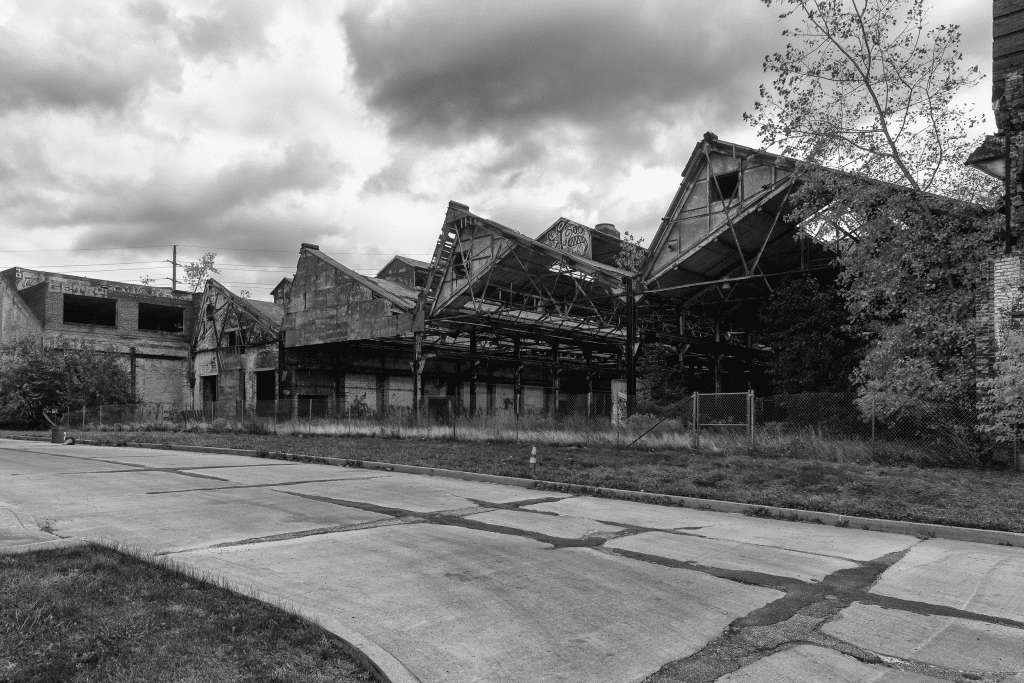
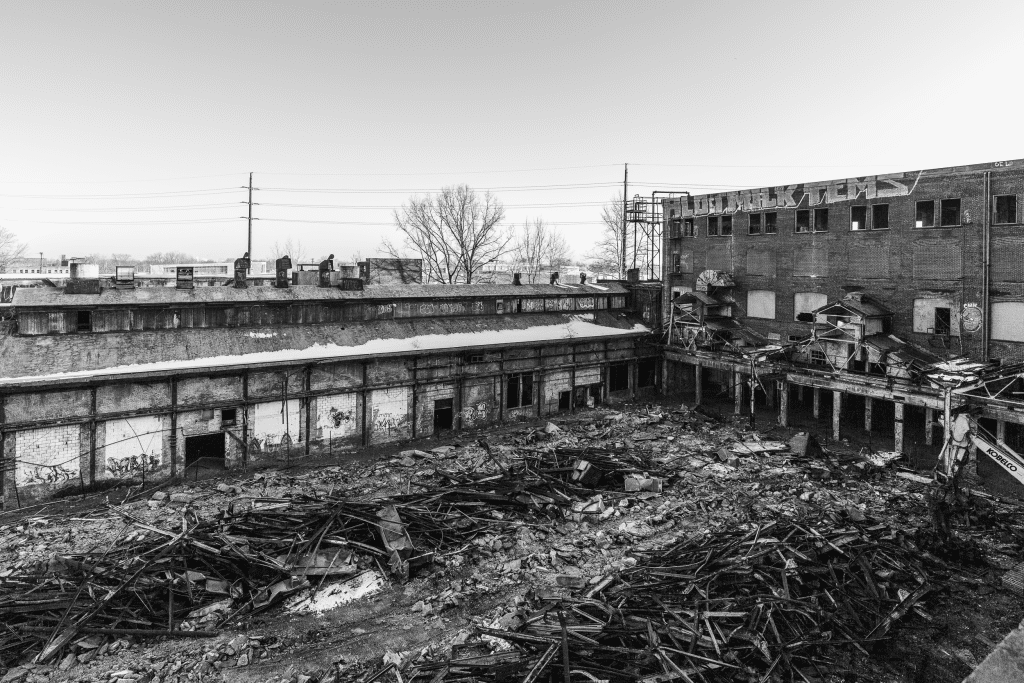
In addition to the new five-story building, approximately 70,000 square feet of one-story manufacturing space, known as the Sawtooth Buildings, north of the main building. They derived their name from the distinctive roof shape used in industrial structures, to maximize light on the shop floor. The roof consists of a series of repeating sloped surfaces with windows facing north to allow maximum natural light to reach the shop floor. When viewed from the end, the steep front, and the shallow sloped back side, resemble the teeth of a saw.
The strategy continued when the construction of the western half of the new five-story building was completed in 1908, and production was relocated to the first part of the new building so the the old building could be demolished, and the rest of the new five-story structure could be built in its place. At the same time, a 25,000-square-foot, five-story, wedge-shaped building was built to abut the northeast corner of the new main building and abutted the east end of the sawtooth buildings. The geometry of the building was dictated by the pre-existing railroad tracks of the Pennsylvania Railroad. The nearly 300,000-square-foot complex was completed, and the office functions returned from Caxton Building in 1910.
The next major addition was in the early days of World War II, when the single-floor, 50,000-square-foot building known as Plant 5 was built abutting the west side of the sawtooth buildings, allowing a flow of materials between the two buildings. In 1948-49 a single-floor, approximately 9,000-square-foot cafeteria, was built on the open space west of the main building, and south of Plant 5. There being no further land available on the north side of Carnegie, further expansion took place on the south side of Carnegie.
For the rest of the summer, I dreaded having to walk through the department as the machinists “cat-called” and whistled, and the one whose machine I baptized with goo shouted things like “Hey, little Rembrandt (everyone called my boss Rembrandt) have you broken any windows lately?”
Telescopes won prestige in the company’s early years, but it was machine tools that sustained its profitability. The Warner & Swasey No. 3 Turret Lathe introduced in the 1920s was the top-selling Warner & Swasey machine of all time, still selling as the No. 3A in the early 1970s. By 1928, Warner & Swasey was the world’s leading manufacturer of turret lathes. More than 50,000 turret lathes were sold before Warner & Swasey began to phase out their production to concentrate on Numerically Controlled, and then and Computer Numerically Controlled technologies, which may have a added between 10 and 20 thousand more, not counting the boring mills and special-purpose machines. NC machines, introduced in the early 1950s were controlled by punched paper or Mylar tapes and hard-wired logic. CNC machines emerged in the late 1960s and 1970, when digital computers and microprocessors became practical for shop floor use.
Intense foreign competition, particularly from Japan and Taiwan in the 1970s took its toll on American industry in general, and the machine tool and precision instrument industries in particular, eroding Warner & Swasey’s market share and increasing its vulnerability to acquisition. In October 1979, Dominion Bridge Company, a Canadian corporation headquartered in Montreal, initiated a hostile takeover of Warner & Swasey, with an opening with a $57 per share, raising the bid to $75 in December. Dominion had already acquired multiple U.S. firms. Warner & Swasey’s expertise would add turret lathes and automation capabilities to Dominion’s drive toward diversified manufacturing.
Bendix Corporation, in a friendly effort, countered aggressively, outbidding Dominion/AMCA multiple times, forcing Dominion to withdraw. Bendix integrated the financially struggling company into its operations as a division focused on automation, but profitability continued to drop sharply by late 1982, due to increasing foreign competition. In the meantime, Bendix failed in a hostile takeover attempt of Martin Marietta, and Allied Corporation acquired Bendix in 1983 and sold Warner & Swasey Cross & Trecker, a major machine tool manufacturer in 1984.
Warner & Swasey opened a major manufacturing plant in Solon, Ohio in March 1968. The plant was part of a broader plan to move several operations out of the older Cleveland facility into suburban Solon. In 1985, the company closed its factory and offices at East 55th Street and Carnegie Avenue, Cross & Trecker was struggling with declining orders and low prices, due in part to a downturn in automobile manufacturing, which made up 40% of C&Ts sales. Giddings & Lewis, a Wisconsin-based firm, machine tool manufacturer absorbed Cross & Trecker and shut down Warner & Swasey’s last remaining plant in Solon, Ohio, in January 1992, ending nearly 111 years of operations in the Cleveland area.
The iconic Midtown Cleveland building at 5701 Carnegie Avenue, vacant for forty years, was acquired by Pennrose in September 2025 for adaptive reuse into mixed-income housing. In partnership with the Commercial Development Corporation, MidTown Cleveland Inc., the long-vacant Warner & Swasey factory will be transformed into a mixed-use, mixed-income community. The adaptive reuse of the historic five-story building will protect its architectural legacy while introducing new life to Cleveland’s midtown.
In Phase I, the second and third floors will consist of fifty-six units of affordable senior housing. The fourth and fifth floors will consist of an added fifty-six units of affordable family housing. Phase II will provide twenty-eight additional units of housing in what is known as the “Wedge Building,” attached to the northeast side of the main building, and narrows as it proceeds north, parallel to the railroad tracks. This project has been a long time in coming, but the result will return this historic building to its former glory.
After Warner & Swasey ceased manufacturing at Carnegie in 1985, the entire complex sat idle, with the rear sheds and sawtooth structures bearing the brunt of neglect. Exposed roof monitors, lightly framed trusses, and open‑sided sawtooth buildings decayed more quickly than the massive front building, and repeated vandalism accelerated the loss of envelope integrity. The first step in the site preparation for the adaptive reuse, was the demolition of the Sawtooth Buildings.
On my last day that summer my boss said the machinist wanted to see me. I walked into the department to cheers and applause, and the machinist thanked me for being such a good sport, admitting that all his anger had been put on. I remembered that summer as I watched the sawtooth buildings being demolished. I just wish I could remember his name.
Keep our local journalism accessible to all
Reader support is crucial as we continue to shed light on underreported neighborhoods in Cleveland. Will you become a monthly member to help us continue to produce news by, for, and with the community?
P.S. Did you like this story? Take our reader survey!