Support from the Transformative Arts Fund signals big opportunities to come for Cleveland artists – and it could be just the beginning.
Sometime before the leaves begin to shift hues, a handful of Cleveland creatives are due to receive the largest grants ever available to artists in the city.
Distributed by Assembly for the Arts (AFTA), using $3 million of the city’s American Rescue Plan money, the Transformative Arts Fund (TAF) still needs to sift through 103 applicants before awarding stipends ranging from $250,000 to $500,000 to Cleveland artists for projects in an array of mediums.
AFTA intends for these sizable grants to support “innovative, thought-provoking and inclusive” public art projects that will leave some sort of noticeable mark on the city after Mayor Justin Bibb debuted them at the end of January. According to Cleveland City Hall spokesperson Tyler Sinclair, the TAF advisory committee still has a slew of decisions to make before AFTA announces which creative applicants residing in the city will get some of the overall $3 million TAF fund after applying earlier this year.
Determining the total number of artists who will get a taste of the TAF is step one; a set of six artists would allow AFTA to distribute $500,000 handouts, but the nonprofit is considering a modular payout schedule that would select up to 12 recipients, with some getting $250,000, and more for others. The multidisciplinary nature of the grant means filmmakers, painters, musicians, chefs and designers are also up for inclusion.
Between the city’s January announcement of the TAF and the late-March application deadline, AFTA and a committee at city hall dedicated to the fund hosted a series of virtual information sessions that dove deeper into the TAF application and selection processes.
“Something we’re really making sure of is keeping this artist-led and artist-focused,” Sinclair told The Land in April. “What I mean is, during the entire process, we have our TAF advisory committee. It’s an artist-led committee with artists of various disciplines throughout the city. Seven artists are involved in developing the vision and mission of the grant and running point for evaluation and scoring.”

Aisia Jones, who co-chaired the Verge Fellowship and juried the five grantee artists selected as an extension of the Cleveland Foundation-funded Cleveland Arts Prize (CAP) earlier this year, identified the TAF’s size and immediacy as the two biggest factors differentiating it from previous local arts grant opportunities.
“For the Transformative Arts Fund, it’s a one-time deal,” Jones said, alluding to the fact that TAF beneficiaries will get their sums of no less than a quarter-million-dollars in singular lumps.
“Groups can get upwards of $500,000. That is not your normal [grant]. The TAF… is a tremendous opportunity for groups of artists here in Cleveland to display their work, display their creativity and be able to collaborate with other artists they may not otherwise have the opportunity to.”
Just as the city partnered with AFTA to disburse these grants, applicants were required to initiate relationships with regional institutions ranging from community development corporations to schools and religious organizations before submitting their grant proposals in late March. These partner institutions, Sinclair added, will then serve as sluices in controlling the flow of funding to their partnering artists and help tender quarterly progress reports to city hall.
Sinclair’s most recent timeline suggests project work will begin in the third quarter of 2024 after a late-summer artist announcement, roughly six months after the city initially announced the funding in January. The short, two-month application window gave applicants cause to meet with institutional partners and third-party consultants while crafting their applications.
While artists spent the early months of the year shaking hands with nonprofits and creative partners, the remainder of administrative work is for the fund’s seven-member volunteer advisory committee, a group stocked with names that play into Sinclair’s promise of an artist-led initiative.
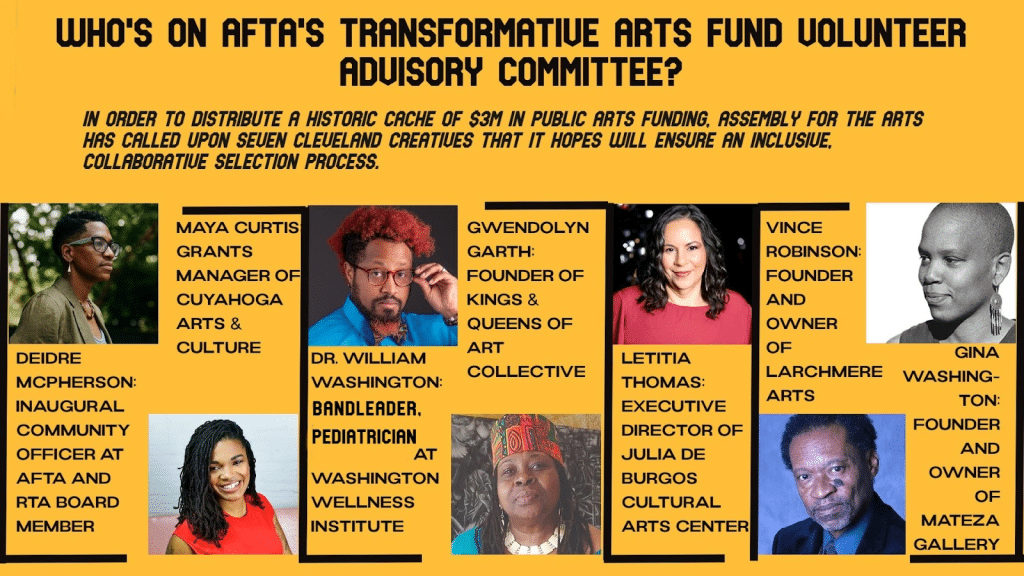
Assembly for the Arts has merged seven multidisciplinary artists from throughout Cleveland into a volunteer task force that will decide which Transformative Arts Fund applicants will receive money from the grant’s $3 million, as well as how much each recipient will receive.
City Council first approved using a portion of Cleveland’s $512 million in ARPA funding for the grant project in January as the national deadline for state and local ARPA funding approaches on Dec. 31. That encroaching due date has prompted other recent city-involved economic and development initiatives. Even with the money earmarked, however, Sinclair suggested much work remains before wire transfers are initiated.
Fellow funds
Compared to previous and ongoing yearly funding opportunities like the Assembly’s own Creative Impact Fund (CIF) – which is accepting applications through May 31 – this latest fund is massive.
The CIF most recently awarded $6,250 to 16 individual and group recipients, while the CAP is locked at $10,000 and the aforementioned Verge Fellowships max out at $2,000 for five multidisciplinary artists. Cuyahoga Arts & Culture, meanwhile, offers varying grants for nonprofits and working artists throughout the county.
Jones began co-chairing the Verge Fellowship this year based on her previous role at MidTown Cleveland and continues to work with local arts and culture nonprofits.
In addition to helping to select the five Verge Fellows who will receive money in 2024’s cohort, Jones will also assist in the continued coaching and mentorship of the grant recipients. This is a new feature that accompanies the fellowship program’s return from a coronavirus-induced hiatus after it launched in 2018 to aid Black artists and other underserved Cleveland creatives.
“The benefits of the Verge Fellowship are connection and relationship-building,” Jones said. “Now, it’s not just the $2,000, but it comes with a mentorship as well to help manage the funds and look for grants nationally.”
Whereas the behemoth TAF opportunity is a good fit for artists who have already established names for themselves and trajectories for their careers, Jones stated that the mentorship aspect of her fellowship can help newer artists narrow down their specific needs.
“We understand that we need support, and the support is not always just monetary,” Jones said. “Artists need social and emotional support. There are a lot of artists that deal with anxiety around things, self-doubt. It’s good to have the perspective of what a creative career is and can be and what it looks like. I think mentorship informs and supports that.”
AFTA’s assistance
Sinclair and others involved in the TAF believe that AFTA’s involvement will lubricate the allocation process once the committee makes its decision.
“This is a critical component we included that was based on feedback (that) both the city and AFTA received directly from the artist community,” Sinclair said. “This was done with the hope that more artists would apply, as we know many don’t have the means to front the funds and resources at the onset of a project.” On some occasions, he added, artists will avoid applying for grants entirely if they come in staggered payments.
Rhonda Brown, who joined the Mayor’s Office as senior arts and culture strategist in 2023, leads the project within City Hall but was not available to comment by the time of publication.
Money up FRONT
Arts grants operate in a unique corner of the public-private funding space for many reasons, not least because they often function as late-in-life, “unrestricted” scholarships for individuals or groups who need the money for materials beyond art supplies and spaces.
“Funding has gone down for so many arts and culture organizations,” Jones said. “(The goal is) to fund artists with unrestricted funds that help them with projects, buy gas, getting to rehearsal; some (use funds) on equipment that helps their practices.”
Getting access to those necessary resources may be more difficult for artists after FRONT International: Cleveland Triennial for Contemporary Art announced its collapse in February. FRONT’s now-canceled third iteration in 2025 would likely have followed in the footsteps of the public event’s 2022 edition, which introduced four $25,000 grants for Black artists distributed across three years.
Three would also have been the magic number for nonprofit Collective Arts Network’s next CAN Triennial exhibition, had it not also folded after a pair of large-scale exhibitions, most recently in 2022. Leadership for both FRONT and CAN cited a lack of available funding when announcing the cancellations and closures, emphasizing the need for funds like TAF.
“Funding has kind of gone down for so many arts and culture organizations that, for us to have an impact on the underserved community, we need funding,” Jones concluded. “With the closing of… FRONT and CAN Triennial, I think it’s important for arts and culture organizations to collaborate and celebrate uplifting artists.”
Readers who wish to learn more about the Transformative Arts Fund can contact the project team via transformativeartsfund@clevelandohio.gov. Artists who missed the TAF or Verge application windows but still wish to apply can seek Assembly for the Arts’s Creative Impact Fund, open through the end of May. Assembly is hosting an application information session from 6 to 7 p.m. on and 22.
Keep our local journalism accessible to all
Reader support is crucial as we continue to shed light on underreported neighborhoods in Cleveland. Will you become a monthly member to help us continue to produce news by, for, and with the community?
P.S. Did you like this story? Take our reader survey!