
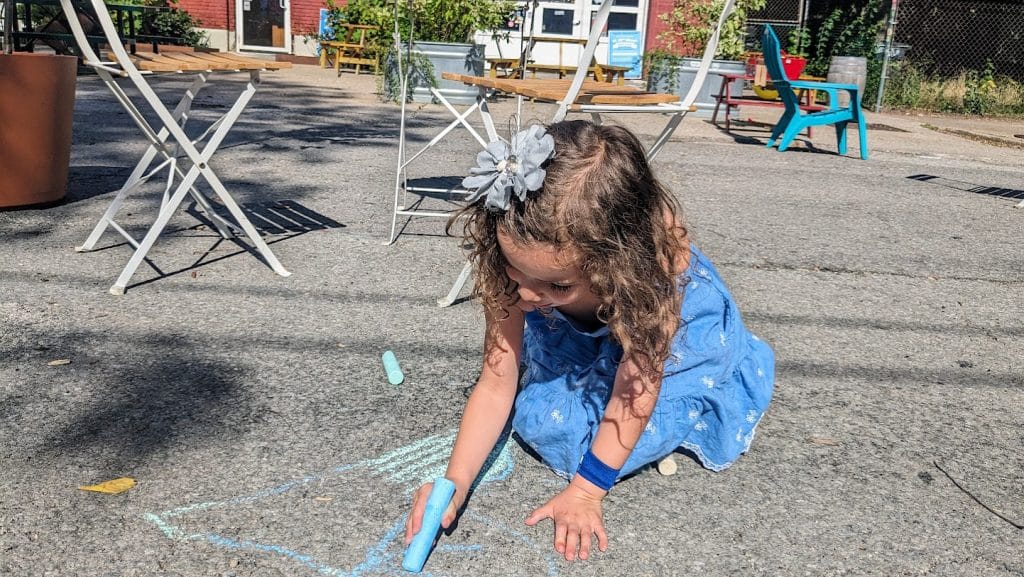
The kids were playing in the middle of the street.
Fortunately, it was closed.
Remi Maron, 7, and his sister, Siena, 5, were chalking the pavement on a half-block stretch of West 29th Street closed to vehicles from Aug. 24 through Sept. 8 and soon to be closed to them again for good. “We’re making the same heart,” Remi said. Then he paused and pondered her contribution. “You did it!”

The sibling’s mom, Jessica Maron, watched them from an Adirondack chair in the street while sipping a cappuccino from the adjacent Rising Star. “We’re excited to have a public space for the kids to enjoy their hot chocolate,” she said.
City officials don’t call such spaces closed streets but open ones: open to pedestrians, bicyclists and others who might lounge, play, picnic, phone, text, keyboard, scroll, shop nearby, join official events, create their own events, or do other things besides guzzle gas. “Open streets encourage people to get out, get active, socialize and experience their neighborhood in a whole new way,” said city spokesperson Tyler Sinclair.
In April, Cleveland won a $100,000 grant from the nonprofit Project for Public Spaces to open one or more stretches of West 29th — the main artery of the booming Hingetown neighborhood — somewhere in the two blocks between Detroit and Clinton Avenues. Through a survey and workshop, the city got feedback about possible spots and features from residents, merchants, visitors and others.
Over the years, the city has barred vehicles from East 4th Street, Market Avenue and (except for buses) Public Square. West 29th’s open street is meant to be a model for future ones elsewhere. Joyce P. Huang, planning commission director, said that the city was looking into closing the eastern end of Huron Street in Playhouse Square and a couple of other streets that she was not ready to identify.

Officials settled on a 60-foot stretch running south from Church Street. The stretch is flanked on the west by the Cleveland Museum of Art’s Transformer Station and on the east by the old Ohio City Firehouse, which hosts Rising Star, Larder Delicatessen, Urban Orchid and other businesses.
The temporary ban on vehicles helped officials gauge the likely effects of a permanent ban. Ohio City Inc. supplied a box of toys. The Northeast Ohio Areawide Coordinating Agency supplied chairs, tables, a small stage and other furnishings. The city set up traffic barriers, and locals painted a message on them: “Welcome to Our Open Street.”
Officials staged picnics, a dog meetup, a kids’ vendor market and other events. The ban also overlapped the Hingetown Jazz Festival on Aug. 31.
During the vehicle ban, officials made some adjustments based on feedback and observations. For instance, after seeing visitors slide chairs around for shade, they furnished several umbrellas.
Sinclair said the ban has gotten positive reviews, and officials would consider specific suggestions in designing a permanent streetscape and furnishings. Among other ideas, they’re considering planting more trees, installing climbable seating, using removable barriers or bollards, grading some of the surface for better play, and painting asphalt or replacing it with permeable pavers. They hope to open the street for good in late fall or early spring.
Graham Veysey, who co-owns the firehouse and the nearby Church and State complex, praised the ban’s first phase. One evening, “there were five families having a picnic, kiddos running around, doing a play on the stage. It’s helped to foster and deepen a sense of community.”
Visitors echoed the praise. “It’s nice having a place to sit and chill out,” said Tamra McMillion. “It’s nice to see everybody walking by.”
Pete Anderson said, “It’s a lot more space for people to stop and eat. I used to have to sit on the cement blocks.”
Charles Widen said the traffic barrier at Church helped to calm a busy corner. “This intersection’s nuts. It’s tight. You don’t see much.”
Traffic and parking spaces
During the ban, despite warning signs, some drivers turned toward the barrier, then had to back up and reroute.
A couple of merchants said they regretted losing the stretch’s curbside parking spaces. Free spaces have grown scarcer as the neighborhood grows denser, and the city plans to put meters on more of them soon to encourage shopper turnover. But the Transformer Station has a paid public lot, and Church and State has a paid public garage.
Tymeka Greer, who owns Blow Hair & Nail Studio on West 29th north of Church, said the closure drew a couple of walk-in customers but also some homeless people. Sinclair said the city had gotten no reports of homeless people there.
Molly Cheraso, who owns Verbena Shoppe, Cafe & Dry Bar on that block, welcomed the ban. “I think it will drive business to the area, especially people with kids.”
Jeremy Umansky, who co-owns Larder, sees another advantage. “The more people you have on foot, the safer it’ll be.”
Fred Bidwell, a Hingetown resident who created the Transformer Station’s galleries, said of the neighborhood, “It needed a central square, and that’s what we’re creating: a village square.”
Keep our local journalism accessible to all
Reader support is crucial as we continue to shed light on underreported neighborhoods in Cleveland. Will you become a monthly member to help us continue to produce news by, for, and with the community?
P.S. Did you like this story? Take our reader survey!

![Lakewood High School students organize walkout to protest ICE [photos]](https://d41ow8dj78e0j.cloudfront.net/wp-content/uploads/2026/02/12155714/DSC_3775-800x600.jpg)


