Moses Cleaveland’s great-great-great-great granddaughter is helping to celebrate him and the city he founded.
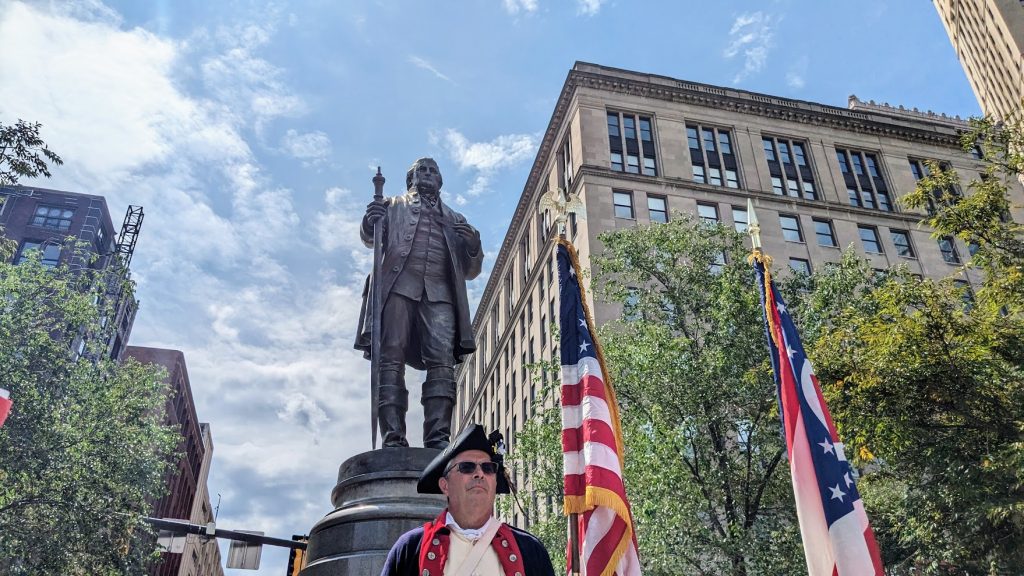
Mary Artino is the first female president of the 144-year-old Early Settlers Association of the Western Reserve, which honors Cleveland’s pioneers. During an annual ceremony on July 22, Artino and her son, Joe, laid a wreath on Cleaveland’s monument,commemorating the 228th anniversary of the founder’s 1796 arrival here. The monument on Public Square is one of several around town created, restored and maintained by the association.
“We’re keeping the story alive,” Artino says of the city’s history. “It opens your eyes to what we were given and what we have.”

Cleveland has some descendants elsewhere, but Artino says her family line is his only one in the area. The Russell Township resident has three kids, two of them in town, but no grandkids.
Artino began participating in association events as a little girl, hoisted over an old garden bed by Mayor Ralph Locher to place the wreath on Cleaveland’s statue.
The association might sound establishment, but it gave its annual Herrick Award for civic contributions this year to journalist Roldo Bartimole, 91, long a leading muckraker. The association might sound Waspy, but its members are diverse and don’t need to descend from early settlers. Women have been active, and Artino says “It fascinates me” that none have been president before her.
The group helps to maintain several older cemeteries, including Erie Street off East Ninth Street in downtown Cleveland. It helps every March with National History Day at Case Western Reserve University, which founded the nationwide event. It is inventorying the area’s remaining Moses Cleaveland trees, so called for appearing to predate the founder’s arrival.
On Tuesday, Sept. 10, at 10:30 a.m., the association will gather at Commodore Oliver Hazard Perry’s monument at Huntington Park, West Third Street and West Lakeside Avenue, for a yearly celebration of his1813 victory at the Battle of Lake Erie.
History and Background
Moses Cleveland was a brigadier general, a Connecticut legislator, and one of seven directors of the Connecticut Land Company. For $1.2 million, the company bought 3.3 million acres of land from the Connecticut government in what today is Northeast Ohio. Proceeds were committed to the Connecticut School Fund.
Cleaveland led 52 surveyors here in 1796. Partly through gifts, he persuaded Native Americans to yield all the territory east of the Cuyahoga — 2 million acres between Pennsylvania, Lake Erie and a line just south of today’s Youngstown and Akron. Artino thinks he treated them fairly. “He had to get what he needed. They had to barter back and forth and figure out how they could help each other.”
The Early Settlers website says, “Native American life was as rich with stories as was our own settlement period. The Early Settlers Association therefore acknowledges the collective Native American experience on the land that becomes known as the Connecticut Western Reserve and seeks to honor it as we have that of our early European ancestors.”
The surveyors divided the land into townships of five by five miles. They put the flagship settlement in the northwest corner. Cleaveland later wrote that “the location, where river, lake, low banks, dense forests, and high bluffs provided both protection and shipping access, was the ideal location for the ‘capital city.’”
Cleaveland left the Reserve for good that fall, but the surveyors continued their work, and some settled here. The project lost money, though. Legend holds that the Cleveland Advertiser, which began in 1830, simplified the spelling of the city’s name to fit the newspaper’s masthead.
Artino is proud of the mark her forebear made in the wilderness. “We grew so much. It kept going from one short visit to this big beautiful city.”
The Early Settlers hope that the past will inspire the city’s present and future. Their website says, “As we move deeper into the 21st Century and all its momentous events, we need to remember the similar events that propelled Cleveland to prominence in the 19th. The westward push in Ohio, including the Western Reserve, the Battle of Lake Erie guaranteed our young republic’s safety, the canal made Cleveland an industrial powerhouse, and the stories of so many early residents of all origins – Yankee, Scots-Irish, Irish, African-American, German, and the original Native Americans – weave together to produce the culture of northeast Ohio.”
Keep our local journalism accessible to all
Reader support is crucial as we continue to shed light on underreported neighborhoods in Cleveland. Will you become a monthly member to help us continue to produce news by, for, and with the community?
P.S. Did you like this story? Take our reader survey!