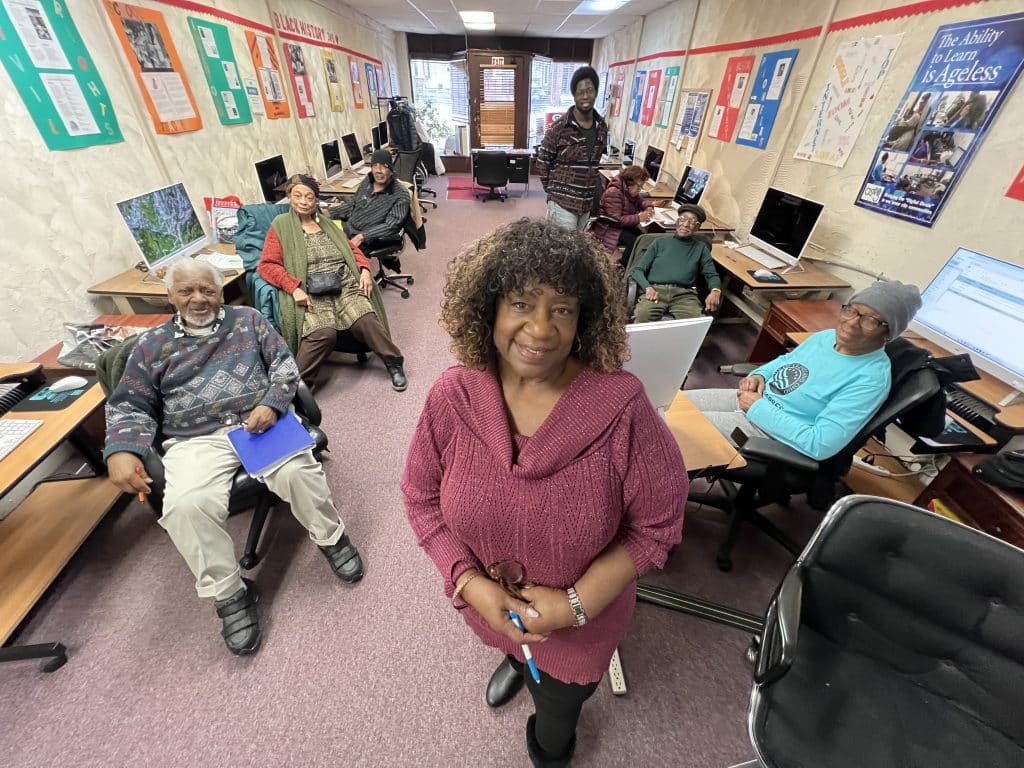
About two years ago, Jenny Pennington came across a flyer advertising the Ashbury Senior Computer Community Center (ASC3) on Ashbury Avenue in Cleveland. It’s a nonprofit that teaches senior citizens, and even younger adults, how to operate computers and navigate the internet. The classes are free.
Pennington, now 75, conquered her computer anxiety and called the center. She’s been taking classes there ever since.
“When I first started, I didn’t even want to turn a computer on,” said Pennington, an East 110th Street resident. “I was fearful and didn’t know how to maneuver through this.

“But it was taught very easily to me and I began to feel comfortable, to turn it on and go to my email and do different things on the computer,” Pennington said.
Today, Pennington pays all of her bills electronically, thanks to the Ashbury center.
“That is one of the best things I ever learned on the computer,” Pennington said. “I tell everyone, if you don’t learn anything else, learn how to pay your bills online.”
Wanda Davis, executive director of ASC3, said fear of technology is the number-one reason seniors avoid computers. Other obstacles include unaffordability of both electronic devices and internet connectivity, especially for those on limited incomes, and finding technical support.
Yet it’s more important than ever for seniors to know computer technology.
“We are now a digital society,” Davis said. “Just about 90 percent of everything our seniors have to access is online, including their health, their finances, reaching their kids and e-commerce. It’s an everyday skillset now that they need through their laptops, desktop computers, phones or tablets.”
Seniors taking classes at Ashbury learn how to create and log onto “MyChart” medical-care accounts to communicate with their doctors, see test results and schedule appointments. The center uses a dummy MyChart account to show seniors what happens at a typical telehealth appointment.
Email, Zoom and Google Meet are presented as opportunities to connect with children and grandchildren living far away.
“The socialization aspect is phenomenal for them,” Davis said. “A lot of them love church so when COVID-19 hit we found ways for them to communicate with their churches. That’s when everybody knew they needed these skillsets.”
The Ashbury center even gives refurbished computers – donated by corporations like AT&T and Spectrum Digital and nonprofits like RET3, PCs for People and Compudopt – to its seniors.
“We try to make sure that each senior, once they take a class with us, ultimately winds up with a device, at least eventually,” Davis said.
The center doesn’t provide free or low-cost Wi-Fi for students but works with organizations that do. They include Mobile Citizen and DigitalC.
The Cleveland nonprofit Benjamin Rose Institute both contributes free laptops and helps cover the cost of wi-fi for Ashbury students. In exchange, Ashbury trains Benjamin Rose clients in computer technology.
‘A good place to be’
The Ashbury Senior Computer Community Center, 11011 Ashbury, was established in 2002. Davis said the center has served about 10,000 seniors since it opened. Any senior anywhere, not just Cleveland, can sign up.
At Ashbury, volunteer instructors – past center graduates and students from Cleveland State and Case Western Reserve universities and Hawken School – teach classes twice a week in eight-week sessions. Seniors are taught computer basics like word processing, emailing and internet exploring. They learn how to bank online. Classes include one-on-one instruction.
The curriculum comes partly from Senior Planet from AARP, a national nonprofit that according to its website enables older adults to learn, work, create, exercise and thrive in the digital age.
When the center isn’t holding classes, students can use the computers at no cost.
Edward Scott, 86, of East 135th Street, said the center even taught him and his wife, Theresa Scott, 74, how to type.
“I was terrible in typing when I went to high school – I managed to get a D,” Edward Scott said, laughing. “They have this typing program here. They have helped me so much to be able to type without looking at the keys.”
Ashbury has a second permanent location at 9926 Lorain Avenue. Five satellite offices, where the center sometimes teaches classes and holds events, are at Rose Center for Aging Well on Fairhill Road, PNC Fairfax Connection on Carnegie Avenue, Silver Connections LLC on Lakeshore Boulevard, Alexia Manor on Hector Avenue and St. Martin De Porres Family Center on East 123rd Street.
The center will soon open a sixth satellite office at Cleveland Clinic’s South Pointe Hospital in Warrensville Heights.
Theresa Scott said she and Edward first attended computer classes at Ashbury’s PNC Fairfax Connection satellite before continuing their education at the main center.
“This is a very good place to be,” Theresa Scott said. “The training, the information – and they are very kind and friendly. They show you, direct you, open you up and keep you updated. The instructors here are very knowledgeable.
“We have to learn the computer like any other technology,” Theresa Scott said. “Things move so fast and things change. If we don’t keep up, we get left behind.”
When seniors sign up for services at the center, they’re given an evaluation form to determine their existing level of computer knowledge and in what areas they might need help.
Christine Shields, 79, of East Cleveland, filled out the evaluation during her first visit to the center in January. She went there after receiving an alarming message on her laptop that her computer would no longer receive updates. She worried that she would lose her internet security
“I was asking around at my church and somebody told me about a place I could go,” Shields said. “I looked online and found the Ashbury center.”
On the evaluation form, Shields wrote down terms she wanted to learn about: Hard drives, programs, icons, software, apps and flash drives.
Safe space
The center is funded through grants from The Cleveland Foundation, Verizon, AT&T, Spectrum Digital, Growth with Google and other corporations and foundations. Ashbury hosts a large fundraiser every year in December. Students and former students organize fundraisers in the summer.
“Our ideal annual budget is $700,000,” Davis said. “We managed that at least twice. Lack of funding means we can’t give out as many computers as we would like.”
The center also offers classes for “mature adults” 45-64 and young adults 18-40 because that’s what the community wanted. Sometimes older and younger adults share the same classrooms.
“When we first opened the primary target was seniors,” Davis said. “Within a year-and-a-half to two years, we started helping mature adults, then the younger set with workforce development, internet and computing competence, for people returning to work or starting work for the first time.”
This “intergenerational learning,” according to several studies, benefits both young people and seniors. A report by Switzerland-based MPDI, a publisher of academic journals, has shown positive outcomes through intergenerational learning in several areas, including overall attitude, family relationships and health knowledge. Intergenerational learning also helps bridge the digital divide between age groups.
In addition, the center gives neighborhood youth a safe space to use and learn about computers. The center, partnering with AT&T, just launched a new program called Dream Opportunity, through which young people explore career opportunities virtually with business leaders.
Students who complete two or more eight-week sessions receive a graduation certificate during a formal ceremony and reception, usually offsite at a senior living community or apartment complex.
Alfonzo Wilson, 88, of East Boulevard, is due for a graduation certificate this spring. He first learned about the Ashbury center on his route delivering mail for the U.S. Postal Service.
“I just retired,” Wilson said. “Why wouldn’t I want to learn about computers?”
To register for a class, visit the ASC3 website or call 216-421-2305.
Keep our local journalism accessible to all
Reader support is crucial as we continue to shed light on underreported neighborhoods in Cleveland. Will you become a monthly member to help us continue to produce news by, for, and with the community?
P.S. Did you like this story? Take our reader survey!