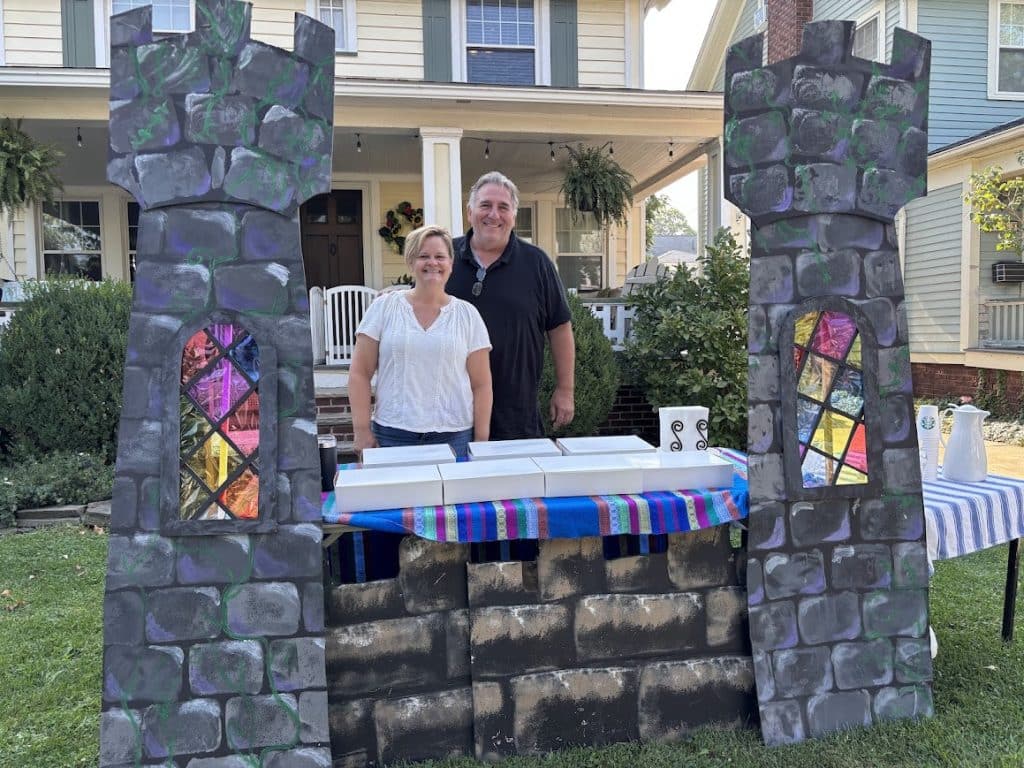
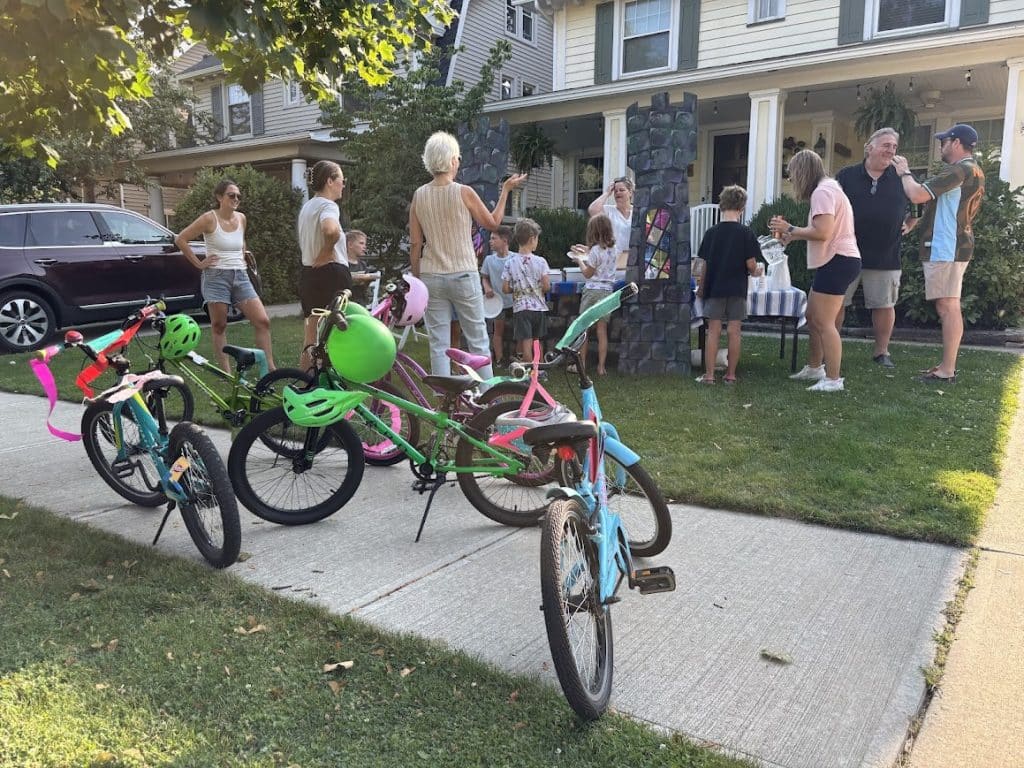
Julie Warren smiled and greeted bike parade participants as they pedaled off the brick street and into her driveway to partake in coffee and donuts. “Good morning! Welcome to our castle.”
The tradition might not actually date back to medieval times, yet it’s enough to make neighbors feel like royalty.
Residents of Lakewood’s Virginia Avenue celebrated their 58th annual block party in August with a two-day extravaganza built around the theme “Once upon a time.” It featured trick-or-treating, four communal meals, a book exchange, a balloon artist, a bake-off and a backyard adult party, among other festivities.

The theme changes annually, but Virginia Avenue’s decades-long tradition perseveres thanks to tight-knit neighbors and extensive planning, according to Warren. Block club captaincy and institutional knowledge get passed down to new neighbors, and a committee approach makes for lighter work.
When severe weather knocked out power for half the street during the week of the 2024 block party, neighbors prepared to lean heavily on those residents who maintained electricity, according to Maureen Tuleta, a Virginia Avenue resident of 36 years and current host of the adult party. Power ultimately was restored during the block party, and neighbors excused themselves to tend to their properties and reset their appliances before returning to resume the celebration.
“We’ll never leave this street. It’s a great street, it’s a great community,” said Tuleta. “It’s really fun to hear some of the younger people saying that their kids, who are probably now in high school, would say that it was like Christmas Eve waking up to the block party being Christmas Day. My son said it’s the best day of the summer.”
While benefactors of one of the city’s oldest such celebrations, residents of Virginia Avenue are far from alone in contributing to Lakewood’s block party culture. The City of Lakewood has issued 66 permits for its 2025 block party season, which runs from April to October, according to Melissa Garrett, the city’s community relations specialist. A permit entitles a neighborhood to receive barricades to block through-traffic and convert their street into a temporary all-aged playground.
King Arthur’s Basketball Court
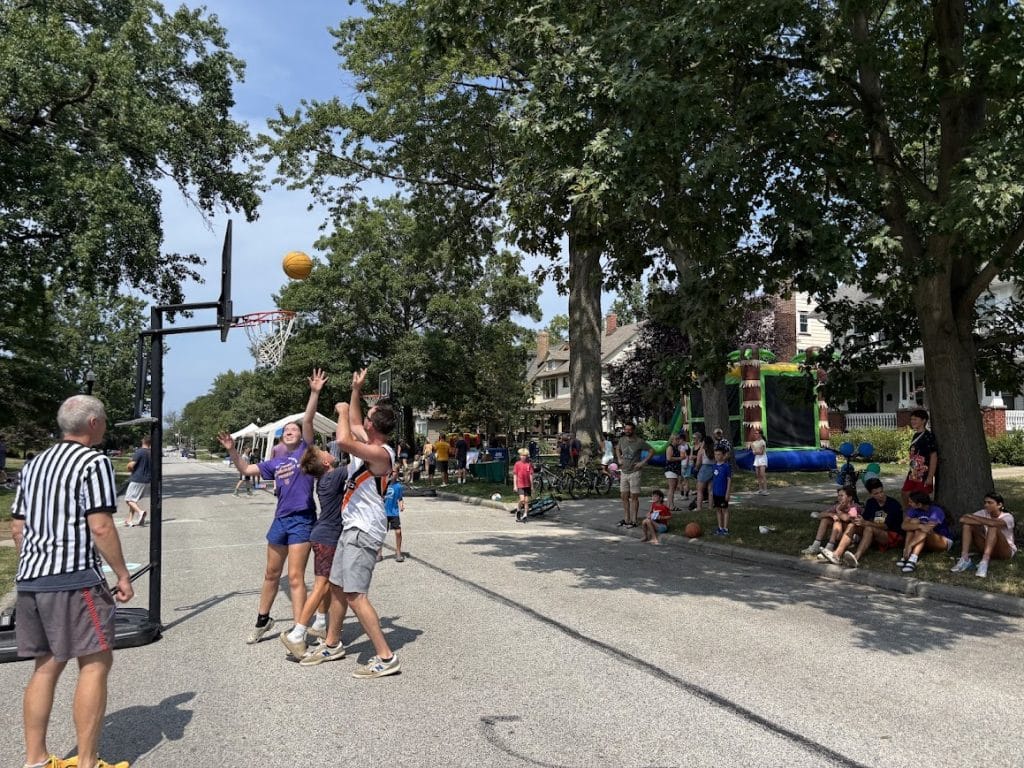
One week later and one mile south, the block of Arthur Avenue between Detroit Avenue and Franklin Boulevard hosted its own block party. An early afternoon bike parade gave way to an inaugural basketball tournament in the middle of the street, complete with brackets, a referee and a large championship trophy.
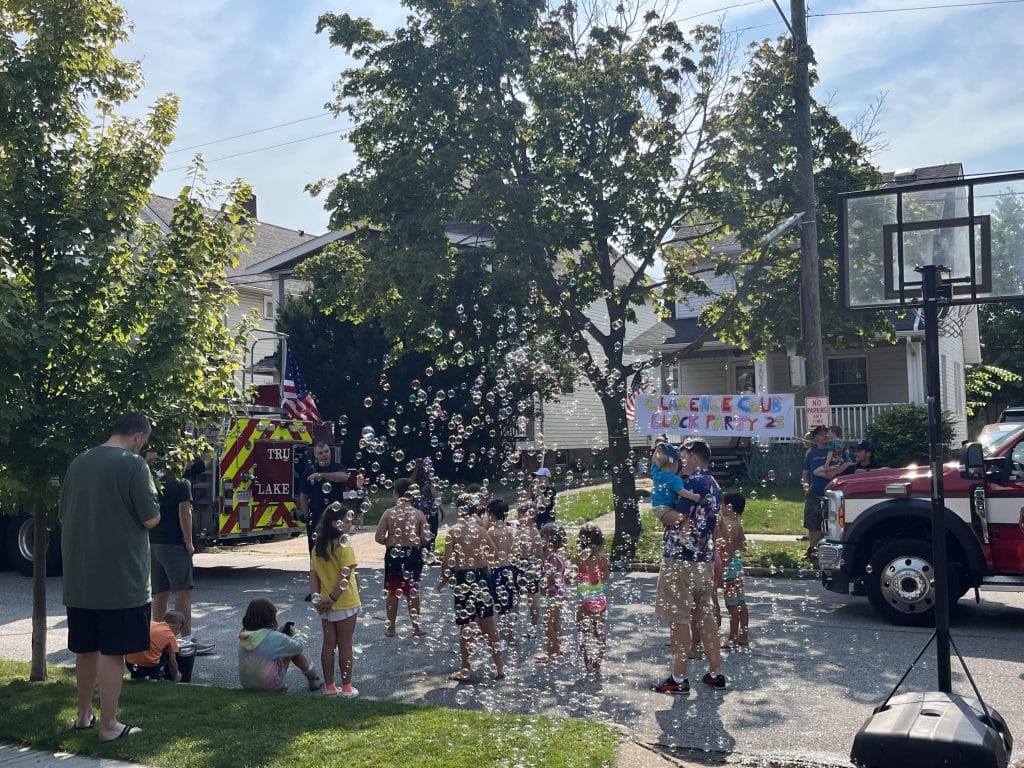
Other highlights of the Arthur Avenue festivities included a visit from the City of Lakewood’s fire department, photo opportunities with Disney princesses, karaoke and an outdoor movie.
Jen Demmitt grew up in the suburbs of Akron. She moved to Arthur Avenue in 2017 and spent several years spearheading the block party, having now partaken in nine years of this neighborhood tradition.
“It was unlike anything I had experienced before living here,” said Demmitt. “I didn’t understand how neighborhoods worked in Lakewood before moving here – it’s like your street is your neighborhood. I grew up in a subdivision.”
Benefits of Block Parties
When Vanessa Elias, a human connection and mental health activist, returned to the United States after living abroad in Switzerland for six years, she noticed a stark contrast in face-to-face interaction and outdoor free play among youth. Kids were over-scheduled and loneliness was on the rise.
In 2018, Elias responded by founding Block Party USA, an initiative to encourage community connection and combat loneliness through simple neighborhood block parties. She started in her hometown of Wilton, Conn. With a mission of “building community one block at a time,” Block Party USA brought together more than 1,200 residents for approximately 40 block parties throughout Wilton during the inaugural weekend.
The movement, per Elias, continues to grow and now aims to raise awareness regarding the positive ripple effect that can result from hosting a block party and forming a block club.
“A block party is fun, right? It’s a fun time. But it’s the launching spot for so much more. Most basically, just knowing your neighbors and feeling that you belong, that this is not just a road that you live on, but it’s your road,” said Elias. “It’s feeling that stewardship, to getting a neighborhood contact list. We have a text group, and I always talk about how it’s anywhere from, ‘Has anyone seen my dog?’ to, ‘My power’s out. What about you guys?’ Or, ‘I have 1,000 zucchinis. Does anybody want one from my garden?’ It’s immediate support right there.”
“Also, with the storms and floods and fires that we are experiencing more and more, your neighbors are your first responders, and you don’t feel like you’re alone in the world,” said Elias. “To have other people that you can reach out to and that also, reciprocally, they can reach out to you for help. It makes our sense of safety much stronger.”
Petting Zoo Comes to You
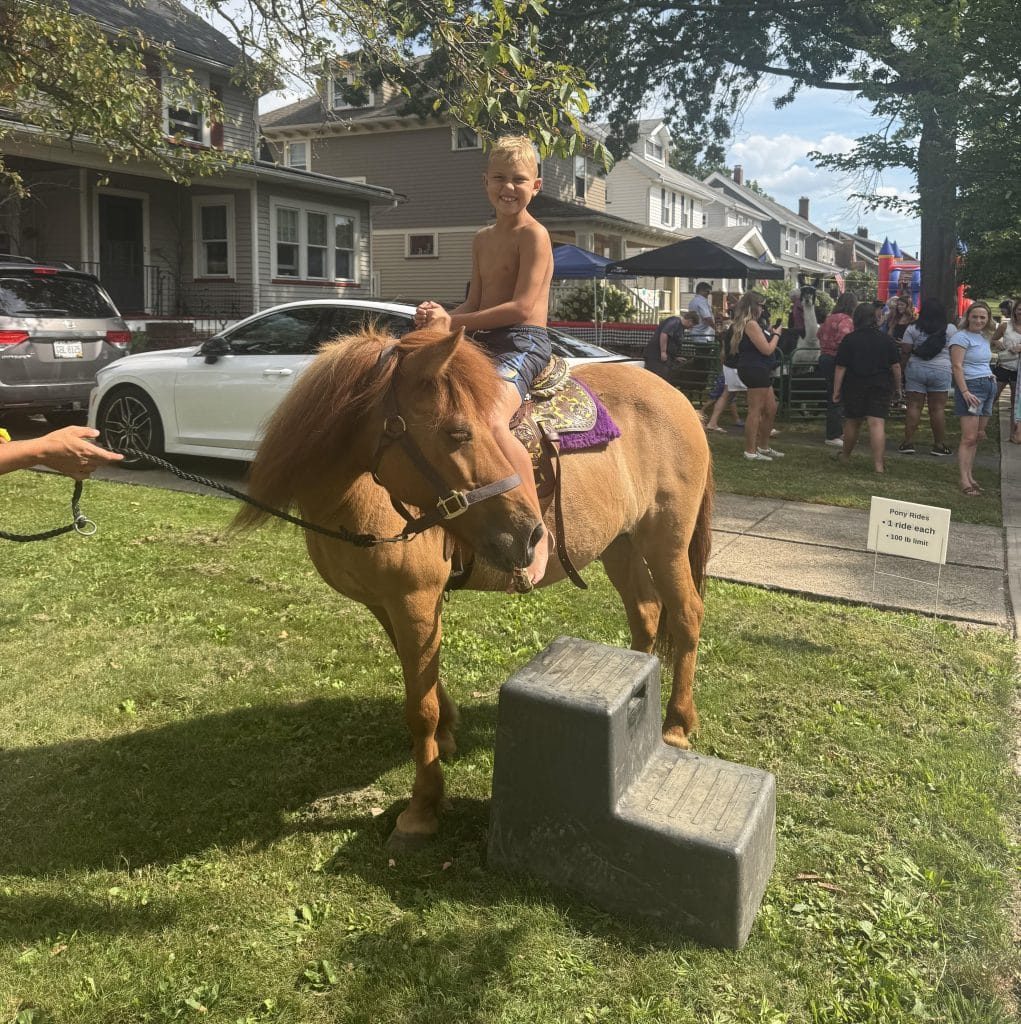
Beka DeChant and her family moved to the block of Chesterland Avenue between Madison Avenue and Franklin Boulevard during the heart of the pandemic in the summer of 2020, and her first neighborly interaction involved being invited to the annual block party. Her family has been attending ever since. This year’s Chesterland Avenue block party included a bounce house, a live band and a petting zoo featuring a variety of farm animals.
“I’m just really grateful for my neighbors. They’re all kind, giving people,” DeChant said. “We’re not the neighbors that are always out hanging out with each other every day. That’s just not our street. But it’s a tight community. We have a Facebook group and if someone’s moving, which is rare, they’ll offer furniture for free to the neighbors first. If there’s something going on, the neighbors will communicate in that format together. I feel like it’s a nice way to continuously build community when you’re not able to physically knock on everyone’s door every day.”
Rebuilding Social Trust, One Block Party at a Time
The share of adults who said “most people can be trusted” declined from 46% in 1972 to 34% in 2018, according to Pew Research Center. Kaitlin McCready witnessed the power of social trust and community-building firsthand while working for the Metropolitan Transportation Authority in New York City. When addressing transit riders about a major reconstruction project that would cause a service disruption, she found they were more receptive when she spoke as a fellow community member also impacted by the project, rather than simply as an employee doing her job.
This experience helped inspire McCready, now a resident of Cook Avenue, to launch a block party in her neighborhood in 2024. This new tradition, the first such event on the street in more than 25 years, featured a variety of festivities, including a visit from the Lakewood Historical Society to offer a Cook Avenue history lesson.
“I think a connected community is a smarter community. It’s also a more well-resourced community,” said McCready. “A lot of what is at the foundation of people’s relationships is trust. The way that you establish trust is really through knowing people, right? Knowing people is highly correlated with higher levels of social trust. And when you have that social trust, what can you do? You can do a lot with that. You have the ability to want to water each other’s plants when they’re on vacation.”
Where There’s a Will, There’s a Workshop
This year, in addition to once again spearheading the Cook Avenue block party, McCready, a communications and marketing consultant, took her ambitions a step further by orchestrating a ‘How to Plan a Block Party’ workshop in May at Lakewood Public Library. This free, public workshop aimed to offer block party best practices while providing a step-by-step guide with everything from hosting a planning meeting to enlisting community resources.
Thanks to McCready, a Lakewood-specific Block Party Playbook now exists.
“From what I’ve seen and who I talk to, including at the workshop, it’s not even a will to get started,” said McCready. “It’s just overcoming that initial barrier of, ‘I’ve never done this before. I generally understand the benefits, but I don’t really know where to start.’ And that was part of the impetus for doing the block party workshop. It was to give people that boost to say, ‘You can do it.’”
How to Plan a Block Party
The process of starting a block party can seem daunting at first. If a particular street has not hosted a block party in the last three years, the City of Lakewood requires completion of a survey by which 75 percent of all residences on the street must sign in favor of a block party in order to receive a permit. Among other block party rules, main and secondary main streets are unable to be closed for block parties, and the City of Lakewood will only issue permits for a maximum of six block parties on any given weekend.
Elias suggests hosting an initial block party across front yards to gauge interest and attendance levels before pursuing a permit to close the street.
“My whole thing is to keep it simple, simple, simple,” said Elias. “We are suffering from our one-upping and our perfectionism, and it’s getting in the way of making things happen, getting together. It’s all about bubbles and chalk, jump ropes and cornhole – that just brings so much joy to both kids and adults. Adults need to play, too. We’re not playing enough, right? To have that joy and fun is just really, really important.”
Challenges can exist with building buy-in for a block party among neighbors with varying levels of digital awareness, and with developing ways to share the financial burden associated with hosting a block party. According to McCready, these obstacles can be overcome by starting small, getting organized and building both a team and a vision.
“Start by finding two other people on your street who you can be collaborators with and share the idea with them,” said McCready. “If you started doing these kinds of events, what’s the change you want to see? And from there, have them ask two other people and get to a group of about 10 people. By then you’ll have a coalition of people who are aligned with making a change on your street. That change starts with a block party.”
We're celebrating four years of amplifying resident voices from Cleveland's neighborhoods. Will you make a donation to keep our local journalism going?