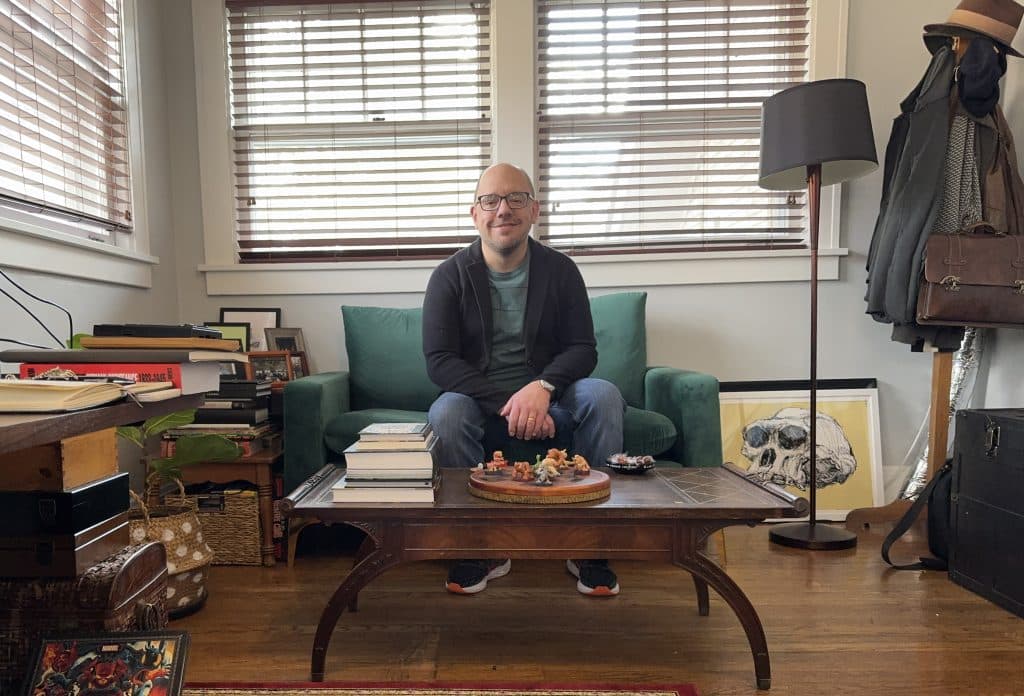
In his newest narrative nonfiction book, author Brad Ricca transports his readers to a different time and place with his usual verve.
Ricca’s previous books chronicled the exploits of less well-known historical figures. “True Raiders” depicted British Nobleman Montague “Monty” Parker on his 1909 expedition in search of the Ark of the Covenant near Jerusalem based on a secret code in the Bible.
“Mrs. Sherlock Holmes” reveals the true story of Grace Humiston, a bold female lawyer and detective who gained her nickname for her success in solving the 1917 disappearance of 18-year-old Ruth Cruger in New York City.

“Lincoln’s Ghost,” however, took Ricca into new territory: the most famous magician of all time Harry Houdini and Abraham Lincoln, arguably America’s greatest president, whose spirit spiritualists frequently feigned conjuring.
“This was the first book I’ve written about someone who’s already famous on the level of Houdini and Lincoln,” he said. “My way into these things has been to pick somebody no one has ever heard of before, so you become the automatic expert and people say, ‘Oh, that’s fascinating.’”
The exhaustive depth of Ricca’s historical research helps him paint a vivid, detailed and moving narrative so that readers of “Lincoln’s Ghost: Houdini’s War on Spiritualism and the Dark Conspiracy Against the American Presidency” feel like they’re witnessing the event.
“You take artistic license with the story, but not with the facts,” explained Ricca, author of seven books.
In this case, readers enter the story with Houdini testifying before a subcommittee hearing in the U.S. House of Representatives Office Building in 1926. The master magician and escape artist was there to support H.R. 8989, a bill aimed at outlawing fortune-telling and fraudulent spiritualist practices for profit in the District of Columbia.
His testimony included demonstrating mediums’ tricks with the goal of exposing and criminalizing charlatan spirit channelers as frauds who exploit grieving people solely to take their money.
As a child, Ricca didn’t know much about Houdini other than he liked the story of the man and his magic. He was entranced when his father took him to watch Harry Blackstone, Jr. perform his magic act at Public Hall. His parents gave him a magic set for Christmas. But he didn’t learn about Houdini’s impassioned attack on mediums until several years ago.
“When I heard that in the last part of his life, Houdini waged this intense battle against basically a religious cult, that was a surprise to me,” said Ricca. “If I’m interested in it, I want to write a book about it because that’s the way of finding things out, and if the reader discovers things right alongside me, that’s even better.”
Ricca added that, when he started the book, he aimed to be as objective as possible about spiritualism.
“I’m not going to come down on one side or the other, but I’m going to present Houdini’s side, and he hated spiritualism,” said the author, who won a Cleveland Arts Prize in 2014. “He thought it was totally fake, and he spends the last few years of his life traveling across the country debunking it, publicly humiliating spirit mediums, and some of them were getting paid very well for this.”
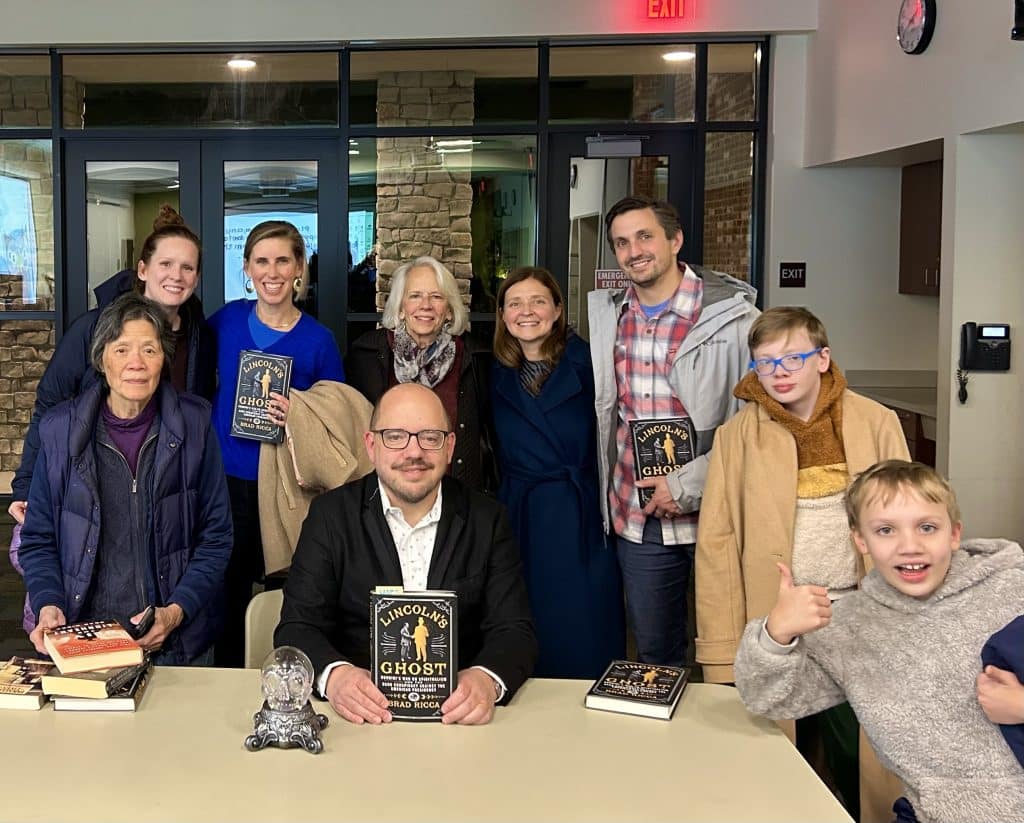
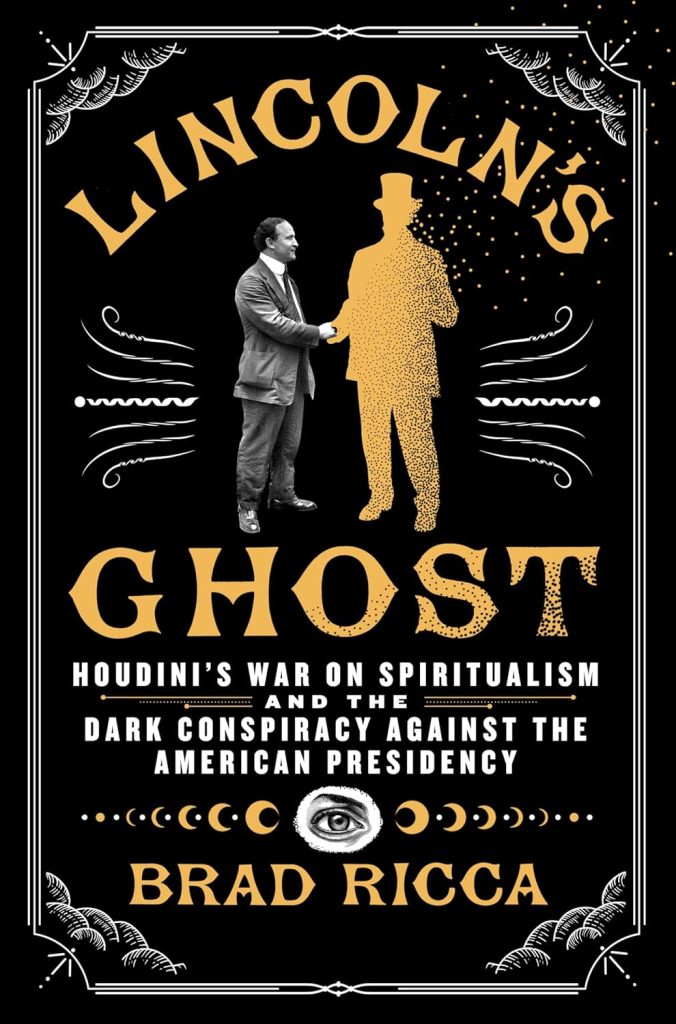
Suzanne DeGaetano, co-owner and manager of Mac’s Backs-Books on Coventry in Cleveland Heights, said, “Brad always finds a detail in history that’s been forgotten or unexplored, writes about it and puts it into perspective in a social history of the era. His research enables him to supply those details, so the whole beginning scene of the book you are in that room feeling what the people in that room felt.”
Independent reviews of the book offer similar opinions about Ricca’s ability to immerse his readers in history, with a deft touch in leveraging his in-depth research to reveal the complex characters and elaborate settings of the story that make it compelling reading.
Tracey Daugherty, a “New York Times” bestselling author, called Ricca’s book: “A mesmerizing mix of ghost story, political thriller, conspiracy theory, and romance.”
David Dawidziak, author of “A Mystery of Mysteries,” said: it’s “a haunting slice of history that reads like a page-turner of a mystery thriller.”
Closer to home, Laurie Kincer, director, William N. Skirball Writers’ Center, Cuyahoga County Public Library, South Euclid-Lyndhurst Branch, said, “I just like how entertaining his books are because he writes page-turners, and nonfiction like this that is well-researched and fun to read is just a great combination.”
The chapter that disappeared
In addition to his youthful explorations of prestidigitation, Ricca also had a close encounter with a medium in his 30s. His mother had fallen down the stairs while alone at home and believed she had been pushed. Though he and his father were skeptical, they engaged the services of a Cleveland spiritualist.
After examining the house and its spirit realm, the medium disclosed that she believed the house was haunted by a small child and her dog on the staircase. Ricca’s mom had taught in Cleveland for 30 years, and apparently, the ghost child and her ghost dog had followed her home at some point and now resided on the staircase.
The medium proposed doing a ceremony to expel the spirits. Curious and open to the possibility, Ricca set up several cameras that he owned, all aimed at the staircase and surrounding areas of the house. He was ready for an X-Files experience with a ghost dog.
“Then the woman does something to set the spirits free, and the moment she does it, there’s a weird feeling in the room,” Ricca, a self-proclaimed nerd, recalled. “I’m not going to lie. I looked at my dad, who is a strong Catholic. I don’t think he believed it, but we kind of looked at each other.”
Later, when Ricca had the film from his cameras developed, there were images of every space, except the staircase, which was completely whited out.
While he remained open to what he had experienced, his editor nixed the chapter about his own private spiritualism moment, informing him that it detracted from his tale of Houdini and Lincoln. Ricca agreed.
“I’m not saying I believe in it. I’m not saying I don’t believe it. But I think there is something really powerful about it,” he said. “In the book I talk about how it becomes hugely popular, millions of followers in the 1920s because WWI is over and the Spanish Flu epidemic is over, and there is just so much death in so little time that people don’t know what to do.”
One of the reasons he wanted to write this book was it resembled the world’s more recent COVID-19 pandemic experience.
“I kept asking, what are we going to do about this? How are we going to process this?” he said. “I still don’t think we have even remotely.”
2026 Writer in Residence at the Skirball Writers’ Center
Based on the strength of his book publishing and extensive teaching experience, including working as a teacher at Case Western Reserve University, where he earned his Ph.D. in English and was a SAGES Fellow from 2010 to 2018, Ricca was named Writer in Residence at the William N. Skirball Writers’ Center through October of this year.
He’s been a part-time lecturer in the English Department since 2020, the year he decided to focus on writing full-time partly because of the pandemic, which enabled him to be a stay-at-home dad when his three children were younger. His wife Caroline is a teacher.
“He’s got the experience writing and teaching that we look for, and he’s also quite comfortable in the author conversation space, so we have him host interviews with authors we bring in for our Writers Center Stage Series,” Kincer said.”
As part of the series in 2023, Ricca interviewed actor/author Henry Winkler.
As Writer in Residence this year, he will hold one-on-one meetings with writers during his weekly, by-appointment-only office hours in April and May and teach a class once a month. His April class will be How to Start (and Sustain) a Writing Project, and the May class will be Finding the Power of Narrative Nonfiction.
For the 41st Annual Western Reserve Writers Conference on Saturday, March 28 at CCPL’s South Euclid-Lyndhurst Branch, he will provide the keynote speech, teach a breakout session and moderate a panel of writers.
On Thursday, March 19, Ricca will read from “Lincoln’s Ghost” at 6 p.m. at the Coventry Library in Cleveland Heights.
Keep our local journalism accessible to all
Reader support is crucial as we continue to shed light on underreported neighborhoods in Cleveland. Will you become a monthly member to help us continue to produce news by, for, and with the community?
P.S. Did you like this story? Take our reader survey!