

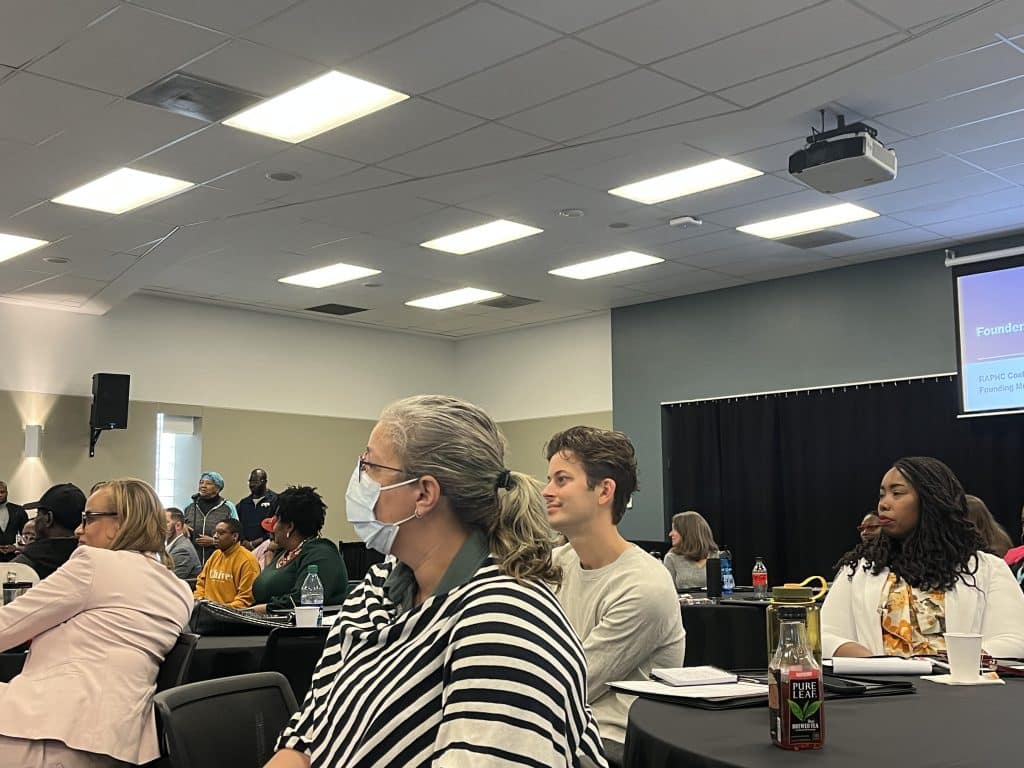
Cleveland City Council’s 2020 declaration of racism as a public health crisis created a working group to come up with solutions to address racism. This year, the group shared its work at a community town hall in late April and, on Nov. 28, it gave a presentation to about 60 community leaders.
After postponing two community meetings originally scheduled for this month, the Racism as a Public Health Crisis Coalition (RAPHC-C) is now planning several community events for January and February. The coalition plans to incorporate feedback from these meetings into a report coming out in early 2024, and it will use this report to determine how to put its proposed strategies into action, the group’s co-chair Marsha Mockabee said.
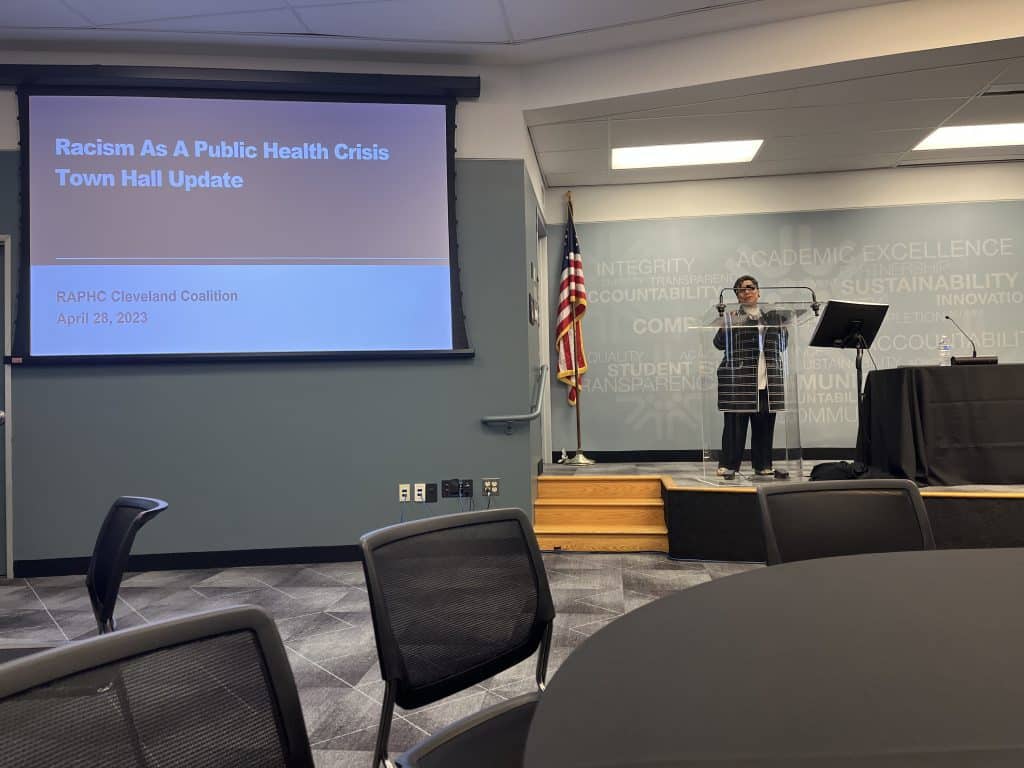
In summer 2022, Mockabee told The Land that RAPHC-C would hold a town hall and release a report of its work at the end of 2022. At a City Council committee meeting in May 2022, she mentioned plans to hold “listening tours” in the community. The group hasn’t released a report yet. It presented at a town hall organized by the Cleveland Office of Minority Health in April 2023. This month, Mockabee told The Land that RAPHC-C is planning three “listening tour” meetings for January and that it will hold another town hall before its report comes out in the first quarter of 2024.

Between 2021 and 2022, RAPHC-C received $200,000 from the city of Cleveland and $250,000 from JP Morgan Chase. See the group’s most recent timeline of its work and the funding it’s received here.
“It is not going to happen overnight,” Mockabee said at the community leader meeting, echoing statements she’s made in previous presentations to City Council and community members and interviews with The Land.
“When you consider that it took 400 years for us to be in the position that we’re in, I think it’s highly unrealistic to think that in three, or five, or even 10 years, you can have a total solution,” Mockabee told The Land on Wednesday. “It’s going to take time, and it’s a work in progress.”
Rather than creating programs, Mockabee said the coalition is doing collective impact work, which means government, community organizations, and other institutions work together to make changes to systems.
“It does not happen that easily. It’s messy work; it’s challenging work. But it is the best way to get at transformation in systems,” she said at the community leader meeting.
Yvonka Hall, executive director of the Northeast Ohio Black Health Coalition, said RAPHC-C needs to inform all community-based organizations about its work and give them opportunities to get involved.
After the town hall in April, Hall posted on Facebook that her organization was not invited to the event. Hall said she doesn’t know about RAPHC-C’s work because the group has not invited the Northeast Ohio Black Health Coalition to the table.
“If you’re responsible for having a coalition that’s focusing on equity and how to make sure that we’re addressing racism as a public health crisis, then that means that you need to make sure that all the community-based organizations that are out here doing the work are at the table,” Hall told The Land this week. “There should be an invitation for them to decide whether they want to come to the table.”
In response to this comment, Mockabee said RAPHC-C is in the “community listening tour and the community engagement phase” right now and will invite the Northeast Ohio Black Health Coalition and other community-based organizations to its upcoming community meetings. “So that’s exactly what we’re doing,” she said.
Postponed meetings, upcoming community engagement
At the Nov. 28 community leader meeting, which was held on Zoom due to the weather, RAPHC-C leaders said that a “grassroots community” meeting would take place at City Hall on Monday, Dec. 4, followed by another town hall in mid-December.
Later that week, RAPHC-C co-chair Helen Forbes Fields told The Land via email that the group was postponing the meetings to the first quarter of 2024. RAPHC-C wanted to avoid holiday interruptions and give itself more time to plan and promote the meetings, Mockabee said. Outside of the community leader meeting, the group had not shared the details of the meetings with the community before postponing the meetings, she said.
“The Committee will use this time to revisit its current engagement plans and make any necessary adjustments,” RAPHC-C project manager Gabrielle Fowlkes wrote in a Dec. 4 email to the community leaders.
The coalition is working with its partners to finalize details for three “listening tour” community meetings in January and February at different locations throughout the city, Mockabee told The Land. RAPHC-C plans to announce the dates and locations for the first two meetings by the end of December, she said.
“We’re talking about going to grassroots community locations where there are community residents, there are community folks that come to these locations, and they can provide their lived experiences and their input from their lived experiences to the process,” Mockabee said.
Residents can attend additional community meetings in February to learn more specifics on RAPHC-C’s work.
The group has committees, with two co-chairs and five to 18 other members, for each of the following five topics:
- Health/public health
- Housing, environment & infrastructure
- Education
- Economic mobility, wealth creation & workforce development
- Criminal justice
RAPHC-C calls these topics and their corresponding committees “pillars.” February’s “pillar meetings” will allow residents to take a deeper dive into the five individual topics, Mockabee said.
A report coming out early next year will shape RAPHC-C’s next steps
RAPHC-C will share the feedback it gathers in a report at the end of the first quarter of 2024, Mockabee said. It will also share insights from the community meetings with attendees following each session, she said.
The coalition has presented slides at a City Council committee meeting, the spring 2023 town hall, and the November community leader meeting, but it hasn’t released an official report to the public yet.
RAPHC-C is working with consultant Clear Impact, a company that helps organizations set goals and use data to measure their progress. In virtual meetings with Clear Impact, the coalition’s committees analyzed racial disparities and came up with potential solutions to get rid of these disparities, said Marcos Marquez, the consultant’s national equity lead and senior consultant.
Marquez presented slides listing each committee’s proposed strategies at the community leader meeting. Examples of the strategies include increasing high-frequency public transit, making trauma-informed care available in schools and community centers, and employing community health workers in neighborhoods to help residents navigate the healthcare system and connect them to other resources. View the presentation listing the proposed strategies here.
RAPHC-C is proposing solutions to address racism, but it has not yet answered the question of how it will carry out these strategies.
“Of course, what is missing from this page here is, ‘How are we going to do this? What does the implementation plan need to look like?’ And again, that is the work that is yet to be done by the community at large. So there is far more work that needs to happen beyond the strategic development that the groups have done so far,” Marquez told the community leaders while presenting the criminal justice strategies.
As the coalition looks toward implementation, it will need to align its work with existing efforts to address disparities, said Fowlkes, RAPHC-C’s project manager.
Right now, RAPHC-C is focusing on gathering feedback from the community. Then, it will put that feedback into a report and figure out how to implement solutions to address disparities, Mockabee said.
“The implementation phase is really going to be the proof in the pudding: How do we begin to actually look at systems and begin to interrupt policies and practices that are maintaining racism in those particular places? And how do we begin to move the needle?” Mockabee said at the community leader meeting.
Read The Land’s previous coverage of efforts to address racism as a public health crisis here. Click the following links for more information about the coalition:
–Most recent timeline of RAPHC-C’s work
–Slides with each committee’s proposed strategies
–Slides from the November community leader meeting, including committee membership
–Slides with information about the city of Cleveland’s Interdepartmental Equity Team, which like RAPHC-C, is also using a data-driven model to set goals and measure its progress
You can contact RAPHC-C project manager Gabrielle Fowlkes at gfowlkes@ulcleveland.org.
Update: This article has been updated to clarify that the Cleveland Office of Minority Health put on the April 28 community town hall where RAPHC-C presented its work.
Keep our local journalism accessible to all
Reader support is crucial as we continue to shed light on underreported neighborhoods in Cleveland. Will you become a monthly member to help us continue to produce news by, for, and with the community?
P.S. Did you like this story? Take our reader survey!

![Lakewood High School students organize walkout to protest ICE [photos]](https://d41ow8dj78e0j.cloudfront.net/wp-content/uploads/2026/02/12155714/DSC_3775-800x600.jpg)


