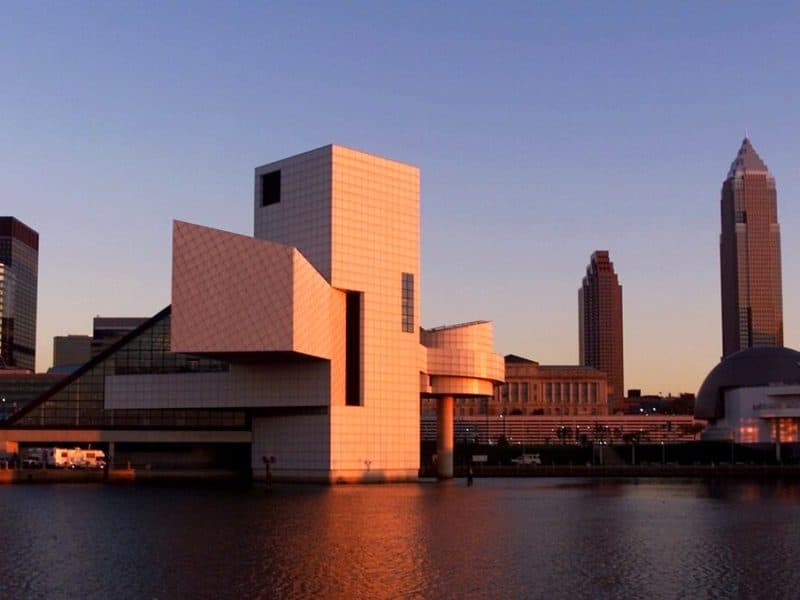
[Photos courtesy of Michael Ruffing]
Far from your average book depository, libraries are meant to be guardians of our collective history, culture and knowledge. The Cleveland Public Library aims to uphold this standard by digitizing a massive collection of news from after World War II through the late 1980s.
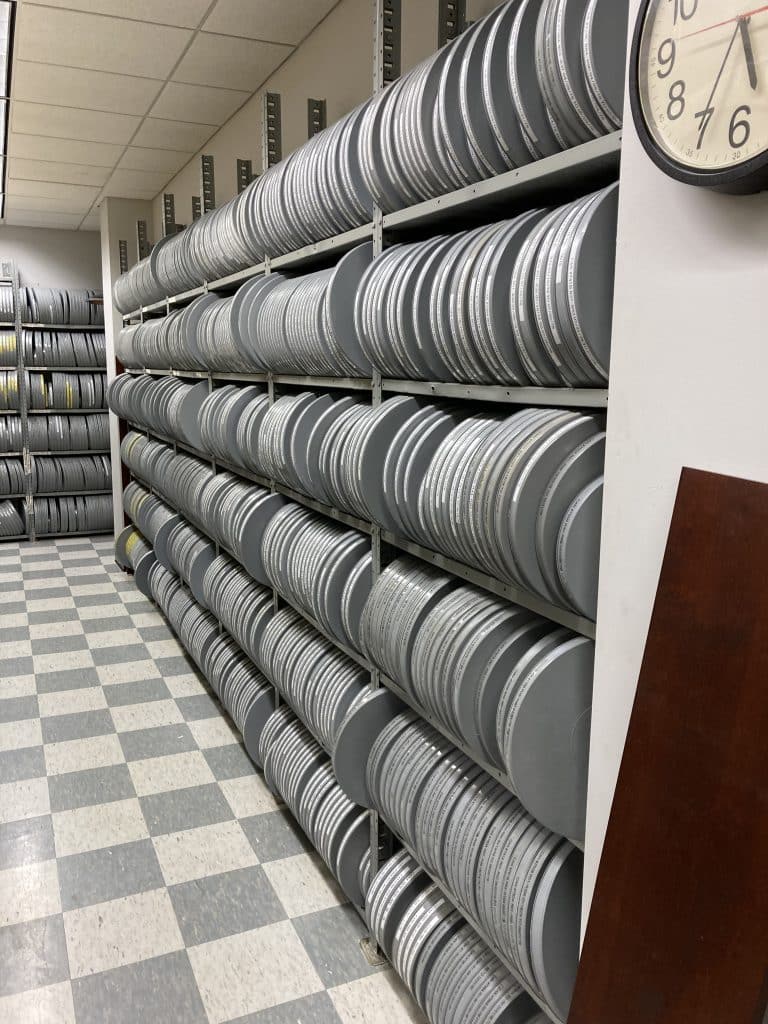
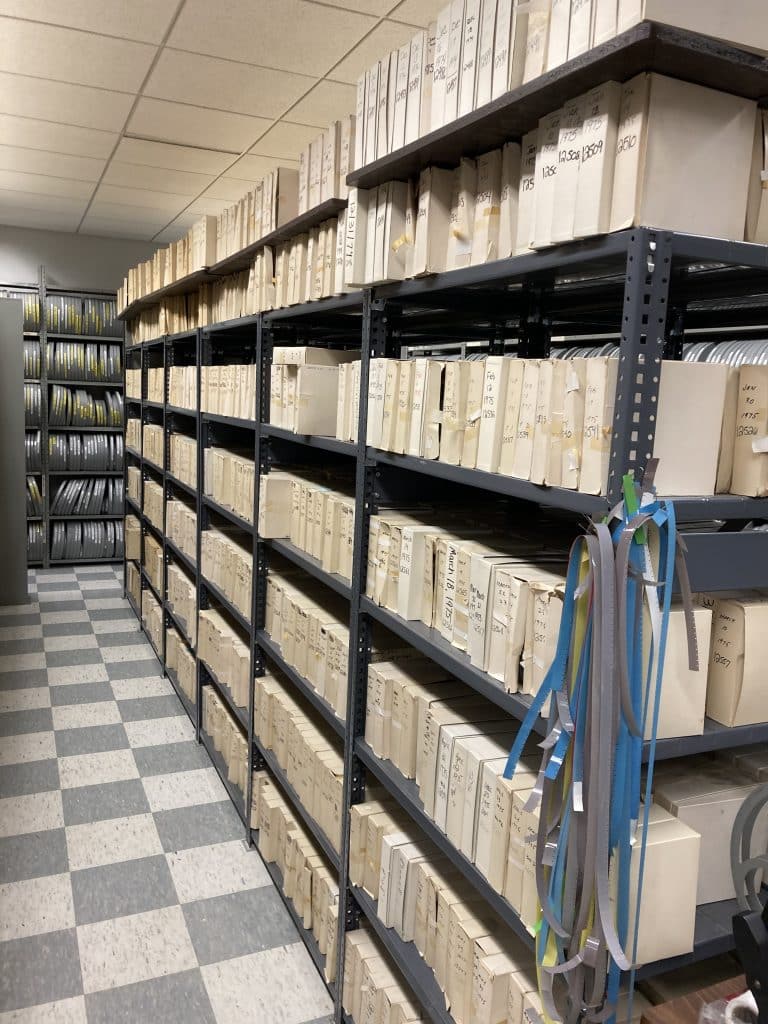
CPL acquired the Northeast Ohio Broadcast Archives (NEOBA) in 2023 from John Carroll University, which had been housing the collection since 1987. A veritable trove of regional and national history, the archive comprises 250,000 news stories enshrined on 16mm film, magnetic tape video, reel-to-reel audio and glass phono-discs.
“If you can think of something that happened between the mid-1950s and 1990, it’s probably in there,” says Michael Ruffing, director of special projects at CPL. “The archive covers most anything that would have been on the news at the time.”

The collection is mostly supplemental “b-roll” used by news stations to complement their main footage for a story. Shot by television stations WKYC and WEWS – as well as WGAR radio – the film covers both the historic and mundane. Unedited footage uncovers everything from Martin Luther King Jr.’s Cleveland visit to public pool openings to old episodes of the “Romper Room” children’s television show. True masochists can also enjoy detailed coverage of the Cleveland Indians’ many, many losing seasons from 1955 to 1994.
“Our mission is to preserve the record of the city and Northeast Ohio,” says John Skrtic, CPL’s chief of special projects and collections. “When we learned about this amazing collection, we knew it would fit within our mission as the ‘people’s university.’ It’s about bringing information to our users – to help them enrich their lives and learn about their past.”
CPL acquired the archive to digitize it for future generations, notes Ruffing. Preserving this vast collection is costly and time-consuming, given the sheer volume of materials, the specialized equipment required, and the complexities of long-term storage for physical copies.
To that end, CPL hired Los Angeles-based consultant Linda Tadic, co-founder of the Association of Moving Image Archivists (AMIA). Working alongside Tadic, library officials developed a 100-page blueprint that identified media in the collection along with potential storage options.
For instance, 16mm film stock necessitates storage in climate-controlled environments with low temperature and humidity to prevent deterioration. (The NEOBA archive is being temporarily stored at CPL on shrink-wrapped pallets.) Prior to digitization, individual film rolls must be cleaned and spliced together onto a single large reel.
“Moving ahead, the goal is to have a space with a separate storage room so we can work in optimal conditions,” Ruffing says.
Digitizing the complete collection, including backing up footage onto high-tech magnetic tape, is estimated to take five years. Initial digitization and processing is projected to cost $8.6 million, which CPL plans to fund through philanthropic contributions. Library visitors would have access to content soon after full-time digitization begins, says Ruffing.
The completed digital archive could operate like the Paley Center for Media in New York, which allows for home viewing of some archival footage, while requiring on-site visits for content with third-party rights restrictions.
“We brought on an (intellectual property) attorney to sort through these issues,” Ruffing says. “There might be an old NFL game where the league has rights, so you’d have to come to CPL to view it.”
Access to materials would be provided free of charge, with the exception of requests for copies. Ruffing envisions teachers using the archive for assignments, or the library sponsoring a student documentary competition that utilizes the collection.
“What about VR headsets where you can interact with content?” says Ruffing. “The possibilities are endless, and would open a door to history that people didn’t know existed. If a photograph is worth a thousand words, then moving images are worth a million words, depending on the subject.”
Keep our local journalism accessible to all
Reader support is crucial as we continue to shed light on underreported neighborhoods in Cleveland. Will you become a monthly member to help us continue to produce news by, for, and with the community?
P.S. Did you like this story? Take our reader survey!