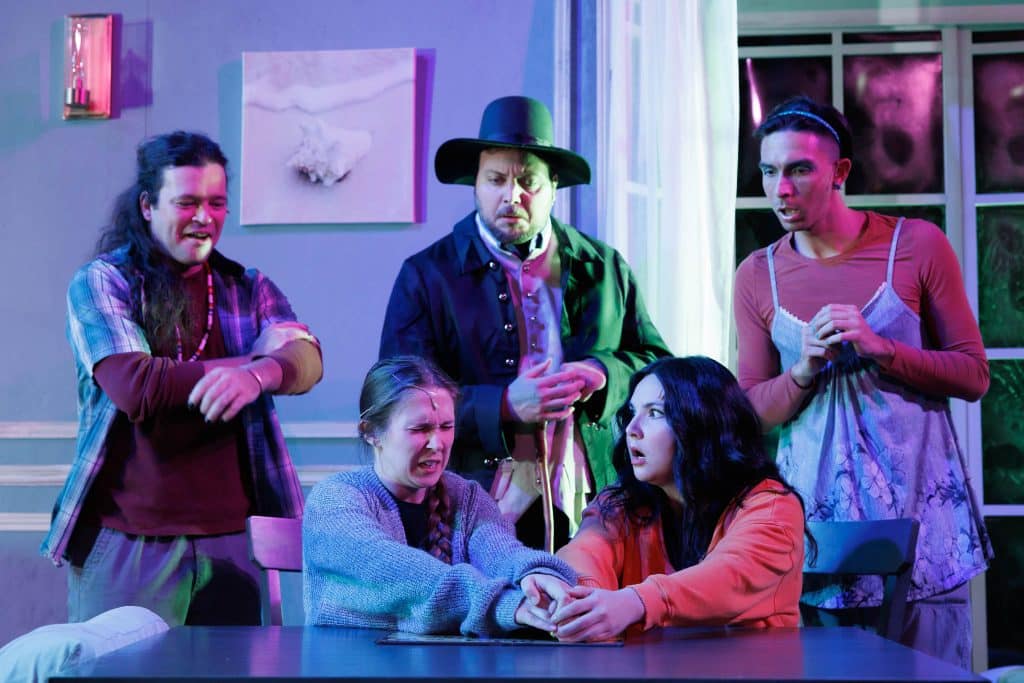
Cleveland Public Theatre will open its production of “Haunted” by Tara Moses (Seminole Nation of Oklahoma) on March 5, running through March 22. An Indigenous horror comedy about two siblings trapped between worlds — history, memory and the house they haunt — the production is directed by Nailah Unole didanas’ea Harper-Malveaux (Cherokee Nation of Oklahoma).
The production marks CPT’s first collaboration with Crowded Fire Theater, a San Francisco–based company devoted to developing new plays. It also grows out of the Mellon Foundation–funded Future of American Theatre Cohort, a five-theatre alliance that includes Company One (Boston), Mosaic (DC), and Perseverance Theatre (Alaska).
“Haunted” arrives in Cleveland as the final stop in a National New Play Network Rolling World Premiere — a three-production model in which each theater mounts its own fully realized version of the same new work. The previous productions took place at Company One in Boston and at Greenway Court Theatre in Los Angeles. Moses is the first Indigenous playwright to have a work included in NNPN’s Rolling World Premiere program, and CPT has worked with the Lake Erie Native American Council to connect the play with Northeast Ohio’s Native community.

“At a time when spotlighting diverse stories is critical, we are grateful to Cleveland Public Theatre (CPT) for bringing ‘Haunted’ to Northeast Ohio,” said Nancy Kelsey (Anishinaabe), a member of the Lake Erie Native American Council and CPT boards, via the company’s press release. “We look forward to seeing this beautiful representation of universal Indigenous values — such as reciprocity and spiritual connections to the homelands and waters of our ancestors on stage.”
A haunted-house comedy — seriously
If the phrase “horror comedy” sounds like a contradiction, “Haunted” leans into the friction. Two Indigenous siblings, Ash and Aaron, have been dead for 20 years. They haunt the families who try to move into their house, kill time dancing to Y2K pop (yes, Britney Spears makes an appearance) and wonder whether they will ever reach the Spirit World. Along the way, the play takes sharp aim at racist stereotypes and asks what it means to live — and die — on stolen land.
Raymond Bobgan, CPT’s executive artistic director and CEO, said he came to the play through a long arc of relationship-building with Cleveland’s Indigenous community and through the cohort’s connections. CPT, he noted, has historic ties that reach back decades, including the theater’s support in the 1990s for what was then called the American Indian Festival. For Bobgan, “Haunted” represents a new step.
“This is the first play that we’re doing in direct relationship with the Indigenous community. In my time here, we’ve done some workshops and things like that, but this is the first full production,” he said.
When Company One asked CPT to be the third producing partner in the rolling premiere, Bobgan said his instinct was strong even before he’d read the script — but the piece was still a revelation to him. “The play was completely surprising to me,” he said.
“It really breaks a lot of stereotypes. You go in and you think, ‘Okay, I’m going to see this play about Indigenous rights,’ and suddenly you have someone lip syncing to Britney Spears.”
He described it as “a little bit of Scary Movie,” with “a lot of fun and campiness,” and said the writing proves itself early. “It is laugh-out-loud funny,” he said. “In our very first reading, people were just really cracking up.”
Harper-Malveaux echoed the idea that the play’s tonal mash-up is part of its accuracy. “This play contains multitudes, just like our world,” she said. In her view, “Haunted” offers “the best kind of good medicine in these really chaotic and violent times” — a mix of a 90s and Y2K mixtape, some familiar horror tropes, and “a really good belly laugh,” while remaining “primarily about the land back movement and about Indigenous sovereignty.”
Why the rolling premiere matters for Cleveland
Rolling premieres often mean small rewrites — a line tightened here, a moment clarified there — but Harper-Malveaux said “Haunted” uses the model in a different way. The script is designed to change from city to city, with location-specific references and instructions meant to be adapted.
That flexibility mattered, she said, because Boston, Los Angeles and Cleveland sit in very different Indigenous geographies.
“In Cleveland, there are no reservations in Ohio. There are no federally recognized tribes in Ohio,” she said. As a result, the Cleveland version required deeper local research — and different kinds of specificity — so that audiences can leave with concrete next steps rather than an abstract sense of sympathy. “Our biggest goal is for people to want to learn about land back and also to be able to take action,” she said.
Land back: a better relationship
The play’s humor and horror ultimately circle back to a larger theme: land back.
Asked to define land back, Harper-Malveaux framed it as more than a property transaction. It is, she said, “a decolonization and repatriation movement” rooted in Indigenous sovereignty and stewardship — and connected to both reparations and climate justice. She also offered a second, more inward dimension: “Land back to me is more than just giving the land back… It’s also… giving the people back to the land.” For her, that means reconnecting to language, practices, and relationship with the natural world — forms of restoration that colonization disrupted.
Bobgan said the play makes these ideas feel reachable without draining the room of laughter. “It’s funny, it’s joyful, it breaks a lot of stereotypes. It’s scary,” he said, “and simultaneously, it has this message… you could do something today that will change your relationship to this land and to the history of this land.”
That combination — entertainment with consequence — is central to CPT’s purpose as Bobgan sees it.
“Our mission is to raise consciousness and nurture compassion,” he said. “I believe joy is a big part of that.” He does not separate being entertained from being moved to think: “If you can’t engage me as an audience member, then it almost doesn’t matter what you’re saying.”
Bobgan described that same intention in plain terms: he wants the play to show that audiences can participate in building better relationships with the land and its history. He acknowledged how quickly conversations about reparations or land back can slide into defensiveness. “Haunted,” he said, tries to move the focus away from guilt and toward relationships.
“So much of our work in this country has been centered around guilt,” Bobgan said, “but the play pushes past that. What can I do to be in a better relationship with those around me? And when I do those things, it always ends up being better for me.”
For CPT, that effort includes partnerships with the Lake Erie Native American Council (LENAC), a grassroots organization led by Indigenous community members. Bobgan described LENAC as “a local organization made up of Indigenous folks who run programs for youth and a number of other things in the community,” adding that the Native population in Cuyahoga County is “small… but mighty.” According to the 2020 Decennial Census, 1,827 residents of Cuyahoga County identified as Native American or Alaska Native alone (non-Hispanic), which is about 0.14 % of the county’s population.
He noted that Moses’ script leaves space for local adaptation, allowing productions to connect audiences with organizations and resources in their own cities.
“Haunted” is built to point outward — beyond the theater and into the community.
A cohort of peers
Both Bobgan and Harper-Malveaux stressed that the Future of American Theatre Cohort began as a self-organized alliance, not a foundation-driven initiative. The cohort — funded by the Andrew W. Mellon Foundation, a national philanthropy that supports arts and humanities organizations — includes Cleveland Public Theatre, Company One Theatre in Boston, Crowded Fire Theater in San Francisco, Mosaic Theater Company in Washington, D.C., and Perseverance Theatre in Juneau, Alaska. Bobgan said the idea came from Company One’s leadership: “Sean Lecount from Company One approached me and said, ‘Raymond, we seem to be outsiders in so many aspects of American theater — what about making a cohort?’”
The group formed first, Mellon Foundation support came later. When Mellon joined, Bobgan said, the dynamic remained unusually collaborative. “It really is bottom up,” he said. “It’s a totally different relationship than I think many foundations have with their grantees.” He credits Mellon’s performing arts leadership — particularly Stephanie Ibarra — with treating the cohort less like a grant portfolio and more like a working group. “Stephanie is like one of the cohort members,” he said. “She’s in a lot of these meetings.”
Harper-Malveaux said she has felt that difference, too. “I have not experienced pressure from Mellon,” she said. In her description, the funding is largely general operating support. “It gives us so much freedom to continue to do the work, to continue to take the risk that we’re taking,” she said.
For Bobgan, the deepest impact is cultural rather than procedural. “Culture eats strategy for breakfast,” he said, meaning organizational habits and values matter more than formal plans, and the cohort has changed how he thinks through problems day to day. “I can’t tell you how many times I’ve gone into a meeting and said, ‘How would Reg Douglas approach this?’” — referring to Mosaic Theater Company’s artistic director and a fellow cohort member. ‘How would Crowded Fire approach this problem from a collective leadership?’ It changes how I think.”
That ethos of exchange is also how Harper-Malveaux described the cohort’s working sessions — site visits where leaders learn “boots on the ground” from one another’s local models. She recalled coming to Cleveland last summer and seeing what she called CPT’s unusual transparency with its own artist community, including an artists’ meeting where leadership shares budget realities and organizational challenges directly. “They’re really transparent and accountable to their artists in a different way than I’ve ever seen,” she said.
Ticket and show information
“Haunted” runs March 5 through March 22 at Cleveland Public Theatre. CPT’s ticket model is “Choose What You Pay,” with prices ranging from $20 to $80 and no handling fees, plus a limited number of $10 and $1 tickets available per performance on a first-come, first-served basis. Tickets are available at cptonline.org or by phone at 216.631.2727.
Original music and sound design are by Geoffrey Short, CPT’s new Kulas Theatre Composer Fellow, and the production will be “accented with snippets of iconic Y2K pop,” according to the press release — a nostalgic pulse running under a story that insists the past is not past.
If “Haunted” succeeds on its own terms, audiences may leave with more than a catchy tune in their ears — a sharper sense of the land they stand on, and what a better relationship to it might look like.
We're celebrating four years of amplifying resident voices from Cleveland's neighborhoods. Will you make a donation to keep our local journalism going?