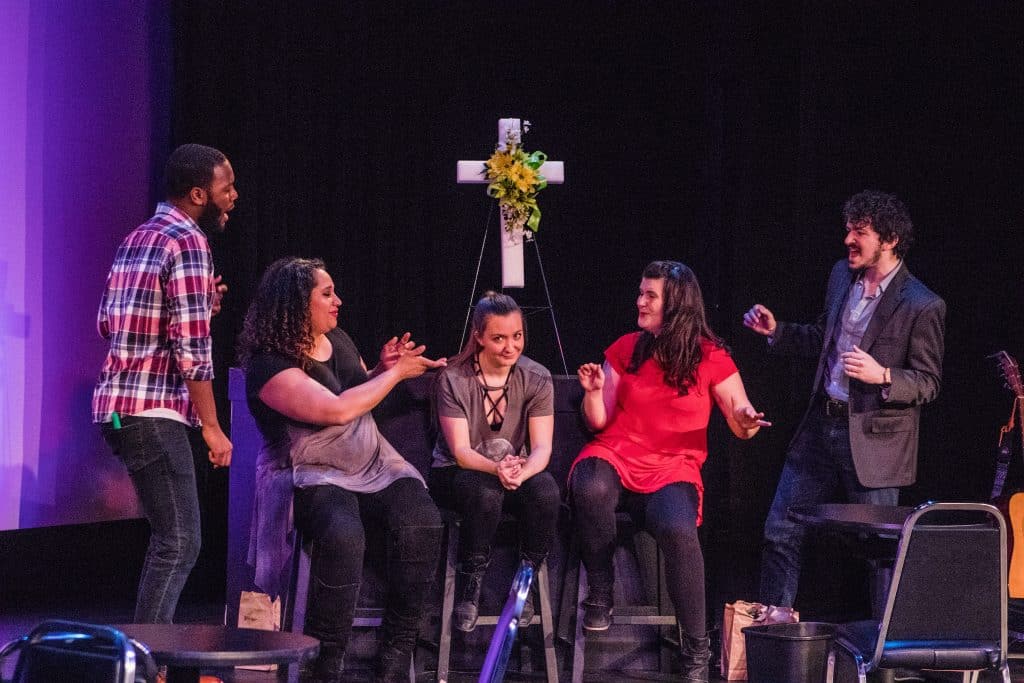
A few minutes before curtain time at Cleveland Public Theatre (CPT), the audience holds its breath. Not in anticipation, exactly, but in uncertainty. Actors have scripts in their hands, the set is a suggestion (if visible at all), and the show may change tomorrow.
Test Flight — Cleveland Public Theatre’s annual new-play development program — is built on a simple and, in the theater business, slightly radical premise: unfinishedness is the point.
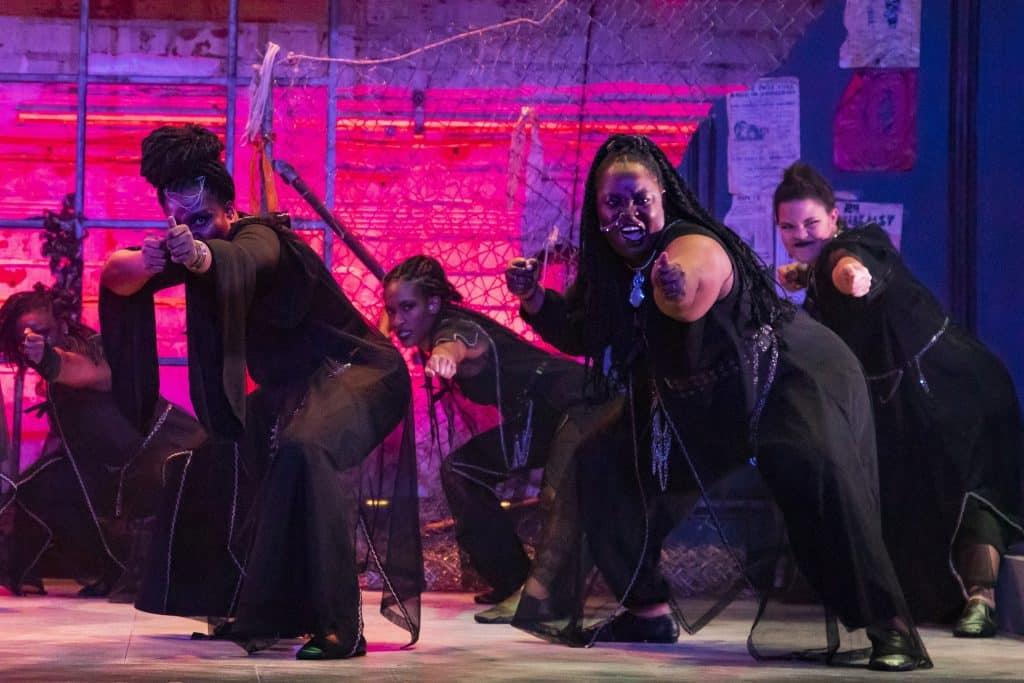
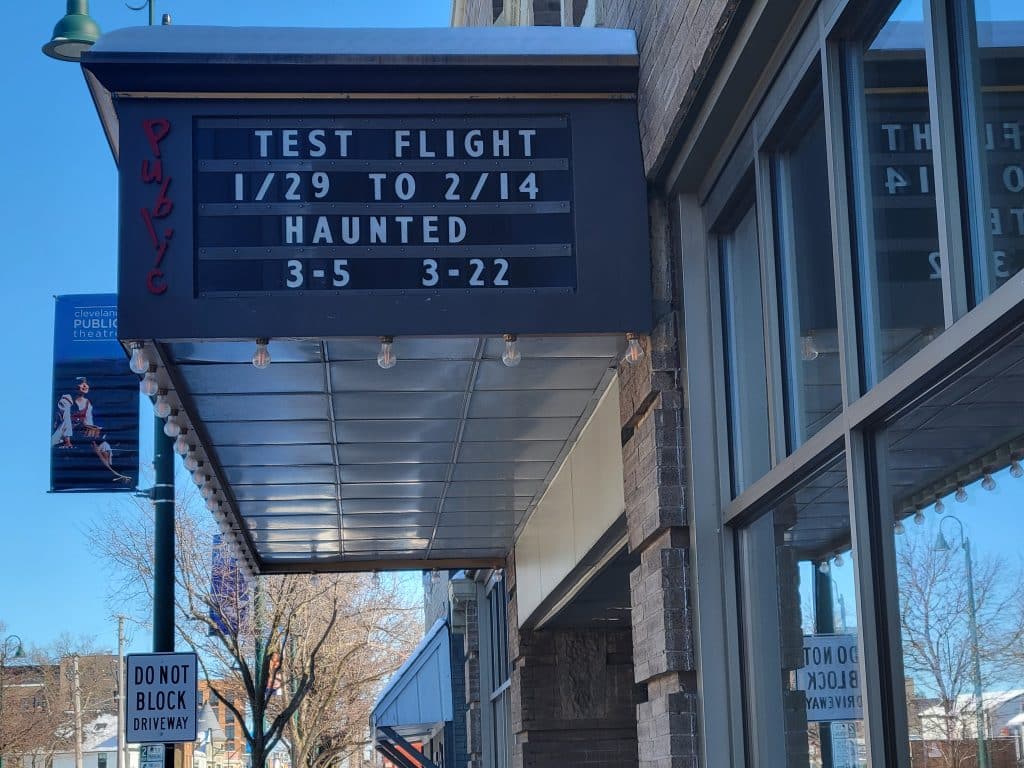
The program turns 10 this year, and in 2026 it runs from Jan. 29 through Feb. 14 in CPT’s James Levin Theatre in Gordon Square, with six works presented over three weekends, as double bills. The performances are workshop productions — full pieces staged from beginning to end, but with minimal sets and scripts and structures still being tested.

How Test Flight works
“Test Flight is one of my favorite things that we do,” Paige Conway, CPT’s associate artistic director, told The Land. Conway is one of this year’s two line producers, overseeing Weeks 1 and 2, while Anastasia Urozhaeva,CPT’s community ensembles manager, handles Week 3. Test Flight, Conway explained, has a lot of moving parts: rotating teams, quick turnover, a technical schedule that changes from week to week.
Conway described line-producing as being an “Uber producer” — coordinating the transition from rehearsal rooms into the theater, making sure groups have what they need, keeping the calendar sane, and serving as the liaison between artists and the institution. If Test Flight is a machine, the line producer keeps it from throwing a belt.
A theater built for new work
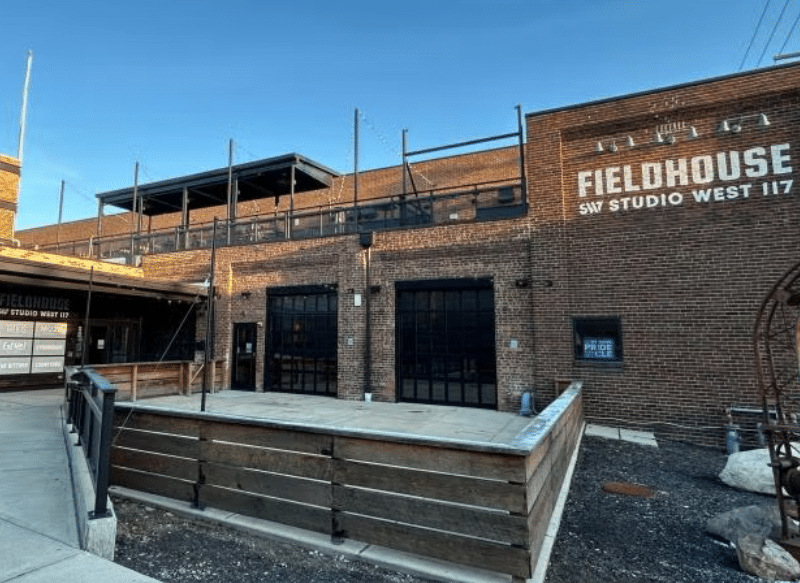
CPT was founded in the early 1980s by James Levin with a particular impulse: to build a theater rooted in the community, committed to experimentation and focused on original work rather than familiar repertoire. The space itself has a history in layers. The James Levin Theatre is upstairs in what was once an Irish dance hall. Downstairs is the Gordon Square Theatre, formerly a vaudeville house. Nearby, CPT owns a former Romanian church building — now the focus of accessibility renovations as part of a capital campaign.
Conway said CPT remains unusual in how fully it prioritizes new work. “CPT is one of the few theaters left that is still producing almost exclusively new works and world premieres,” she said. “Developmental programs remain central rather than peripheral.”
Test Flight, in that sense, is not a side project. It is the project.
A producer for every playwright
In earlier years, Conway said, playwrights were often expected to write, direct, produce and market a piece alone. In the past few seasons, CPT has developed a more intentional structure to the program, especially in the way playwrights are supported. Every writer now brings a producer — not necessarily someone experienced, Conway emphasized, but someone willing to learn. The goal is to demystify producing and send artists out with transferable skills, while giving the playwright something rare: time to do the work of revision.
Conway said the model has also had an unexpected upside. “Now, when I talk to the playwrights, many of them don’t just talk to me about what they learned about the play itself,” she said. “They talk to me about, ‘Oh, I learned how to produce!’”
The audience as part of the process
Test Flight isn’t a reading series, and it isn’t a season of premieres. The adjustment for audiences is mainly in attitude. These are works-in-progress, and CPT says so plainly. Conway said house managers work it into the curtain speech: audience response is part of the process. Laughter, silence, attention — all of it becomes data for writers and directors. People listen differently — noticing whether a laugh comes late, a silence turns awkward, a performer has to glance down at a script before continuing.
“You could come tomorrow and see something different based on how you respond tonight,” she said.
Audience size varies from show to show. “Since each (playwright) is in a different stage of career development (and renown), house sizes vary,” Kim Furganson, Director of Audience Engagement & Marketing says. “Generally speaking, the series is well-attended and we have had some sellouts.”
The 2026 lineup (three double bills)
The 2026 lineup is arranged in three double bills. The first has already passed. Here are the remaining two.
Week 2 (Feb. 5–7) pairs Perigon: A Birth Story by Marie McCausland with Boxed, devised and choreographed by Elizabeth Pollert (Julia Dillard, producer). McCausland’s one-woman show draws on lived experience, including “the trauma and difficulty… in the medical field as she was giving birth,” Conway said. Pollert’s Boxed uses a stage full of boxes to explore, with humor and bite, the ways people are categorized.
Week 3 (Feb. 12–14) pairs The Exit Door, created by CPT’s Teatro Público de Cleveland (by Nathalie Bermudez, produced by Alejandro Martinez), with The Wolf (الذيب), from Masrah Cleveland Al-Arabi (written and directed by Shakeeb Julien; creative partner/producer, Rita El Jamous). The press release describes The Exit Door as an exploration of “migratory grief” set in an airport, while The Wolf draws on folklore for a devised theatrical journey.
All CPT performances use Choose-What-You-Pay pricing, starting at $1. But Test Flight adds a direct incentive to paying something: artists receive a split of the box office.
In the end, the audience is asked to do something that sounds modest but is not: to watch a play become itself, and to accept that the most honest work doesn’t come fully formed. It has to be flight-tested.
We're celebrating four years of amplifying resident voices from Cleveland's neighborhoods. Will you make a donation to keep our local journalism going?