This story is part of a new series of columns written by The Land’s staff and editors. Send feedback or ideas for future columns to Michael Indriolo at mindriolo@thelandcle.org or to Lee Chilcote at lchilcote@thelandcle.org.

When the pandemic pushed back voting dates for the 2020 primary elections, Pagan and YLN organized “caravanas,” or vehicle caravans, to make sure Cleveland’s many Latinx communities got the election information they needed and were able to fill out the census.
That’s how it started, but the caravanas quickly became a source for Covid-19 information, tests, and PPE, too. Pretty soon, YLN, which is not a healthcare organization, was organizing health clinics and tending to community health needs beyond the pandemic.
“This is all connected,” Pagan said during a panel organized by The Land and My Cool Solutions Inc. “When we think about this pandemic and the work that we’re doing, we have to think about it holistically. It can’t just be one thing, right? So when we’re talking about the work we do in democracy, and the impacts within our community, we need to be talking about all of the social determinants of health and the health of our communities and a healthy democracy.”
Those social determinants of health are different for different cultural and ethnic communities, Pagan said. Getting local governmental and medical systems to understand and address those differences is key to fostering healthier communities better equipped to resisting a pandemic in the first place.
We’re well into this pandemic, and now more than ever, it feels, we may be on our way toward an entirely new era of it. Still, if we have learned nothing else from these last few years, it’s that the politicization of global humanitarian events like this pandemic is inevitable. But that doesn’t have to be only a bad thing. For Pagan and the other community advocates who spoke at this week’s Tour The Land discussion, the pandemic has been an unprecedented challenge wrought with suffering and heartbreak, but it has also underscored the trust-building nature of their work.
At the intersection of politics and pandemic, there appears an opportunity to confront head-on an issue that’s at the core of democracy: trust in leadership.
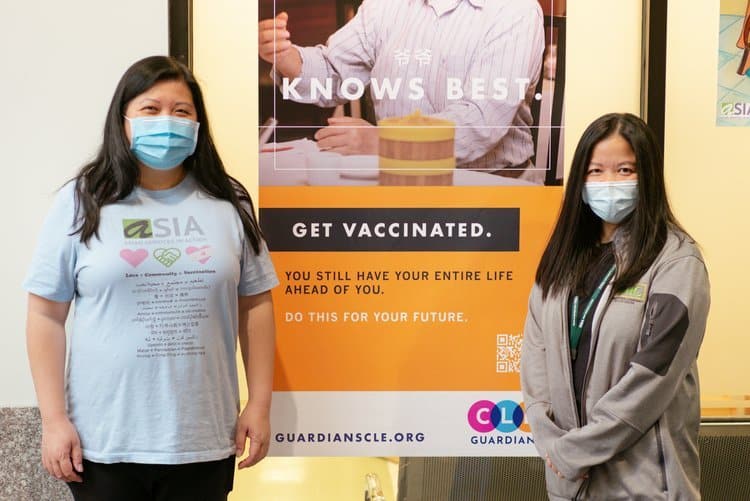
Elaine Tso and Dr. Sibley Strader, a bilingual staff physician, stand in front of ASIA’s clinic in AsiaTown. Photo by Michael Indriolo
The disparate effects of Covid-19 on communities of color were most prominent early on in the pandemic when access to testing and PPE was limited, but now that mask mandates and restrictions appear to be on their way out, Cleveland’s communities of color will once again be left vulnerable to whatever new variant is to come.
“As we see other neighborhoods with higher vaccination rates and people lifting mandates, our people in our communities are still vulnerable,” Rev. Dr. Lisa Maxine Goods, of Shiloh Baptist Church and Greater Cleveland Congregations (GCC). “People are still getting sick. And unfortunately, with cuts to Covid funding, there may not be resources available. And again, those populations will be left behind.”
The reasons for the knee-jerk mistrust of power that’s become so common in discussions of the vaccine are as varied for different ethnic communities as they are for each individual that makes up those communities, but it often comes back to systemic racism, in one way or another.
The wave of hate many in Cleveland’s Asian American community endured in the wake of the pandemic isolated her community, said Elaine Tso, of Asian Services in Action (ASIA). Residents came into ASIA’s clinic with stories of being spit on and sprayed with hand sanitizer and disinfectant while going about their regular daily lives. Legally speaking, that’s assault, Tso said, but many didn’t want to report these incidents to police because they mistrusted systems and institutions that, both here and in their home countries, have let them down.
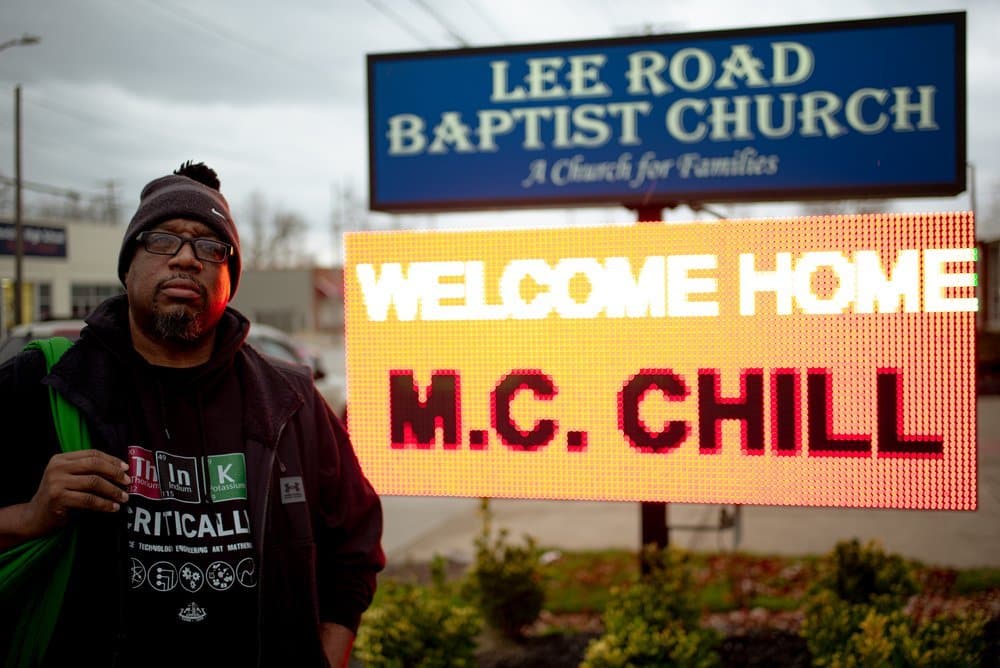
Kevin “Chill” Heard at his childhood church in Lee-Harvard. Photo by Michael Indriolo
Kevin “Chill” Heard, who advocated for the vaccine in Cleveland’s Lee-Harvard neighborhood through the Guardians of Cleveland initiative, has learned a thing or two about the relationship between mistrust in power and systemic racism throughout his decades-long journalism career.
Heard coined the phrase “We’re Tuskegee-ing ourselves,” in a video he made with the guardians initiative, referring to the infamous Tuskegee Syphilis Study in which researchers withheld treatment from African American men with Syphilis. He’s caught heat from that, he told me, from neighbors and friends who think he’s “sold out” to the establishment by promoting the vaccine.
However, Heard said he’s had his most enlightening conversations with those who’ve disagreed with him. He’s spent hours in the local barbershop debating, and it has opened both his eyes and the eyes of his neighbors to new insights about the nature of misinformation and trust.
Those raw, one-on-one conversations worked not only for Chill, but for Tso, Pagan and Goods, too. ASIA, GCC, YLN and the Guardians of Cleveland initiative have all shown what it takes to gain the trust of communities that have too often been left behind by local medical and governmental systems. It’s my personal hope, perhaps naively, that our governmental leaders learn from these community organizations not only how to address a public health crisis, but also how to foster a healthier relationship between the local government and those it’s designed to serve.
Michael Indriolo is a reporting fellow at The Land.
Keep our local journalism accessible to all
Reader support is crucial as we continue to shed light on underreported neighborhoods in Cleveland. Will you become a monthly member to help us continue to produce news by, for, and with the community?
P.S. Did you like this story? Take our reader survey!

![Lakewood High School students organize walkout to protest ICE [photos]](https://d41ow8dj78e0j.cloudfront.net/wp-content/uploads/2026/02/12155714/DSC_3775-800x600.jpg)