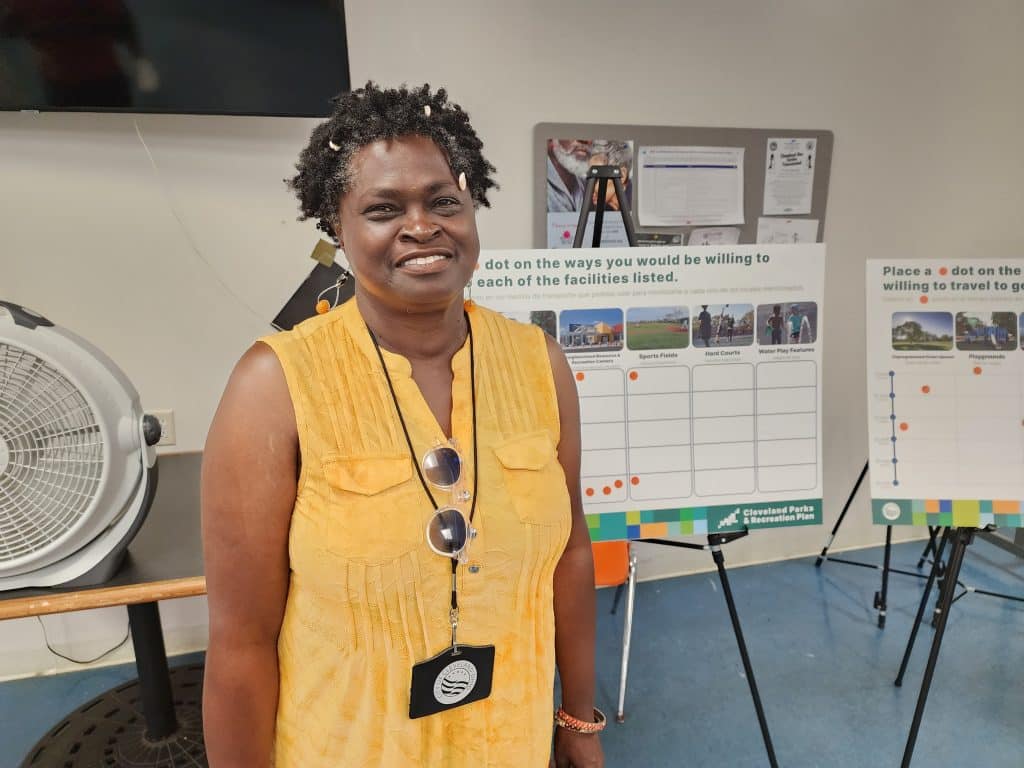
To some, the city’s parks and recreation centers are merely public spaces to shoot some hoops or take a leisurely walk. However, to many Cleveland residents, they’re much more than that. Many locals, from teens to young adults to senior citizens, see them as places where they can boost their mental and physical health, make new friends and build new relationships, and even acquire new skills that will help them develop personally or professionally.
These are some of the comments that emerged from public meetings held two weeks ago as part of the city’s parks and rec master planning process. Hundreds of people attended the meetings, which were held July 26-29. This is the first phase of a plan being managed by the Mayor’s Office of Capital Projects (MOCAP) to engage Cleveland residents in planning the future of their parks, which are managed by the city’s Department of Public Works. If you missed the open houses, you can still weigh in by taking the city’s online survey.
In a press release, the city said the 18-month process will examine the city’s 179 parks and recreation sites, which include 155 parks, 23 recreation centers, and one golf course. The first phase will look at current and future needs, the second phase will create a long-range plan, and the third phase will create a strategic plan for implementation.

Challenges and opportunities
The process will not be easy or simple. Although Cleveland has a plethora of parks – the city is ranked 26th in the country among large cities when it comes to park access, according to the Trust for Public Land – they’re not evenly distributed throughout the city, and some are in disrepair. Although there are plenty of projects in the pipeline, residents sometimes wait years – or even decades, as was the case with the now-completed Collinwood Recreation Center – for upgrades to be completed.
Some have also complained about the difficulty of accessing recreation center programs, given that the city’s website is outdated and schedules are hard to find online. In a recent story by Angie Schmitt in The Land, residents complained about finding out about pool closures only after they’d already gotten there and frustrating policies like having to leave the outdoor pools after 45 minutes and sign back in if they want to use them again.
OLIN, a design studio based in Philadelphia, is charged with leading the 15-year plan for MOCAP. Lucinda Sanders, OLIN’s CEO and president, told The Land she believes the process of community engagement is “absolutely essential” to building a master plan for Cleveland.
One of the city’s challenges is the fact that the division of parks and recreation is also tasked with maintaining over 30,000 vacant lots. “So, what do you do with that when you’re trying to build this incredible parks department and recreation facilities when you have that added burden?” Sanders asked.
On the bright side, she added, Cleveland’s planning process presents an “amazing opportunity” to be able to utilize over 155 parks with several thousand acres. “I want to say what’s good about it is that we’re not trying to find a lot of new land, which is different [for us],” Sanders said.
In an interview with The Land, Ward 15 council member Jenny Spencer complained that many of the city’s parks and recreation centers are overdue for improvements. She cited the fact that in her ward, which encompasses Detroit Shoreway, Edgewater, and parts of Cudell, Stockyards, and Ohio City, the showers don’t work properly in the women’s locker room at Zone Recreation Center, and Herman Park has been waiting years for an upgrade. She also complained that the city only gave three days’ notice for the parks and rec meetings, so she couldn’t promote them.
However, she said the long overdue strategic planning process could change how the city invests in its parks, which would be a good thing, in her opinion. In the past, she said, funding for recreation center and park improvements was rotated around the city on a “worst first” basis, instead of going to areas with the most use. “The city is transitioning from a ‘worst first’ mentality to a new paradigm, and this process will help to develop that,” she said.
The city is asking the community for help
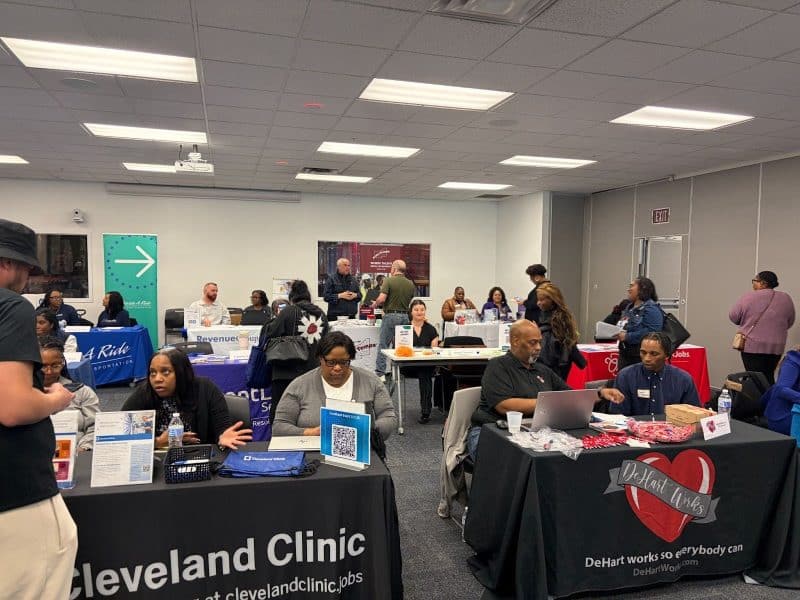
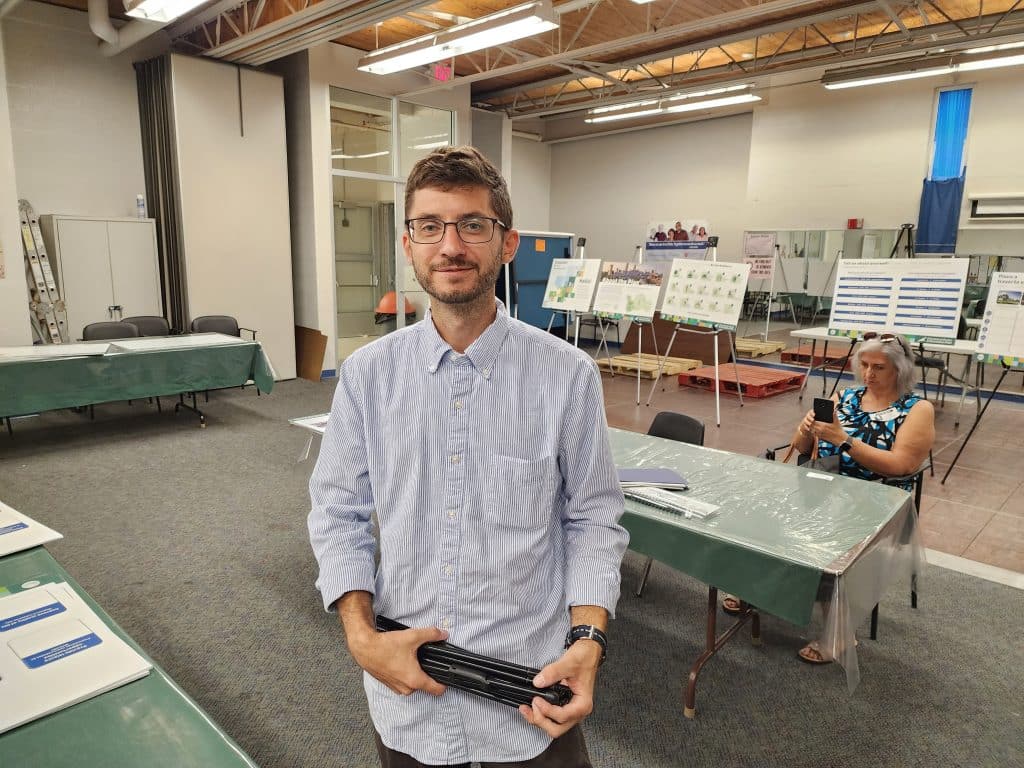
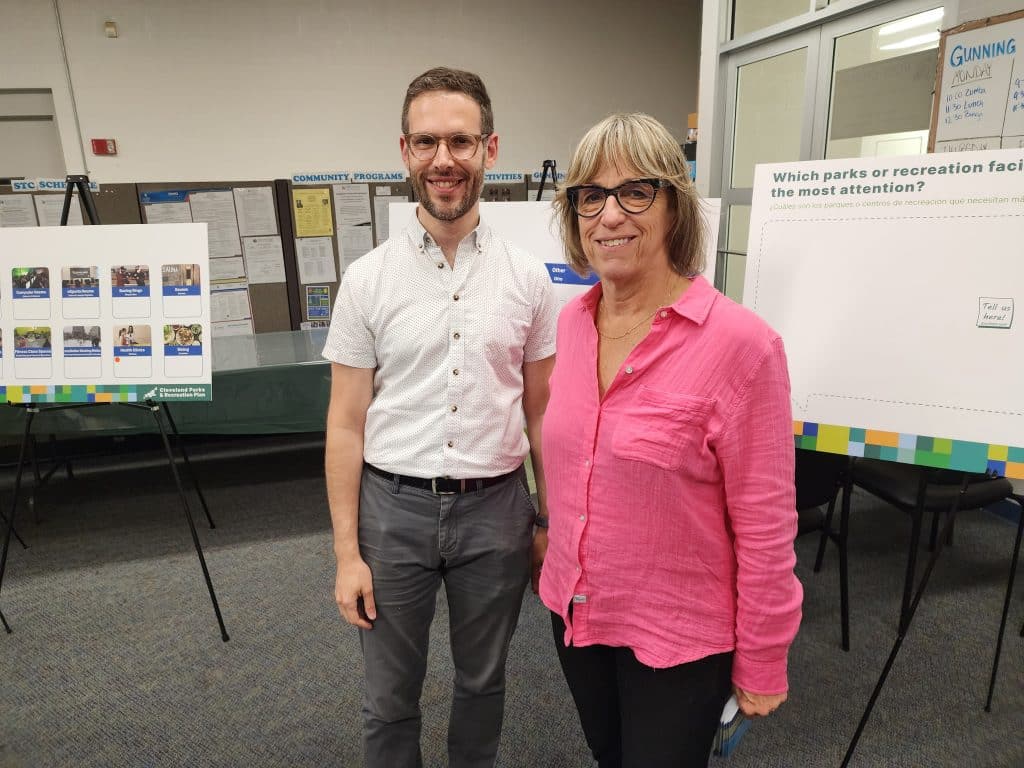
While at Gunning Park Recreation Center in the Bellaire-Puritas neighborhood, the first of four locations to host open houses, Jay Rauschenbach, a parks and recreation planning manager for MOCAP, talked about the importance of collecting information directly from members of the community. Additional events were held at Zelma Watson George Recreation Center, Thurgood Marshall Recreation Center, and South Branch Public Library.
“These open houses are really important because we want to hear from residents about what they want to see in the future,” said Rauschenbach. “We’re looking at a 15-year-long plan. We’re looking at next year, five years, and all the way to 15 years to see what we can do to help support the residents and build out a better parks and recreation system for the residents.”
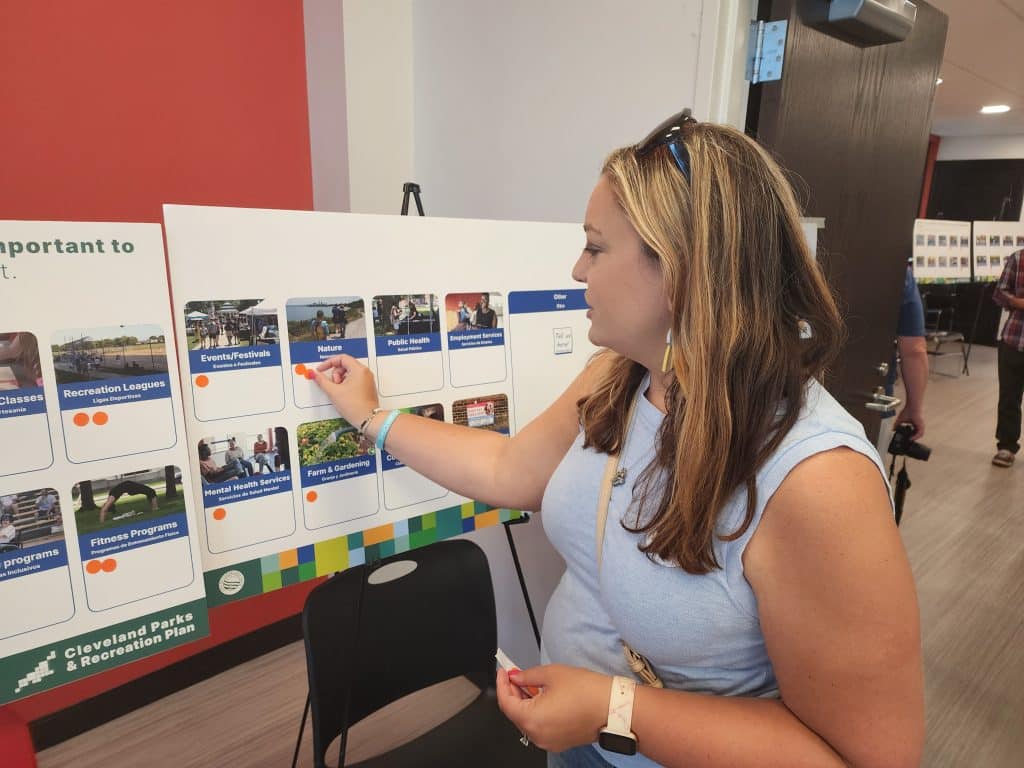
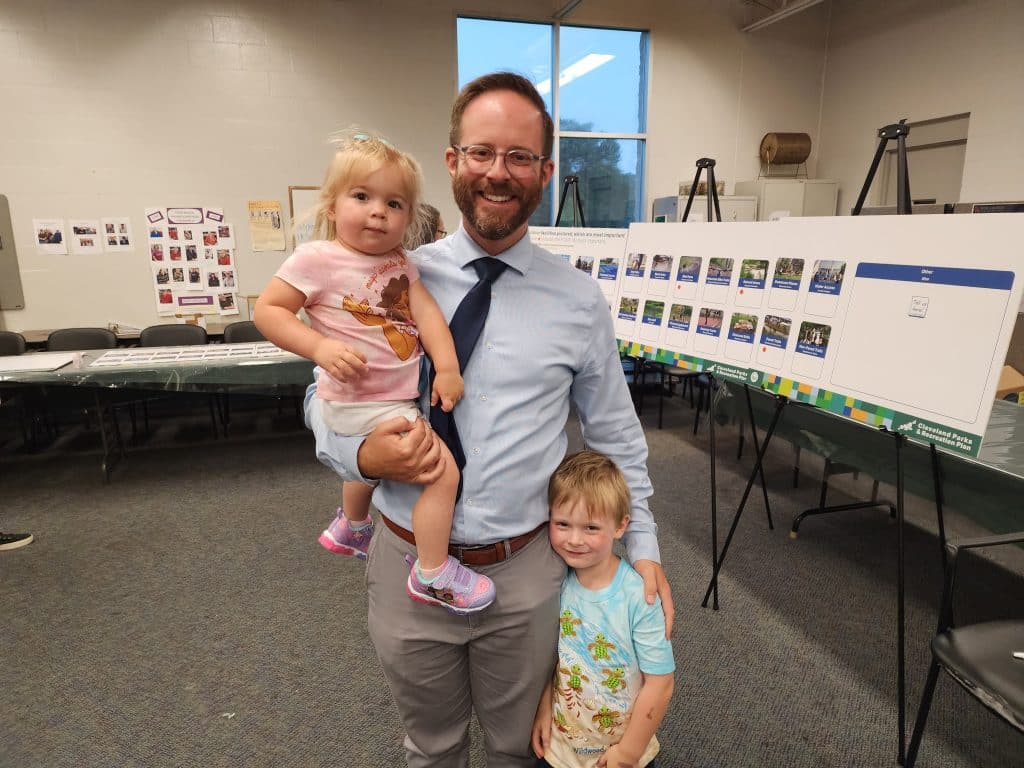
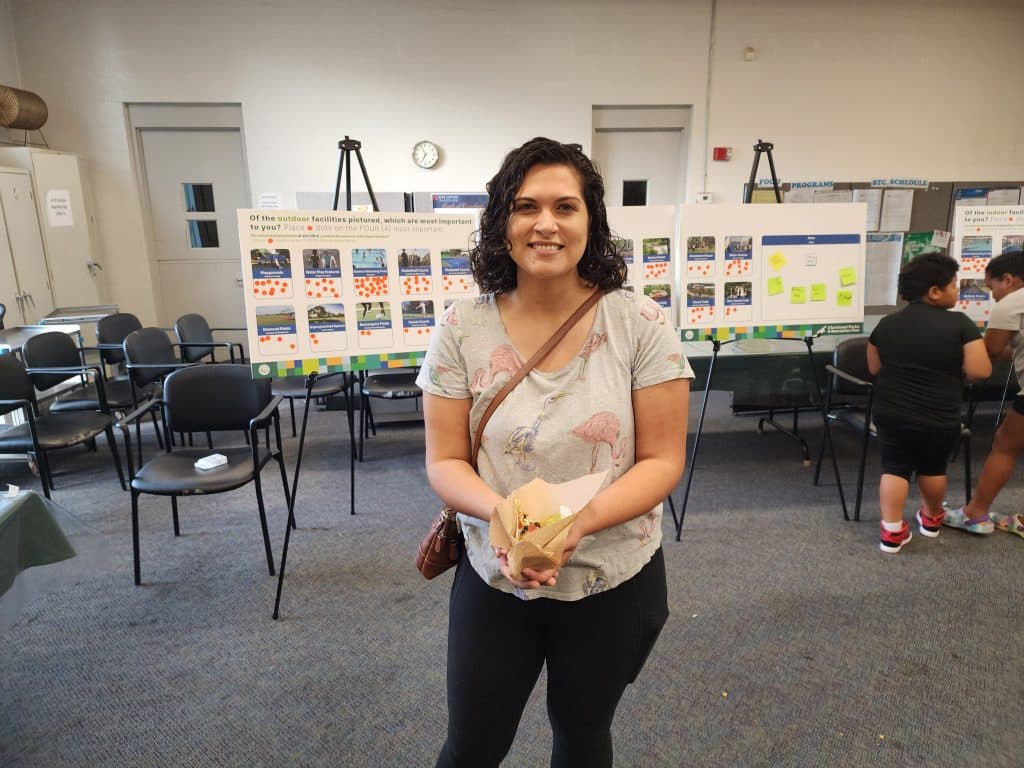
Each location that held an event featured informational boards where residents could place dots or sticky notes to note their preferences and opinions. “We have boards to see what amenities they like in the parks,” Rauschenbach said. “We have boards that talk about what they don’t like in the parks. We also want to know who we’re talking with. We want to know how they travel to parks – are they walking, biking – or the other ways they access the parks.”
Ward 17 council member Charles Slife said that he gets calls about all sorts of city services, but that calls about parks and recreation top the list. “What people want are high-quality parks that are well-maintained, keep people in the neighborhood, bring in new residents, and keep people aligned with the level of pride we have in our neighborhood,” he said.
As for the MOCAP initiative, Slife says that he is excited to hear what people want, and to see how that shapes the future of parks and recreation in the city.
Voices from the community
The Land attended several open houses to see the planning process firsthand and learn what residents want in their parks.
Cathy Kortyka, a member of the Rocky River Watershed Council, shared that she’s interested in finding out what the city’s overall goals are when it comes to parks and recreation planning. “I’m very interested in preserving the wetlands in some of these park-planned areas,” she said.
Gloria Smith, who lives close to Zelma George Recreation Center in the Mt. Pleasant neighborhood, said that her recreation center is a place where she enjoys life after her retirement. “I love Zelma George Rec Center,” she said. “I come here twice a week, and sometimes when it’s something special going on, I come to that as well…It’s a lot of nice people here, everyone loves everybody, and we’re all on a first-name basis. We help each other out.”
Ward 4 council member Deborah Gray said that Zelma George is hugely important. “It’s the main hub that everyone loves to come to since it was built in 1997,” she said. “They have a lot of programs offered to the senior citizens, teens, and young adults. It’s something going on every day.”
Gray said that she’s standing up for recreation centers in every ward throughout the city. “I believe in all recreation centers and their need to stay open,” she said. At the same time, Gray said, the parks and rec master planning process is important because times are changing. “We need new programs, we need new and fresh services and activities so the citizens will continue to come,” she said.
The turnout at Zelma George and other venues was robust, with hundreds of people turning out to comment. The council member took time to look around the room at community members eagerly participating in the process. “You see how many people came out for this in the early afternoon?” she commented. “I am so impressed to see people of all ages coming out to be part of the change and be engaged with what they want to see, and I love it.”

Bringing expertise together with community voices
Sanders said that one of OLIN’s strengths is their outside perspective and their ability to suggest that things be done differently. “We’re here to inspire and challenge,” she said.
Andrew Dobshinsky, a planner and associate at OLIN, said that he is excited about working in Cleveland because the city has never done a parks and recreation plan like this before. “The open house process is absolutely a great way for us to have people drop in and chat with us and find out what they’re looking for,” he said. “We get to find out what’s on their mind, what the city can be doing better, what the city already does well. We want to hear all of it.”
The goal is to make sure that the city gets feedback from diverse groups that are representative of the community, including teens at Camp Forbes (a free summer camp for youth run by the city), where OLIN collected input at workshops. “They’re going to be the ones who grow up and use the spaces as adults, so it’s important for us to reach out to them,” said Dobshinsky.
One open house participant, Tania Benites, said residents need to show up and provide their feedback if they want to see improvements. “Events like this are important because this is our chance as community members to make our voices heard,” she said. “We can complain all day about what we would like to see happen, but when events like this happen it’s in our hands to make a difference, get some ideas going and maybe get [those ideas] to the right people.”
To share feedback as part of Cleveland’s parks and recreation master plan, visit www.cleparksrecplan.com.
Keep our local journalism accessible to all
Reader support is crucial as we continue to shed light on underreported neighborhoods in Cleveland. Will you become a monthly member to help us continue to produce news by, for, and with the community?
P.S. Did you like this story? Take our reader survey!