A new book examines the lives and decisions of the Van Sweringen brothers – including their impact on public transit in Northeast Ohio, their vision in creating an exclusive suburb for Cleveland’s wealthy, and more.

Lauren R. Pacini has been fascinated by the Van Sweringen brothers for decades. As a boy, he was captivated by their stately home in Shaker Heights. Now, he’s dedicated to understanding their impact on the development of Greater Cleveland.
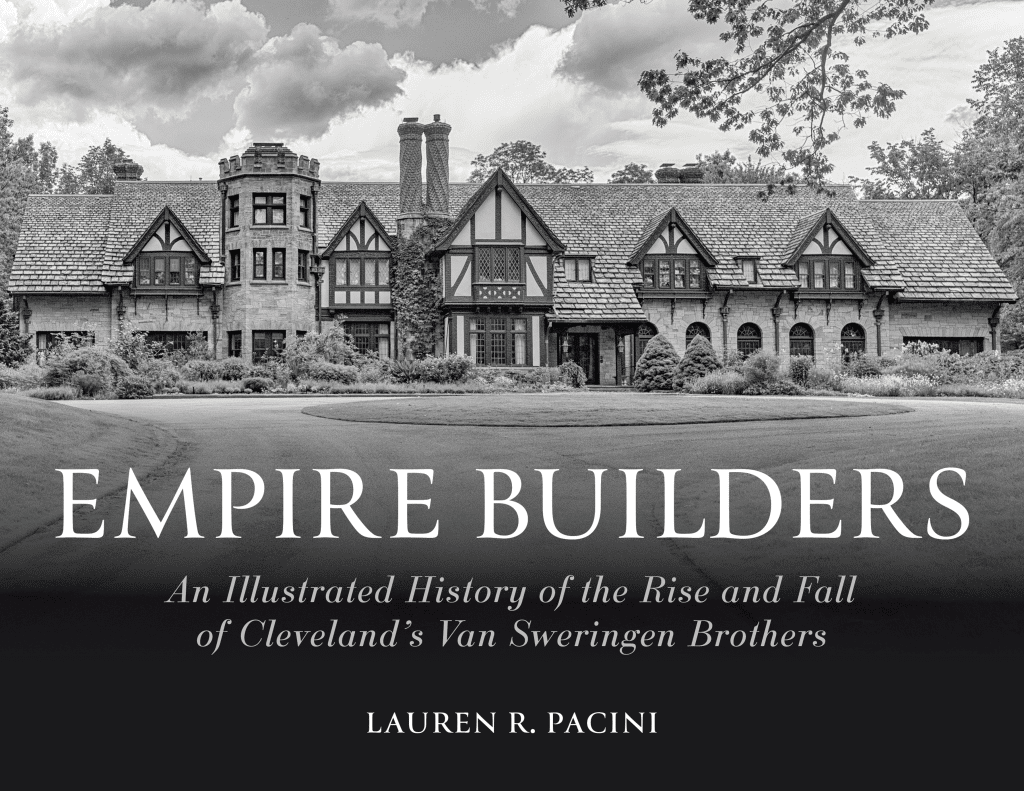
In his new book, “Empire Builders: An Illustrated History of the Rise and Fall of Cleveland’s Van Sweringen Brothers,” Pacini examines the lives and times of the two brothers – who primarily went by their initials OP and MJ – dispelling lingering myths and delving into their eccentric but impactful careers.

The Land sat down with Pacini to discuss his book and why the Van Sweringens are of vital interest to Clevelanders today. After the interview, we’ll share an excerpt from “Empire Builders.”
The Land: You mention in the introduction to your book that one of the unique challenges of writing a biography of the brothers is they were extremely private. They didn’t have a lot of personal recordings – be that notes, diaries, journals,etc. How did you work around that to tell the story of their lives?
Lauren R. Pacini: And that is very true. They hired a publicist at one point and after he’d been on the job for a while, he went, hat-in-hand, to OP, apologizing for not getting any publicity. And OP said, “Well, that’s your job…to not get publicity.”
So how did I prepare the book? Well, in part, I spent a lot of time digging through the archives of the Shaker Historical Society and the Western Reserve Historical Society.
The Western Reserve Historical Society had a piece in it that was really an eye opener. Raymond F. Blosser [one time bureau chief of the Associated Press in Cleveland], who I quote, and cite frequently throughout the book, was himself a hopeful biographer [of the Van Sweringens]. However, his biography was never published. It didn’t even have a title, but it is in its entirety at the Western Reserve Historical Society.
So Blosser really gave me a lot to then go out and fact check and try to pull pieces together. If not for Blosser I probably would have been in serious trouble. People draw conclusions about them because [the Van Sweringens were] a little eccentric maybe. Aren’t we all? I don’t jump into the rumor mill and I often find that the rumor mill really had it all wrong. Not always but a lot. So, having Blosser’s journalistic view was a really big help.
TL: If you had somebody who was new to the region, who knew nothing about Cleveland or its inner-ring suburbs or their development, how would you summarize the impact of the Van Sweringen brothers?
LP: Well in a lot of ways – with all apologies to John D. Rockefeller – I think the Van Sweringens put Cleveland on the map. They really contributed to making Cleveland a much better city. Cleveland was at a crossroads at the end of the 19th century. It had been one of the wealthiest cities in the country, but the glow of Millionaire’s Row was diminishing. It was time for those families to move on.
Most of the people on Millionaire’s Row were the industrialists behind the companies in the Flats or the bankers funding them. Their successes were driving them out of their own homes because of the stench and the pollution. So, what did the [Van Sweringen] brothers do? They created a garden community outside of Cleveland. It was an attraction for wealthy Clevelanders who hadn’t already moved out of the city. It gave those residents an early promise of a 15-minute transit from their homes to their offices in Public Square.
TL: What were the obstacles the Van Sweringens had to overcome during their endeavors?
LP: There was a two-mile gap in the plan connecting Shaker Rapid Transit to Terminal Tower. They tried to negotiate with New York Central Railroad and New York Central wouldn’t negotiate. But New York Central did sell them a 513-mile railroad, which the Van Sweringens took off and ran with. They developed the $130 million Cleveland Union Terminal Complex, which went a long way to changing the complexion of Cleveland.
TL: What do you hope readers take from this book?
LP: I would hope that they see the brothers as two very dedicated, hardworking, visionary men who would stop at nothing to deliver what they thought was best. In a lot of ways, certainly Shaker Heights, definitely the east side of Cleveland, and Greater Cleveland as a whole, benefited from the fact that the Van Sweringens lived here.
Now, with permission from Indiana University Press, an excerpt from “Empire Builders: An Illustrated History of the Rise and Fall of Cleveland’s Van Sweringen Brothers.”
Cleveland, The Early Days
Cleveland was founded in 1796 when General Moses Cleaveland, a veteran of the American Revolution and one of thirty-six founding investors in the Connecticut Land Company, led a surveying party from Canter-bury, Connecticut, to the Western Reserve, a part of Connecticut’s old colonial claim.1 The land was divided into five-mile square townships, including Cleveland Township, East Cleveland Township, Euclid Town-ship, Newburg Township, Bedford Township, and Warrensville Town-ship. Cleveland Township was laid out around a ten-acre town commons and smaller lots, where homes would be built. The remaining townships were divided into one-hundred-acre lots suitable for farming. The surveyors also recorded the natural resources, including details about the terrain, trees, plants, animals, and water, before returning to Connecticut for the winter.
Although Moses Cleaveland remained in Connecticut, the rest of the surveyors returned the following year. With them were Lorenzo Carter and Nathaniel Doan. Carter became Cleveland’s first permanent settler, building a small log cabin, and later a larger one on the east bank of the Cuyahoga River that would serve as a hotel and tavern, a town hall, a jail, and an informal religious meeting house. In 1802, having bought more than twenty-three acres of land, Carter began to build the first frame house in the village, but it was destroyed by fire before the construction was completed.
Doan, a blacksmith, who oversaw the livestock during the journey to the Western Reserve, would return to Connecticut with the surveying party for the winter, returning with his wife and six children in 1798. The following year, he purchased a one-hundred-acre lot near the intersection of a trail and a brook, five miles to the east of the public commons that we know as Public Square—where he first set up a blacksmith’s shop, followed by a hotel and tavern, a store, and a saleratus (sodium bi-carbonate) factory. The trail, a part of the historic Native American Lake Shore Trail, would become known as the Buffalo Road that extended from Buffalo, New York, to Detroit, Michigan. In 1825 it was renamed Euclid Street, and in 1870, Euclid Avenue. The brook would be named Doan Brook, as it remains known to this day. In 1906, when the Cleve-land City Council adopted an ordinance changing north–south street names to numbers, and houses were renumbered accordingly, Doan Street became East 105th Street. Contemporary street names will be used once the historic names have been introduced.
Settlement in the Western Reserve was not for the faint of heart. On June 3, 1797, David Eldridge died while attempting to cross the Grand River with his horse on his way to Cleveland. He was the first known European to die in the Western Reserve and to be buried in what be-came known as the Ontario Street Cemetery, south of Public Square. He was joined that year by William Andrews in July and Peleg Washburn in August, both succumbing to dysentery. Eldridge’s remains were re-located to the Erie Street Cemetery in 1835. Located on the east side of East 9th Street, between Erie Court and Sumner Avenue, and extend-ing to Brownell Street (East 14th Street), Cleveland’s second cemetery had been established in 1826, replacing the original community burial ground.
Following the opening of the new cemetery, the remains of unknown pioneers were relocated from the Ontario Street Cemetery to a common grave on East 9th Street, later marked by a bronze plaque placed by the Early Settlers Association of the Western Reserve in 1946. Other early pioneers buried in the Erie Street Cemetery included Lorenzo and Rebecca Carter and John W. Willey, Cleveland’s first mayor. Willey’s remains have since been relocated to Lake View Cemetery in East Cleveland, although the original headstone remains in the Erie Street Cemetery.
The first recorded deed in the records of Cuyahoga County documents that on April 14, 1808, Timothy and Mary Burr of Hartford, Connecticut, conveyed 260 acres of land in Tract 8 in Cleveland Township to Timothy and Maria Beardslee Burr for $260. The deed was recorded in book 1, on page 1, on July 14, 1810. Page 2 of the same book shows that the State of Connecticut, Andrew Kingsbury, Treasurer, conveyed 5,320 acres in “Township No. 6”—Rockport Township—to Ephraim Root of Hartford, Connecticut, on April 7, 1810, as recorded on July 20 by John Walworth.
By 1814 there were more than a dozen log cabins along a four-block section of Euclid Avenue beginning at Public Square. Some of the cabins doubled as businesses, including a brewery, stone yard, carpenter’s shop, and doctor’s office. In 1819 Rufus and Jane Pratt Dunham arrived in the Western Reserve from Mansfield, Massachusetts. On May 14, 1824, they purchased 23.63 acres on Euclid Avenue for $147.68. By 1827 they had in-creased their holdings to nearly eighty-two acres. They began to build the north portion of the structure at what is now 6709 Euclid Avenue, and known as the Dunham Tavern Museum and Garden, likely completing it in 1832. That was followed by the main block of the home immediately to its south. By 1838, with the addition of the west wing, the house looked very much as it does to this day. The frame house served as their home and a tavern for weary travelers on the Buffalo Road.
Cuyahoga County records show that the Dunhams initially moved to sell their home and its immediate surrounding acreage to the Wil-bur family, relatives of their son-in-law James S. Welch. Title transfer complications ensued, resulting in the sale of the property instead to Cleveland banker George Williams and his wife Mary for use as a private residence in October 1857. The nearly two-hundred-year-old home has had remarkably few owners. It remained in the Williams family until 1889 when George Williams died; Dr. James A. and Oriana L. Stephens then acquired the property, making it their home until Dr. Stephens’s death in April 1930.
In 1932 landscape architect A. Donald Gray rented the tavern from the doctor’s widow, restoring much of the building and replanting the orchard. For a time, the tavern served as a studio for artists and printmakers sponsored by the Works Progress Administration. On December 24, 1936, Mrs. Stephens sold the property to Dunham Tavern, Inc., funded in part by a gift from Mrs. Benjamin P. Bole, who had grown up on the “most beautiful street in America,” in a mansion designed by Levi T. Scofield and built in 1875 at 7809 Euclid Avenue. Today the Dunham homestead is the oldest structure on its original foundation in Cleveland, thought to be the first structure east of Willson Street, now known as East 55th Street.
To learn more or to order “Empire Builders: An Illustrated History of the Rise and Fall of Cleveland’s Van Sweringen Brothers,” visit artographypress.com or iupress.org.
Keep our local journalism accessible to all
Reader support is crucial as we continue to shed light on underreported neighborhoods in Cleveland. Will you become a monthly member to help us continue to produce news by, for, and with the community?
P.S. Did you like this story? Take our reader survey!