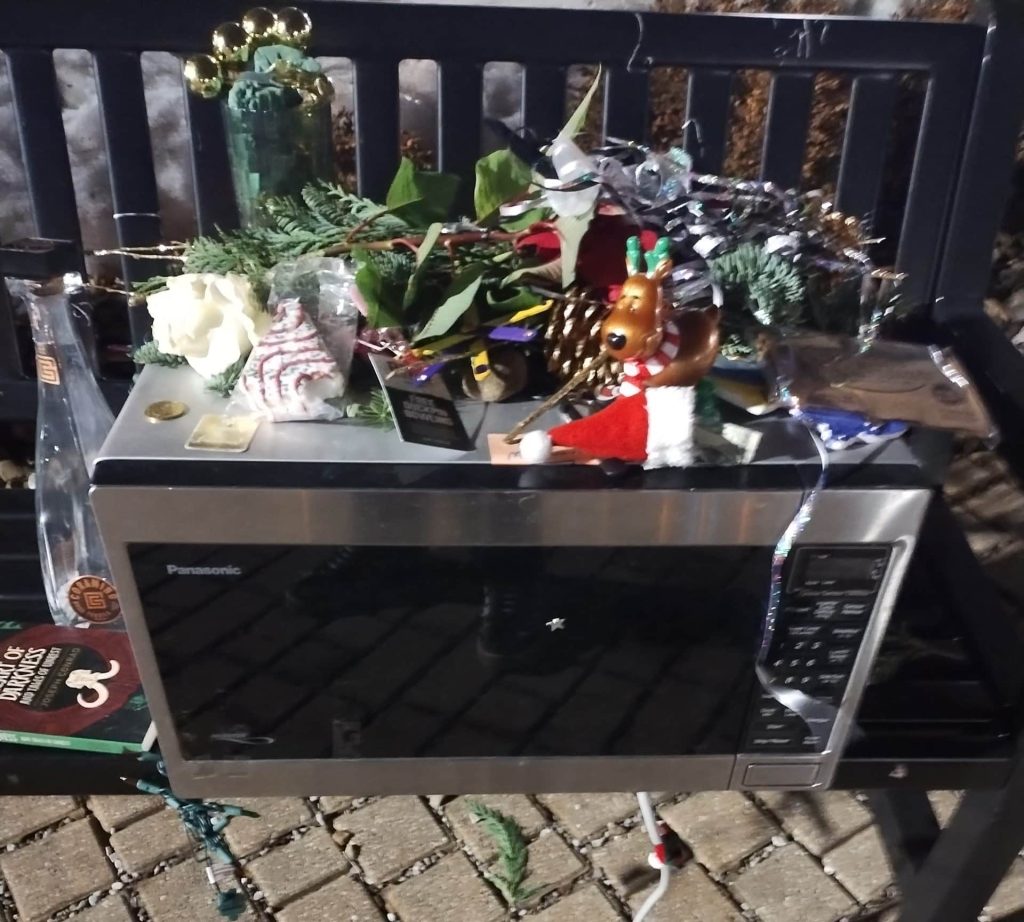
At some point in the last couple of weeks, as the snow started melting in Northeast Ohio, someone noticed a microwave sitting on a bench outside a Starbucks on South Green Road in South Euclid.
No explanation. No sign.
Just a microwave.

Outdoors.
On a bench.
Word spread the way these things always do now, quietly at first through photos and confirmed sightings, then faster, until it became clear that people were deliberately not sharing the exact location. Not out of secrecy, exactly, but out of preservation. The microwave had become a thing.
Why did it become a thing? Because a group of random strangers on the internet decided it was one. And like all good things, it felt fragile. It felt as if, once spoken about too loudly, it would vanish as quickly as it appeared.
But people showed up for the microwave. They brought gifts. They wrote wishes on scraps of paper and slid them inside. They posed for photos. Someone put a video game inside of it for a kid to open and find. Some treated it like a shrine. Others treated it like a joke. The honest-to-God truth is that it was both. A shrine to an absurd occurrence that, for a brief moment, everyone seemed to be in on. That kind of organic, shared understanding is a rare thing to find out in the wild.
I eventually found it by studying photos and landmarks like I was tracking a rare bird or a fugitive. I’m not especially whimsical these days. I’ve become pricklier, more guarded, and less inclined to believe that random public objects are imbued with meaning. But when I found it, sitting there looking at a microwave that absolutely should not have been there, I felt something soften a little bit.
The thing about a microwave is that it’s aggressively ordinary. It’s not art. It’s not clever. It almost certainly didn’t even work anymore. I saw a little bit of myself in that microwave. It made me wonder how it got there in the first place and how something so unimpressive made this strange little journey. It’s just a box designed to make leftovers slightly too hot on the outside and still cold in the middle. And yet there it was, pulling people out of their cars and routines and apartments, asking nothing of them except a few seconds of attention.
It was around 9:30 on a Saturday night when I made my pilgrimage. While I was there, I met a woman who had immigrated from Russia nearly three decades ago. We talked because the microwave made it easy to talk. It gave us permission. Two people from insanely different backgrounds and cultures, who started their lives thousands of miles apart, ended up in front of the same bench, staring at a microwave that didn’t belong there.
She told me how excited she was to have found it and how delighted she was that something so silly had pulled people together. She said she hadn’t seen the community come together like this in the 29 years she’d lived here.
It struck me how low the bar has become for connection, and how that low bar reveals how little it actually takes to bond with another person. No institution organized this. No one monetized it. There was no cause attached. Just an object abandoned, and a collective decision to treat it kindly.
I left without taking anything. I didn’t make a wish for the microwave to grant. It had already done its job. It gave me a brief, unexpected holiday moment that didn’t involve buying something or pretending to feel a certain way. It gave me a conversation I wouldn’t have had otherwise.
The microwave is gone now. It got moved sometime Monday morning, and who knows where the next stop on its journey will be. But for a brief moment, it existed, and it turned us into neighbors.
That’s pretty good for a microwave.
Keep our local journalism accessible to all
Reader support is crucial as we continue to shed light on underreported neighborhoods in Cleveland. Will you become a monthly member to help us continue to produce news by, for, and with the community?
P.S. Did you like this story? Take our reader survey!