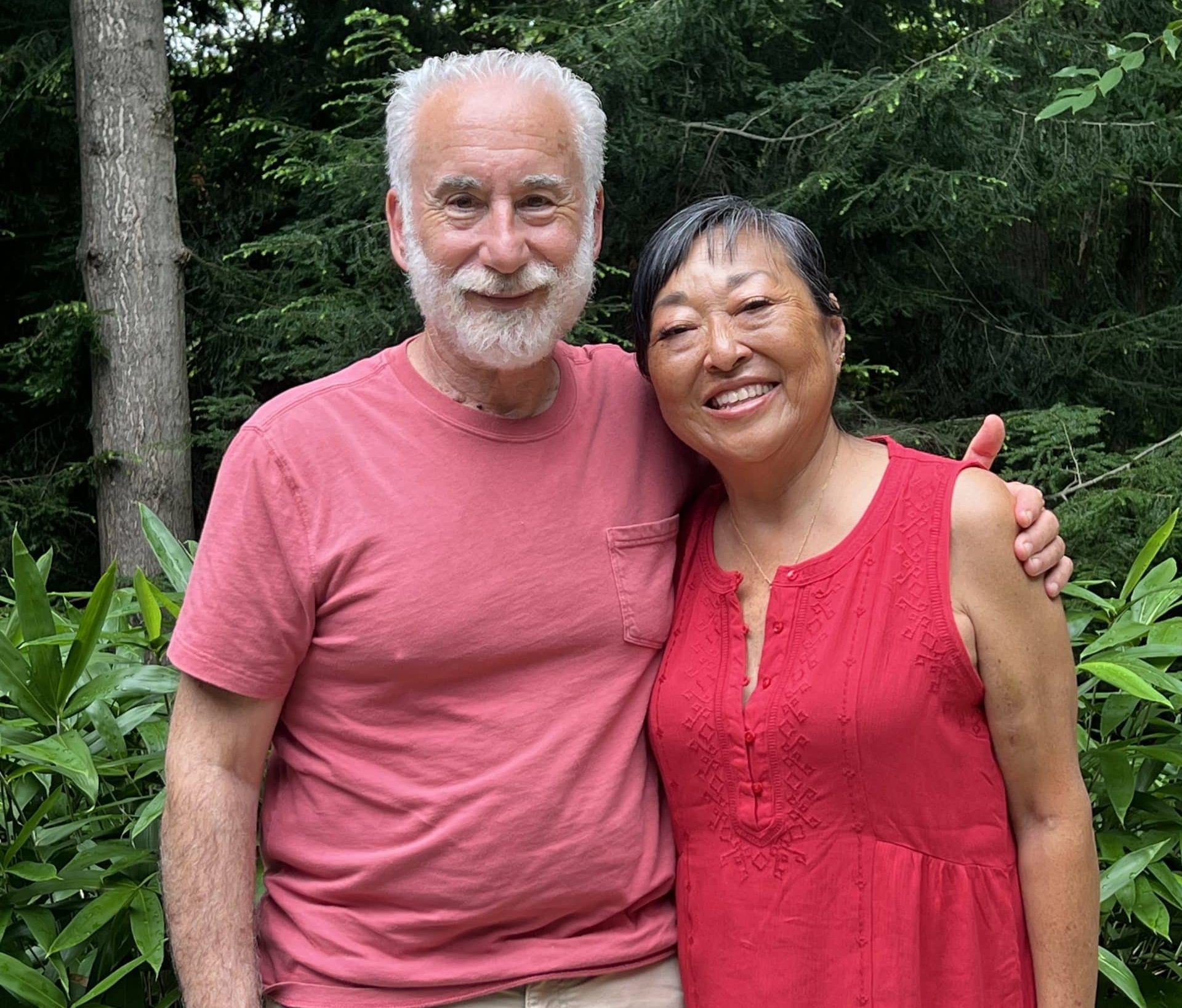
Jim Sollisch has led what he calls an “ordinary” life. Yet, even in the everyday, magic can be found. Sollisch discovered this firsthand when compiling How Donating a Kidney Fixed My Jumpshot, an essay collection that reveals the extraordinary circumstances within the daily grind.
Sollisch leads the life of a working writer, with personal essays and columns published in nearly every major U.S. outlet – his musings on parenthood, politics, sports and Judaism are archived in the New York Times and Wall Street Journal, among other highly-read outlets.
Now in book form, the collection’s main draw is likely the titular story: Sollisch’s kidney donation to a colleague at Marcus Thomas Advertising, where he’s been a copywriter for 37 years. Though the Cleveland Heights resident feels a sense of pride for all 74 collected essays, the career ad man knows the value of a strong hook.

“The (kidney story) is the most interesting headline of any of the 74, so let me start there,” says Sollisch, whose book is available online as well as at various area independent bookstores. “That might pique a wide range of attention. It’s a little clickbaitish, but I kind of liked it. How can I build on that?”
While the kidney essay is the book’s centerpiece, it’s the parenting pieces that seem to have the most lasting resonance. Sollisch read his column “Fruitful Questions” – a treatise exploring fruit, philosophy and child-rearing – on National Public Radio before being published in the Chicago Tribune.
Otherwise, Sollisch organized the book into nine main themes, including a “rants and riffs” section that gathers thoughts not fitting elsewhere. Eliciting a lightbulb moment among readers is the larger goal for each piece collected in the volume, he says.
“My theory is that you should write until you surprise yourself, or make a connection you didn’t expect,” says Sollisch, 67 “All of these essays have that little ‘a-ha!’ moment.”
A selfless gesture
Let’s get that spoiler out of the way: Sollisch gave a kidney to his friend Joanne Kim in 2012, motivated by camaraderie and the experience of someone else he knew who made a similar gesture.
“My friend Paul Ernst donated a kidney to a friend of his a couple of years ago” Sollisch writes. “I watched him go through the experience with ease and grace. So when one of my friends,
Joanne Kim, needed a kidney, I thought, ‘If Paul can do it, maybe I can do it.’”
Kim, now retired from Marcus Thomas after 30 years as the agency’s chief creative officer, was diagnosed in 1990 with IgA nephropathy, a disorder that would eventually drop her kidney function to 7%.
Needing a transplant, Kim found 11 matches among her family and friends. Kim thought she had a donor lined up, but when that individual was discovered to have a fatty liver, Sollisch’s offer to donate his own organ became vital.
“Jim said he’d be next, and I said, ‘Are you sure about this?’” says Kim. “He told me the story about a friend who gave a kidney, and said he had a golden kidney that would last me until I’m 95. It goes back to his generous personality, and the way he cares for people. He’s just very selfless in a lot of ways.”
Nor would the friends allow such a gesture to change their relationship, adds Kim, who also praises Sollisch as an insightful and humanistic writer.
“Both of us were very practical, and said this wouldn’t affect us in any way,” Kim says. “I always admired his work as an advertiser, but it wasn’t until I got to know him that I realized he was a great editorial writer. (The book) is a great legacy to pass on to his kids and grandkids.”
It’s all right here
During his wayward 1970s youth, Sollisch’s main pursuits were writing and basketball, with Bob Dylan and Simon & Garfunkel among his inspirations on the creative side. After majoring in English at Kent State University, Sollisch taught freshman comp for seven years at the University of Akron.
Needing steadier work to support a growing family, Sollisch landed a copywriting job at the Jayme Group, starting an advertising career he’s still active in three decades later. Although he had a few novel manuscripts in the can, the time-consuming duties of work and fatherhood pushed Sollisch to short-form writing. Next came essays on family, sports and politics that found traction in The Plain Dealer and Cleveland Jewish News.
When a friend suggested Sollisch pitch his writings to national publications, he had no idea where to begin. Sollisch found his path with the help of a handy editor’s guide – he faxed an essay to the Chicago Tribune, and soon found his words before a million readers.
“I became fixated on that style of writing,” Sollisch says. “It was like an instant rush, so I just shifted from writing long-form to short-form.”
Sollisch resisted the idea of a book for years, believing there was no market for an essay collection from a non-famous person. Still, the appeal of leaving written reflections for his family could not be denied, leading him to pare down about 350 essays into a more digestible format.
Among Sollisch’s personal favorites is “Cooking is Freedom,” a food-centric column and his very first piece published in The New York Times. “How Donating a Kidney…” may never become a best-seller, but the examination of a regular life is a fine legacy to leave, he notes.
“I want people to take away the fact that there’s fascinating things in an ordinary life,” says Sollisch. “You don’t need a trip to Thailand. All you need to lead an interesting life is right here.”
Keep our local journalism accessible to all
Reader support is crucial as we continue to shed light on underreported neighborhoods in Cleveland. Will you become a monthly member to help us continue to produce news by, for, and with the community?
P.S. Did you like this story? Take our reader survey!