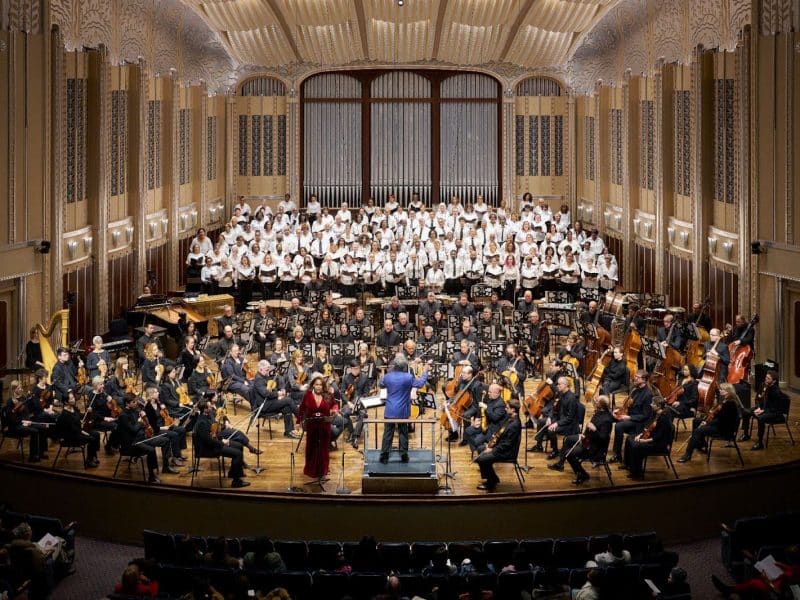
In September of 2023, ClevelandClassical.com celebrated its fifteenth anniversary as the local web journal of classical music in Cleveland.
It all began when Daniel Hathaway, who retired in 2008 as music director and organist at Trinity Cathedral Church in Cleveland’s Campus District, hit upon an idea for what to do next. As a musician and concert organizer himself, he had become frustrated that print media were largely ignoring classical music, a genre patronized by thousands of listeners in the region. He decided the time had come to start a one-stop source for classical music information online.
His frustrations were shared by his colleagues and peers throughout NE Ohio, many of whom felt, like Hathaway, that “unless you were one of the handful of major presenters or performing arts organizations, your chances of receiving advanced publicity – much less a critical accounting after the fact – were nil.”
Using a rudimentary web application, Hathaway created a two-week concert calendar and sent it to colleagues and contacts in his address book. On September 15, 2008, ClevelandClassical.com was born.

The response was immediate and overwhelmingly positive.
“You are filling an incredible void in this community. I feel you are the only voice championing classical music,” one person wrote.
“I’m devoted to your calendar!” said another.
“Northeast Ohio has needed something like this for years!”
Attracting additional writers and technical help became a concern as the basic calendar format blossomed to include concert reviews and features, as well as a diary of historical and current events. By the end of the 2009 summer season, a handful of writers had joined the ranks, and that fall, Mike Telin – who now serves as Managing Editor – came on board to write concert previews and features.
“It’s become more than I conceived of fifteen years ago,” Hathaway said. “We were always meant to be an alternative to other sources of news. But now I think we’ve become a primary source, as we’ve moved into reviews, previews and news coverage. Fifteen years ago, it really was intended just to be a calendar listing, and we’ve evolved to fit the needs of the community.”
Hathaway and Telin joined the Music Critics Association of North America, the professional organization of music journalists and critics. Back then, the landscape for classical music coverage in Cleveland was a little bleak. The Cleveland Plain Dealer had just released its one full-time music and dance critic, and publicity or after-the-fact coverage was negligible.
According to Tim Beyer, founder and artistic director of no exit, a professional new music ensemble, “There was no coverage of most arts organizations before Cleveland Classical — no press and no interest.”
“I don’t remember ever not writing.”
So, how did the Cleveland Classical team learn music journalism?
“I don’t remember ever not writing,” said Hathaway. “My mother had stories published in national magazines, and when I was in, I think, the fourth grade, I published a little neighborhood news rag called The Inquiring Reporter which I copied on a hectograph. Kansas Historical Society still maintains all the file copies!
“I also wrote editorials for the Topeka High School paper, The Tower, and features for the Harvard freshman magazine, The Yardling, but I never formally studied journalism,” he added. “Performing musicians constantly find themselves writing — press releases, program notes, grant applications — and I learned by imitating the writing of others. I expect that my experience of learning by doing isn’t that unusual.”
“When I was 16, I found a mentor in Don Rosenberg (former music and dance critic of the Cleveland Plain Dealer) — he and I have been friends ever since,” Telin recalls. “I was working in the Circulation Department at the Akron Beacon Journal and one day I walked into the canteen — there was Don Rosenberg getting a ham and cheese sandwich. I said, ‘Hi, I’d like to learn. I read you all the time.’ And we just sat and talked.”
“And it’s reading,” Hathaway added. “You need a mentor as a writer, but above all, just read, find somebody you admire and read.”
“Our intention was always to be local.”
As for the scope and format of Cleveland Classical, there were precious few models to look to nationally.
“I don’t think there’s another source quite like ours, even now,” said Telin. “If you think about other markets, like New York, Chicago, LA — they still don’t have anything similar.”
Classical Voice North America (https://classicalvoiceamerica.org/), the official web journal of the Music Critics Association of North America, had not yet been formed in 2008, and San Francisco’s Classical Voice and Classical Voice of North Carolina, though valuable models, were still in their infancy.
“Our intention was always to be local, said Telin. “Which is why, you know, many times people along the way have said, ‘Well, there’s nothing like this in Detroit. Why don’t you become a franchise?’ Well, that’s straying away from our mission.”
Aside from their stated purpose, “to support and advance classical music in Northeast Ohio through information, advocacy, and education,” there have been other impacts as well.
A bond between amateur performers and concert goers has been a local characteristic of Cleveland for many years — enhanced in part by Cleveland Classical’s broad and consistent coverage.
Toni Miller, who has played violin in various community orchestras including the Cleveland Philharmonic, Women’s Philharmonic and Heights Chamber Orchestra for nearly 60 years, waxes effusive on this point:
“When I go to a symphony concert, I know about three hundred people because I’ve been sitting by them for 60 years,” Miller said. “There’s a music community here — people who have a mutual interest in classical music. There’s really a spiritual, almost religious connection, like a church congregation. I’m grateful to Cleveland Classical for bringing a lot to my attention that I wouldn’t have access to otherwise.”
Planning with your community, not for it
In addition to classical music, there is a surprising breadth of music genres represented on Cleveland Classical’s pages. Recent reviews have included commentary on the Boars’ Head Christmas festival, jazz and world music at the Cleveland Art Museum, even silent film — and its attendant live musical accompaniment.
“Programming has to be done in a way to attract people who don’t go to concerts regularly, or who have never been to concerts before, and it has to be done in a way that engages — doesn’t repel — the public,” said Telin. “I’ll tell you the classical music scene of the past was very slow at adapting the philosophy of ‘Don’t plan for your community, plan with your community.”
Hathaway added, “And that is why we go out of our way to list so many types of performances and organizations; it’s why we spend so much time on our calendar. We also have a place on our website where you can enter upcoming concerts that we may not yet have listed ourselves.”
Teaching at Oberlin
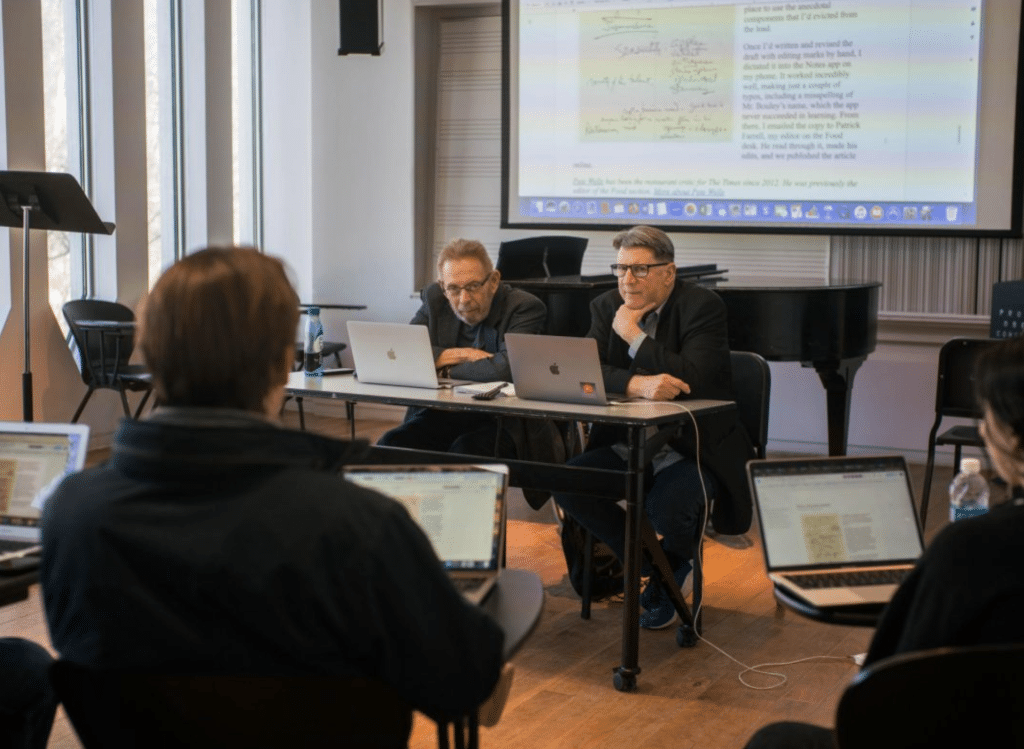
In 2008, Hathaway and Telin were hired at Oberlin Conservatory to teach as part of the Rubin Institute for Music Criticism. After the Rubin Institute moved to San Francisco in 2011, they continued to educate Oberlin students in music journalism courses with a grant from the Getty Foundation.
“Basically, we were hired to start this music journalism class and it became popular among the students – and the faculty seemed to support it as well,” Telin said. “So, they asked us to stay on, and we’ve just never left. In fact, we’ve expanded the class over time, and I love it. I just love it.”
“It’s fun to see how young people who love music react when they have their first little mini argument over this and that,” Hathaway added. “‘You like this band? Why?’ It’s a discourse. It’s a public discourse going on, and later, seeing them put those thoughts on the page, is really satisfying.”
What makes a good music critic?
“‘Critic’ is more a 19th century term,” said Telin. “I differentiate between ‘music critic’ and ‘music journalist.’ In fact, I don’t consider myself to be a music critic. I consider myself to be more of a journalist. Criticism is part of journalism, but that’s not the hat I wear solely.”
“Knowledge of music and an ability to write well go into it, but it’s also being an enthusiast about your subject,” Hathaway added.
Hiring writers
“We’ve always come down in favor of people who have some performing experience rather than possessors of ‘a disc of audio files,’” said Telin.
“I think you need to be able to approach writing from an informed perspective, which means that you need some (musical) training,” Hathaway elaborated. “Those are the people who have been interested in writing for us, anyway. We never put (performance experience) out as a prerequisite for trying them out; it has just tended to work out that way.”
One area that remains a challenge, though, is representation.
“Over the years, we’ve had so many great writers,” Telin said. “All publications are only as good as the people who are part of you. But our ratio between men and women still skews towards men. Women have come, as have people of color, but you know, that’s something we still need to improve. It’s like performing music by under-represented populations. I am a firm believer that the more voices and perspectives you have at the table, the better the publication is going to be.”
Classical music as a local asset
Coverage of classical music in Cleveland is a long-prized, well-loved asset, especially when it comes to the highest profile organizations such as The Cleveland Orchestra, the Cleveland Institute of Music, Cleveland Museum of Art performances and the various star-studded chamber music series around the city. But just as assiduous has been coverage of lesser lights, tucked away in neighborhood churches, colleges and recital halls. In this way, Cleveland Classical has been an agent of neighborhood vitality. The price of entry is either free or none at all, thus broadening participation in, and enjoyment of, concert-going by every economic and geographical sector in the city.
“We have always wrestled with the problem of ‘how do we find the people who aren’t reading us?,’” said Telin. “One way has been to hire a person to handle social media outlets — Erika Aoki. You need those kinds of things — that is how younger people are getting their information. I wish we could get our name and every program that’s out there. How you attract new people is still a lot about word of mouth through social media.”
Accomplishments
Cleveland Classic started publishing the “Daily Diary” feature – a daily listing of news items and announcements – during Covid, when there weren’t a lot of live performances to preview or review.
“I’d always been looking for a place to stick little pieces of news that we didn’t have time to write an article for, or that didn’t seem to require an article,” said Hathaway.
Enter Jarrett Hoffman.
“We cannot say enough about Jarrett. I don’t know where we would be without him,” said Telin.
Jarrett came on to write for Cleveland Classical as a student, “And he’s never left,” said Telin. “His life has taken him to graduate school, to marriage, to his own career as a clarinetist. But he’s never left Cleveland Classical.”
“Hoffman comes up with things even before press releases come out on them. I’d like to know how he gets this information (which is all documented). I think he just subscribes to every RSS feed possible!”
What success means
“I always see it in two ways. There’s the daily and the weekly success,” Telin said. “You know, some weeks are better than others, but that’s what you always strive for. Also, to include something that we’ve never written about before is a measure of success. And the ultimate measure of success is making sure that Cleveland Classical continues after us.
“It’s impossible for me to say that I am successful. It’s not in my nature. More successful than not, maybe,” he added. “But I’m sure, wherever my mother is right now, she’s still thinking I’m not successful. I will go as far to say, I am very proud of what we’ve accomplished, and I am thankful for all the great people that have advanced Cleveland Classical since its founding.”
“Goals are interesting when you do what we do. Our plan needs to be nimble enough to move with changes around us,” Hathaway said. “New things are popping up all the time. There are some groups here that have come about in the past couple of years – with whom I would love to be able to establish a relationship. We need to find a way to make sure that we’re doing an article on the new people that are coming in.
“And so, there’s always a balancing act. I wish everything had just remained the same as it was,” he added. “You know, in the field … we had one major paper in the city that had a couple of full-time music writers that could go out and do this, and we could spend all of our time burrowing into the landscape of the lesser known things. So you know, you’re always keeping your ear open to collaborative efforts. And nobody, very few people, will ever refuse the opportunity to have something written about them.”
We're celebrating four years of amplifying resident voices from Cleveland's neighborhoods. Will you make a donation to keep our local journalism going?