John Ewing helped launch the Cleveland Institute of Art’s Cinematheque in 1986. After nearly 40 years, he will say goodbye to the Cleveland film community on June 30th.
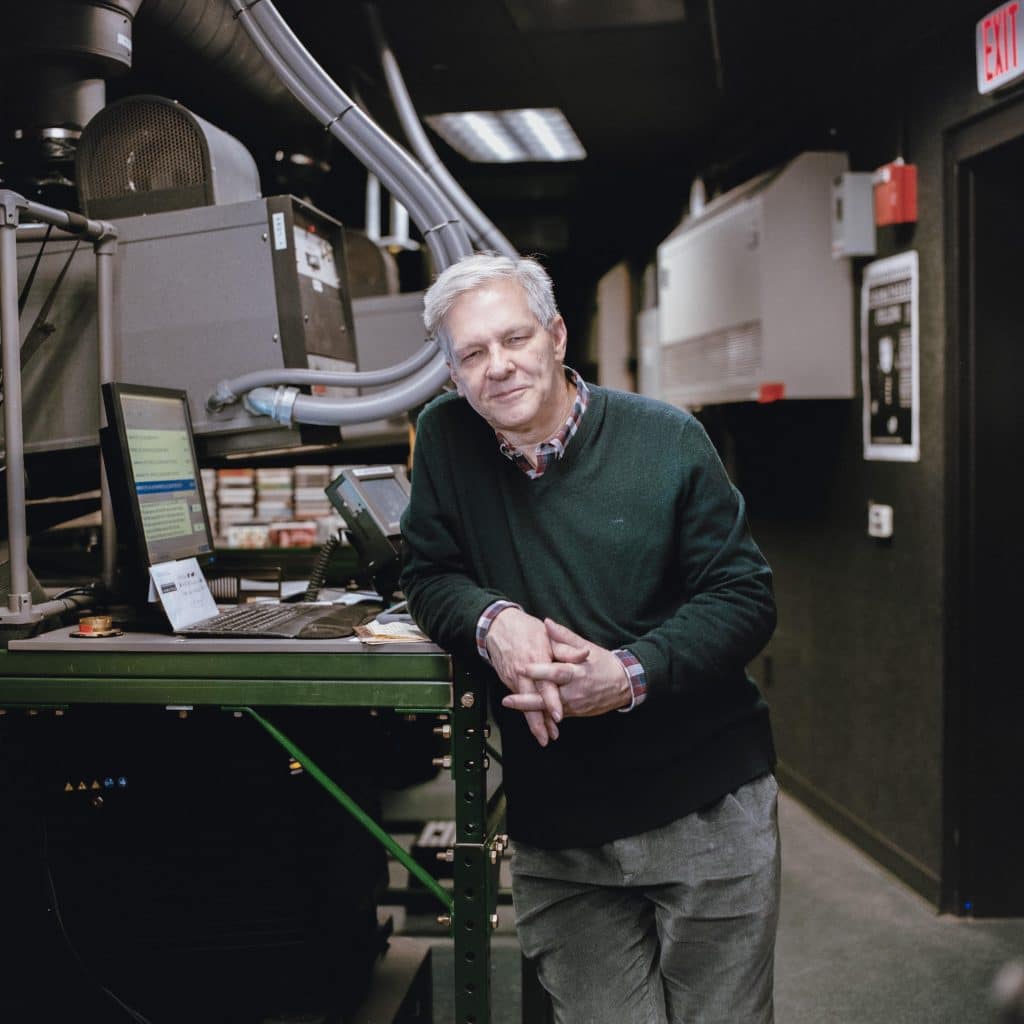
For nearly four decades, John Ewing has served as director at the Cinematheque at the Cleveland Institute of Art in Cleveland’s University Circle district. On June 30, he will show his final three films — three of his all-time favorites — before, like Alan Ladd in Shane, he rides off on his horse to final credits.
The Land sat down with John Ewing for a bit of reminiscing and to talk movies.
“The most satisfying thing,” he said, “is that we got it going at all.” Ewing co-founded Cinematheque in 1985 alongside Ron Holloway, a film journalist for Variety magazine, and philanthropist George Gund III. “Once you do it, nobody can take it away from you,” he said.
A close second on the satisfaction scale is “that we kept it going for 38 years.”
The third most satisfying thing is Cinematheque’s impact in the region.
“We’ve kept Cleveland filmgoers apprised of important new directors and movies and trends,” said Ewing. “So that’s knowledge we’ve imparted in a way that will live on in the minds of everybody who saw those films.”
The gamut of films shown at Cinematheque is wide, reflecting Ewing’s taste, interest and curiosity.
Genevieve Schwartz, assistant director at Cinematheque since 2019, and a staff member since 2009 remarked, “I think there’s the ‘easy art house’ [i.e., popular] films that people show up for,” but then there’s the kind of film they’ve never experienced.
“They’ve never sat through a seven-and-a half hour [Hungarian director] Béla Tarr film like Sátántangó (Satan’s Tango),” for example, “and John has likely influenced that,” she said. “Without the Cinematheque, it probably would not be shown in Cleveland.”
Cinematheque has also provided a launching pad for local filmmakers over the years, according to Mike Wendt of the Cleveland Film Commission.
“I will forever be grateful to John for showing my first documentary “The End of the World As We Knew It” (2008). It’s Ewing’s welcoming presence and establishment of the Cinematheque as a safe space for film watching and discussion that has nurtured a growing number of local film makers, sometimes returning to film or present in Cleveland,” Wendt said.
For example, there is Steven Caple Jr., who attended Baldwin Wallace University and later filmed “The Land” in Cleveland in 2016. The Russo brothers, too, shot “Welcome to Collinwood” and “Captain America: The Winter Soldier” in Cleveland, and have since returned to the Cinematheque to present their work.
Wendt added, “It is great to be able to say that you don’t necessarily have to move to one of the coasts in order to get a foothold in this industry.”
But Ewing says it was not a primary aspiration of his to show the work of local film makers.
“The older I get, the more I feel that showing local filmmakers isn’t really what we’re supposed to do,” Ewing said. “I’d like to think that a screening at the Cinematheque is something that [filmmakers] would aspire to. Clearly, if we think there’s a filmmaker who supports us, like Mike Wendt does, or Robert Banks, we kind of make exceptions for them.
“But there are other outlets in the region for that purpose, such as the Cleveland International Film Festival, the Short Sweet Film Fest, and the Ohio Independent Film Festival.
“A number of years ago, we did a weekend of all locally-made films,” said Ewing. These weren’t premieres but films that had already played at least once elsewhere.
“We didn’t do very well [at the box office] with them, so it made me think that with a lot of local films there’s like, one screening in them, with an audience of maybe the cast and crew, the parents of the director, and a few people from the public who might be interested. But I think we depend on movies to stand on their own merits.”
“I think the Cinematheque’s focus should be showing the great contemporary films, foreign and independent, that don’t come theatrically to Cleveland — plus, all the great movies from the past when nobody else is doing that.
“And I would like to think that young filmmakers could benefit from seeing the great movies from the past. So maybe they should stop making movies for a minute and look at some of the best stuff that’s already been made and learn something from that.”
Learn by watching
Ewing, who earned his Bachelor of Arts at Denison University, is modest about his educational preparation but also clear-eyed about what it takes to do what he does.
“I had two majors at Denison: English, and Theater and Film, which prepared me well. I do a lot of writing. I do all the film blurbs in the printed schedule, for the website, my cinema talk, press releases. Yeah, there’s a lot of writing.”
His pre-film talks are not written (“I wing those — and you can tell.”). But as far as what academic film departments can do for young filmmakers and future cinematheque directors, he is candid:
“I just read a great quote while cleaning out some files at the Cinematheque. It was from Edith Kramer (Director Emerita, Pacific Film Archive). She said that growing up she didn’t go to film school — she watched films. And I feel the same way.
“I don’t know that people who go to film school watch as many films as they should. Academic departments seem to turn out people who are “experts” in one little field. But they don’t have the kind of general, wide-ranging knowledge they need — to make films or even manage a movie theater, you know.
“We had Foster Hirsch (from Brooklyn College), a much-published film historian, come to Cinematheque last November. He asked me about my retirement, and he said, ‘Nobody in academic programs could replace you.’”
Meet the new director
Bilgesu Sisman, who will officially succeed Ewing as director on July 1, seems, on paper at least, to possess Ewing’s ideals of experience as a programmer and educator, and a deep love for cinema.
Most recently Sisman served as director of programming at Maryland Hall in Annapolis and before that as director of programming at Film Streams in the Omaha-Council Bluffs, Nebraska area, curating new releases, repertory titles, and community collaborations.
In a written statement to The Land, Sisman remarked, “The Cinematheque John Ewing has created is an exceptional space that is hard to replicate almost anywhere else, and one that has become the anchor of Cleveland’s cultural offerings. As evidenced by the passion and dedication of Cinematheque patrons – and it wouldn’t be a stretch to say the [local] community – John’s impact and influence on the public understanding and appreciation of film is undeniable.”
Schwartz echoed this sentiment, “John Ewing is an institution, but he also created an institution. That’s something that can be carried on forever. We have a good community of filmgoers.”
“I’m kind of a believer in watching movies cold.”
Is there something Ewing would like to see Sisman accomplish or do differently?
“We never did much in the way of program notes,” he said (brief commentary about a film, synopsis and cast, etc.). “If she wanted to do something like that, that would be great.
“But I have mixed feelings about program notes.” Good ones “provide background information about films and filmmakers,” though “they can also serve as a crutch for people. If people have program notes, I would hope they might read them after they see the movie. I’m kind of a believer in watching movies cold…because notes can not only spoil things in the movie but impart certain perspectives which you may not have agreed with [otherwise]. If you hadn’t read it before you saw the movie you might have a different take on something.” Ewing never had much inclination to write them anyway. “I don’t have the expertise. I’d have to do some work to produce anything cogent or worthwhile.”
Ewing’s three favorite films
Maybe the best part about a conversation with Ewing is when he starts talking about movies he likes. On Sunday, June 30, as a kind of departing gift, Ewing will present his three favorite films at the Cinematheque.
Magnificent Ambersons (1942)
“At 2 o’clock we’ll show The Magnificent Ambersons, my third favorite film,” said Ewing. “It’s an elegiac chronicle of the decline of a wealthy Midwestern family at the beginning of the 20th century, during the rise of the automobile. Starring Tim Holt, Joseph Cotten, Anne Baxter, and Agnes Moorehead star. Bernard Herrmann composed the music.
“I just love Ambersons because it’s a tale of the Midwest. I grew up in Canton in a family of car dealers, so it has this automobile subtext and I just find it very poignant and moving. The film was mutilated by the studio, so the ending is unsatisfactory, and [Orson] Welles didn’t really shoot that final scene.
“So, it is this mutilated masterpiece. But what exists on screen to me is so sublime. I still love it. I like it better than Citizen Kane, although I love Citizen Kane. I just think it’s a very heartfelt, moving story about the decline of a great midwestern family, and about history moving on, you know, with automobiles — a way of life changing.”
Late Spring (1949)
“Late Spring (1949) by Japanese director Yasujiro Ozu will show next, at four o’clock on Sunday. It’s a piercingly beautiful family drama in which an elderly widower tries to marry off his devoted grown daughter—who doesn’t want to leave him — and stars Ozu’s two greatest actors, Chishu Ryu and Setsuko Hara.
“I’ve always regarded Late Spring as my second favorite movie of all time. If I had seen it earlier in my life maybe it would be my favorite, I don’t know. I can’t view these things objectively anymore.
“It’s kind of a sad movie. It has this inevitability of real life to it — the widower father who wants to marry off his only daughter, and the grown daughter who is totally devoted to him and wants to spend her life taking care of him. The father thinks she needs to go away and live, to lead her own life, get married, and have her own family.
“I don’t want to spoil it for you but it’s quite moving,” Ewing said.
Shane (1953)
Shane (1953) will be shown at 7 p.m. on Sunday, Ewing’s final night, and is Ewing’s all-time favorite film. George Stevens’ celebrated western concerns a feud between cattlemen and homesteaders in late 19th-century Wyoming—and the mysterious stranger who sides with the “sodbusters.” With Alan Ladd, Jean Arthur, Van Heflin, Brandon de Wilde, and Jack Palance.
“I just realized recently that when I was a boy my family went on a 10,000-mile Western vacation in 1962. We drove a nine-passenger Chevy Station wagon 10,000 miles throughout the West,” — through a lot of national parks, and then back to his hometown of Canton, Ohio.
One of the places his family went was the Grand Teton National Park, which left an indelible impression for its beauty.
“When I found out that Shane was filmed in Jackson Hole and at the Grand Tetons, I was very keen to see it. I’d also read the book (by Jack Schaefer), when I was like 13 or 14 years old and loved it.”
So, he became “kind of obsessed” with the movie.
It was re-released in 1966 as the second half of a double bill (with “Night of the Grizzly,” a Clint Walker film). “And my parents were nice enough to drive me to the drive-in theater in Canton which was showing “Shane” starting at 11 p.m.
“What I like about “Shane” is, first, it has a great story. It’s a coming-of-age story; you’re seeing it all through the kid’s eye.
“It’s also an unspoken love story between the character Shane and Mary the farm wife, who’s also very devoted to her husband.
“It’s got good guys versus bad guys — the homesteaders, who want to put up fences, versus the cattlemen, who want an open range.
“Then maybe, most importantly, I love the character of Shane, who’s a killer, essentially a gunslinger, who’s trying to live down his past but is now kind of isolated from civilized society because he knows what he is. He can’t settle down and raise a family. Shane becomes this kind of Messiah figure who may sacrifice himself to save all the homesteaders and their families, and to preserve the future of the settlement.
“It’s a very mythical story about sin and redemption. I just think it works on so many levels. It’s a very gripping story and it’s beautifully filmed.
“By the way, Jack Schaefer [the author of the book] went to Oberlin College and was born in Cleveland.”
Riding into the sunset
You feel you could listen to Ewing talk about films for a long time. Does he have any plans to return to the Cinematheque for us to hear him talk about films again?
He gets a distant look. “I would think so somewhere. Nobody has invited me back to the Cinematheque yet. I don’t know what’s going to happen.” The music swells and Ewing rides off, leaving the movie lover behind, dolefully waving goodbye.
We're celebrating four years of amplifying resident voices from Cleveland's neighborhoods. Will you make a donation to keep our local journalism going?