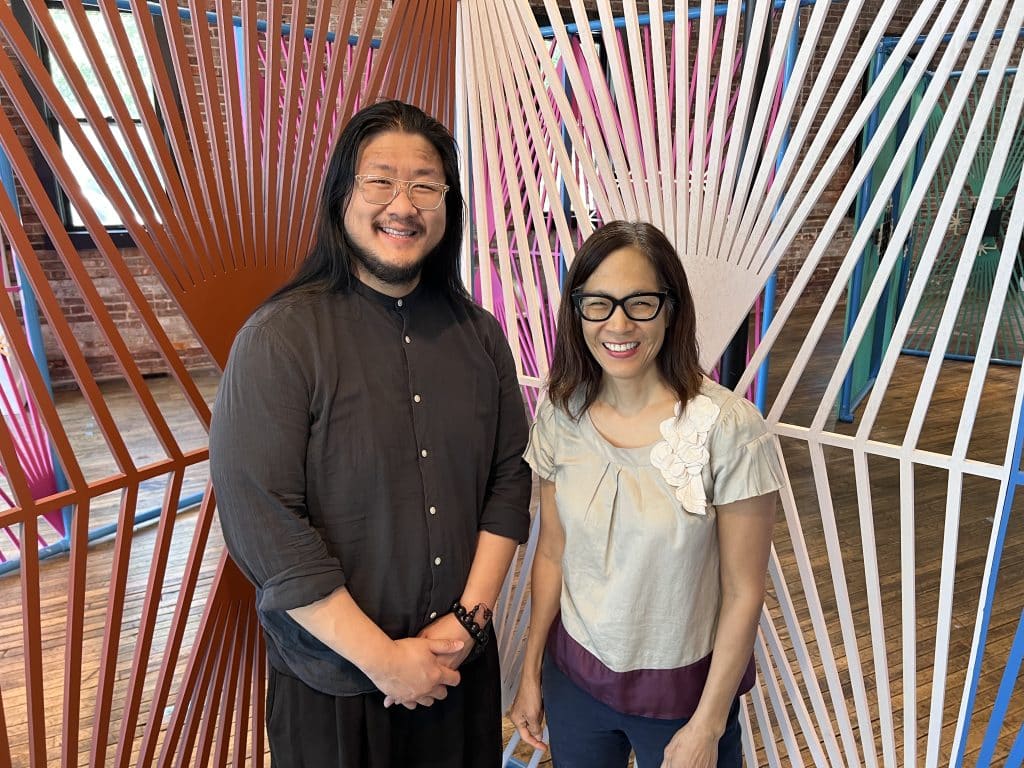
Jordan Wong has always struggled with cultural and ethnic identity. As a Chinese American, he has felt isolated between the native land of his grandparents and the U.S. melting pot. He never believed that he fit in either world.
“I’m not fluent in Mandarin or Cantonese, so when I was in places where everyone looked like me, I was still removed because I didn’t speak the language,” said Wong, 35. “I was existing in this third space and that’s a very common experience with a lot of other people, especially children of immigrants.”
Wong found a way to connect with others in that third space, along with anyone who sensed they were different, through art. He’s a Cleveland-based graphic designer and illustrator whose work has been displayed, among other places, at the Akron Art Museum, the Children’s Museum of Pittsburgh and the Art Wall in Cleveland Public Square.

More recently, Wong was one of seven artists chosen from more than 100 applicants for the city of Cleveland’s Transformative Arts Fund program, launched in 2024 by Mayor Justin Bibb. The program, using funds the city received through the federal American Rescue Plan Act of 2021, distributed $3 million in grants to those artists to create work that promotes the diversity and richness of Cleveland’s neighborhoods.
Wong, of Ohio City, received a $449,750 TAF grant to produce artwork in AsiaTown. The collective pieces, designed but still being put together, are called, “For Those Who Call Here Home,” honoring immigrants who came to Cleveland and raised families.
The hope is that someday the art will become part of a park on a site that is now a parking lot outside a former Dave’s Market store at Payne Avenue at East 33rd Street.
“We focused on AsiaTown because it doesn’t have any public parks or gathering spaces,” Wong said. “This is a prominent cultural neighborhood. Residents and families have no place to go to have a picnic or go for a walk or have community programming.”
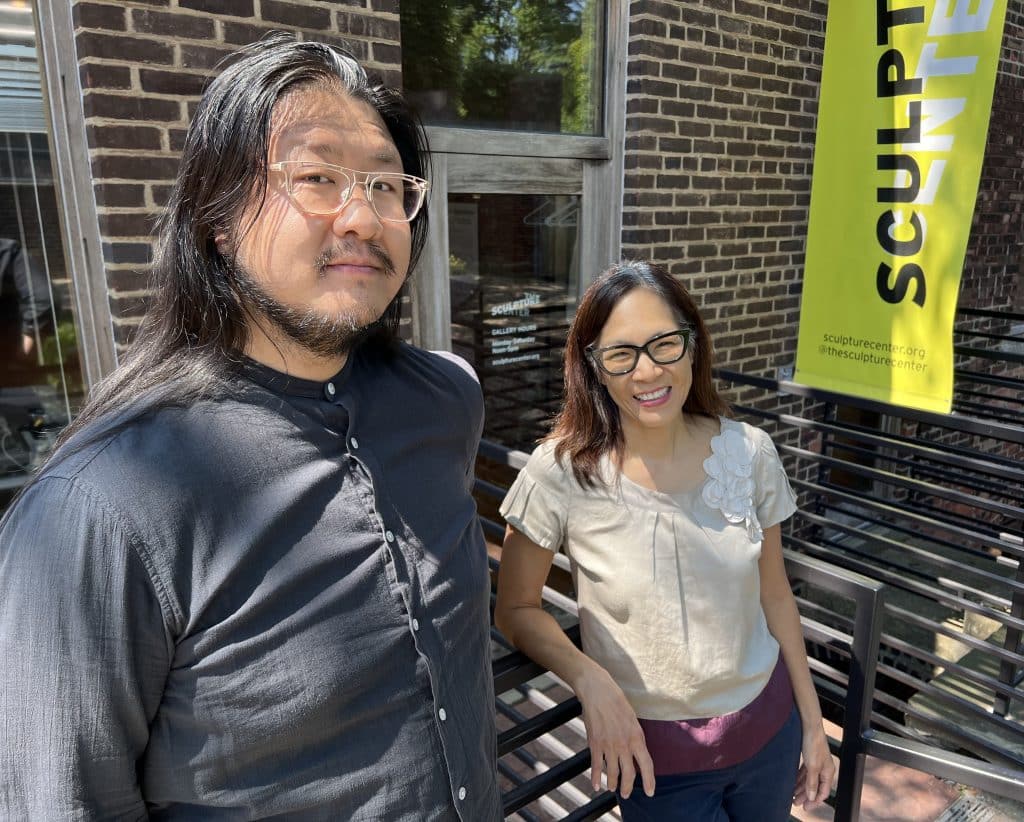
TheTAF program requires each artist to partner with a Cleveland institution – a nonprofit, private business, community development corporation or religious group, for example. Wong’s partner is The Sculpture Center, a 35-year-old nonprofit that supports the careers of young artists in Ohio and neighboring states.
As a partner, The Sculpture Center is overseeing the art project’s finances and budget, preparing project financial reports for the city and will help with the final installation, which is scheduled for late September.
It was Grace Chin, executive director of The Sculpture Center, who invited Wong to submit a proposal for the TAF program. Together, they chose AsiaTown as the location.
“Jordan is a highly creative visual artist who has a strong practice,” Chin said. “His bold language speaks to more youthful, contemporary voices of younger generations who straddle American and Asian cultures.
“Further, Jordan has experience creating public art works and made a good candidate for someone who could take on a large-scale project such as the TAF,” Chin said.
Powerful protagonists
Wong, a Pittsburgh native, was exposed to anime and manga while growing up, like millions of other kids. Anime, a style of Japanese animation commonly seen in videogames, and manga, the printed version of the artform appearing in Japanese comics, left deep impressions on him. They showed characters overcoming life challenges and becoming heroes.
“Anime and manga were mysterious and perplexing,” Wong said. “The actual art was stunning and dynamic and detailed. That’s really what inspired me to pick up a pencil and express my love for these visuals and these iconic character designs.
“From a narrative perspective, I was really encouraged by these stories of heroes that start off weak and go through some immense training and on the other side are these all-powerful protagonists,” Wong said. “For me, struggling with a sense of belonging and self, I really gravitated toward that.”
Wong’s work, although clearly influenced by anime and manga with its bright colors and movement, is different in that it doesn’t tell a straight-flowing narrative. It’s abstract, calling on the viewer to search for meaning. He calls it “exploratory” in that it examines ways to navigate life and grow inside.
In his art, Wong references various philosophical schools of thought and ideologies, including Daoism, Buddhism and Wu Wei, the idea that harmony is achieved through effortlessness or inaction.
“I look at cultural ideas like collectivism versus individualism and how the two relate to each other,” Wong said. “Ideas like how to soften, which is much more Eastern school of thought than Western. Ideas like how to cultivate our sense of self.”
Wong’s images are computer-generated. He uses ultraviolet printing to place the images on vinyl.
Art in the park
Wong applied for the TAF grant in 2024. A seven-member TAF Advisory Committee, led by Cleveland artists, made final recommendations to Bibb and Cleveland City Council. Wong learned that he won the grant last summer.
“When the TAF program was first announced, I wasn’t even going to apply,” Wong said. “I was focusing on a solo exhibition at the children’s museum in Pittsburgh and some other projects. I didn’t prioritize it until Grace reached out and asked me if I wanted to partner with an application.”
Chin had met Wong at a 2023 Cleveland Institute of Art student exhibition, where he was one of the jurors.
“To have Grace and The Sculpture Center showing interest to partner with me encouraged me to give it a shot,” Wong said.
Wong’s pieces in the AsiaTown parking lot were designed with the expectation that they will one day be part of a park with green space. MidTown Cleveland Inc., the community development organization for the AsiaTown area, is helping to lead the park project.
For his contribution, Wong collaborated with Marika Shioiri-Clark, an environmental designer and strategist, urban designer and architect. In 2022, Shioiri-Clark – along with MidTown and Cleveland Urban Design Collaborate, part of Kent State University – talked with AsiaTown residents about what they wanted in a park.
Wong’s five installations are based on that input. He’s also working with other artists and Greater Cleveland businesses on the pieces, which include:
- A permanent entrance gate, 10 feet tall and 28 feet wide, with aluminum panels and yellow-gold linework. Rotating tiles on one side of the gate contain Chinese symbols and icons. Visitors can spin the tiles to see different characters. Signature Sign Co. in Cleveland is fabricating and installing the entrance gate.
- A large-scale lightbox, 8 feet tall and 30 feet wide, that will illuminate the site and neighborhood, establishing a safer space. The lightbox will display an original Wong mural-style piece. WestCamp, a Westerville printing firm, is fabricating and installing the lightbox, another permanent element of the site.
- Three aluminum planters, made by the Rustbelt Welding Co. in Cleveland. The exteriors will feature UV-printed-vinyl artwork created by three emerging Asian artists: Thao Nguyen, Lydia Guan and Nicki Lee.
- “Playful seating” made of wood by Costello Construction Group in Beachwood. The seating resembles stairs but with asymmetrical steps and will include Chinese characters, symbols and icons.
- Three ping-pong tables with UV-printed-vinyl artwork on the playing surface. Wong said play was something the community said it needed to attract families and children.
Chin said Wong’s sprawling proposal appealed to her because the work is a reflection of AsiaTown.
“Sculpture is all about space, whether it’s in the gallery or outside,” Chin says. “When I think about placing art outside, I believe it has to have a relationship to the site, so that it’s not just plopped on the land but takes into consideration where it actually is.”
Keep our local journalism accessible to all
Reader support is crucial as we continue to shed light on underreported neighborhoods in Cleveland. Will you become a monthly member to help us continue to produce news by, for, and with the community?
P.S. Did you like this story? Take our reader survey!