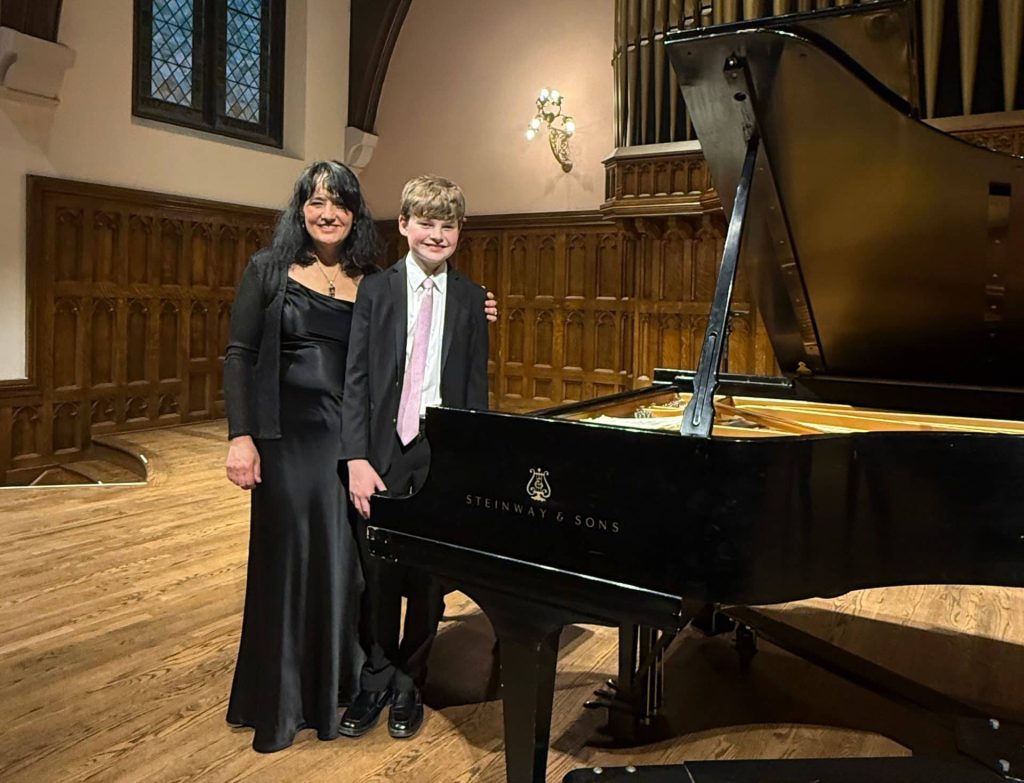
When the Zoom call flickers to life late on a Friday afternoon, the Kleins come into view — Donna first, offering the sort of apology parents give when technology misbehaves, and then her son, John Michael “Mikey” Klein, 13. He gives a small wave and takes his seat. Nothing showy about him. He looks like any eighth grader at Lakewood Catholic Academy — polite, a little shy and ready to talk about music.
Music, steady and surprising in its reach, has already carried him far beyond the usual school concert circuit. In the past year, Klein has won first prize in the Grand Prize Virtuoso competition in Oxford, England, the Charleston International Piano Competition, and, most recently, the Golden Classical Music Awards. That last win will bring him to Weill Recital Hall at Carnegie Hall on December 18, 2025.
Klein’s road to Carnegie Hall began not at a piano at all, but behind a trombone.

From Fisher Price to full piano
Klein started trombone in fourth grade because, as he puts it, “I thought the trombone was really cool because of the slide.” His school didn’t offer piano in the band, and he’d never played any instrument before. Then he rediscovered a toy Fisher Price keyboard in the basement.
His sister was picking out simple tunes like “Twinkle, Twinkle, Little Star” on it. Mikey went a step further: “I started playing my trombone music on the really tiny piano,” he says. He quickly began spending hours on those plastic keys.
At Thanksgiving 2022, his parents bought him a 66-key electric keyboard. The next Christmas, neighbors who had heard him play gave the family a Story & Clark upright piano. Today, there’s a Yamaha baby grand in the living room — a steady upgrade for a fast-developing musician.
At first, Klein treated piano as a hobby. The turning point came with the full 88-key instrument. “When I got the 88-key piano, I realized I could play any song because I wouldn’t be limited with the keys,” he says. He started tackling harder pieces — and practicing more.
His mother laughs at the notion that he has to be pushed. “Sometimes we have to get him to stop practicing,” she says. “He’ll wake up and go right to the piano. At night he has a keyboard in his room with headphones. It’s an integral part of our lives — and it’s beautiful music. I love hearing it all day.”
A chance recital and a new teacher
One of the people most responsible for harnessing that energy is pianist Halida Dinova Ph.D, who now teaches piano at Lakewood High School.
Dinova remembers the exact date they met: April 14, 2024, at her solo recital at St. James Church in Lakewood. After the concert, during the reception, the Kleins introduced themselves. Mikey had been struck by her virtuoso showpieces — Liszt’s Legend: St. Francis of Paola Walking on the Waves, Mendelssohn’s Scherzo Op. 16, and Tchaikovsky’s miniatures.
As Dinova recalls, Mikey turned to his mother and said, “Mom, I should study with her — her hands never get tired after a long program.”
She invited him to study at Westlake Music Academy, where she was then on faculty. They began weekly 45-minute lessons in early May 2024. At that point, he was 12 and had been playing piano for only about two years, studying with David Holmberg, a Lakewood School of Music teacher who introduced him to popular styles and sight-reading. Holmberg also involved Mikey in a church ensemble and had him perform 70s and 80s songs for residents at senior apartments.
Dinova started by rebuilding fundamentals: etudes for wrist flexibility, tone and posture. Their first big project together was all three movements of Beethoven’s “Moonlight” Sonata, along with Bach and Schubert. By late June 2024, Mikey played the first movement of the “Moonlight” at a school concert.
Dinova was struck by what she heard. She says he showed “a musical understanding unusual for a young boy.” Over the summer they met almost weekly, adding Schubert’s Impromptu in A-flat, more etudes, Chopin’s Polonaise Op. 40, and even a Mozart Rondo.
By the end of September, “I realized that Mikey is amazingly talented and serious,” Dinova says. “He can concentrate and accomplish musical tasks on the level of a conservatory student.”
That’s when she decided to prepare Mikey to play Chopin’s Polonaise in A Major as a recorded entry for the Grand Prize Virtuoso competition in Oxford.
Oxford, Charleston, and the road to Carnegie
For the Oxford competition, Dinova arranged a professional recording session at Harkness Chapel on the Case Western Reserve campus. The rules were strict: one continuous take, no splicing, hands clearly visible. Klein recorded the Chopin Polonaise there, and the judges awarded him first prize and an invitation to perform in Oxford’s Sheldonian Theatre in December 2024.
When the news came, Mikey was in the basement playing video games. “My parents called me up. My mom and my nanny were both crying,” he remembers. “I said, ‘Wow, this is cool,’ and then I went back downstairs to play more video games.”
“My parents called me up(stairs). My mom and my nanny were both crying,” he remembers. “I said, ‘Wow, this is cool,’ and then I went back downstairs to play more video games.”
The Oxford trip became a family milestone: his first international performance, a visit to Oxford University and a boost of confidence. Around the same time, his video entry also won First Prize at the Charleston International Piano Competition. He was still only 12.
Through the winter and spring, Dinova and Klein moved on to the Mozart Rondo from the D-major concerto (for which he learned the solo part and the accompaniment entirely from memory) and Chopin etudes, and a virtuoso Weber piece. In June 2025, they recorded Weber’s Rondo Brillante Op. 62 together and submitted it to the Golden Classical Music Awards competition — the contest whose winners perform at Carnegie Hall.
Once again, he took first prize in his age category. That award: a recital at Weill Recital Hall at Carnegie Hall on December 18, 2025.
When he first brought Dinova his Oxford medal, she remembers reading the inscription — “Grand Prize Virtuoso” — and seeing how much the experience meant to him. “He still remembers meeting teenagers from all over the world,” she says. “I am so glad that such competitions are available for youth.”
Rock orchestra and real-world skills
Klein’s musical life has not been confined to classical music. He is also a member of The Lakewood Project, Lakewood High School’s long-running rock orchestra, meeting outside of regular school times Mondays or Sundays, 3-6 pm, directed by Dr. Elizabeth Hankins. Hankins has worked with Mikey for about two and a half years.
She explains that the Lakewood Project, founded 22 years ago, was designed “to teach students to play the music they love on the instruments they love.” The premise is simple but provocative: “We ask, what would Mozart sound like if he were alive today?” she says. The result is a mix of classical pieces with a twist and rock covers.
“We ask, what would Mozart sound like if he were alive today?”
— Dr. Elizabeth Hankins, Lakewood Project
The group is also a laboratory for practical musicianship. Students learn theory and refine their ears, but they also learn how to collaborate with guitarists, drummers, and a full rhythm section. There is no conductor. “This group does not have a conductor, so they have to communicate with each other,” Hankins notes. The ensemble now numbers 47 musicians.
Hankins encouraged Mikey early on and helped connect him with a high-level teacher, eventually leading him to Dinova. In the Lakewood Project, both teachers have watched him stretch in new directions: improvising, accompanying an adult band and playing duets with pianist Dennis Lewin — all by ear, without printed music.
From her vantage point, Dinova sees the rock orchestra as a vital complement to Mikey’s classical training. “The Lakewood Project programs are opening new channels for Mikey’s creativity, making him grow as a musician,” she says. “He’s now interested in orchestration and is developing themes for his own compositions.”
She’s also seen his curiosity spill into orchestral repertoire. “Sometimes,” she says, “he will sit and play large fragments of Beethoven’s Fifth Symphony, Tchaikovsky’s 1812 Overture, or Mussorgsky’s Pictures at an Exhibition from memory. He’ll quote a melody from a Liszt rhapsody, then flip it into minor and smile.”
“Mikey is more than a young pianist,” Dinova says. “He is interested in different styles of music… Mikey Klein is a happy, talented kid. It is a joy to see him grow and develop.”
Klein’s approach to stage fright is disarmingly straightforward. “I just tell myself, stop being scared. Just do it,” he says.
Nerves, friends, and what comes next
For all the high-profile performances, Klein’s approach to stage fright is disarmingly straightforward. “I just tell myself, stop being scared. Just do it,” he says. “I don’t try to say, ‘Oh, it’s going to be okay.’ I just say, ‘Go up there, stop being scared of it, just do it.’ And it works all the time.”
He memorizes easily and likes being onstage. He still wants to be a concert pianist — that part hasn’t changed. His favorite composers are firmly in the Romantic camp: Chopin first, then Beethoven and Franz Liszt. With Dinova, he has begun work on Rachmaninoff’s Second Piano Concerto, starting in the middle rather than with the famous opening.
Away from the piano, he hangs out with friends, plays football outside with his brother and logs his share of video-game time. His friends are supportive — even if they’re not musicians themselves. When they’re online together, his mother says, he’ll sometimes start playing the game’s music on his keyboard. “They all like it,” she says. “It’s just part of who he is, and that’s how they accept him.”
High school is the next big fork in the road. His friends are headed toward St. Ignatius, while he’s leaning toward St. Edward — but he hasn’t decided. He’s thinking about music programs, friendships and where he might grow best.
In the nearer term, he’s focused on two stages: the Lakewood Project’s Eric Carmen tribute concert at Lakewood High School, and that December evening in New York, walking out under the lights at Weill Recital Hall.
He knows what Carnegie Hall is, and he knows the old line about how to get there. In his case, the punchline is both cliché and completely accurate: practice, practice, practice — and then, when the time comes, tell yourself one more time:
Just do it, kid.
We're celebrating four years of amplifying resident voices from Cleveland's neighborhoods. Will you make a donation to keep our local journalism going?