On a cold morning in late January, Curt Brosky was feeling optimistic.
“The weather’s up in the 20s,” he said. “And we have a new football coach — so life couldn’t be better!”
He had reason to be upbeat.
Brosky, a Rocky River resident and a 30-year Rotarian, chairs the grants committee for the Lakewood-Rocky River Rotary Foundation, which this year awarded $84,004 in grants to local nonprofits. It’s the largest total in the foundation’s history, and the latest chapter in a tradition of organized local giving that stretches back more than seven decades.
Since 1952, the foundation has provided more than $1.25 million in scholarships and grants, supporting everything from hunger relief and youth programs to education and community wellness initiatives.

A local foundation with global roots
Rotary’s mission, Brosky explained, can be summarized as “community service,” but the organization’s reach extends well beyond Northeast Ohio.
Local members donate money to their local clubs and to neighboring clubs, and this goes into the annual fund. A broad outlook is paired with a clear local priority: “There are clubs all over,” he said. “[The Lakewood] club provides some money, along with neighboring clubs, but most of our [grant] recipients are local.”
“Organizations headquartered outside Lakewood and Rocky River may be doing excellent work,” Brosky said, “but the foundation aims to ensure the money comes back to residents.”
“Because we’ve raised the money,” he said, “it’s going back to help the citizens of Lakewood.”
Why this year’s grant cycle matters
The foundation’s grants have steadily grown year to year — “it gets larger each year,” Brosky said — but the 2026 cycle involved some especially pointed discussions about need.
Committee members considered what Brosky described as “changes in federal funding” and other broader shifts that could affect community services. The results were a familiar Rotary mix: food and basic needs, youth development, job training, and local support organizations — many of which also partner with Rotary members for hands-on volunteer projects.
Brosky emphasized that the grants work is carried out entirely by volunteers — Rotary has no paid staff to continually track shifting nonprofit needs or the ripple effects of government cuts. The foundation’s annual giving, he said, follows a formula designed to keep the 74-year-old fund viable long-term, and strong contributions from Rotarians alongside solid investment returns have helped the foundation roughly double its annual community support over the last dozen years.
The grants committee, made up of 14 Rotary volunteers, reviewed roughly 50 applications and approved funding for 24 organizations.
“This year we really sat down and asked where the need was greatest in the community,” Brosky said.
The difficulty wasn’t in finding worthy applicants. It was the opposite.
“They’re all so worthy,” Brosky said. “We wish we could give to everybody — just terrific organizations.”
“Andrew Carnegie said the hardest job he ever had was giving his money away,” Brosky said. “I get that — deciding why one group is more worthy than another, when both are doing terrific things.”
“Give more to a few — or help more with less?”
Rotary’s grants committee confronts a fundamental question every year: how best to distribute a limited pot of money.
“If we’re going to give out whatever — 80-some thousand dollars — is it better to give four people 20 a piece?” Brosky asked, “or is it better to help as many as we can?”
Their decision affects not only grant totals, but the overall character of the program. A wide net supports more organizations — but with smaller checks. Concentrating resources can help a handful of nonprofits make bigger, more targeted moves.
The committee also benefits from its members’ community connections. Many Rotarians volunteer directly with local nonprofits, giving the committee a clearer sense of the work — and the need.
“We encourage all of our Rotarians to be involved in nonprofits,” Brosky said. “And they certainly have a say.”
Four top grantees — and why they stand out
In scanning the long list of recipients, Brosky highlighted a handful of the largest awards — organizations Rotary has partnered with for years — including support for food banks, summer youth programs, and high school seniors and their families.
Lakewood Charitable Assistance Corp.
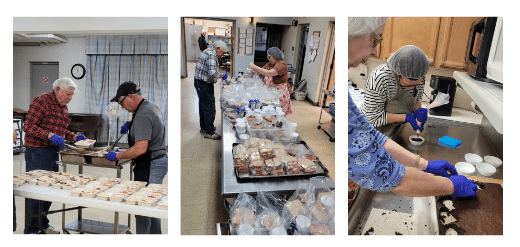
A nonprofit that supports underserved Lakewood residents through food assistance, fundraising, and volunteer-run holiday food basket programs. This year, LCAC received a $5,000 grant to purchase groceries for those in need. “Rotary members don’t just fund this organization — they volunteer with it,” Brosky said. Members help distribute food bank items three times a year to hundreds of residents, and also stock and sort the food pantry.
Meals on Wheels
A longstanding provider of meal delivery and support services for seniors and others with limited mobility — a need likely to grow as household costs rise and public resources fluctuate. Rotary awarded $5,000 to help subsidize meals.
West Shore Meals On Wheels, which has operated since 1973, delivers meals to residents in Rocky River, Lakewood and Fairview Park, and is expanding service this spring to West Park in Cleveland. According to executive director Bill Ridmann, the organization receives no government funding and relies on individual donors and grants such as Rotary’s to sustain its work.
The Rotary grant helped offset the growing cost of the organization’s subsidized meal program, which has expanded significantly in recent years as more clients struggle to afford regular meals. From October 2024 through September 2025, West Shore Meals On Wheels served 1,003 recipients — an average of 84 per month — delivering 25,483 meals, or roughly 100 meals each weekday. During that period, 187 clients received subsidized meals, reflecting an increase from about seven percent of participants to nearly 19 percent.
Ridmann said the subsidized program was created after staff recognized that some residents wanted the meals but could not afford them. Eligibility is tied to SNAP income guidelines, with qualifying clients paying $3 for two meals. The organization also lowered the price for full-paying clients from $8 to $7 in recognition that many live on fixed incomes. During the federal government shutdown in late 2025, Meals On Wheels temporarily waived charges for SNAP recipients, a step Rotary leaders considered when awarding this year’s grant.
Help To Others (H2O)
A Lakewood Schools-based initiative focused on helping students and families. Another Rotary partner with deep community ties. This year, H2O received a $5,000 grant to pay and train summer-camp student counselors.
LakewoodAlive
An organization known for neighborhood development and community-building programs, frequently supported through local foundations and grants. This year, it received a $5,000 grant to launch a small-business hub offering training and support for local entrepreneurs.
Jo Higgins, interim executive director of LakewoodAlive, said the grant reflects how economic pressures ripple through communities in interconnected ways. While LakewoodAlive’s work focuses on supporting small businesses and entrepreneurs rather than direct food assistance, she said the challenges facing households and local businesses are closely linked. When residents facefinancial strain, small businesses feel the effects through reduced spending, which in turn affects jobs, neighborhood stability, and access to goods and services.
“From our perspective, confronting these cuts means thinking holistically about community health,” Higgins said. “We have to strengthen our small business ecosystem while also recognizing that many of the same residents and entrepreneurs we serve are navigating increased financial pressure at home. The need feels more interconnected and more immediate than ever.”
Brosky noted these grants are not products of new relationships.
“We’ve funded all four for an extended period of time every year,” he said. “We just feel they do a good job.”
More than grants: scholarships, schools, and student programs
While the headlines focus on grant totals, Rotary’s giving also includes education and youth development initiatives that have become annual community fixtures.
Among them:
• High school scholarships
• A speech contest for Lakewood and Rocky River students — a program the Lakewood-Rocky River club has helped sponsor for 81 years, Brosky said.
• A program that provides dictionaries to third graders in Lakewood and Rocky River — in place for 23 years.
• Partnerships with the Beck Center for the Arts, including prizes supporting music and art, going back more than 20 years.
“It’s not just writing checks,” Brosky said. “We’re also rolling up our sleeves and working alongside people.”
How nonprofits can apply
The foundation’s grant funding comes entirely from the foundation itself — built over decades through donations.
“Traditionally, over 75 years, all of those assets have been donated,” Brosky said.
As for how organizations learn about the program, Rotary shares notices through social media and newspaper outlets, and maintains an outreach list of nonprofits in the area. Each year, the Rotary committee communicates directly with about 50 organizations — whether or not they’ve received grants in the past.
“As we learn of new nonprofits,” Brosky said, “we add them to our mailing list.”
A long view: giving today, staying strong tomorrow
In a year when needs feel more acute and funding uncertainties loom, Rotary’s leaders are also thinking about longevity — how to keep the foundation healthy enough to continue giving for decades.
“We’re giving away a [large] percentage each year,” Brosky said. “Occasionally we’ll talk about… maybe we should give twice as much.”
But the foundation has to ensure that generosity remains sustainable.
“If we give away too much, too many times in a row,” he said, “then we’re not going to be around.”
The goal, Brosky added, is to keep the foundation on solid footing — and keep showing up for folks.
“The fact is, we’re there,” he said, “and we want to be there in the future.”
We're celebrating four years of amplifying resident voices from Cleveland's neighborhoods. Will you make a donation to keep our local journalism going?