
Kurt Karakul and his colleagues at The Literacy Cooperative are concerned about Cleveland and Cuyahoga County’s historically and consistently low literacy levels. The most recent statistics back them up.
According to “The Nation’s Report Card” issued by the National Assessment of Educational Progress (NAEP) on Jan. 24, 2025, Cleveland was ranked 24th for fourth and eighth grade reading out of 25 major cities across the U.S. The city only marginally outscored Detroit in both categories of the NAEP’s tests.
Since 2019, Cleveland, however, recorded the steepest decline in reading scores for fourth and eighth graders amongst all big cities in the entire country, where the NAEP assessment is given. The testing indicated that 8% of all Cleveland students scored proficient in reading. By comparison, the big city average was 26% proficient and the national average was 30% proficient. The report says that results for large cities are drawn from “students in public schools located in the urbanized areas of cities with populations of 250,000 or more.”

“The fact that we have had the worst deterioration of our reading levels of any place in the country indicates we have an emergency,” says Karakul, co-vice chair of the board of The Literacy Cooperative; he retired as Executive Director of the Third Federal Foundation in 2021. “We’re trying to raise awareness of this deficiency and make this a community issue. We need to teach our kids to read by third grade. That should be the first thing that anybody thinks about.”
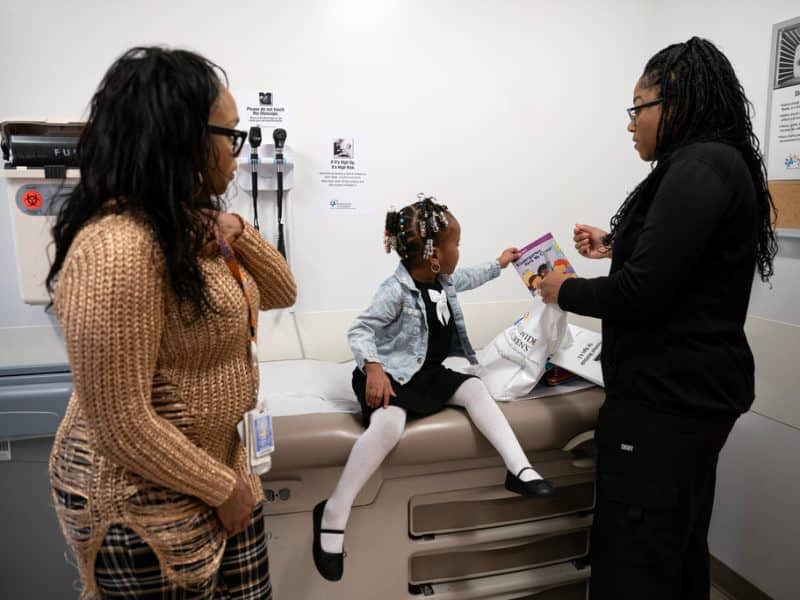
Robert Paponetti, president and CEO of The Literacy Cooperative, concurs. He’s been with the nonprofit organization for 17 years, and under his leadership, they adopted Dolly Parton’s Imagination Library as one of its central tools for fostering literacy in children, ages 0 to 5 throughout the county. Once enrolled in Parton’s early literacy program, the child receives an age-appropriate book every month that parents can use to read to their child and build a children’s library for them.
In annual surveys The Literacy Cooperative does with participating families, Paponetti says, 80% of respondents said their child does ask them to read to them more. Additionally, 91% from their “highest priority zip codes” – those in low-income neighborhoods in Cleveland – confirmed that their child asks them to read to them more because of the Imagination Library books.
“They’re reading to their children during those formative years of their brain development, which is helping them get prepared for kindergarten,” Paponetti says. “The evidence that we have is that we had Case Western Reserve University do a study of kindergarten readiness scores, and they saw when a child who was connected to the Imagination Library was more likely to be better prepared for kindergarten.”
Referring to the NAEP kindergarten readiness scores, Paponetti says they indicate 80% of children starting school in Cleveland in 2023 were not prepared for kindergarten.
“The likelihood of them reading at a third grade level by third or fourth grade is slim,” he says, adding that a cornerstone in early childhood education is that a child learns to read by third grade so that they can then read to learn. “So, we have an opportunity to support parents more during those early years of their child’s life, and one way we can do that is through Imagination Library. We want to make sure every child is enrolled.”
Currently, he adds, there are approximately 39,000 children enrolled in the program, out of the 66,000 children in Cuyahoga County who are eligible. In the city of Cleveland proper, there are between 10,000 and 11,000 children enrolled of the 22,000 who are eligible..
Paponetti says that, in addition to receiving the Imagination Library books, parents of enrolled children also provide their email or mailing address and cell phone numbers. That enables The Literacy Cooperative to send regular information about family reading, education and health programs.
“We begin to develop a line of communication with the families,” he says. “We try to leverage that relationship and connection so that we can expose them to all kinds of other beneficial programs and services.”
Julian Khan, a lifelong resident of the Buckeye neighborhood, enrolled his son Cassius in the Imagination Library program before he was born, that way there were a handful of books awaiting his arrival. Three years later, the books have become the center of Cassius’ evening routine and a core part of the Khan’s engagement and bonding as a family. Lately, the fledgling bibliophile has been walking around their house with his copy of Eric Carle’s “The Very Hungry Caterpillar.”
“We have all sorts of conversations about emotions and empathy after we read the story, and we’re able to get into the developmental and foundational stages of phonics,” Khan relates. “He’s starting to sound and spell things out, put two letters together. I didn’t think we’d be there this quick.”

History of The Literacy Cooperative
Founded in 2006 by The Cleveland, Gund and Martha Holden Jennings foundations to address reading proficiency challenges, The Literacy Cooperative has implemented a variety of programs to accomplish its mission. However, the recent figures stunned Karakul, Paponetti and their colleagues and made them redouble their efforts to increase literacy throughout Cuyahoga County.
Fortunately, Cleveland Mayor Justin Bibb has fully supported these literacy efforts. Last August, Bibb hosted the Northeast Ohio Science of Reading Summit at Cleveland State University. Key leaders and educators, including Karakul, Paponetti and Michelle Pomerantz, Bibb’s Chief of Education for the City of Cleveland, discussed the anticipated impact the recently revived science of reading approach will have on Pre-K and K-12 education.
In November, Governor Mike DeWine announced a $5 million grant to support the Science of Reading training for early care and education programs. The Science of Reading approach emphasizes teaching the basic building blocks of language, like phonics, to help children become confident, proficient readers. At the Governor’s press conference, Ohio Department of Children and Youth (DCY) Director Kara B. Wente cited the fact that the latest brain research into literacy development confirms that the Science of Reading is considered the most effective method for reading instruction.
Overcoming the ongoing challenges
“For many years, the thing that frequently frustrates us is that people don’t understand how reading is a key to success,” Karakul says. “No matter what career people choose, their ability to read is critical to them being able to do what they need to do and do it well so they can have a satisfying and successful life, and we don’t seem to understand that from the beginning.”
According to Paponetti, as part of their Side-by-Side initiative to provide reading resources to parents and teachers, they plan to make their Family Reading Readiness Toolkits with phonics flashcards and other instructional items on their website available to parents who may not have access to printers. The free kits will also be available at Cleveland Public Libraries, pediatricians’ and dentists’ offices and other locations. The cooperative is now seeking funding to support printing and distribution of the kits.
“We made a presentation to educational funders on February 20th at City Hall with Mayor Bibb and several of us making presentations,” Karakul says. “The meeting was set up through Philanthropy Ohio. We received a very positive response at the end of the meeting but have not yet made an ask from that meeting. So we do not yet have funding to support the tool kits or the Imagination Library expansion.”
For her part, Pomerantz states that dealing with the challenges of teaching reading effectively is “not something new,” but it is a topic people and organizations have been trying to solve for some time. Gov. DeWine’s commitment to the science of reading, however, provided the tools and an approved reading curriculum based on phonics, sounds and phonemic awareness that will improve reading proficiency in children.
“At a time when there’s no common ground on anything, the one common ground is the science of reading,” she says. “It’s the one piece that everyone agrees on, so teaching reading and the whole reading wars between the whole language approach and phonics or the science of reading is over.”
While Pomerantz sees the advantages of involving parents and families with encouraging children to read, she does have one caveat about relying solely on the Imagination Library. She believes the combination of both the Imagination Library and employing the science of reading is a powerful approach. Incorporating phonics and helping children tease out letters and sounds serves as the “vegetables or greens” that children need to grow before they can fully enjoy the “desserts” of sitting on their parent’s lap while they read fun books or rich children’s literature to them.
“One does not exclude the other, but for a long time we put the focus on the child’s library access to books, which does need to be supported,” Pomerantz says. “But now let’s teach reading and have parents understand and not be afraid to grab decodable books [i.e., books that sound out letters and words: ‘A fox sat on a box.’].” They’re boring but make sure you do those sound learning, how to read exercises so that you can get to the reading comprehension stage.”
Patti Choby, founder, Cobalt Group, Inc., a consultant to The Literacy Cooperative, says she’s been involved in efforts to improve reading proficiency as an important contributor to education, innovation, entrepreneurship and economic development strategies for Cleveland students since 1990.
“Until we decide to invest in human beings as much as we invest in all of the other initiatives in the community,” Choby says, “we are not going to move the needle on either educational attainment or workforce readiness or the ability of our region to compete nationally and globally for the best and the brightest.”
On April 16 at the Jerry Sue Thornton Center at Tri-C, The Literacy Cooperative will present the fourth Kurt Karakul Literacy Award at its annual Read Across America Celebration. Funded by Third Federal to honor Karakul’s long-held passion for this endeavor, the $20,000 award recognizes a nonprofit or public service organization in Cuyahoga County doing exemplary work to advance literacy in our community. Past winners include Seeds of Literacy, Reach Out and Read, and America SCORES Cleveland.
If you have children ages 5 to 8 who would benefit from Family Literacy Tool Kits, email your name, mailing address, phone number and email address and the number of children in each age group to read@literacycooperative.org. Keep up on literacy in the news by subscribing to The Literacy Cooperative’s newsletter here. If you would like to volunteer to support Dolly Parton’s Imagination Library, sign up here to make a difference in your community.
Keep our local journalism accessible to all
Reader support is crucial as we continue to shed light on underreported neighborhoods in Cleveland. Will you become a monthly member to help us continue to produce news by, for, and with the community?
P.S. Did you like this story? Take our reader survey!