The longer one contemplates the new bus shelter at MetroHealth Glick Center, the more beautiful it becomes.
That’s because it isn’t just a bus shelter. It’s a sculpture by Chicago-based artist Edra Soto, and its glories lie less in the beholding than in the pondering, in grappling with and understanding what it signifies.
“It’s not just a structure but a reflection of the neighborhood,” said Grace Chin, executive director of The Sculpture Center, the Cleveland nonprofit that commissioned the work with support from the Joyce Foundation, RTA and MetroHealth. “The definition of sculpture has expanded. It’s not just something on a pedestal. It’s a whole installation. The idea is to be a catalyst for conversation and make you think about the work and its relevance to today’s cultural and political issues.”

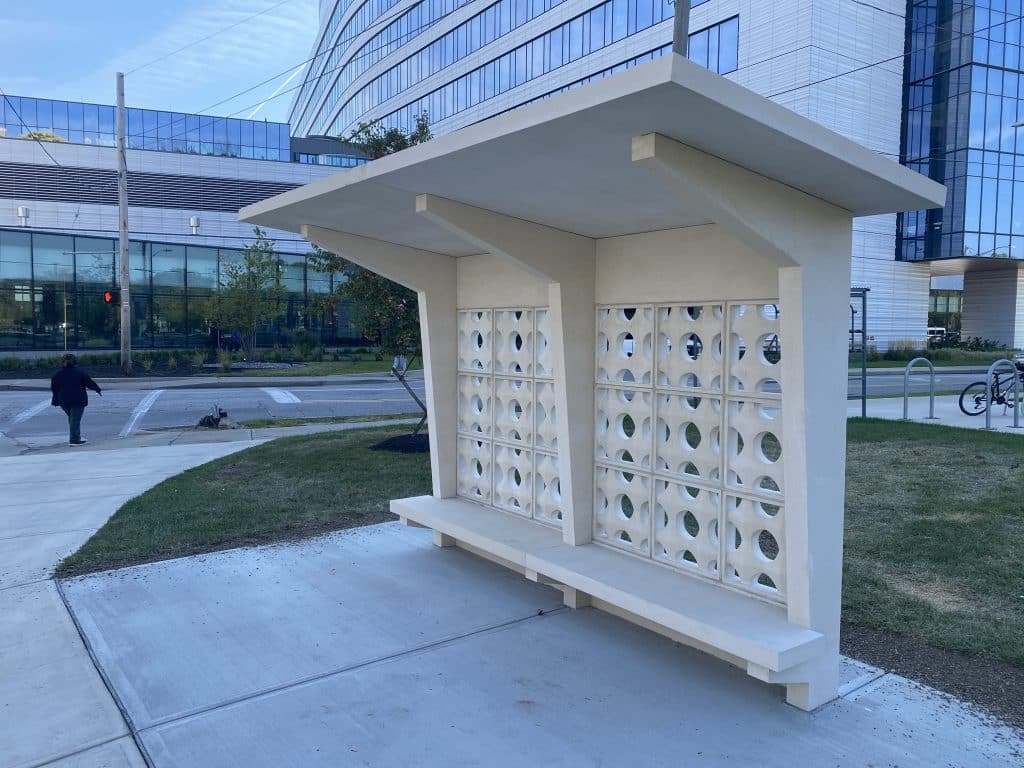
Titled “La Distancia” (“The Distance”), the new shelter – unveiled Thursday, Sept. 18 – is a stop on RTA’s 18 line, which runs from West Blvd. in Cleveland to Marymount Hospital in Garfield Heights. It sits on a patch of grass near the Glick Center, along a curved access road off W. 25th St.
More importantly, it occupies a prominent spot in the Clark-Fulton neighborhood, a district heavily populated by Puerto Rican and Latinx people, near CentroVilla25 and other Hispanic organizations. Soto herself is from Puerto Rico. She chose the location explicitly to address that community and to counter today’s unwelcoming political climate with a structure that’s familiar and friendly.
This is where the beauty of “La Distancia” begins to take hold. Although, with its bench, cantilevered roof, and rear wall, it serves as a perfectly functional bus shelter, the sturdy concrete structure also evokes Puerto Rico, containing architectural and design elements common in Soto’s homeland, where bus shelters often mirror the neighborhoods they serve.
Specifically, its back wall consists entirely of a rounded, four-point star motif Soto said exists all over Puerto Rican architecture, typically in the background. Soto said she was inspired to use the pattern after marveling at one prominent exception to the rule: the post office in her hometown of Dorado, where the star shape is repeated boldly across the entire façade.
On a practical level, the Swiss cheese-like pattern provides ventilation. No one waiting at “La Distancia” will sweat, as they might in a glass shelter. But the design also has an artistic aim: to strike a cultural chord.
“This is something that can be a symbol for celebration and care for working-class communities,” Soto said, noting the star’s roots in African Adinkra symbolism. “There’s a chance people will identify with that.”
That’s not the end of the story, however. Further reflection on “La Distancia” yields deeper meaning, and greater poignance.
In essence, a bus shelter is a point of transition, an in-between place. No one intends to stay there long. It’s the beginning, mid-point, or terminus of a journey, not the destination itself.
In that sense, “La Distancia” is a metaphor for migration, for both the process and the people engaged in it. Those using the shelter as a bus stop are like immigrants. They’re on their way somewhere, and possibly far from home. Their need for shelter is therefore real, and great.
All of this resonates keenly in Clark-Fulton. There, more than in many other places, those using the shelter are more likely to be true immigrants, people literally or figuratively making their way in a new land. What’s more, in the current political climate, those same people could genuinely use a refuge, a place in which to feel safe.
“It’s residential architecture as a monument,” Soto explained. “It’s the perfect symbol to represent migration and the gesture of waiting on the journey.”
Soto is well-qualified to be making such statements, as she herself was a migrant of sorts, albeit during a friendlier era.
She grew up and trained in Puerto Rico, and was enjoying an auspicious start as a painter when a fellowship in Paris presented itself. That led Soto to continue her studies at the Art Institute of Chicago and ultimately to take up residence in the U.S., where she’s now been living since 1998.
“La Distancia” is Soto’s first major undertaking outside Chicago, but it is not her debut in Cleveland. In fact, the shelter is the culmination of a series of projects in which the artist has showcased her designs and collaborated with the Hispanic community in Northeast Ohio.
Already, Soto has been the subject of an exhibition at The Sculpture Center and spent time in Cleveland meeting with Hispanic locals, compiling their artwork and writing into a journal titled “La Casa de Todos” (“Everyone’s Home”). This, in turn, will be available for riders at “La Distancia” to view, using a QR code posted at the stop.
“When you make public art, you’re working with a community,” Soto said. “It’s such an amazing honor. I love that part about it.”
Still, for Soto, the best part about “La Distancia” is its broad functionality. It’s a bus shelter but also a totem, something useful but also something symbolic.
With one giant piece of concrete, Soto has managed to celebrate, inspire, assist, and maybe even unite an entire community. No artist could ask for more.
“This is a real service that artists can provide,” Soto said. “It’s been so satisfying to see the project develop in this manner.”
Keep our local journalism accessible to all
Reader support is crucial as we continue to shed light on underreported neighborhoods in Cleveland. Will you become a monthly member to help us continue to produce news by, for, and with the community?
P.S. Did you like this story? Take our reader survey!