Editor’s note: This reporting began as hard news but developed into an opinion piece due to both perceived and actual conflicts of interest, including the author’s personal and professional relationships with sources and her public position in support of United Residents of Euclid Beach.
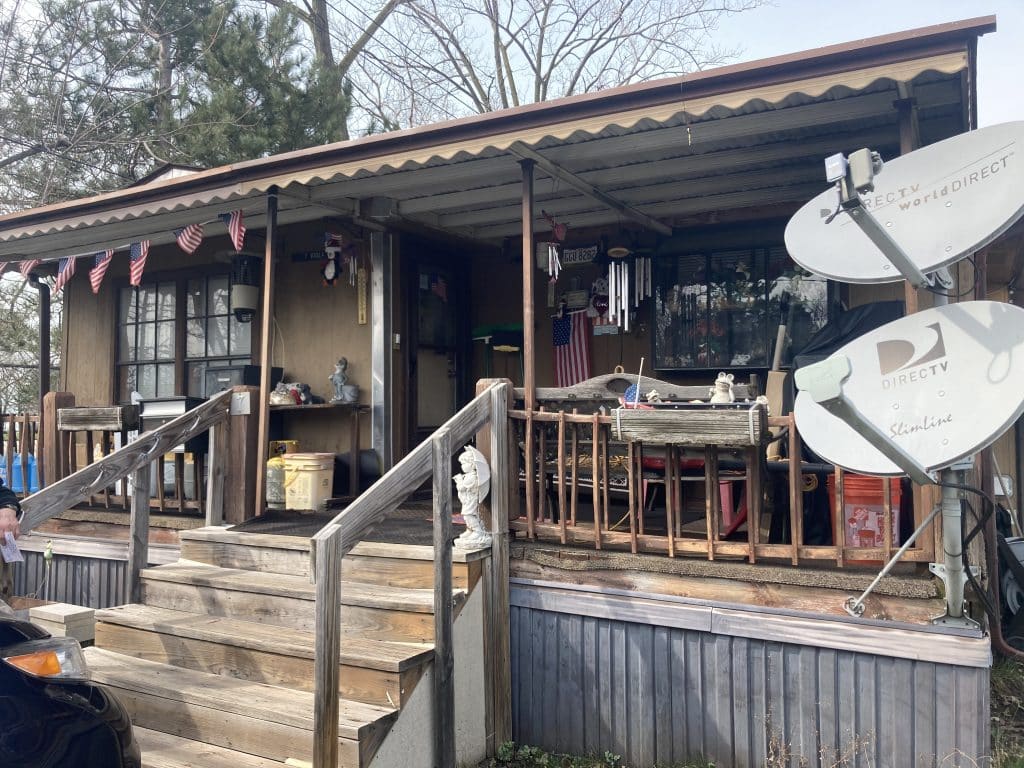
In December 2021, the nonprofit Western Reserve Land Conservancy bought the 28.5 acre Euclid Beach Mobile Home Community in Cleveland’s North Collinwood neighborhood from a Texas developer for $5.8 million. After buying it, they completed a year-long planning process with other stakeholders to determine the future of the property and surrounding area. In February of this year, Western Reserve Land Conservancy (WRLC) announced their decision to turn the entire lakefront property over to the Cleveland Metroparks, creating a signature new lakefront park on Cleveland’s east side and forcing residents to move by August 31, 2024.
The decision was framed by stakeholders as a win for the neighborhood, but is it really? I believe it’s not. This harmful decision would force residents, many of whom are elderly and disabled, to move and give up their affordable housing, and it would permanently remove affordable housing from a majority Black neighborhood and city that desperately needs it. Matt Zone, Senior Vice President and Director of Thriving Communities at WRLC, said the park must be closed because it’s too expensive to redevelop it as a mobile home park, but he has provided no evidence to back up this assertion.

What’s more, a 2019 offer letter shows that displacement and demolition was always the goal, and that the community planning process was a cover for this decision (view the letter here and here). The letter, which was written by WRLC President and CEO Rich Cochran to Moore Enterprises, the previous owner of the park, details the financial reasoning for their offer on the property, including the projected costs of the “messy, expensive, legally-complicated, and time consuming … public battle” they’d “have to endure” to “convince residents to leave.” In other words, WRLC calculated and accounted for “reputational risk” when they bought the park.
WRLC and its partners should reopen the planning process for the mobile home community, allowing more neighborhood input, and prioritize affordable housing over recreational amenities. They should publicly evaluate alternatives to closing Euclid Beach Mobile Home Park as well as funding sources that would allow the community to remain open and help residents who live there to gain ownership rights. Doing so would provide a true “win-win,” because it would potentially allow a portion of the property to be turned into a metropark while also allowing residents to stay in their homes.
Decision process excluded mobile home residents
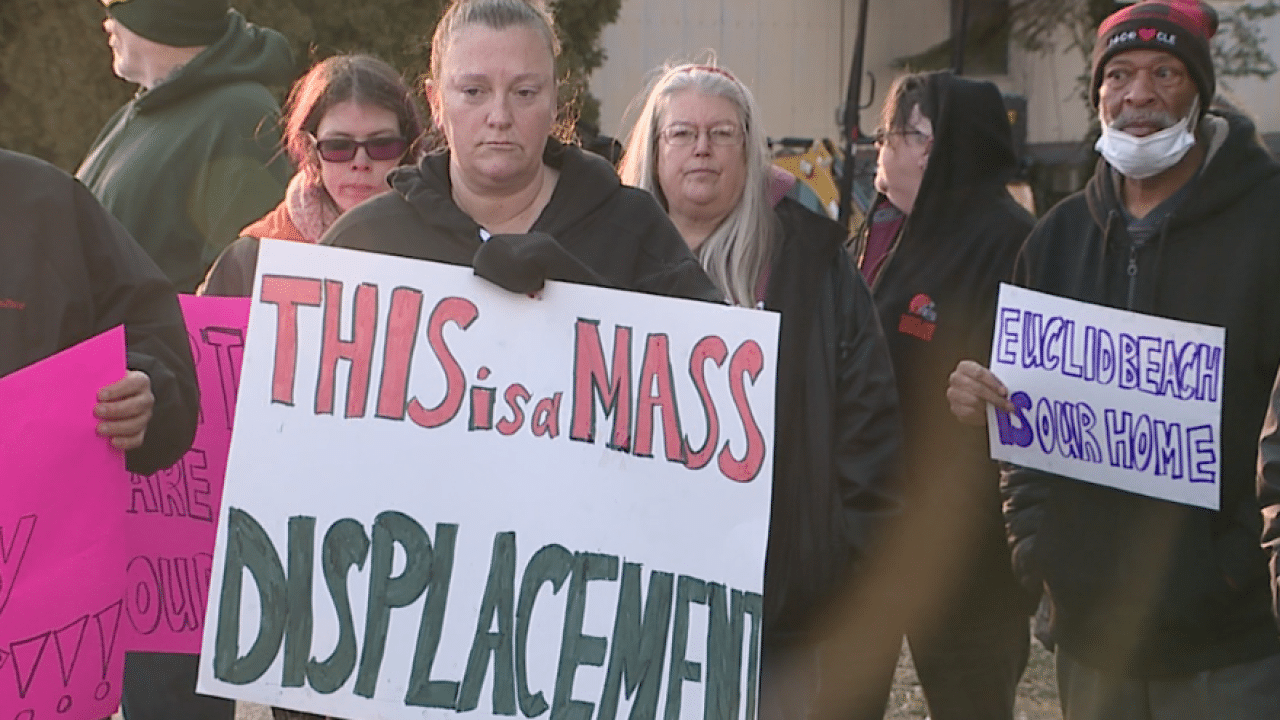
Since WRLC announced its decision, a group of residents, neighbors, and housing advocacy organizations have coalesced under the umbrella of the United Residents of Euclid Beach (UREB). They’re represented by the Legal Aid Society of Cleveland. The stakeholders on the other side include WRLC; Cleveland Neighborhood Progress (CNP), which led the planning process; and Ward 8 city council member Michael Polensek, who supports closing the mobile home park.
UREB leader Katie Nolan said she feels betrayed by the decision to close the community, which she said came as a shock to many residents. She told me, “I think if our neighbors knew that we were never included in this plan, they (the neighbors) might have changed their mind (about participating) … They conned the neighborhood so it would look like it wasn’t their decision.”
Josiah Quarles, director of organizing and advocacy for the Northeast Ohio Coalition for the Homeless (NEOCH), which has assisted the UREB in the effort to save their homes, said, “The feeling that people had going through that neighborhood plan was that there was a predetermined decision and they were just being lied to, that it was more of a PR campaign than an actual process of determining their own futures.”
Zone refuted these accusations, saying that hundreds of people participated in the planning process, including many neighborhood residents. Yet there were no residents from the mobile home community on the steering committee, according to Andrew Sargeant, Director of Open Space and Planning at Cleveland Neighborhood Progress, which oversaw the planning process.
Amy Callahan, executive director of Waterloo Arts, said the decision to close the Euclid Beach Mobile Home Park was made behind closed doors without community input. While theoretically keeping all or some of the mobile home park open was an option, in reality, she said, WRLC and others were pushing to close it.
“I was a part of the planning process,” Callahan said. “I participated in the focus groups. I answered the survey. I came to the workshops. There was not one question that I remember that was about the mobile home park. So how is that a process about the closing of the mobile home park if none of the questions are about the mobile home park?”
Renovations need to be fully considered, and WRLC needs to be transparent
One of the main conclusions of the planning process was that it was impossible to renovate the mobile home park as housing, because the water and sewer infrastructure needs are too great. In other words, if these underground utilities were upgraded so they were no longer leaking, then the owners would have to pass on those higher costs to the tenants, and the rents would no longer be affordable.
Sargeant said that planners considered residents’ needs, but faced a tough decision. “We’re not saying that residents are in support of displacement, and it’s not that we are prioritizing public amenity over where people want to live,” he said. “But WRLC inherited a situation where the housing condition was substandard. Residents understand that if (rebuilding the mobile home park) cannot be done, it’s better to turn this into a public entity than into something that’s privately owned or dysfunctional.”
Zone said WRLC held a tenant-only meeting in November 2022 in which they explained the cost of putting in new infrastructure to rebuild and consolidate the park, and that tenants said they couldn’t bear that cost. “There was a strong understanding (among residents) that it would’ve been cost prohibitive for people to absorb the cost of rebuilding that infrastructure,” he said.
But WRLC will not release these costs, underscoring the lack of transparency in the planning process. United Residents of Euclid Beach have made repeated requests for the owner’s financial projections and the engineer’s report on infrastructure issues, but these requests have been denied. WRLC also refused to provide this information to The Land.
Additionally, WRLC has said that it will not seek additional funds to redevelop the mobile home park. The national nonprofit Resident Owned Communities (ROC) USA recently developed and successfully lobbied for the federal PRICE program, a new $225 million program to invest in infrastructure and acquisition funding to help tenants purchase manufactured home communities. Yet WRLC has said it’s not interested in seeking funding for infrastructure improvements or to help residents purchase the park. Planners also turned down the idea of creating a land trust, which could help keep down costs, allowing residents to own their homes but keeping the land in community ownership.
When I asked if the steering committee had considered applying for the PRICE program, Sargeant said he was not aware it existed. Apparently the program had rolled out after the planning process concluded – yet another reason the process needs to be reopened.
WRLC considered eviction since 2019, but residents were blindsided
The lack of neighborhood involvement may have led to a condition in which WRLC could push forward their intention to close the park without community opposition. Although WRLC has denied this intent, the 2019 offer letter, obtained by Legal Aid, to the previous owner suggests otherwise. In the letter, CEO Rich Cochran factored into their final offer the costs of both demolition and the “hassle factor” of the “public battle” they’d “have to endure” to “convince residents to leave.”
“That’s a very disrespectful tone,” Quarles said. “It views people as numbers and things to be wiped away. But I think the part that’s more damning broadly of the whole process is that years before the park was even purchased, or the plan even began, the vision was to remove all residents from the park.”
The Cleveland Foundation, which was the primary funder of the planning process, and an entity that helped the WRLC purchase the property in the first place, said it was in the dark about WRLC’s intentions. “No, we weren’t aware of that language used in the 2019 letter,” said Stephen Love, program officer for the Cleveland Foundation and a Collinwood resident. Love nonetheless backs the plan because he believes it would improve equitable access to the lakefront and also, he said, ensures that residents have more time to move than they likely would have had if a private developer bought the property instead.
But WRLC did not run the planning process. CNP did – through a contract with OHM Advisors. When I asked Sargeant if WRLC had outsized influence on the planning process, he said no.
On Feb. 9 of this year, OHM Advisors presented the final recommendation of the steering committee to about 80 Collinwood residents.
“At first, it was a very cool, casual, almost procedural slide presentation,” Quarles said. “The consultants went through the different things like benches and streetscapes. Even when they presented the slide of the consolidated park, they did not talk about the closure. Residents were like, ‘Hey wait, so what you’re presenting is the mobile home park no longer existing. You’re talking about clearing the park of all the residents!’ The audience became very volatile, and then Matt Zone stepped in and said, ‘This is the final recommendation. The decision has been made.’”
The Land received a copy of the February 9 slide presentation, and it does not explicitly mention the closure of the mobile home park. It presents the recommended housing plan as “Neighborhood-Based Infill Housing” and uses the word “Transition” to refer to the process of eviction and demolition of the mobile home community.
Quarles said this was how the tenants first heard about the decision, as well. “(Mobile home park) residents were having to hold something that was devastating and very personal for them in this very public space,” he said.
United Residents of Euclid Beach leader Anthony Beard said residents “were in shock because we didn’t know what it all meant because they never said anything about closing the park until prompted.”
Creating a different outcome
If there was a stronger voice for residents at the table, could the outcome have been different? I think so. For one thing, it doesn’t appear that the option of allowing residents to remain in a portion of the park was ever seriously considered. I think it would have been brought up earlier in the process, and more forcefully, if there was a strong CDC and residents were at the table.
“As a landowner, Western Reserve ultimately had to make a decision based on their return on investment but also the capabilities of their organization,” Sargeant said. “Western Reserve is not fundamentally a landlord. They’re a land conservation organization.”
Zone expressed a similar sentiment when he outright told me, “We’re not in the housing business.” But the problem with this argument is the fact that they purchased a community with more than 100 families living there. Because of this, they are, in fact, in the housing business. Yet they refused to consider different options for keeping the mobile home community open.
UREB leaders told me that tenants want to form a resident-owned community with a land trust agreement so they can collectively own a portion of the land. In order to apply for funding to rebuild the infrastructure, however, residents need the cooperation of the owner and access to the engineer’s report. While there would be logistical and financial challenges to implement this kind of plan, there is no evidence to suggest they’re insurmountable.
“People are here and we want to help solve this problem so that everybody wins,” said Callahan of Waterloo Arts. “But the door has been shut since the beginning of this process. It’s very frustrating. There is a powerhouse of creativity and smart people here.”
It’s not too late. Reopen the planning process, keep it open to the public, and put residents and their needs at the center of the process. During a time of global forced migration and climate crisis, this is what environmental equity looks like.
For more information or to get involved in United Residents of Euclid Beach, contact them on Facebook. To learn more about the Western Reserve Land Conservancy, visit wrlandconservancy.org, call 440/528-4150 or email info@wrlandconservancy.org.
We're celebrating four years of amplifying resident voices from Cleveland's neighborhoods. Will you make a donation to keep our local journalism going?