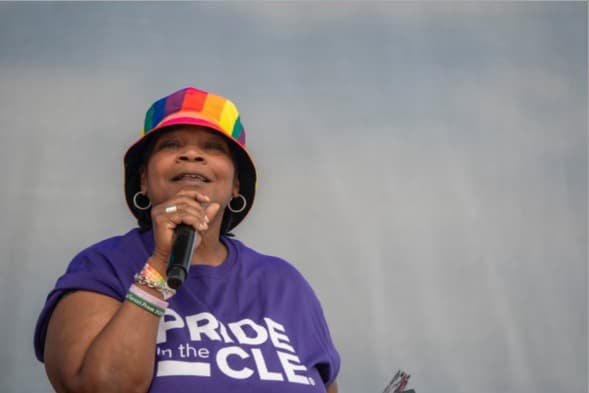
Welcome to “People of The Land,” a new series with Dahlia Fisher, celebrating the diverse stories of Clevelanders who live and work in the city. This June, in honor of Pride Month, we’re featuring prominent LGBTQ+ leaders from different organizations, who share passion for building community and making connections.
Phyllis “Seven” Harris is well-known in Cleveland as a thought-leader on cultural change. Recently awarded the Rev. George Hrbek Social Justice Activist Award, Harris was also appointed to Cuyahoga County’s Community Advisory Board for Equity, and recognized as one of 2020’s most interesting people by Cleveland Magazine. She laughs easily, listens intently, and invites strangers to feel comfortable in her presence. It is both a skill that comes naturally, and one that has served her well in her role as Executive Director of the LGBT Community Center of Greater Cleveland. But Harris acknowledges that she is part of a heteronormative society, and changing assumptions long ingrained in people’s ideologies is bound to make at least a few people uncomfortable. And so be it, she says, because the society she is striving to create is one in which LGBTQ+ people are not defined by their gender or sexual orientation, but rather celebrated for their individuality and humanity.
Dahlia: Last time we saw each other, you were speaking at Rebel Readers Book Club. We had read the book, “You Exist Too Much” by Zania Arafat, which is sort of a new adult coming out story. You said something during that book talk that stuck with me, which was: “I come out every day I meet someone new. I am constantly having to come out again, and sometimes I don’t feel like it, that’s the truth.”

What was coming out like for you and what do you mean when you say, “come out again?”
Phyllis: You know, we all have our unique coming out stories that we may choose to share or not share depending on if there’s pain associated with it, loss associated with it. But there’s the coming out to oneself that typically happens first.
I had to be about 19 or 20, and I realized that I had different feelings for another human being – and it was a woman – and I was like, holy, you know, is this real? I was by myself in a new apartment, and I remember looking in the mirror in the bathroom, and for some reason now as I recall it, I didn’t have the light on, I was just in the bathroom and I remember looking in the mirror, and I thought, “Oh my gosh, you’re a lesbian.” And taking a deep breath. That’s my memory of when I came out to myself.
After that, I had the benefit of having a supportive community around me. I could see other women, other lesbian feminists, to be really exact, living their lives. I could dream the dream of being happy, of going to college, of having a career, of having children. I didn’t understand the depth of the community and how it would be so impactful in my life.
Eventually, as I was living my life as an adult, my mom came to me and said, “I want to know what’s going on in your life,” essentially. And was like, “What? I’m just going to school and, you know, being a good person.” She let me know that she knew. She said, “You came through my body. I know who you are.” So that was a big relief. The fact that my mother did not reject me. She didn’t shame me. Some people’s parents really are so afraid that they say the worst things, in the worst ways. And that causes pain and loss, that didn’t happen for me.
Dahlia: You mentioned yourself, your friends, and your family, but I noticed you didn’t mention work. Did you come out at work? What was that like?
Phyllis: Coming out is not linear. When I went to work in regular heteronormative spaces I was the person who was just a good worker. I showed up on time. I worked hard. I focused on being a good human being and I didn’t come out. But I didn’t feel that I was being necessarily true to myself. I worked at a pharmacy in Cleveland and when someone would say, “Well, what’d you do on the weekend?” I wouldn’t really tell them that I went to the women’s variety show and, you know, there were a bunch of lesbians and women who love women there, and it was great. I was just quiet. I worked nine to five and did my job.
Later in my 20s, all of my 20-something cool friends were moving away from Cleveland. So I moved with a good friend to San Francisco and I worked on 18th and Castro as a pharmacy tech at the Walgreens there, right in the heart of everything lesbian and gay and queer in San Francisco at the time. This was in ‘92 and ‘93. Everybody was mostly gay or lesbian or trans in that space. So that was easier. It gave me courage, right? It gave me courage to live my life in my work, play, and home, as myself.
I learned two things there. I learned compassion for people because it was during the HIV/AIDS crisis, you know, really tough times. People were dying. There was a lot of fear. And I learned about being compassionate to people who are afraid. When I gave them medicine, I made sure I touched them and smiled, you know. I also learned that I am an OK human being, whatever my sexual orientation, I am going to live. And so that was pivotal to me coming back and saying I’m going to be myself everywhere.
I only stayed a year in San Francisco because I missed my community in Cleveland.
Dahlia: It sounds like that year in San Francisco was transformative. What was it like to return to Cleveland?
Phyllis: When I came back I got a job at the Cleveland Rape Crisis Center and it was inclusive and so there wasn’t that feeling of having to leave part of myself behind at work. But, loss started happening when I had to be in networking spaces, right? I recall being at a health and human services conference and at that time I was partnered. I did wear a ring and the question would be, well, “What does your husband do?” I would have to, at that point, assess whether or not to come out.
A friend gave me this line that I will use forever. The response is, “I’m in a loving relationship with a woman.” So when asked, “What does your husband do?” which is the heteronormative way of thinking that everybody’s straight, having a response that allows for you to keep the integrity and authenticity of who you are in terms of sexual orientation and watching the response, is always interesting.
Sometimes the response is, “Oh, cool.” And you know that they are cool because they’re willing to re-engage with you. It’s funny when people whisper and tell me about the gay people in their life, like, they have to keep it quiet, you know like, “I have a black friend,” that kind of thing, “I have a gay friend.” But the times when the loss is felt immediately, is with the face of like, “Oh God,” like they are thinking, “How do I get out of this?” And then nothing else. They avoid you for the rest of the dinner or whatever.
And so coming out happens like that. You’re always gauging it, you know, it’s an ongoing thing.
Dahlia: Do you ever feel like being out has hindered you professionally?
Phyllis: People have actually told me, “Well, we wanted to give you this award three years ago, but our committee wasn’t ready for that.” And I want to say, “You could have kept that to yourself.” They mean that they fought hard and advocated because they’re an ally. I think that’s what they feel, and what they mean. But that makes it about them. That’s them telling me how good they are. So I feel like that is a kind of loss, like what are the awards or opportunities that I am not being considered for professionally because I am an out lesbian?
I think I do a good job as a non-profit leader. But I also feel a level of isolation, of loneliness. I don’t feel like I’m in the club with other straight women who are non-profit leaders, who might provide support for each other because they are comfortable with each other. A few progressive women have actively reached out to become advisors, mentors, friends. More generally, I feel like I land in an orbit by myself.
Dahlia: Have there been situations when you opted not to come out, to see if people respond to you differently?
Phyllis: When I say I work at the LGBT Center, I’m coming out. I have to choose, sometimes, what I will say when someone asks me. If I’m in an Uber ride, you know, it’s like, “Oh, what do you do?” They’re just making small talk and I have to decide, “Do I tell them I’m going to Pride in the CLE?” Or do I just say, “I work at a community center in Cleveland.” Always gauging the risks, the potential for loss when coming out, when is it OK being real about who you are.
And it is not the first thing that I want people to know about me, necessarily. I want to talk about parenting. My kids are 18 and 26 and I still want to talk about it. I get excited about that.
Dahlia: Great, let’s talk about parenting! What was it like becoming a mom in a same-sex relationship, 20-plus years ago?
Phyllis: Parenting is more heteronormative and becoming a mother allowed for more acceptance from my extended family. I got a lot of good advice from Black aunties and grannies. My mom’s best girlfriends became interested in talking to me because they had a frame of reference for motherhood. I wanted to be part of it.
I didn’t want my kids to feel difference or separation, but I also didn’t want to raise homophobic kids because we were hiding who we were as if there was something to be ashamed of. We were very intentional about raising kids who did not hold their own internalized oppression about their parents’ identities. I know other queer parents have this issue.
Dahlia: How have your kids handled it?
Phyllis: I have beautiful memories like when my son was taking French class in high school and had to do an introduction about who he was and he described his parents. He talked about us in terms of what we did for our professions, sort of nonchalantly, like his mom does this, and his mama does that – he has a mom and a mama. His grievance in his essay was that we were vegetarian and he wanted to eat meat. He was mad about that. I thought my kid’s going to be alright. And my daughter has a different, but similar story. It was never an issue, you know, never seemingly an issue and that really signaled to me they’re OK.
So I do think that there is hope around young people because they are part of our movement for respect and rights and protection and equality. We’ve raised some amazing human beings. We have added value to our society by choosing to have children, allowing them to see that we love ourselves and we’re OK with who we are and we can have wholesome lives. I really do think our children are the strongest allies we can have. And along with that when their peers come out, or when they meet people and their families are different, and configured in all sorts of ways, they don’t flinch. In fact, they much rather be in a more diverse and inclusive experience. If I think about my children and who their friends are and the diversity, it’s wonderful.
Dahlia: Do you think, culturally, things have changed for people who are coming out today versus when you were young?
Phyllis: I think older people that come out, they’re in a different sort of position of power within themselves. Young people feel much more vulnerable. They have less control over the circumstances of their lives around basic needs. It doesn’t mean that when you’re older, you don’t struggle with that because of what you might lose and discrimination is real for LGBTQ folks. Even those who are perceived to be gay or lesbian or trans are sometimes discriminated against.
I do think society has progressed. There has been progress in terms of the LGBTQ movement for rights, protections that are needed, given that we are a small percentage of the dominant culture, right? But, I think that it’s very easy to sort of whip-up the anxiety, the fear, the whatever-it-is, and use us in a way that our lives can be politicized.
Opportunists divide and polarize. And so it never goes away, right? We don’t have federal protections. And so the Equality Act needs to happen.
Dahlia: What do you mean there are no protections?
Phyllis: There are no federal protections. And, in Ohio, there are no statewide, anti-discrimination protections. So, when folks are feeling like they need to feel better about themselves by way of oppressing someone else, it’s very easy to use, say, the few trans kids who want to do sports, as targets to get people to be hateful, committing acts of violence, verbal or physical discrimination, marginalization.
Sometimes, it can be hard to see the progress or feel the progress, and yet I do think more people are coming out. I don’t think there are necessarily more LGBTQ people, but more of us are finding strength and comfort in being our full selves. That takes courage, to have a desire to live. And their physical and mental health are OK because they have had whatever privilege that they’ve had. They’ve been able to insulate themselves from the challenge of being different. Then there’s the mainstream, where there’s lots of work to do.
I really think that there’s an opportunity for change, as much as we’re hearing anti-LGBTQ violence and legislation, I do think that there’s hope for change. There’s hope in our children, who we’ve raised to be humanitarians. There’s hope in the language that exists now for folks to be able to say, “This is who I am and I feel affirmed because this makes sense for me. And yes, it’s different from mainstream, but I’m not out there floating thinking I’m lost.”
Dahlia: Our society definitely seems to have language around gender and identity that didn’t exist before, or is the language just more mainstream now?
Phyllis: When I first started at the center, I didn’t know to use the term gender expansive. I didn’t know to use the term non-binary. People weren’t using that even 10 years ago. The evolution of language has changed. We are figuring out how to talk about who we are and how we express who we are.
I don’t think I’m flawed, or that being gay or lesbian or trans or non-binary, that it’s a flaw. I think it is. It just is. And if we’re all created equally, in terms of what we bring to the ecosystem, we each have a purpose like any other human being.
If we looked at trans identities and decided to just allow people to express themselves the way that they want to, how much healthier would we all be. Think of the stress that comes with trying to dislike or hate or leave someone out. That takes so much energy.
Instead what if we said, “Come closer. Tell me about who you are. OK, I’ll get it right. I’ll work on it. I can use pronouns. I can come closer to who you are.” We don’t have forever here.
Dahlia: What can we do as a community to be supportive of this idea of coming closer to each other instead of driving people farther apart? What is the center doing?
Phyllis: When I think about it, what comes up is the idea of having a place for folks, right? The center provides a space for us to escape heteronormativity. You step off of Detroit Avenue into our building and it is a space that has been created with LGBTQ people in mind and what they might enjoy, how they might experience culture, and being enriched from the center, a community center, a cultural center, a place where they can find other people, their people, you know. It’s important that we find our people. Our traditions like pride and coming out day and trans visibility day, is prioritized, right? It’s not a second hand inclusion.
One of the things that I like about having a vibrant center that is key to LGBTQ culture and heritage, is that there are places to go other than bars. I like a good bar, but if that is the first foray into finding your people for LGBTQ people, there could be other challenges there, like navigating alcohol and drugs. And like any other young person, people can’t wait until they hit 21 so that they can go to the club and have that type of experience, but what else do we have? What else do our young people have, so that it is not all about partying, but it’s also about connecting to other like-minded individuals.
There’s programming for young people at the center, and there’s programming for seniors at the center. LGBTQ folks, we get old. We age. And so what are some of the challenges around that? And, do we have supports, do we need supports? So I think there’s an educational perspective.
And we need our allies. We forget that there are lots of them. We haven’t activated them. We haven’t said, come on allies, we got this issue, and let’s get organized around it. So I want to do more of that. I want to appeal to straight people, and I want to teach them how to be good allies, because I’m telling you, we need you. Don’t be silent and say things like, “Well, I don’t really care.” We want you to stay curious about who we are, because if you do that, and if you lean in, you’re going to see that we are worthy. So I want to speak to allies more, and I’m not trying to convince allies to accept who I am necessarily, for me to feel affirmed, but I just need your help. We need your help. Our children need to be healthy, have mental health wellness, it’s important.
Some of the mental health challenges may be avoided if our young people aren’t rejected, if they don’t have to live in fear about who they are. Yes, they might have some anxiety about being different, but they need to be able to find their people and find like minded individuals.
Dahlia: Do you have a message for straight people, or any people, who are going to read this?
Phyllis: Be an upstander and be visible, be a vocal active ally. I think that is super important. It will make the difference for our young people, for LGBTQ people in general.
I’m full of gratitude anytime anyone leans in for the good of their own learning, because of their curiosity, or because they want to be part of the change that we need in being accepting and inclusive of people and creating space for people. So thank you. I have the privilege to be in a place where people think I might have something to say, but not everyone asks. So, I’m glad that you did.
Dahlia: I’m glad that you are willing to share your story. Thank you.
Phyllis: You know, I’m not unique. I mean, I’m unique in that I am who I am, myself, my story. But there are other black lesbian feminist moms, nonprofit leaders, and I don’t hear enough from them, so if I don’t hear enough from them, I’m certain that straight people, other people don’t hear enough from them either. Nobody is going to tell our stories. Except for us.
____
Do you know a Clevelander whose story deserves to be told, please email rebelreaderscle@gmail.com to be considered for a future issue of People of The Land.
We're celebrating four years of amplifying resident voices from Cleveland's neighborhoods. Will you make a donation to keep our local journalism going?