
For students who have struggled in traditional high schools, Promise Academy, a free, public dropout recovery high school at East 13th St. and Superior Ave. in downtown Cleveland, offers both a quality education and a path to graduation. Students and staff at Promise say one reason the school is special and different is because of the personal relationships students have with their teachers and staff from the principal to security guards. “Earning a high school diploma completely changes your life, changes how you think of yourself, and how others think of you,” explains Promise Academy board president Lynn Phares.
Jay, a senior graduating in May, started at Promise when his social worker enrolled him after he came home from a residential treatment program in 2021. “It’s a good school,” he said. “They care for their students. They’ll feed you. They’ll hear out your problems. They really care about you, and they want you to do better. They drive you to do better.”
Students come to Promise, which is a public charter school sponsored by the Buckeye Hope Community Foundation, after they’ve already tried traditional high schools. Ranging in age from 14 to 21, most have dropped out of traditional high school several times. Most, but not all, are low income. Some students have children themselves, have been in the juvenile justice system, move frequently, have incarcerated parents or parents who have died, and are raising siblings and taking care of households.

After a student goes through an initial orientation, a customized path to graduation is created and the student works at their own pace. Each student faces a wide range of diverse challenges, yet executive director Dr. Jeff Jaroscak emphasized, “No matter what your traditional high school experience was, we can help you.”
The absolute top priority of Promise Academy is graduating students. This is crucial because of the impact a high school diploma makes on students’ lives. “I think that our laser sharp focus on getting kids graduated makes us special,” said Promise Academy principal Dr. Heidi Rock.
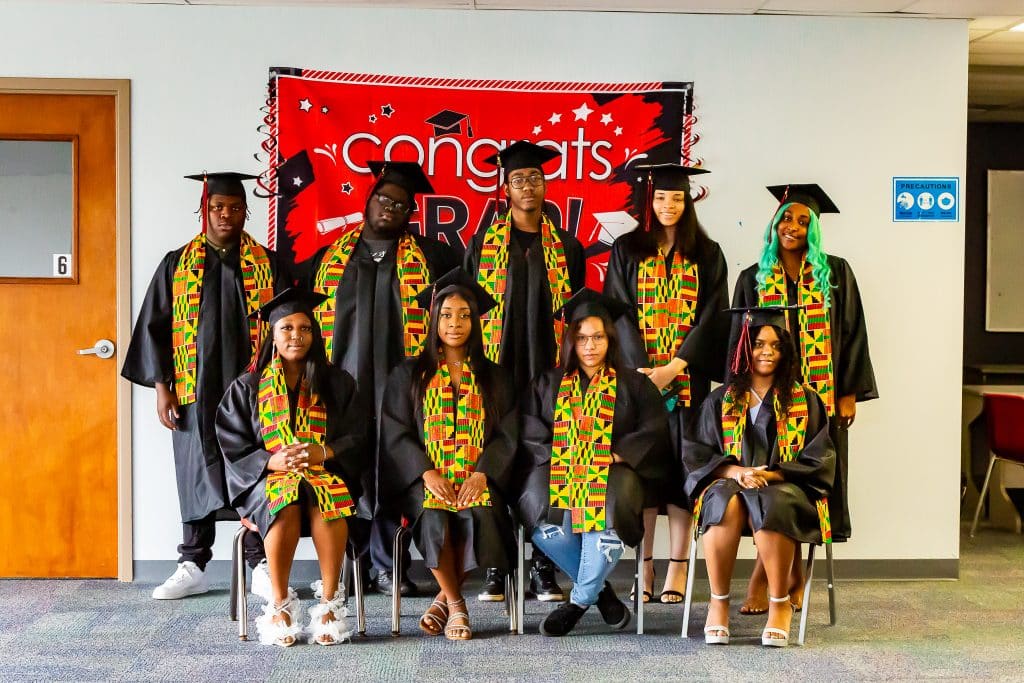
The importance of a diploma
Jaroscak explained that having a high school diploma is better than having a GED, which stands for general educational development and is a high school equivalency certification for adults who didn’t finish traditional high school. “There’s not much difference between a diploma and a GED in terms of equivalence,” he said. “However, when you go somewhere and say you have a GED, you’re going to have to explain why it’s not a diploma.”
Frequently, employers and others make assumptions about people who were unable to negotiate a traditional high school experience, Jaroscak said. As a result, not having a high school diploma can have a long term impact, potentially holding back individuals from earning their full potential once they’re employed. “A diploma from Promise Academy carries the same weight as any other high school diploma,” he said. According to the U.S. Bureau of Labor Statistics, on average, high school graduates earn almost $800 more per month with a high school diploma than GED certificate holders.
Rock shared a story of a young man who quit his job at Papa John’s the day he earned his diploma because he was able to obtain a section leader position at Giant Eagle at a considerably higher salary. “So, for him, that diploma really meant something,” she said.
A high school diploma even carries public health benefits; people without diplomas are at higher risk for chronic illness, diabetes, and liver and kidney disease, Jaroscak said. U.S. Census Bureau data confirms that GED holders are less healthy than those with a regular high school diploma.
What makes Promise Academy special
Jaroscak said there are three things that set Promise Academy apart. First, it is a brick-and-mortar school, meaning that students come to class in person. Equally important is that a teacher is there in the classroom to guide students through the coursework and offer plenty of support. Classrooms are not simply a location for computer terminals where students take online classes.
For kids who went to school during Covid, this is important. Ahleyah, now a student at Promise, did not do well with virtual school during the pandemic, which hit during her freshman year at another high school. Working on the computer “threw me off,” she said. She didn’t like online learning. “So, when Covid hit, me and my friends, we just started slacking. I couldn’t cope with virtual learning.”
Ahleyah found Promise through a friend and immediately liked it. “So, I started doing my work, coming to school every day,” she said. “I even do work at home on the weekends.” Ahleyah is now a senior, and said of Promise, “They’re like a gift. I wouldn’t trade Promise Academy for the world.”
Another reason Promise is different, leaders say, is the school culture. Jaroscak said, “We have had a number of students who say, ‘This is the most quiet part of my entire day.’”
The third reason Promise Academy is unique “is because we have programming designed to treat the initial causes of the dropout,” he said. While every student has a different story about why traditional high school didn’t work for them, there are commonalities. Students can be pulled out of school by family because they are needed at home to care for others or to earn money for the household. To counter that, Promise tries to show the student’s family the economic value of a high school diploma.
Some students leave school because they have been expelled for behavioral reasons, Jaroscak said, but Promise works to keep them in school. “Kids come to us with frustration, anger, discouragement … We’re always cognizant of the fact that we’re a school, we’re not a mental health agency, but if we can keep them in school, chances are, they’ve got the intelligence necessary to get the diploma,” he said.
Some students also decide to leave high school because they’re discouraged. Promise breaks down the school year into smaller time periods so students can experience achievement regularly on a smaller scale. Promise also offers some special programming outside of regular classes, such as art programs.
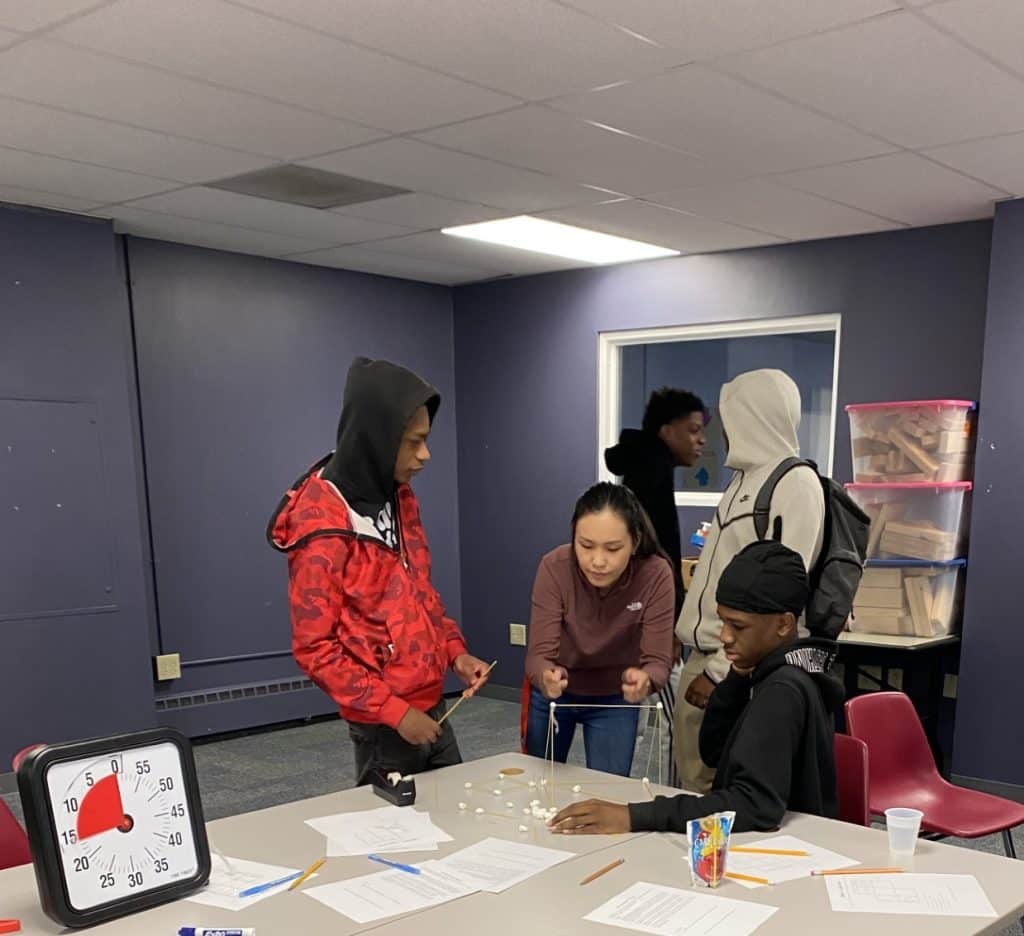
More than anything, students at Promise talk about care and individual attention. Adriana explained, “The school is very small, but the people here, they really care about you. The smaller the environment is, the more you connect with the teachers.”
Jay summed up his experience at another dropout recovery school by saying, “You didn’t get that much care from the teachers. That was really the difference. And the food was worse.”
Phares said teachers and staff at Promise really know the kids. They “have a sense of what’s going on in their lives, and what works with them and what doesn’t, and they all engage with them.” For example, Rock will often take a meal to the house when there’s a death in the family and flowers will be sent after a funeral. During a snowstorm this winter, Promise had staff in the building for students who needed a place to work and lunches and food were available that families could pick up.
This care is by design. Phares added, “We really try and make sure that every kid in the building has one or two adults that if something came up, they would feel comfortable going to them … and saying, ‘Hey, this thing is happening in my life.’”
Success metrics and the pandemic
Standard high schools use four-year graduation rates to measure their success, but Promise can’t do that because most of their students have made previous attempts at traditional high schools and are already behind when they arrive at Promise. Leaders say the school is graduating students even if those accomplishments are not reflected in the state of Ohio’s traditional methods of tracking them. Jaroscak said, “We judge ourselves on individual success stories and also on academic completion.”
During Covid, when Promise students were at home using laptops the school provided, there was no way for teachers and staff to have face-to-face conversations with students, which is the bedrock of how and why Promise’s model is successful. Remembering that time, Jaroscak said, “Who knows what the students’ home life was like. If mom or dad were fortunate enough to still be working, [the students] were trying to manage the household. So yeah, it was really a dark period in Promise’s history.”
Now, Rock said, older students have disappeared and younger students are coming to Promise after being isolated during the pandemic. “We’ve had parents who have said, ‘We walked into our neighborhood high school, and there was a panic attack, and we had to turn around and walk out,’” Rock said. “And then it was, ‘Where do we find a school where my kid will not be anxiety ridden?’”
Adriana will graduate in May and has been accepted to Alabama A&M, where she will study Criminal Justice, something she has always been interested in pursuing. She was 15 when Covid began. ‘I kind of like hands-on, so it kind of ruffled me up a little bit. I just had to learn everything on the computer,” she said. After schools opened up again, she tried traditional school but “it was kind of weird because everyone had to wear masks and stuff, and it really wasn’t the same as before COVID hit.” She and her friends had trouble adjusting to going back to school after spending an entire year learning online.
Chronic absenteeism is a continuing concern that began during the pandemic. Rock said, “Nobody knows where the kids went. Mayfield, Garfield, Maple Heights, Cleveland. They’re all saying enrollment is down.”
In fact, between August 2020 and March 2021, when most students finally returned in person, only five course credits were awarded at Promise. That changed dramatically once students were back in the classroom. From March to June 2021, 50 credits were awarded. For the 2022-23 school year, the school awarded 350 credits. It’s aiming for 390 this year, but may miss that mark because enrollment, which is about 91, is down about 10 students.
Twenty credits is the minimum you need to graduate from a traditional high school. It’s the same at Promise. Typically, at traditional schools a student graduating in four years will earn six credits each year. “But 95% of our kids come to us having already missed the opportunity to be counted as a four-year graduate. So, we are never really going to hit the graduation rate metric,” Jaroscak said. The latest Ohio School Report Card shows exactly that. The 4-year graduation rate is 0%. But the 5-year graduation rate is 12.5% and the 6, 7, and 8-year graduation rates are all above 20%. Phares said that meets the standards for what the state expects for dropout recovery schools, and it’s realistic for the student population, where typically somewhere between 10% and 25% of kids are homeless.
In addition to a standard high school diploma, Promise offers special certificate programs including STNA (State Tested Nursing Assistant); Rise Up, a retail industry credential; Microsoft Office credential; the Six Sigma Lean Yellow Belt; and Leadership Excellence certificate.
Jaroscak explained, “We are very proud of the valuable pathway to graduation that we have established. We have a well thought out program where a kid can earn credits more quickly than they can in the traditional high school, leading to graduation, industry credentials, etc. So, we have a pathway.” But, he added, “Now we just have to keep the students on the pathway. And that’s hard. That is a difficult thing. I could not even begin to count the number of things that could happen to one of our students at a greater rate than what could happen to students in Solon, Aurora.”
Ahleyah, who will graduate in May and recently earned her STNA certification, said she found her place at Promise. “When I came to Promise, it changed my whole world. It blew my mind. I was like, ‘Wow, this is what an actual high school feels like.’ So when you walk out that door, you have a pathway. You want to be a doctor, or you want to be a lawyer, or you want to be a police officer. They have those opportunities that other schools don’t have.”
This article has been updated with Promise Academy’s current enrollment numbers. With 91 students enrolled at the school, enrollment is down about 10 students.
We're celebrating four years of amplifying resident voices from Cleveland's neighborhoods. Will you make a donation to keep our local journalism going?