“I want to be able to read my Bible,” the older man told me. I had asked him what brought him to Seeds of Literacy, the local nonprofit where I’ve been a volunteer tutor for the last few years.
Back then, he didn’t know how to read at all, so together we practiced phonics and sounded out three-letter words. Over the months, in between lessons, we talked about his wife and children and grandchildren. We talked about his memories of his parents, the Southern farm where he had grown up, and the small, segregated school he attended as a Black child.
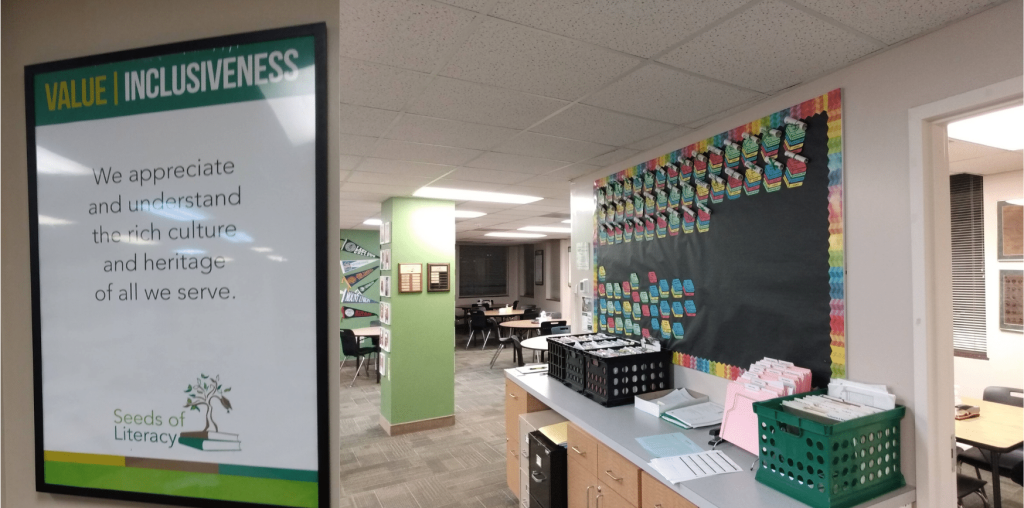
Now, the classroom where we worked side by side is empty. At the end of August, Seeds’ east side location closed.

Every student at Seeds of Literacy has a story. Some are beginner readers like my student above. Most are further along, working on getting to grade level so they can pass GED tests in reading, math, social studies and science. But their reading and math levels are not the stories of who they are as people.
They are spouses, parents, siblings and friends. They knit, dance, work, garden, you name it – one of my students even posts Christian hip-hop videos on YouTube. And they are fun – I have had so many laughs in the classroom with my students over the years.
They also struggle. Name a hardship, and Seeds students have had it. I’ve had students next to me in tears with pain from a toothache and, in one case, a brain tumor – but still wanting to push through and study. Over and over, it’s clear that students have the wrong glasses prescription, or that they need reading glasses they don’t have. Many are disabled or have chronic health conditions. Few have cars, and many take multiple buses to get to Seeds of Literacy. Some students ration how many days a month they can come to Seeds, because bus fare adds up quickly.
All of them are among the hardest working people I know. Tutoring adults is so different from a classroom of children, some of whom may have no interest in school. Seeds students want very much to be there; to get the education they never got; to succeed.
But, now – the closing. Yes, due to its Kinsman Road building being vacated, Seeds East has no home anymore. (The west side location on West 25th Street is not affected.) And due mostly to government funding cuts to adult education this year, Seeds is suddenly hundreds of thousands of dollars in the hole, making it impractical to move to a new location right now – even if an appropriate one, accessible by bus for students, could be found. Many staff members have been laid off, and the overstretched remaining staff are valiantly wearing extra hats.
Seeds is funded through a mixture of federal and state funds, private donations and nonprofit grants. Historically, about 40% of its funding has come from government funds, says Bonnie Entler, executive director of Seeds of Literacy. Last fiscal year, Seeds absorbed a $150,000 cut in its state Aspire grant. Seeds lobbied for an earmark of $250,000 to help ensure funding stability, but it did not pass the Ohio legislature.
“We did a tremendous amount of advocacy work this year,” says Entler, including travel to Columbus and Washington, D.C. and hosting local legislators at Seeds. “We were really trying to share not only the importance of adult literacy, but just the uniqueness of Seeds and the importance of our students and how this really changes our students’ lives and helps fill all those gaps” from workforce development to financial and health literacy. “Education is that foundation to absolutely everything. Sadly, our students are really the forgotten population.”
The funding situation has gotten worse since June, when the last fiscal year ended. The federal portion of the Aspire grant (normally paid at the end of June) was frozen due to the elimination of the federal Department of Education. While those funds have officially been released to the state of Ohio, they still have not been distributed to Seeds and other educational providers while the state puts new federally required processes in place. Meanwhile, Seeds has decreased its annual budget from $2 million (last fiscal year) to $1.6 million in “anticipation of decreased public funding (local, state, and federal),” says Entler.
For now, east side classes will continue at the Shaker Heights main library temporarily and on a limited basis (mornings only, in a small meeting room with no storage or testing spaces). Without a permanent new home and the restoration of funding, Seeds’ good work and vibrant community on the southeast side of Cleveland are in grave danger. Before this recent crisis, Seeds was working toward opening a third location in northeast Cleveland. Ideally, every neighborhood in Cleveland would have its own Seeds branch. The need is tremendous – but so is the work of Seeds of Literacy.
At Seeds, it’s always been about the students. At Seeds, each student is lovingly taught, one to one, with a curriculum customized exactly to their goals and needs.
The sad bottom line is that every one of these students was failed when they were children. They did not get what they needed from their schools. Whether it was undiagnosed learning differences, overburdened teachers, under-resourced schools, or personal burdens that no one helped these kids carry – they were failed.
Without robust support for organizations like Seeds of Literacy, I fear we will fail them again.
Keep our local journalism accessible to all
Reader support is crucial as we continue to shed light on underreported neighborhoods in Cleveland. Will you become a monthly member to help us continue to produce news by, for, and with the community?
P.S. Did you like this story? Take our reader survey!