The event, featuring a gathering of leading local writers, celebrated the mission of helping young creatives in the juvenile detention system to find their creative spark.
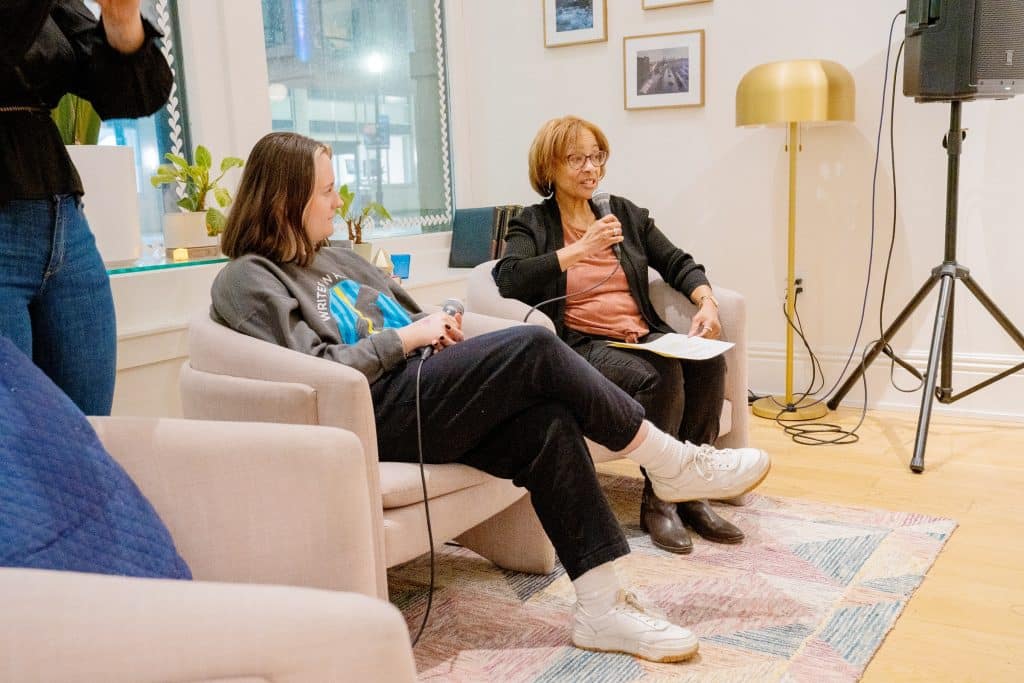
Resilience and hope were the guiding themes throughout a series of readings during an April 12 chapbook release party at Lekko Coffee on Detroit Avenue. Writers in Residence brought together works from young artists speaking to their experiences in the juvenile correctional system, along with insights from some of Cleveland’s leading writers and creatives.
Writers in Residence is a local non-profit that aims to reduce recidivism rates in their residents through creative writing. Their participants (also known as residents) consist of youth currently in detention at their partnered facilities, including Medina County Juvenile Detention Center (JDC), Cuyahoga County JDC, Seneca County Youth Center, Portage-Geauga County JDC, and Lorain County Juvenile Detention Home (JDH).

Writers in Residence has held writing workshops all over the state of Ohio, partnering with several colleges and universities to bring teaching artists and volunteers into the program to inspire creativity in youth.
For the chapbook being celebrated with the release party on Friday, April 12th, this cohort was working closely with advisors from Case Western Reserve University and Cuyahoga Community College (Tri-C). Within the chapbook lies a “Letter from the Cohort” page, on which Case Western & Tri-C representatives penned a letter discussing how inspired they were by the residents, how fervently they tackled the writing prompts and how bold they were in their expression. The chapbook covered topics such as friendship, grief, loss and breaking the stereotypes of being a misunderstood teenager.
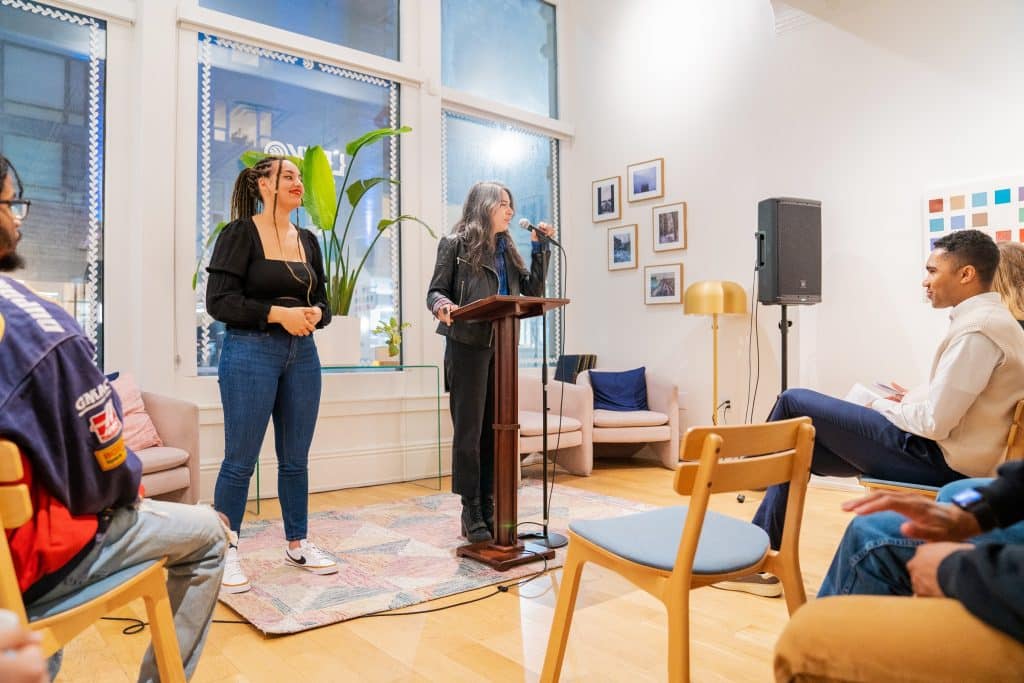
From the perspective of an audience member, and someone who works with youth in art education, I could tell that within this cohort, there was a mutual inspiration, respect and an exchange of lessons and understanding.
A goal of the program, outside of teaching creative writing and reducing recidivism, is to empower the youth and amplify their voices to assist in their process of re-entry into society.
It is clear within their model that they are not just arbitrarily utilizing art to connect with their residents, but skillfully and carefully using it as a tool to help them navigate trauma, establish safe spaces to explore emotion and creativity, and support them as they move through stages of their detention and eventual release.
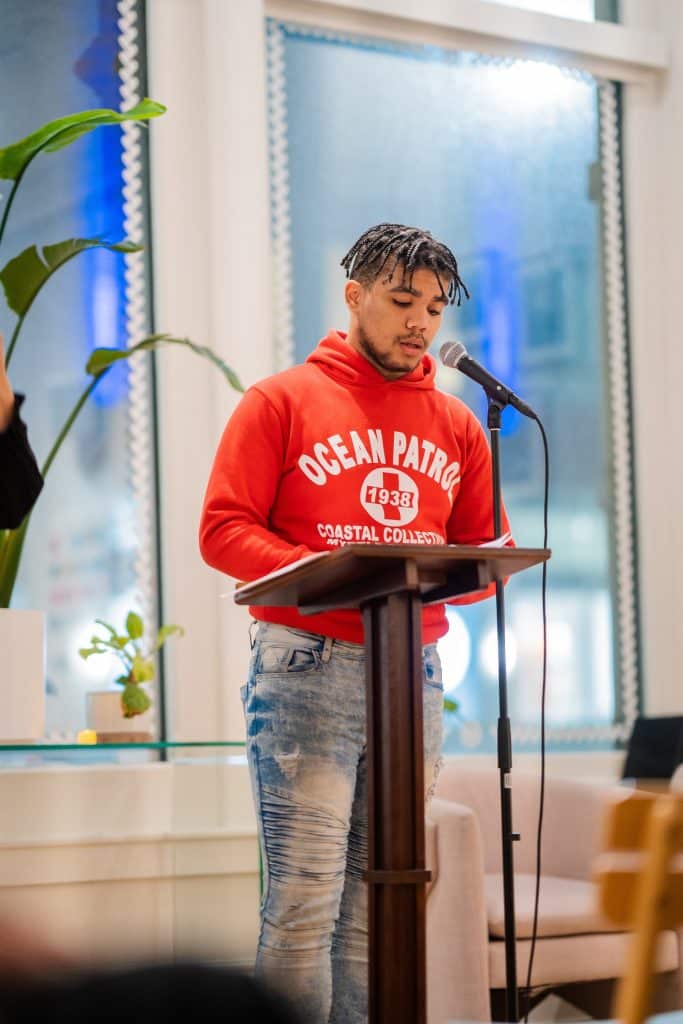
I got there a bit early so I could get a good seat and take in this new space. I had never been to Lekko before and it was an ideal venue for poetry in the community. I noticed a young man in a red hoodie up front that seemed a bit nervous – he couldn’t really sit still. I could recognize that feeling and noted that he must be speaking later on. Staff and volunteers in the Writers in Residence shirts kept checking on him and talking with him, smiles and laughs in each interaction. The sense of support and care was palpable.
He spoke near the middle of the program and I learned his name was Jabari and that he was an alumni, a former resident in a writing workshop.
One of the first things Jabari read was a Robert Frost poem titled, Nothing Gold Can Stay. He stated that this was a key source of inspiration for his own writing, and he shared it with the audience. An eight-line, elegiac poem with a mournful tone, but one that cherishes the moment in the way that only poetry can.
Jabari shared a couple of his own poems to an engaged and attentive audience, who closely watched him and clapped after every “thank you” he finished with. His poetry featured vulnerable explorations of mental battles, emotional trials and promise. His final poem, Let there be hope, discussed a conversation he had with his mother while he was still in juvenile detention and awaiting freedom, while his mother instilled hopefulness in his return home.
The event also involved some of my favorite Cleveland based poets, who I love to see every chance I get. Stephanie Ginese, Kisha Nicole Foster, Quartez Harris and Damien McClendon all graced the stage and read poetry that they had shared with students during workshops; either new works or poems from their own published books.
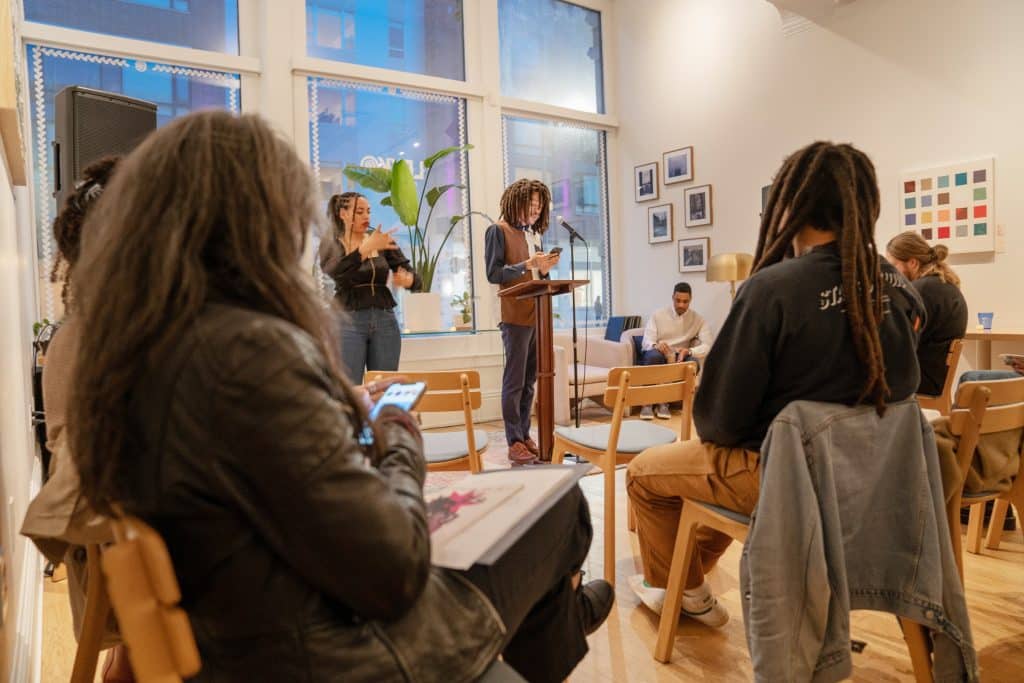
Damien McClendon, the former poet laureate of Cleveland Heights, read poems about presence and black linguistics. His work spoke to the comfort and rich culture within Black American slang and vernacular, and the pride in teaching it to his son. He stated that students really enjoyed that poem, and it made me think of how refreshing and validating it must have felt for the residents to have a guest teacher come in and beautifully write about the ways you have in common to express yourself. Young people, especially young black boys, are often so heavily criticized for the ways they speak, and are quickly judged and labeled uneducated or unwilling to learn to speak “properly.”
Quartez Harris read poems from his recent second edition version of We Made it To School Alive, which is a collection of poems written from his experience as a second grade teacher, observing his students. The book starts with a James Baldwin quote: “It isn’t long – in fact it begins when he is in school – before he discovers the shape of his oppression”. This quote is from Baldwin’s speech, “A Talk to Teachers.”
This speech is Baldwin speaking to educators in 1963, encouraging them to help students break the mold and question the society they live in, help them recognize their reality and build the courage to change it for the better, after all the injustice society was enduring at that time.
This quote preceding Harris’s book speaks volumes, especially with poems like “can I be good,” written from the perspective of a student who is ignored when raising his hands in class, but gets his full name called when they bang on the desk; the final line reading “can I be good / long enough / I swear, I’m trying.”
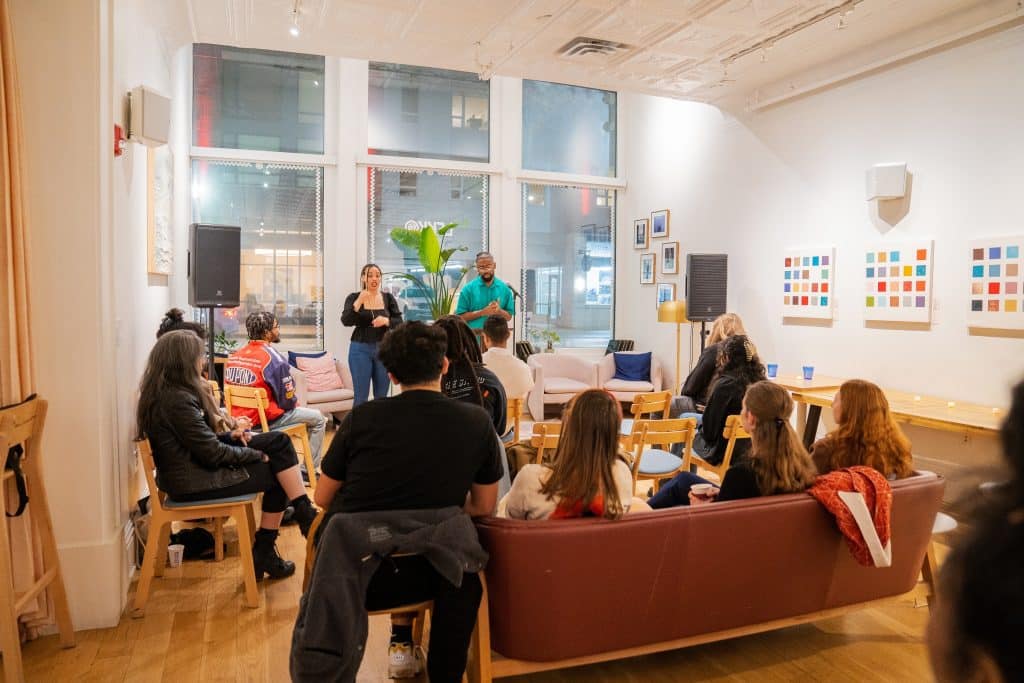
Harris spoke about the challenge of seeing so many young black children in detention centers when working with Writers in Residence.
“It made me really think about the slow drag and the weight of children who are contained,” Harris said. “The hopefulness I have is that they still have a willingness to write. I am grateful to Writers in Residence for making a safe space for them to feel the willingness to write.”
Stephanie Ginese read new work, with rich themes of nostalgia – the purity and wonder of being young in your hometown surrounded by familiar faces and the wind in your face while riding your bike down the street. Her words take one back to one’s own piece of childhood, while she shares hers. She also shared work discussing the lingering themes of colonialism, and how that affects the way we experience different cultures, with the same colonizers. Her debut book, Unto Dogs, explores many of these themes and more. She has a poignant way of displaying seriousness with these topics, sprinkling in her sense of humor and resilience to engage and connect with an audience.
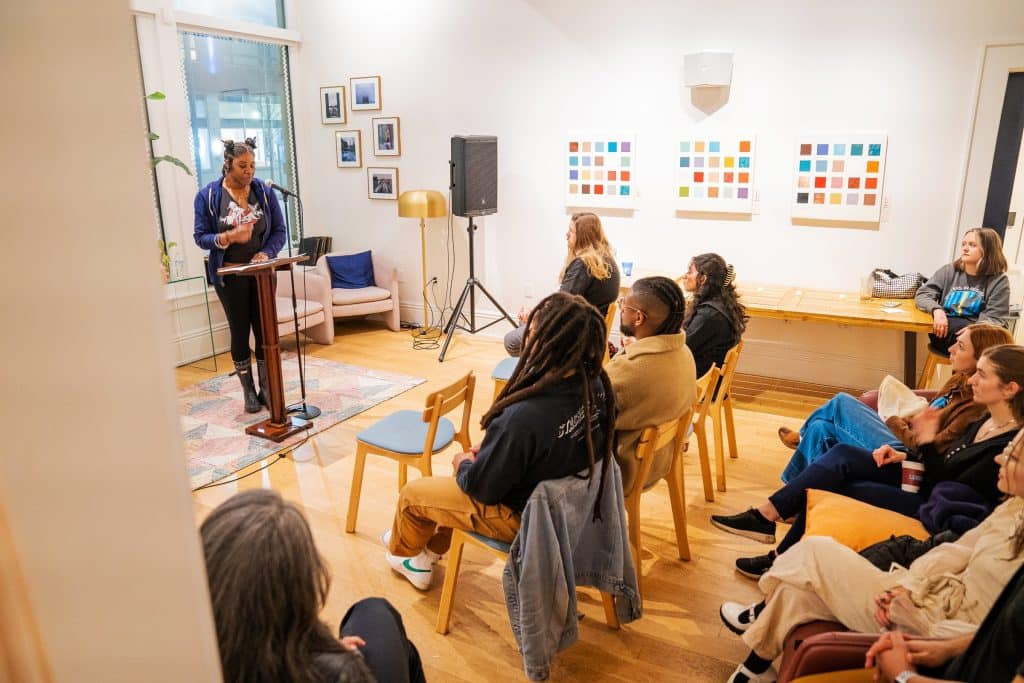
The reading ended with the powerhouse that is Kisha Nicole Foster. She has been writing poetry since the 90’s and has several poetry books, with her poetry work celebrated on public art in Cleveland at the Oriana House Mercy mural. Themes in her work include hope, celebration, radical acceptance and love, and most importantly, authenticity. She steps up to the mic, and she greets the audience with “Peace.”
“It’s been an experience and I love working with the residents. They learn so much in such a small amount of time,” said Foster.
In her poem To Lake Erie, she speaks about the beauty, experiences, love, ugliness and hate that resides in Cleveland on the shores of our lake, all seeking similar things at times. One line reads “You are the ever flowing watering hole that attracts tourists, rats, racists, jealousy…”
Foster’s work doesn’t shy away from reality, and it doesn’t always bother to condemn it either, but names it, identifies it, sees it.
Overall, this event was beautiful and I bought all the poets’ books afterwards. It is important to experience the work of the artists in your city, to read and listen to the ways they experience the same land that you do. Support local artists, watch them evolve, learn from them and let their work serve you.
We're celebrating four years of amplifying resident voices from Cleveland's neighborhoods. Will you make a donation to keep our local journalism going?