

According to the Trust for Public Land, over 28 million kids in America don’t have a park within a 10-minute walk of home. As the group stated on its website, “a solution is hiding in plain sight … schoolyards!”
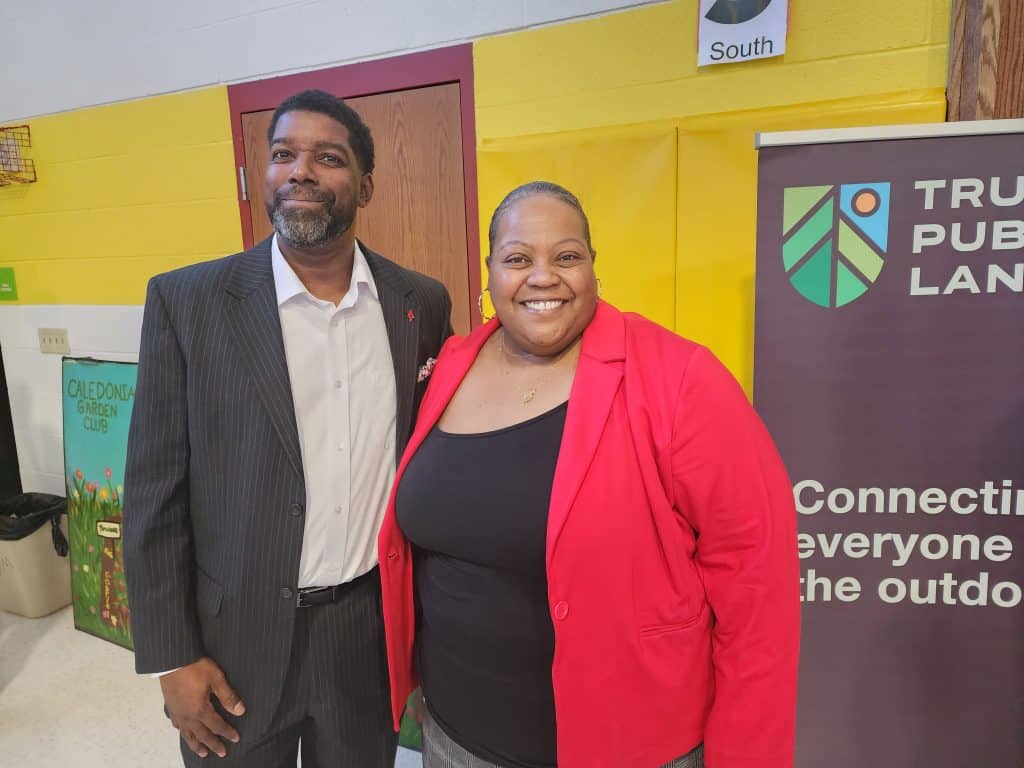
Caledonia Elementary School, which serves East Cleveland students, will soon have Ohio’s first Community Schoolyard, defined as a “vibrant green space that’s accessible to the community after school hours,” according to the Trust for Public Land (TPL). The design unveiling took place December 15 at 10:30 a.m. at the elementary school, located at 914 Caledonia Ave. in Cleveland Heights (although it’s located in Cleveland Heights, it serves East Cleveland students).
Led by TPL, a nonprofit that has revamped 300 schoolyards across the nation in order to improve access to nature and the outdoors, the Community Schoolyard concept is about transforming and repurposing the simple asphalt playground into a vibrant green space that improves student education outcomes, community health, and climate resiliency in one fell swoop. By next fall, Caledonia will be the beneficiary of Ohio’s first official design.

“We’re really excited today. This is the first of hopefully many design unveils for our first community school years project in Ohio, ” said Sean Terry, State Director for the Trust for Public Land, during the unveiling. “Community Schoolyards is a program that we have been running through the last several decades, but now we’re bringing it to Ohio here at Caledonia Elementary. We got a design that the students helped to come up with a concept for, and looking forward to bringing it into reality [in 2024].”

How will this differ from what Caledonia currently has?
Going far beyond the traditional swing set and teeter-totter, the plans for Caledonia include an outdoor classroom and stage for learning and performances, an outdoor musical instrument area, a school garden, artificial turf play areas, and an open lawn area that can be used for baseball, softball and soccer. In addition, the new schoolyard design also includes features intended for use by the entire community (from tots to seniors). These “community-based” features include circular benches, picnic areas, walking tracks and bird houses along the field perimeter.
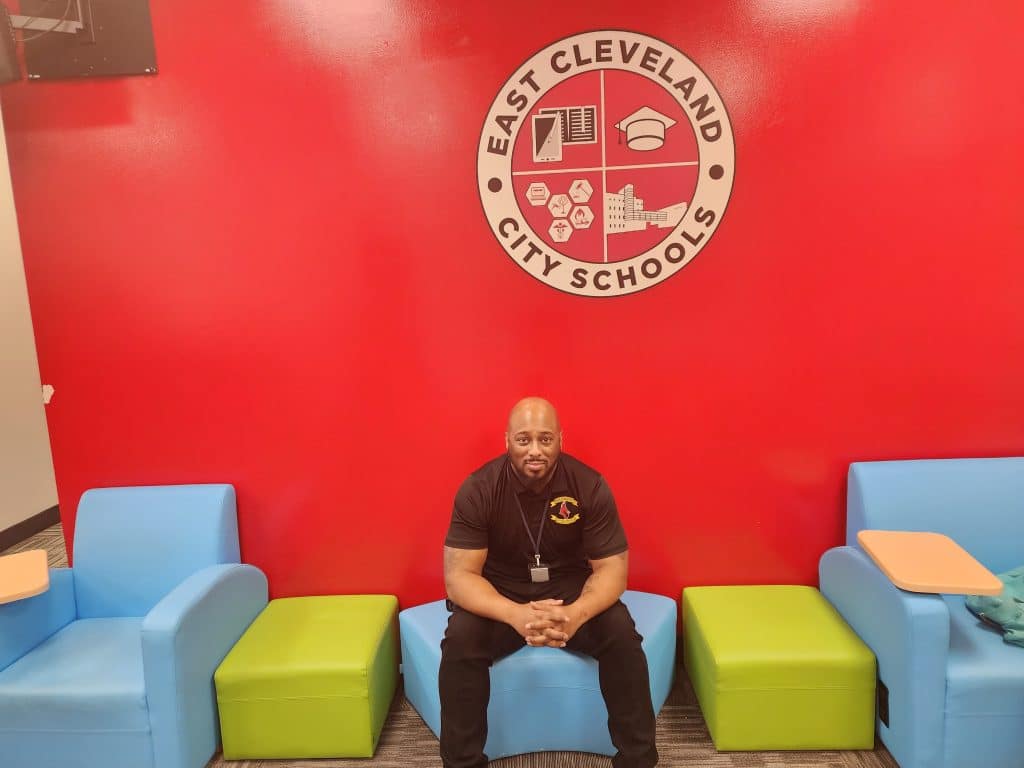
When TPL began the process to create the schoolyard design a year ago, they held community meetings to engage teachers, staff, and members of the neighboring community as co-creators. “We’re here for the unveiling of the new playground project through Trust for Public Land,” said the school’s head custodian, Anthony Lockhart, at the December 15th event. “I’ve watched this process go from just an idea to now at the unveiling. I’m very excited that they took input from all the children, the teachers, and they included me as well.” The park will serve first as a playground for kids, but after school hours it will be made available to the community, providing a safe green space for the neighborhood.
Kaela Geschke, the Parks for People Program Director for TPL’s Ohio office, told The Land that “the coolest part” of the program is that the kids at Caledonia are tapping into their own power and skills to help design a park for their neighborhood. The project came about when Dr. Henry Pettigrew, CEO of the East Cleveland City School District, reached out to TPL and identified Caledonia as a top priority because the students are kindergarten through second grade and don’t currently have any play structures to use. She added that Dr. Pettigrew wanted to make sure that Caledonia got the first round of investments and participated in the program.
According to a 2021 TPL report, community schoolyards are “a common-sense, cost-effective solution to America’s park equity problem. Opening all public schoolyards during non-school hours would put a park within a 10-minute walk of nearly 20 million people — solving the problem of outdoor access for one-fifth of the nation’s 100 million people who don’t currently have a park close to home.” TPL’s report said it wants to accomplish this goal by 2030.
To do this, Geschke said, they need partners. “We have a whole GIS (Geographic Information System) map analysis and we go where there is need,” she said. “Is there a place that doesn’t have a play structure, that doesn’t have access to a park already? We look at the surrounding community, the health outcomes, the social dynamics and if it’s a historically disinvested community. We look to see who’s going to benefit the most. We make sure that that’s where we’re prioritizing.”
The social and emotional impact of a new design
“Children at [K through two] level, their minds are like sponges, they soak up everything,” Dr. Mary Rice, East Cleveland Board of Education President, told The Land. “We’re pleased that the play activity in the new design will also be educational. I think the children [are going] to love it. I know the parents will.”
Geschke said that community schoolyards have social and emotional benefits for families, children, and communities. “We’ve heard from teachers and principals at other schools that we’ve worked in nationally, that when they (the students) would walk through the cafeteria at lunch, they would almost dread it, cringe before they go in,” she said. “But now that the kids actually have a play space outside, an outlet, there’s less fights and less behavioral problems. We know that access to outdoor space can improve learning outcomes, as well.”
Dr. Ralph Murphy II, assistant principal at Caledonia, told The Land that he is especially looking forward to the new schoolyard area because of the benefits that come with structured playtime.
“That’s a big part of learning and a lot of people really don’t understand that when you start talking about structured play, you’re talking about building a camaraderie with teamwork and friendships,” stated Dr. Murphy. “[As educators] we found that a lot of friendships are built on the playground, so to help normalize that for kids that didn’t have a place to go to maybe even after school, it becomes more of a ‘community thing.”
A new climate for learning about the ecosystem
In addition, the children at Caledonia are learning to become good stewards of their environment and the benefits of climate resiliency.
“There is a ravine right behind the school and it provides an opportunity (for the students) to learn about ecology,” said Geschke. “It provides an opportunity to talk about our water and how much of an asset clean water is, especially with us being so close to the Great Lakes and all of the wildlife and plant life that exists right outside of their window.”
Taking The Land for a walk-through of some of the areas slated for the new design, Geschke pointed out the main asphalt “blacktop” location that’s currently the kids’ play area. “We’re going to remove some of the asphalt surface and put in green structures that absorb water that provides shade,” she said.
Geschke said that shade was a high priority for teachers and the students when asked what they would like to see in the playground area. Without proper shade in play areas, the asphalt blacktop retains heat, creating a heat island. A recent study by Trust for Public Land found that 36 percent of the nation’s 50.8 million public school students attended school in a heat island, defined as 1.25 degrees warmer or more, on average, than the surrounding town or city.
“We want to reduce some of the hotness that you feel when you’re on the asphalt, and it teaches students at an early age about changing the climate and some of the mediating steps that we can take to improve our spaces and our health,” she said.
Geschke said that the kids are very excited to have a basketball hoop, and that it was the top requested item. “They will have a basketball hoop that rolls out, but in our design it can be interactive, adding to that will be a lot of color murals and installations on the ground. Students were really excited about having different ways to play, not only with structures, but games they can interact with.”
With the opening of the new schoolyard slated for fall of 2024, Geschke said that they will be going through the permanent plot processing in the spring. She also said that because Caledonia is in Cleveland Heights, they will be going through them for permits, but that administration on both sides know this is happening and are ready to get started.
“We’ve worked a lot with Cleveland Heights Green Team and Heights Tree People to clean up the ravine (that includes a fenced-off wooded area where the kids will be able to play in a redesigned grass field),” she said. “Because of the [adjacent] ravine we’ve been able to talk to the students about water quality and how that impacts the whole community. So now they’re learning about the interconnectedness of the environment while they’re building a playground as well.”
To learn more about Trust for Public Land visit www.tpl.org/who-we-are. Visit www.east-cleveland.k12.oh.us/domain/56 for more information on Caledonia Elementary School.
Keep our local journalism accessible to all
Reader support is crucial as we continue to shed light on underreported neighborhoods in Cleveland. Will you become a monthly member to help us continue to produce news by, for, and with the community?
P.S. Did you like this story? Take our reader survey!

![Lakewood High School students organize walkout to protest ICE [photos]](https://d41ow8dj78e0j.cloudfront.net/wp-content/uploads/2026/02/12155714/DSC_3775-800x600.jpg)


