This story first appeared in the Cleveland Stater and is reposted as part of a partnership between The Land and The Cleveland Stater.
Former WCSB General Manager Alison Bomgardner on Thursday said a lawsuit filed Monday to force Cleveland State University to return control of the radio station to students and the community was about more than CSU’s deal which handed the station to Ideastream Public Media.
“I might be a main plaintiff in the case,” Bomgardner said, “but the main thing we have to recognize here is we’re fighting for the 50-year-old WCSB that was on campus, and that’s the most important part.”

She added that the lawsuit was about more than CSU students and the community deprived of the station, pointing to broader concerns about the future of college radio.
“This isn’t just about one single student group. This isn’t just a present-day issue,” Bomgardner said, “college radio stations have been shut down like this before.”
The lawsuit
On Monday, Bomgardner joined WCSB and Friends of XCSB in a lawsuit suing Cleveland State University, its President Laura Bloomberg, Ph.D. and the CSU board of trustees for violation of free speech, open government and property rights, demanding that the defendants return control of the station to the plaintiffs, in effect the students and community members who previously ran the station.
In the lawsuit, WCSB is listed as a non-profit organization established in the 1970s to promote independent broadcasting in Cleveland. Friends of XCSB is described as a non-profit organization founded in 2025 to promote and protect independent broadcasting in Cleveland. Bomgardner is a CSU student, the general manager of pre-Ideastream WCSB, and a member of the Friends of XCSB Steering Committee.
Representing the plaintiffs is Brian Bardwell, a Cleveland attorney and founder of Speech Law LLC, described on its website as the only firm in Ohio focused exclusively on protecting the right to ask questions, demand answers and speak out against abuses of power.
The filing followed months of community criticism and pushback after the university abruptly handed control of the station to Ideastream on Oct. 3 last year, effectively shuttering the station, which had served as an alternative source of culture, music and community in Cleveland for almost 50 years.
The plaintiffs are demanding a jury trial and are seeking that the court require the university to release documents related to the agreement, declare the deal between CSU and Ideastream invalid, and award damages, attorneys’ fees, costs and any other relief available and appropriate under Ohio law.
The lawsuit marks the latest development in the ongoing battle over the station with the plaintiffs seeking to return access to the FM signal to students and the community.
“What I hope for, ideally and in an ideal world, is not for myself to receive anything, but for there to be an FM signal, 89.3 FM, for the students after me to come back to, to have the ability to broadcast on and to learn from and to find community in,” Bomgardner said. “There’s something so essential for students to get to be part of such a limited medium that I hope it returns to students in the future and that this lawsuit can do so.”
The dispute
The dispute dates to Oct. 3, 2025, when student staff turned up at WCSB to find themselves locked out, a police presence, and silence in the studios. That it was national College Radio Day only added insult to injury for the station members. The lockout came just minutes after a fraught and short call between station principals, Bloomberg and Dr. Tachelle Banks, CSU’s vice president of Student Belonging and Success.
In an email that day to the CSU community, President Bloomberg wrote that “Programming originating from CSU officially ended this morning, and already, the public listenership and Ideastream’s 44,000 members are receiving the broadcast on 89.3 FM and ideastream.org.”
Nearly 50 years of live programming with independent and alternative music was replaced by the anodyne sounds of JazzNEO, a primarily automated 24/7 station run by Ideastream.
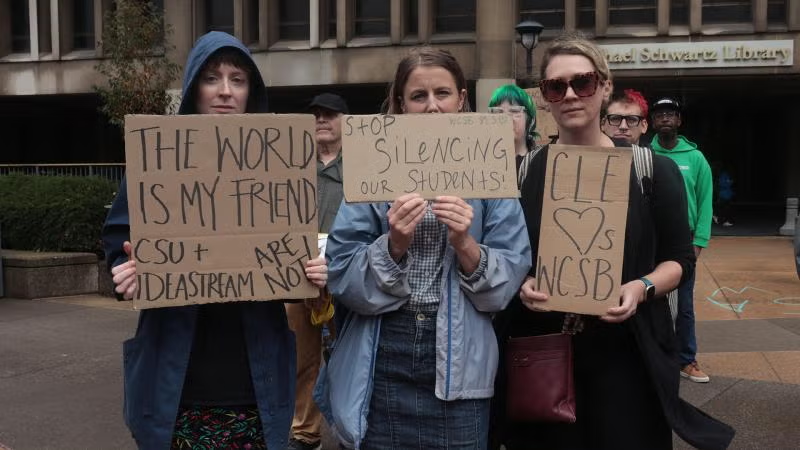
In the months that followed, students, station members and passionate listeners held protests both on and off campus. Cleveland city councilman Kris Harsh, a former DJ at Case Western’s WRUW slammed the decision at an Oct. 6 City Council meeting, saying he canceled his donations to Ideastream due to the new agreement.
“What makes Cleveland a beautiful place is the amount of people we can support in our community,” Harsh told City Council. “Not just the mainstream, not just the normal folks, but those weird misfits that need their own island … We need a home. And college radio gives us our home.” City Council on Oct. 20 unanimously passed a resolution urging CSU to restore WCSB to its students.
Bomgardner described the outpouring of support as a community coming together during a time of grief and frustration and a sign of WCSB’s long-standing influence on the city and suburbs.
”Every single individual who’s even listened to WCSB once has their own personal story about how it affected them, touched them, and made them a better, cooler person,” Bomgardner said.
CSU’s corporate turn
President Bloomberg defended the handover in an interview with The Cleveland Stater, Dec. 2, adding that “a massive part of our strategic plan is building new kinds of strategic partnerships” with local institutions like MetroHealth, the Cleveland Clinic, Playhouse Square and Ideastream.
Stabilizing CSU’s finances was a major task Bloomberg inherited after the board of trustees unexpectedly let go her predecessor Harlan Sands, JD, in April 2022, in still unexplained circumstances. The turn to corporate Cleveland was key to Bloomberg’s plan to revitalize the university.
“To turn my back on the opportunity for a long-term sustained strategic partnership with the largest media outlet (Ideastream) in Northeast Ohio doesn’t seem wise to me,” she said in December.
Part of the Ideastream agreement was the promise of internships for CSU students. But Monday’s lawsuit calls that into question.
“As of this filing, WCSB has not heard a word from Ideastream inviting its students to internships or suggesting it has any intention of fulfilling that portion of the agreement,” the lawsuit states, alleging that the university had literally “pulled the rug out from under” WCSB and its members.
And as Cleveland.com’s Peter Chakerian pointed out, internships cannot substitute for the experience of running a radio station, which WCSB offered its members.
In December, Bloomberg said she felt “strongly about building deep and sustained strategic partnerships with community partners.” She was talking about corporate Cleveland. But why shut down WCSB which had nurtured a decades-long partnership bringing together CSU students and the community for the benefit of both?
What the CSU Ideastream agreement does offer is a seat on Ideastream’s board of trustees for CSU’s president, up to 1,000 on-air mentions annually for the university and another 1,000 on-air PR spots celebrating the institutions’ “joint strategic collaborations.”
The future
Whether the turn to strategic partnerships with corporate Cleveland went too far in the case of WCSB, allegedly silencing student and community voices in the process, will likely now be decided by the courts.
Bomgardner said one goal of the lawsuit was to ensure that future generations would have the same voice and opportunity that WCSB provided for herself and her community.
“Everyone’s getting their opportunity to really look at what college radio meant to them, what college radio means now, and how we can save it for generations of the future so that they can have that same feeling.”
Ahead of Monday’s filing, XCSB (think of an X painted over the W in WCSB) said it was relaunching as a nonprofit, partnering with The Reading Room CLE to assist in the process of becoming a certified 501(c)(3). XCSB is hoping to begin streaming online by May 10, exactly 50 years to the day since WCSB first went to air.
XCSB, staffed largely by WCSB stalwarts, currently is raising funds to help get on its feet, build a studio and buy equipment.
More information about XCSB and the ongoing legal process that could determine whether the shuttered WCSB returns to the air can be found on the XCSB website.
The Cleveland Stater reached out to CSU for comment on this story, but was told the University does not comment on pending litigation.
*** Editor’s note. The reporter was a station member of WCSB until the October 3, 2025 shutdown, and continues to be a part of XCSB radio.
Keep our local journalism accessible to all
Reader support is crucial as we continue to shed light on underreported neighborhoods in Cleveland. Will you become a monthly member to help us continue to produce news by, for, and with the community?
P.S. Did you like this story? Take our reader survey!