
Larchmere’s Fiddlehead Gallery is subject of new documentary by Julian Khan, A Greater Buckeye
Julian Khan and A Greater Buckeye released a new documentary on Fiddlehead Gallery this week. We chat with Khan about his aspirations, documentaries, and his love of Cleveland’s neighborhoods in this interview.
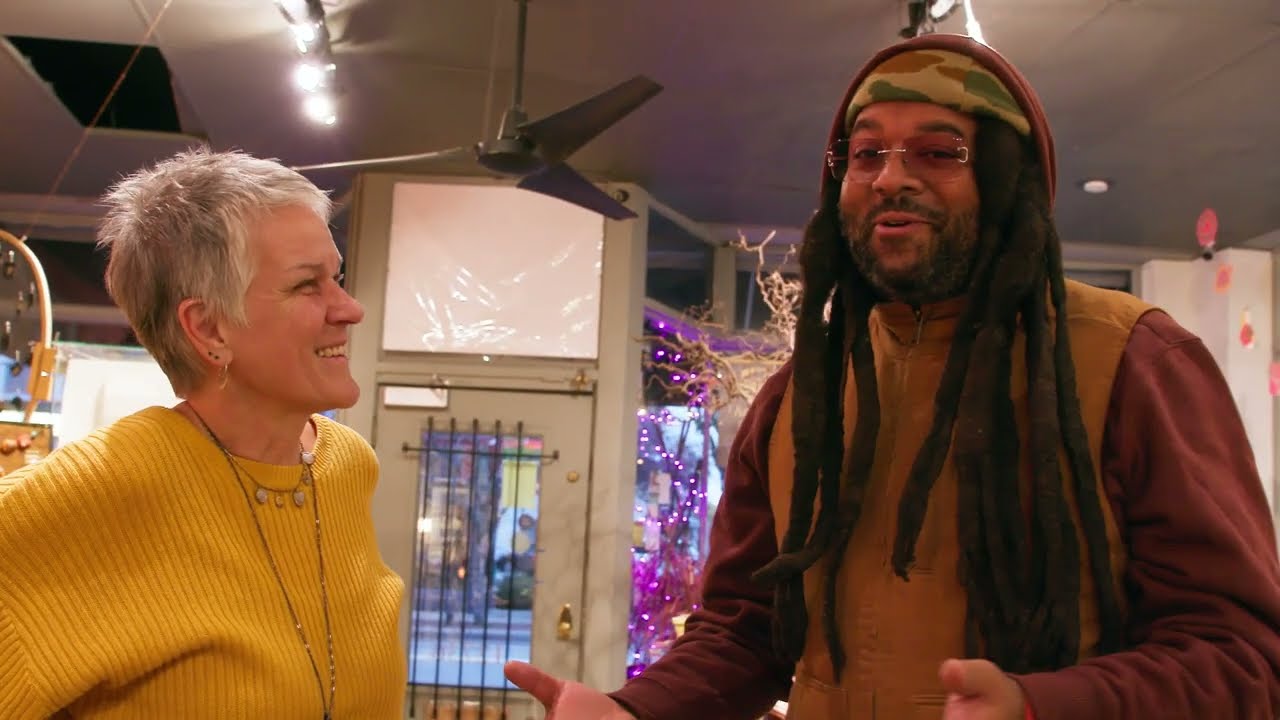
On Thursday, Julian Khan and his media group, A Greater Buckeye, released a new mini-documentary on Fiddlehead Gallery in Larchmere. It’s the first of several mini-documentaries the group has planned for release.
In advance of the Thursday premiere, The Land’s Executive Director, Chris Mosby, sat down with Khan to discuss his work, A Greater Buckeye, documentaries, and more. You can check out the full conversation below (and the documentary is at the top of this story!).
Chris Mosby, The Land: We’ve run profiles of you in the past, but some of our readers might not be familiar with you and your work. Can you tell us a little bit about yourself?
Julian Khan: I am a Cleveland resident, raised and aged in the Buckeye neighborhood. This place has done it all, given me my brightest and darkest days. We’re devoted and quoted, partly thanks to The Land. Right now, I’m working as a neighborhood network manager in this neighborhood with Neighborhood Connections. That language is asset based but loosely translates to an organizer of sorts. The network building is more nuanced because it focuses on what’s strong, not what’s wrong in our neighborhood. That benefits a lot of the conversations that we have at our neighborhood gatherings, which are held monthly. We have a Neighborhood Network Night and that has borne a lot of fruit organizationally, it’s where we really show our strength and resiliency and aspirations as a neighborhood. I’m proud to be a steward of some of those spaces now.
Right now, I’m producing content with another project [A Greater Buckeye] that was born out of this work. We’re recognizing some of the informational gaps that exist uniquely in Buckeye, Woodland Hills, compared to Larchmere and Shaker Square, but focusing on all the much-larger neighborhoods that I call home. We’re trying to creatively fill some of those informational gaps and not perpetuate print media being a barrier for informational access.
CM: You referenced the A Greater Buckeye project. Can you describe what you’re doing and what you’re hoping to accomplish?
JK: Well, at this point, I’m not sure what it is or can be. I’m throwing the hook out there and hoping people can find value in this content, especially in the neighborhood. More importantly, I want it to be a counter-narrative, a creative blueprint, and wayfinding in the neighborhood. I think it also helps to uncover some storylines that can only be told by residents.
There’s a lot of uniqueness to it. We have tremendous partners, Black Valve and Neighborhood Connections is a fiscal partner. A Greater Buckeye is something that I started with a resident friend – Tyler Hughley, who still loosely contributes. This project was part of our aspirations as residents, to fill this information gap with good, timely and culturally relevant news. We wanted to fill all those aforementioned information gaps.
We conjured up this idea with the American Journalism Project, which helped birth a lot of great projects, like The Land and others. We were part of that cohort and actively engaged.
Our community storytelling model was challenged during the pandemic because it was tied to schools and universities. In December 2019, I’m at the City Club talking about our aspirations, and by March 2020, there are no schools functioning or operating. Needless to say, our model was challenged. But here we are, almost, in a way, manifesting the very videos and news that we wanted to tell in this neighborhood. There’s a lot of narratives that we’re working on. Right now, we’ve put together a series of business profiles meant to offer up some creative wayfinding and unearthing some uniqueness to these neighborhood gems.
We think only a resident might uncover some of these stories – like La Pecora, the new pizza restaurant that just opened up in Larchmere. We talk about its previous owner and there’s connective tissue from what she established to what the new owners have now conjured up in that same space. We also establish that same narrative with Peter [Reuter] at Scorpacciata Pasta Co. That was a historic watering hole in the neighborhood – my grandfather worked across the street, at Park View Federal, for 40 years, so I probably romanticize some of his old stories. But I know that unique charm that Larchmere has, and it’s long held because of neighborhood gems like that. And maintaining that also gives it a sense of stability for legacy neighbors.
I think that it also helps to tear down some of the trepidation with legacy owners and neighbors that may have some trepidation around trying new spaces and are still growing through the aches and pains of losing some historic spaces. That’s a real thing in our historic neighborhoods.
I’m really thankful to just be able to tell some of these stories. I’m anxious to see how people respond to it and I’m hopeful that it grows legs and acts as a counter-narrative to tell people that this is a neighborhood of choice.
CM: If people are interested in seeing your videos and following your stories, where can they go to find you?
JK: We’ll be uploading shorts to our socials AGreaterBuckeye (Instagram and Twitter) and on YouTube we’ll be uploading the videos in longform. On YouTube, that’s also @AGreaterBuckeye.
CM: Do you have a release schedule? How often should people expect content?
JK: My goal is not to crack the whip on anybody. Move at your own pace. That’s how we curate the quality of our content. That aside, we’re going with the flow and exploring and deepening relationships with people in the neighborhood. I hope we can continue to corner in on that uniqueness in storytelling and narration. I hope in a year that I cringe looking back at these old videos – because we’ve grown that much.
This is just a resident telling these stories. There’s nothing special about me at all. Anybody with a camera can go out and tell these stories. Go out to your local watering hole and tell these stories about what’s good in the neighborhoods. Ultimately, that’s what I hope A Greater Buckeye can be for other residents in our neighborhood — to use this platform and tell these stories from their lens.
CM: Can you tell us a little about Fiddlehead Gallery? You’re highlighting them this week in your documentary and maybe you can give folks an idea of what to expect.
JK: If I were to paint with a broad stroke, it’s a store of a million pieces. You can easily get lost in there. If you want to spend three hours just looking at a spectrum of offerings. Intentionally crafted products. For example, I purchased hot sauce from a girl’s school in Africa, maybe four or five years ago, and I keep coming back to get it. [Susan Rozman, the owner] was able to build that relationship with the school and brand and we highlight that in the video. We ask how she sources all these items. She has art pieces, jewelry, kangol hats, puzzles, crystals, and all sorts of things. It’s a spectrum, a myriad of options.
The quirky and cool charm is uniquely tethered to the owner and I hope that some of that comes across in the video. Susan is a neighborhood gem, and that’s me speaking, personally. She’s been a first-responder in so many neighborhood situations, good and bad. It reminds me that this is a caring, resilient neighborhood. I’ve seen her house neighbors who were housing unstable numerous times. I’m in constant communication with her and her story warrants an even deeper dive.
The way she values and cares for her neighbors, it exudes neighborhood charm. When I think of Larchmere, she’s the embodiment of it. I think of hyperpresent, omnipresent owners. You see them at a grocery store with their resident hat on, you see them at a neighborhood meeting, you can catch them at their store. Because they have all those hats, all those intersections, it makes those places that much more of a destination for a resident. And it’s where I pick up my UPS packages.
CM: How do you decide which topics to delve into and which stories to tell?
JK: Well, ultimately, I want to walk down Larchmere and pop into places. Like, “Hi, I’m here. I’ve been talking about A Greater Buckeye since 2019. I hope you’ve been ready since then!”
Seriously, I want to highlight the neighborhood. I wanted to explore it as a pizza district. That’s a vantage point that no one has explored or even thought much about. But with the ascension of La Pecora and Scorpacciata, and then also a historic spot like Captain Tony in Shaker Square, that’s worth exploring.
Again, exercising those personal relationships and, again, that contributes to the free flowing nature of this narration. We don’t have the sort of rigidity that traditional production has. As of right now, we’re tapping into our personal relationships in the neighborhood and telling stories from a resident’s perspective. That’s all because I love this neighborhood. I think it’s worth highlighting.
Keep our local journalism accessible to all
Reader support is crucial as we continue to shed light on underreported neighborhoods in Cleveland. Will you become a monthly member to help us continue to produce news by, for, and with the community?
P.S. Did you like this story? Take our reader survey!
Author
Related Articles
The Movie Nerd Report: 3 film festivals this week in Northeast Ohio
Plus, see what other new releases and classics are playing at independent theaters around you!
Walking Cleveland’s past, one story at a time
“How much of Cleveland do I pass by without knowing the story?”
More than a card: Why Cleveland Public Library still matters in the digital age
September is National Library Card Signup Month. The Land talked with Cleveland Public Library Executive Director Felton Thomas, Jr. at the Main Library downtown.


