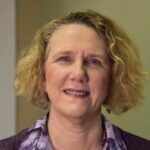
In honor of The Land’s third anniversary, we’re catching up with a few of our 50 community journalists. Learn more about our community journalism program here. The Land’s Lee Chilcote talked with Sharon Core, a Slavic Village resident who has published multiple stories for The Land since completing our program.
I know you’re not originally from Cleveland. Where are you from?
Jacksonville, Florida. Both of my parents are from eastern North Carolina, so this is the farthest north I’ve ever lived. I consider myself a southerner. My mother says that Jacksonville is really south Georgia.
What made you move to Cleveland?
I came here to work for the Presbytery of the Western Reserve in February 2017. I had been in parish ministry for 25 years. The Arlington Church that I served in Arlington, Virginia for 18 years went through a major discernment, and the result was selling the property to an affordable housing developer. I got them to the point that they could make the decision and helped them move into temporary digs.
In the course of all of that, I realized, using Biblical imagery, that I was Moses instead of Joshua. I don’t get to see the promised land, I just get to take them through the wilderness.
And I didn’t really want to be Joshua – I didn’t want to be the one to get them into this next thing.
As I was in the midst of figuring out what I did want to do, I had several people say to me, have you ever considered doing presbytery work? I interviewed and on the 25th anniversary of my ordination I had the chair of the search committee call and offer me the position. I figured, ‘There’s got to be something to this.’
Ironically, I now work with 36 churches. But change management at this level is very different from just working with one parish.
What’s different about living in Cleveland?
I came here from a place that’s very transient. I would not describe Cleveland as transient. If you’re in a transient area, you’ve got new people coming in all the time. If you’re in a situation where you’re trying to figure out, ‘How can we be the best city for the people who live here,’ and there aren’t a lot of young people coming in for work situations or whatever, it does sort of make sense to work with the folks that are here. I get that. And that, to me, is what Cleveland is trying to do, improve the city for the people who live here.
What brought you to Slavic Village?
I lived in Cleveland Heights for about nine months, and then I rented in University Heights. Slavic Village is so centrally located, I tell people, I can get anywhere in 20 minutes. Now that they’ve opened the Opportunity Corridor, I can get to University Circle even more easily. I really didn’t know a lot about Slavic Village. I did the Neighborhood Leadership Development Program when I first came here, and there were three people in my cohort who had connections to Slavic Village. When I moved, I thought, now I live here, I need to know about this place. I found the house before I knew that I was interested in the neighborhood.
Do you like it?
I do. It has its challenges. I’m impressed with the Slavic Village Development group. I think they’re doing a lot of good stuff. I’m a newcomer here, so for folks who have been here a long time, there’s some people who will say, ‘You work here, but you don’t live here.’ I don’t think there’s anyone on the Slavic Village Development staff who lives in the neighborhood. But I’m still of the opinion that the folks at SVD really do have the goodwill of this neighborhood right in the forefront of what they do. And you can choose to support the work they do or not.
Interestingly, they have a program called the Community Stewards program. I did that for two years and met a number of people. I have a lot of respect for folks who are working to make this place the best place it can be. The interesting thing I kept hearing was, ‘We don’t need to be another Tremont. We don’t need to be another Ohio City. We’ve got our own personality.’ I think the folks at SVD hear that and are really working to highlight and move forward what this community has to offer to the wider area.
What drew you to the community journalism program?
I like to write. I had to write a sermon every Sunday, every week. You gotta have something to say, and some Sundays are better than others. I’ve always been a news person. I credit my sixth grade social studies teacher with my love of reading a newspaper. I’m a dying breed, but I do love to hold a good newspaper. I also had been using articles from The Land in a weekly email newsletter to the presbytery, and I would always find good stuff in The Land, Cool Cleveland, and FreshWater. So, when the community journalism thing popped up, I said, ‘You know, this sounds interesting to me.’ I just thought, ‘This will be a different way for me to learn about where I’m living. Let me just apply for this.’ It’s a different kind of writing, I’m discovering.
You’ve written several articles. Has anything surprised you so far?
I’ve written three articles for The Land and had 25 years of writing sermons. I’ve got a long way to go to get my writing to go in the direction of news platforms rather than pulpit platforms. That part of it has been surprising to me, and in some ways frustrating. I fall back into the type of writing I know, which is writing sermons. That part is challenging to me, because I want to put more description in or paint a picture. If I can get you to see something through the words I offer, I think that’s a good sermon. If I can get somebody to walk away saying, ‘Oh, I’ve never thought about it that way,’ that’s a good sermon. It’s not to say those things aren’t important in journalism, but they’re done differently. The other thing I think I’ve come to discover is that while journalism is fascinating to me, I’m more of a human interest type of person than I am an investigative reporter. I want to write about things that pique my curiosity.
Learn more about The Land’s community journalism program here.
We're celebrating four years of amplifying resident voices from Cleveland's neighborhoods. Will you make a donation to keep our local journalism going?