The basics:
What: “Surface & Structure: Contemporary Ceramics on the Edge of Form”
When: Until March 28.

Where: The Sculpture Center, 12210 Euclid Ave., Cleveland.
Hours: 12 p.m. to 5 p.m. Wednesday through Saturday. Free. Visit sculpturecenter.org
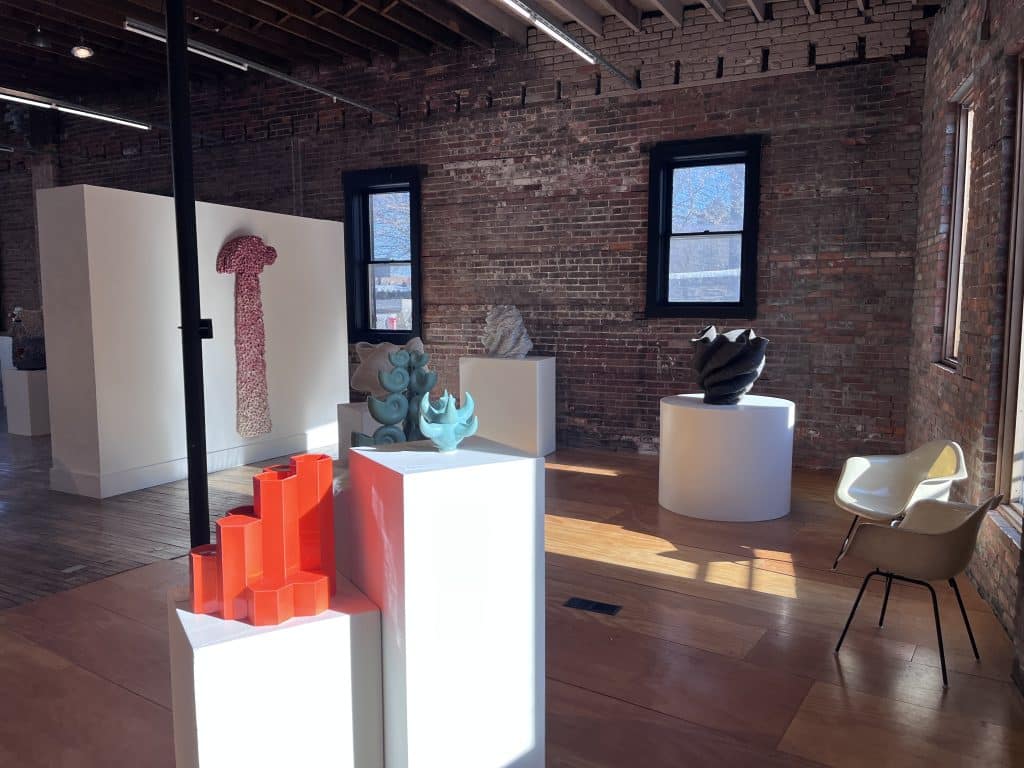
Don’t be daunted by the title. The new exhibit at The Sculpture Center could just as well be called “Fun with Clay.”
Artists from local colleges may be the focus, but there’s nothing academic about it. There are no prerequisites. You can enjoy and ace this course with zero knowledge of art history, terminology or technique.
That’s also not to say it’s unserious or lowbrow. The work in “Surface & Structure” is nothing short of virtuosic. Again and again, one way or another, it defies convention as well as gravity, and blows the mind.
Few media are traditionally staider than ceramics. It’s a field with roots in ancient Rome and Greece and dominated by the pretty and the utilitarian, by lovely dishes and ornate pots, vases and urns.
None of that will you find in this spotlight on artists from Kent State University, the University of Akron and the Cleveland Institute of Art. There are variations on practical objects but nothing that’s truly useful. For some, no doubt, traditional forms were the starting point. For none, though, were they the end. In every case but one, the real objective was to embrace the imperfect, the unexpected, the incredible.
“They’re definitely taking ceramics a step further than what most people think of,” said Grace Chin, executive director of The Sculpture Center.
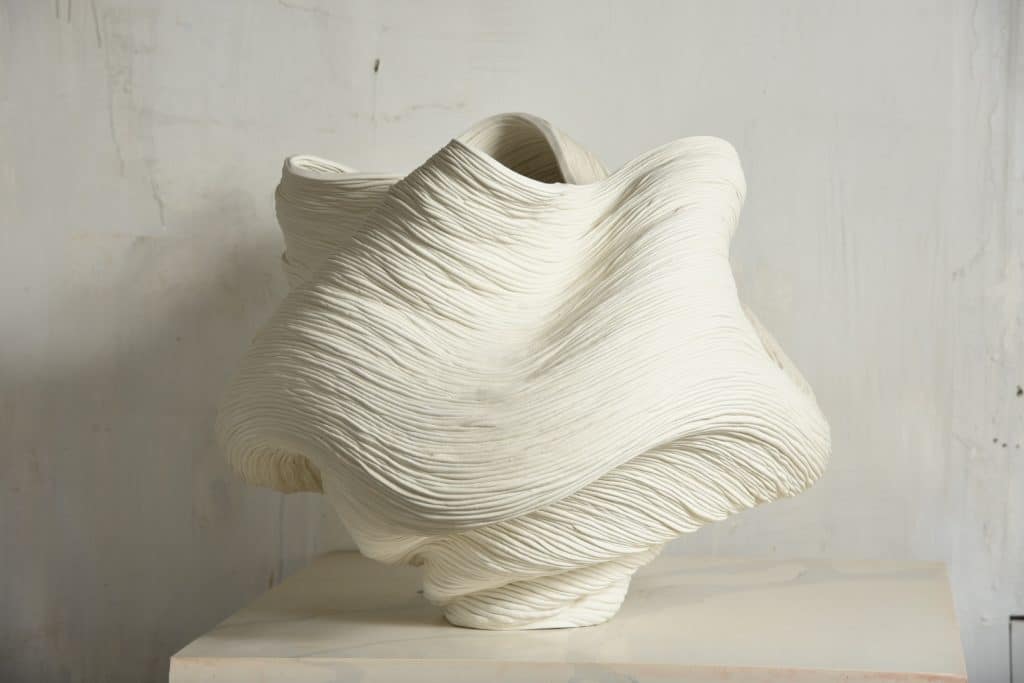
Start with Philip Soucy. His three giant vessels could certainly hold something, but their real value is as art objects. It’s as if, using a potter’s wheel, he allowed large clumps of clay to flop and fold at will, but then somehow striated the surface and halted the whole process, freezing dynamic movement in time. In a word: astounding.
Even more robust is the art of Keenan O’Toole. She, too, flouts physics, crafting large, dense networks out of thick round bars of clay. From things that couldn’t have had much structural integrity at first, she made gorgeous objects that could probably withstand being driven over by a tank.
Anna Kruse works at a similar scale but with a more organic mindset. In pieces like “Tending” and “A Momentary Leave | Forever,” she gives us a veritable Gorgon’s head, a knot of dark coils, and imagines two blue squids bidding farewell, their tentacles stretched out, nearly touching. The elegance of the gesture is heartbreaking.
At the other end of the spectrum is the supremely delicate work of Peter Christian Johnson. Like tiny bridge or rollercoaster trestles, his white lattice creations look like they might collapse any second. And yet they not only hold together. They also curve and twist with improbable abandon.
More playful still is the work of Drew Ippoliti and Seuil Chung. The strength of their funky abstractions lies in juxtaposition, in the contrasts between wildly far-flung shapes, colors and forms.
Chung’s “Nice to Meet You” looks like a boxy ice cream cone, a stack of smooth, colored blocks, complete with dripping chocolate sauce. There’s a catch, though, a disruption to the whimsy. Into the blocks are jammed all kinds of foreign objects: discs, rods and handles. It’s a “meeting” of the most unexpected sort.
Ippoliti takes the concept a few steps further, physically piling dissimilar ceramic objects on top of each other, applying glaze haphazardly, and even introducing non-ceramic media. His “Skidding from Delicate to Disastrous” is probably the high point. What may have started out as a bowl ended up as a warped, orange-hued ship complete with tiny blue-and-white cloth sails.
The two most distinctive voices in “Surface & Structure” are Kristen Cliffel and Seth Nagelberg. Each of them truly breaks new ground, using clay in ways that cause one to re-think the medium altogether.
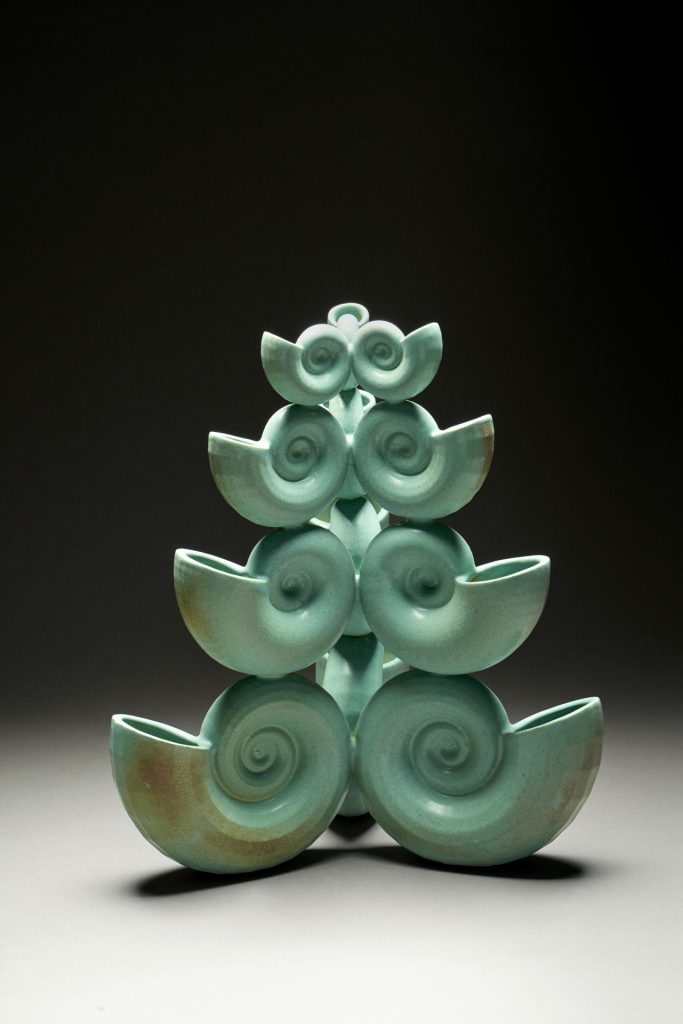
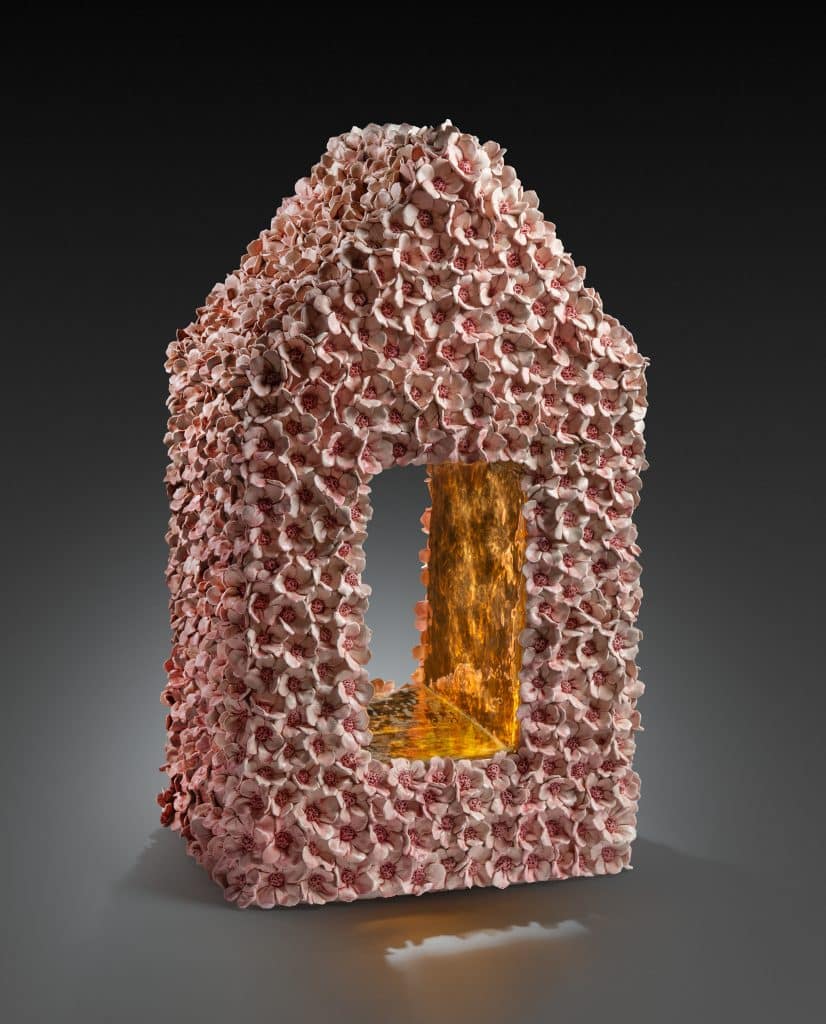
Unlike his colleagues here, Nagelberg chases and achieves perfection. In works like “Columnar,” a clutch of bright-orange hexagonal pedestals, and “Nautilus,” a tower of sea-green nautilus shells, he’s all about crisp lines, flawless surfaces and mathematical precision. What’s amazing about these things, beyond their intrinsic beauty, is that he made them out of clay.
Best-in-show, though, goes to Cliffel. Her “Making Hard Things Soft” stands apart both literally and figuratively, looming large over the exhibit while breaking every boundary in sight. It might actually be menacing if it weren’t so darn cute.
A giant pink hammer composed of hundreds – if not thousands – of discrete ceramic flowers, each of them glazed a unique shade of pink, it’s a technical tour-de-force and a masterful study in contrast. There’s no admission fee at the Sculpture Center, but if there were, the opportunity to admire “Making Hard Things Soft” up close would be worth the price.
Keep our local journalism accessible to all
Reader support is crucial as we continue to shed light on underreported neighborhoods in Cleveland. Will you become a monthly member to help us continue to produce news by, for, and with the community?
P.S. Did you like this story? Take our reader survey!