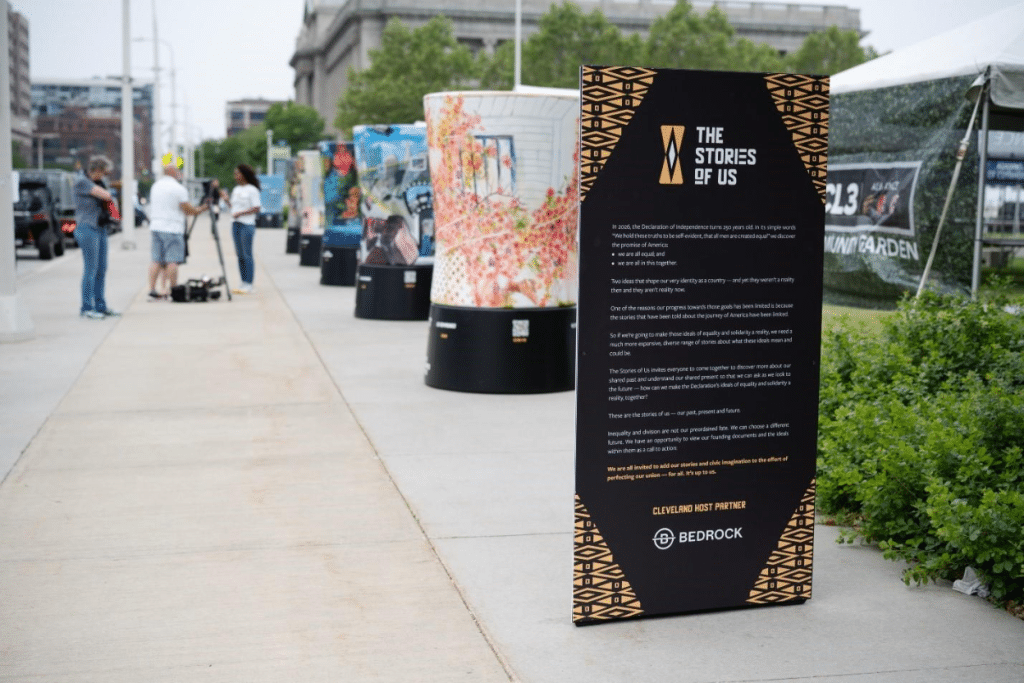
In celebration of the 250th anniversary of the signing of the Declaration of Independence next year, co-creator Ashley Shaw Scott Adjaye wants to create a discussion around our shared history and the Black experience of living in America. She wants to ask the hard questions.
Since 1776, have we, as Americans, achieved the goals set forward in our Constitution? How have we understood the truths set forward by our ancestors? Have we fallen short of their ideals and goals?
“What does it mean to be a we?” she asks.

Explore these questions and more by visiting the Stories of Us exhibit that debuted on June 9, 2025. This showcase consists of ten painted sculptures by local artists that initially were displayed in Mall C. Those ten have now joined with the ten initial sculptures that were on display in Detroit last summer at Skylight Park in Tower City. They will be available for viewing until the end of August.
To better understand the exhibit and its commentary on our society, The Land interviewed Adjaye and all 10 artists on exhibit as well as Jason Russell from Bedrock, a local real estate company sponsoring the exhibit.
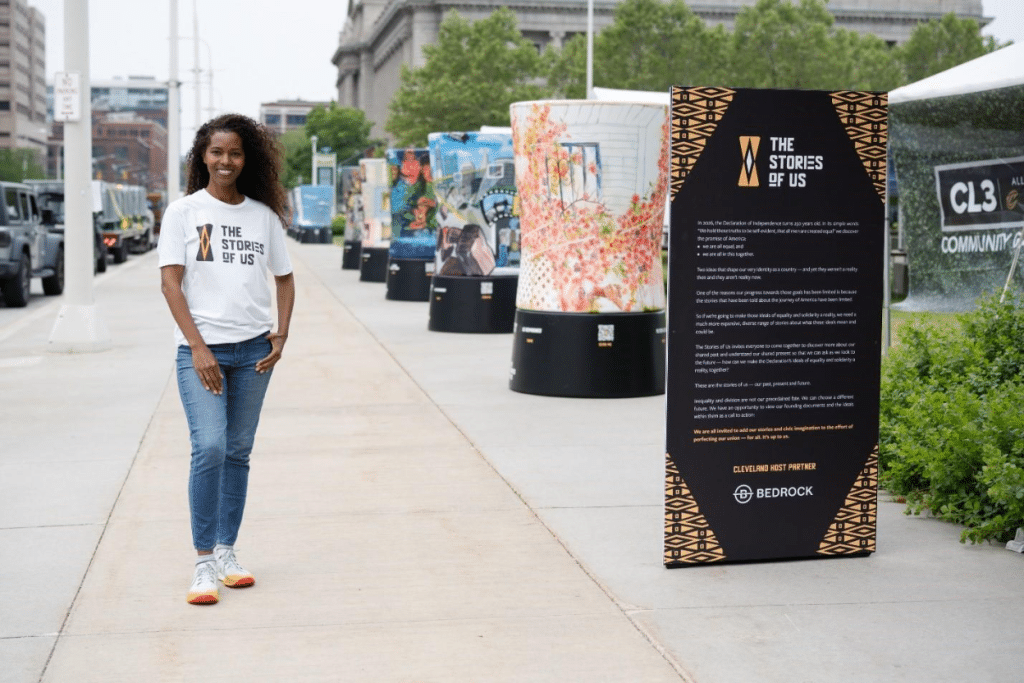
Adjaye is a native Californian who earned a bachelor of arts degree in philosophy and visual arts from Stanford University in 2022. She currently splits her time between Ghana and New York with her husband and two children, aged 7 and 10.
Adjaye was the artistic director for World Reimagined, a UK-national art project that explored the history of the transatlantic slave trade and displayed sculptures by 100 artists across seven major cities around the UK in 2022.
“Not to blame or shame,” she says, “but as an opportunity to understand the past. If you don’t understand the past, ultimately, it’s very hard to understand how things happened and why they are what they are today.”
As work came to a close, says Adjaye, it made sense to bring her work to the United States, where there is a different story to be told.
“I’m grateful to facilitate artists telling their stories and doing their work,” she says.
Russell, who is the vice president of operations at Bedrock, is excited about the exhibit.
“Each piece is very different and unique,” he says, as he points out the small details that most drew his attention. “The blank concrete drums arrived in February, and to see them come to life in three months is truly incredible.”
Stories of Us
In the context of the 250th anniversary of the Declaration of Independence, which is less than a year away, the Stories of Us exhibit offers viewers an “opportunity to help explore ideas that are core to America,” according to Adjaye.
Stories of Us debuted the first exhibit of 10 sculptures in Detroit in summer 2024. Those 10 sculptures will be displayed in Tower City until the end of August. This summer there are another 10 sculptures on display in New Orleans in addition to the ten on display in Cleveland. In 2026, there will be exhibits in San Francisco, Philadelphia and Chicago, and Adjaye hopes to bring all fifty sculptures together sometime next year.
For each exhibit, artists are chosen to create a work that represents one of 10 themes, Origins, We Hold These Truths, Emancipation, Ripples Across Generations, Good Trouble, Still We Rise, The Culture, A More Perfect Union, Me Reimagined, and Us Reimagined.
The process of choosing artists in Cleveland started with connections to people from the local art “ecosystem,” explains Adjaye. From their recommendations coupled with an expanded search, Adjaye and her team chose a pool of artists to send an invite-only request for proposal. Artists submitted a design with a narrative framework, and 10 were chosen from those submissions: Alyssa Lizzini, Brandon Graves, Nathalie Bermudez, Da’Shaunae Marisa, Gina Washington, Jerome T. White, Donald Black, Jr., Isaiah “Starbeing” Williams, Leigh Brooklyn and Alicia Vasquez.
The base for each piece is known as The Talking Drum, conceived by maker Jomo Tariku. The shape of The Talking Drum is inspired by the hourglass-shaped talking drums of West Africa, which are known for being able to accurately replicate human speech, allowing communication between villages over long distances.
Read on below for more information about each artist and their work.
Tapestry of Life
Artist: Alyssa Lizzini
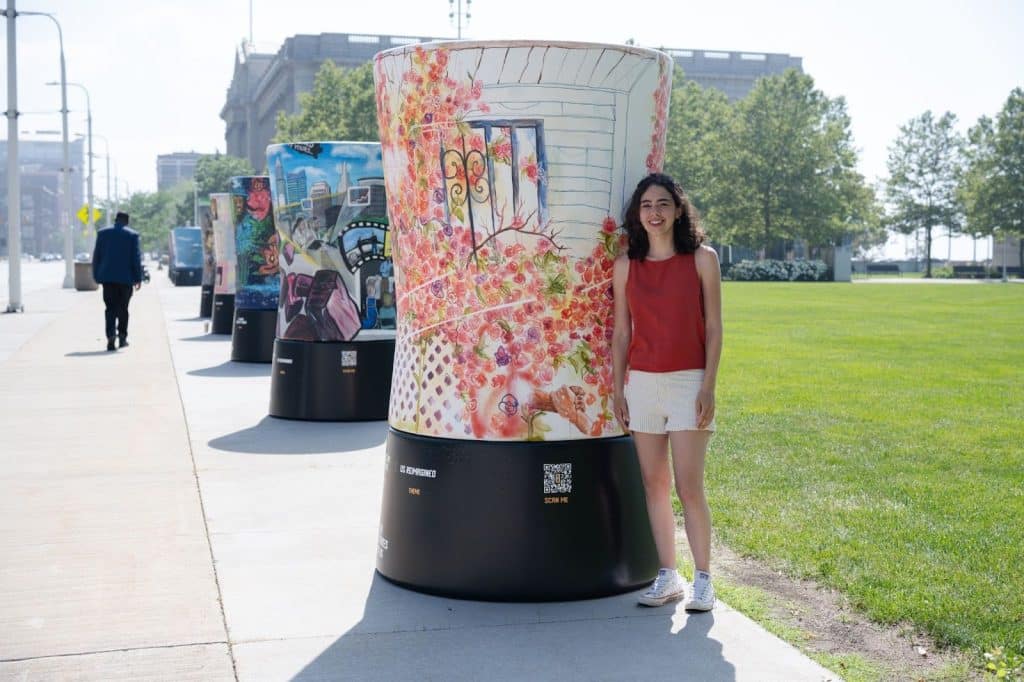
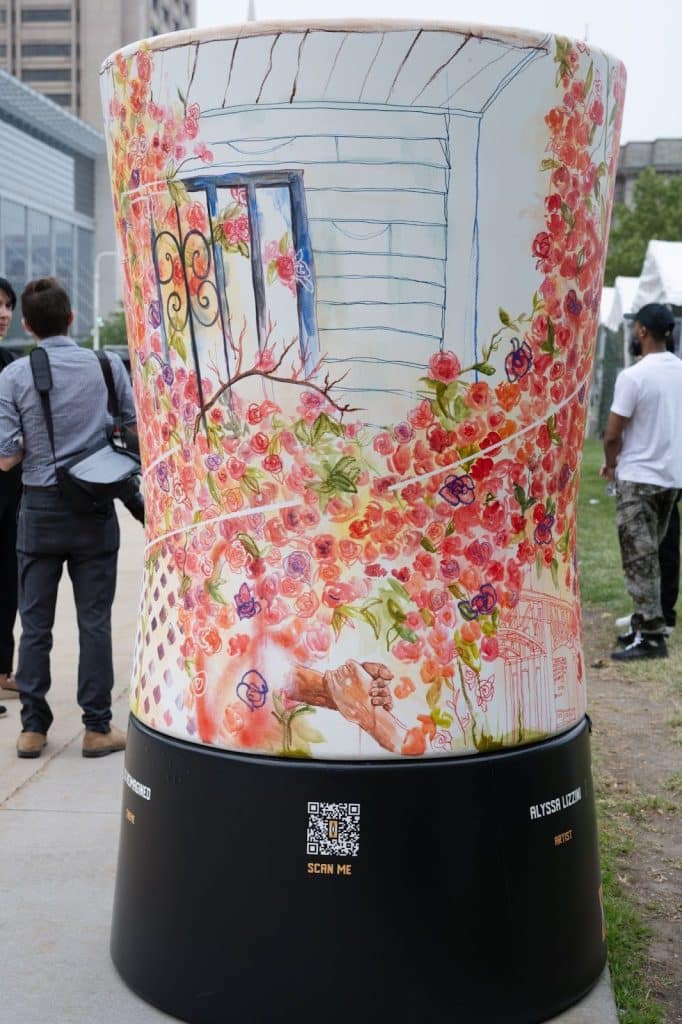
Tapestry of Life by Alyssa Lizzini brims with hope and fits well into the Stories of Us Theme ‘Us Reimagined’, which “invites us to envision the community, society and world we can create if we embrace transformative solidarity and prioritize full dignity and justice for all.”
Born and raised in Old Brooklyn, Lizzini says she has always known she was an artist. She graduated in 2022 from the Cleveland Institute of Art. As part of her senior project, Lizzini illustrated ‘Cleveland: A Snapdragon City,” a book that highlights overlooked aspects of the city.
Lizzini was featured on the cover of the winter 2023 issue of Canvas in celebration of the installation of her piece Our Garden, as a part of the LAND studio project that rotates artwork by up-and-coming artists on the back side of the restaurant REBOL in Public Square.
On her website, Lizzini says, “Our Garden is inspired by the prevalence of community gardens in Cleveland neighborhoods. I believe that through the act of gardening, we are both literally and figuratively putting roots in the ground and growing a sense of home in our communities.”
She finds her inspiration walking through the neighborhoods of Cleveland “picking up on hidden stories that are present all around us.”
Tapestry of Life is inspired by a walk through the Opportunity Corridor in which Lizzini found herself in front of a beautiful display of roses covering the porch of a home in a historically disadvantaged part of the community. She describes the scene in her Stories of Us artist statement.
“And there in front of me is this house with a front porch covered by more roses than you could imagine. The side street was off a stretch of the Corridor that seemed quite empty and devoid of much activity, yet here was this porch overflowing with riotous color. It was a breathtaking symbol of beauty and pride – and a ‘we’re still here’ commitment to the future.”
The Opportunity Corridor connects the city’s east and west sides, and when it was built, it cut through a historically disadvantaged area of Cleveland.
“Cutting the neighborhood in half,” explains Lizzini. The story in Tapestry of Life begins here in this neighborhood and on this porch, where the “roses become a symbol of how we sow beauty into our world.”
Hands of all skin colors are featured in the Tapestry of Life “helping, praying, holding, knitting. […] all of us taking a part in building a beautiful city, a beautiful country.”
Hands in Tapestry of Life knit a tapestry of roses across a front porch, around an old original front door, giving the piece authenticity or maybe showing a path to a brighter future.
“Doors can be a lot of things,” says Lizzini.
The piece also references Cleveland landmarks like the Cleveland Clinic, the Cleveland Public Library, the Westside Market, the Cuyahoga River, and steel mills, amongst others; places that represent the city’s history and “places where you find community.”
Lizzini’s artist statement ends with this line.
“Wouldn’t it be wonderful if we all thought about how we could create beauty in the world, together?”
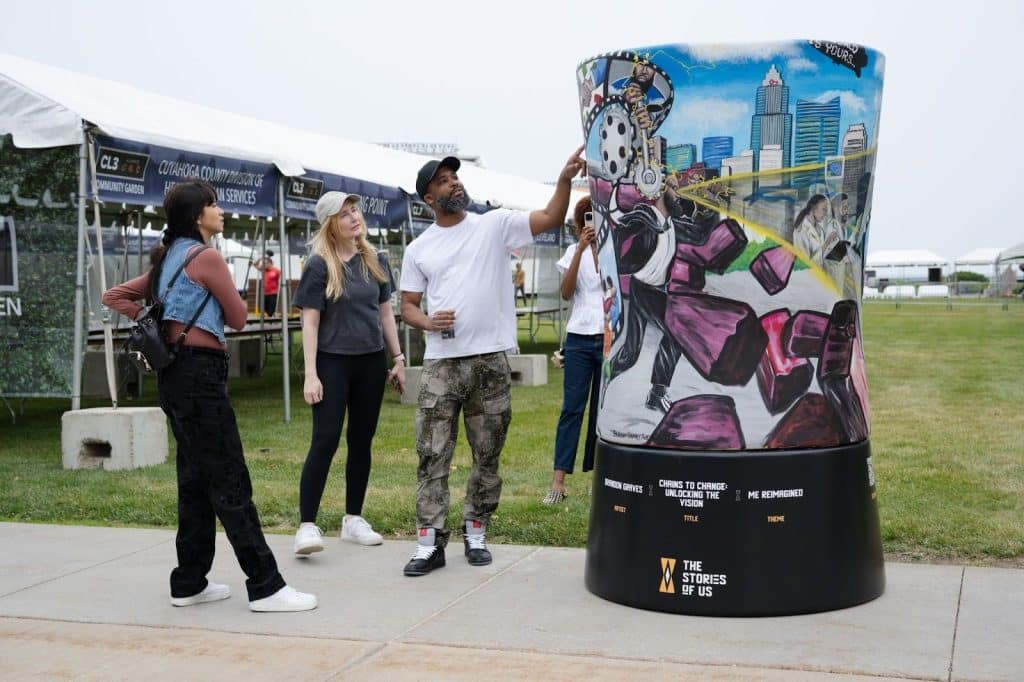
Chains to Change: Unlocking the Vision
Artist: Brandon Graves
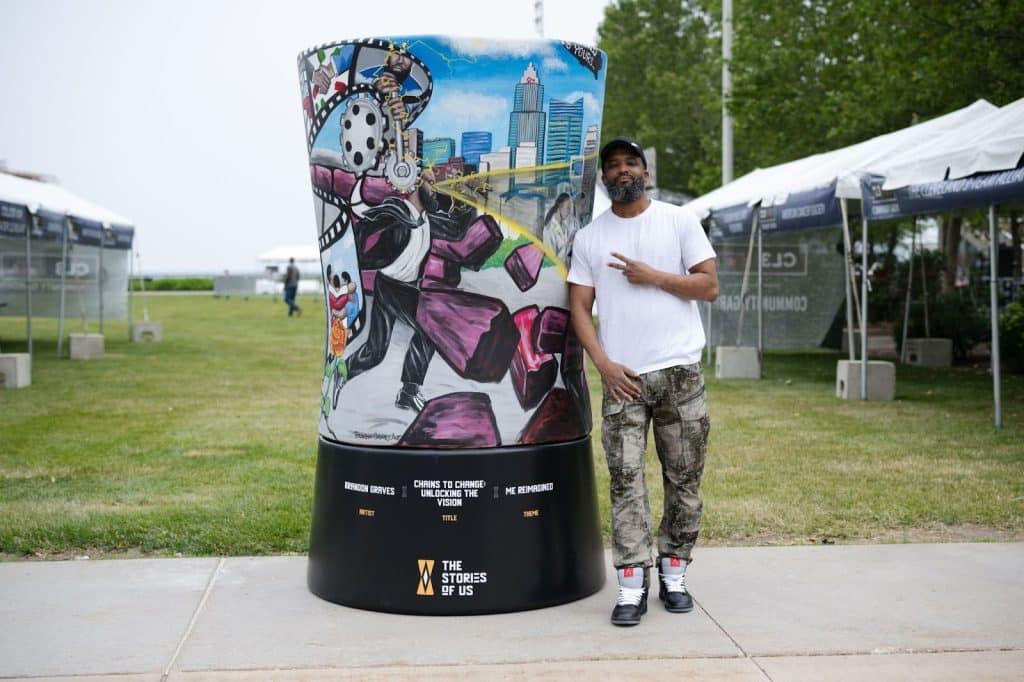
Brandon Graves shares his story and vision for his future in his piece, Chains to Change: Unlocking the Vision. Graves grew up in Euclid and has lived in the Cleveland area his whole life. He discovered art in prison, and he credits it with turning his life around.
Since 2010, Graves has been creating art and inspiring others. He teaches art to kids as part of a youth program called Academic Boot Camp.
“We try to catch kids young because once the streets get a hold of you – the shiny cars, flashing bills. There’s nothing to look up to.”
His piece, Chains to Change: Unlocking the Vision chronicles his own experience growing up in the streets as well as his hopes for the future, a piece that fits well into the Stories of Us “Me Reimagined” theme.
“My piece represents my journey from trials to triumph,” Graves explains.
Graves uses bricks and concrete to represent the streets and his personal breakthrough. A filmstrip shows scenes from his life and his visions for his future.
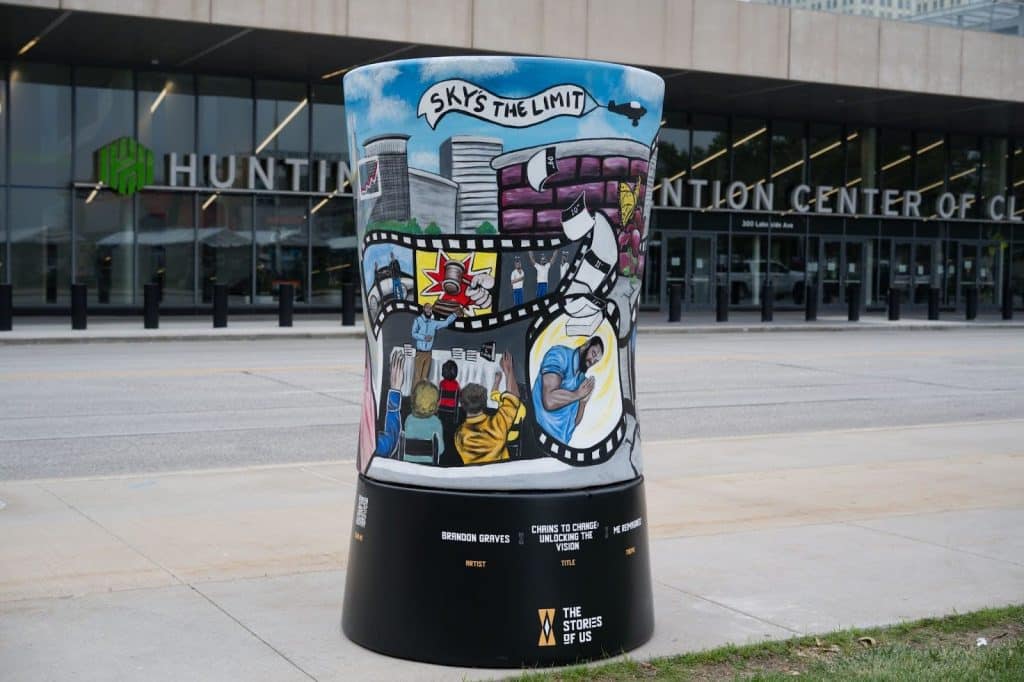
The history Graves paints starts with scenes of him in the streets and the gavel from the judge sentencing him to prison.
“It took me going to jail,” he says. “You see a lot of people you know in jail.”
For seven years behind bars, Graves refocused, found comfort in prayer and started writing a book about his life.
Everything changed for Graves when he wrote his book and illustrated the cover.
“People gravitated towards the book cover,” Graves explains.
While in prison, Graves nurtured his natural talent by studying art, designing tattoos for fellow inmates and even painting portraits of friends’ girlfriends from outside of prison.
In 2019, the Plain Dealer published an article about Graves, titled “Clean Canvas: Cleveland mural artist discovered his talent behind bars.”
By this time, 3 years out of prison, Graves had completed an internship at a local graphic design shop and begun to expand his work from portraits to murals. He started working with Cleveland Ward 7 City Councilman Basheer Jones to create meaningful community art in the Hough neighborhood using a $15,000 grant from the Cleveland Foundation. His first neighborhood mural is a portrait of a successful neighborhood displayed at the Hough Multipurpose Center.
In a 2019 interview for an article with News 5, Graves said “You see a lot of negativity in these neighborhoods, these low income traumatized neighborhoods.”
Graves’ work is meant to inspire others, to bring them hope.
“Here you see me praying, keeping hope alive,” Graves points to his painting, where his faith is depicted as part of the filmstrip.
Graves’ filmstrip wraps around the piece with more scenes, manifestations of Graves’ future vision of himself. He paints a wrench turning the gears in his brain, keeping him on course. A butterfly rises from the concrete. Graves wants to continue sharing his art, travel, and someday work outside of Cleveland.
“If you believe in it, and you work towards it, it’ll happen.”
Whispers of Home
Artist: Nathalie Bermudez
Nathalie Bermudez immigrated to the Cleveland area not long after high school, after waiting for over a decade for her family’s papers to come to the United States. Having grown up in Colombia, she seeks connection in her art and wants to inspire others.
In a snippet from LAND studios, Nathalie says, “I am very interested in making an impact on all Spanish-speaking communities. My intention as an artist and as a Latina is that through my paintings people who have come from other countries feel identified and inspired, that they know how important they are for this country and how important it is for me that they are painted and seen.”
“Everybody is an immigrant,” Bermudez says. “We are all from the earth, and for hundreds and hundreds of years we’ve been moving around the world.”
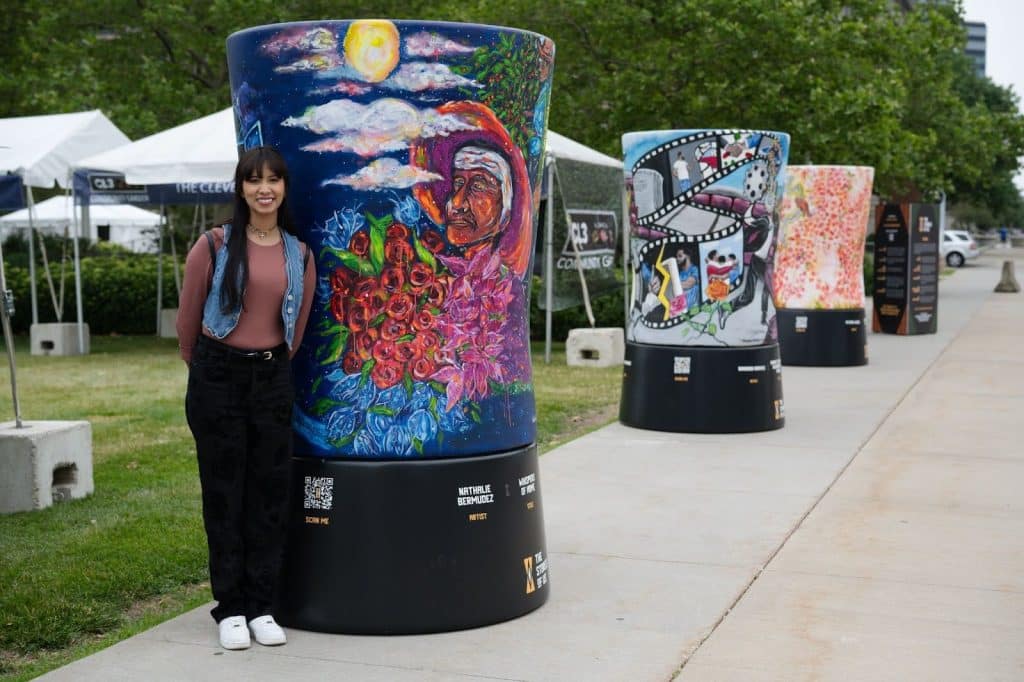
Bermudez’s piece, Whispers of Home, highlights the bravery of immigration.
“When we leave a place, we carry home with us,” she explains. “We leave our culture, language, our things, it’s not always easy.”
She speaks to the imagery in her painting in her artistic inspiration on the Stories of Us website.
“But those sacrifices and insecurities also come with another truth: just as we are leaving somewhere, we are also going somewhere. The migrants in the scene are crossing a river, following a path of flowers, heading towards a window in the sky. That widow speaks to the idea that as one door closes, a window opens. It is our hopes and ambitions, our portal to a new and better life.”
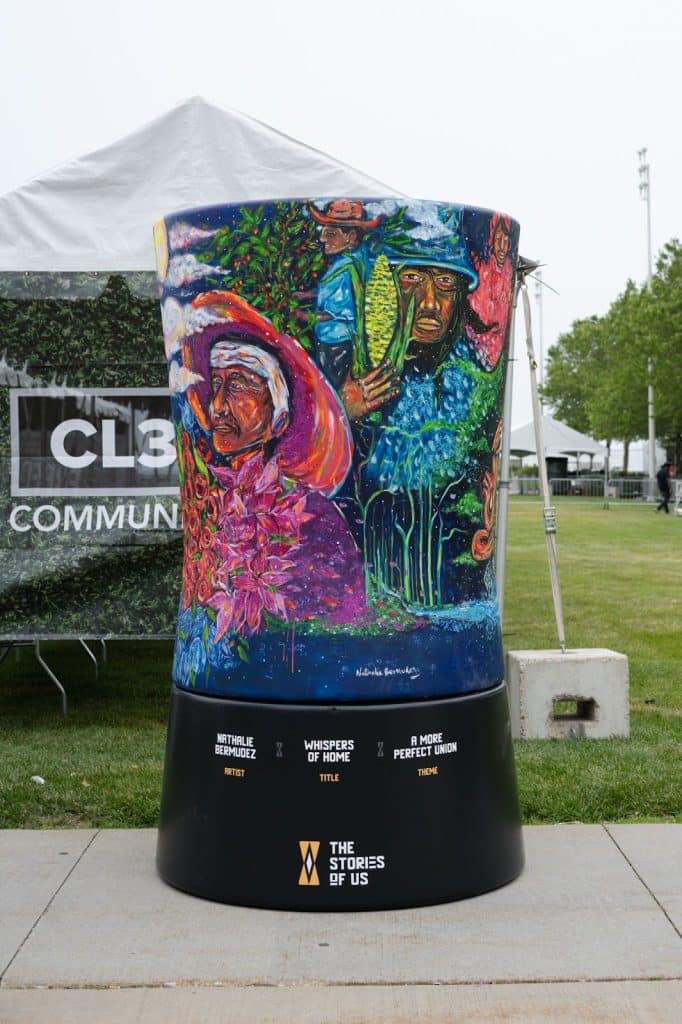
In Whispers of Home Bermudez transports the viewer from river to jungle, symbolizing the immigration journey and its struggles.
“People don’t always talk about what’s happening in that space,” Bermudez says.
Specific elements represent the resources and beauty that immigrants bring with them. Bermudez highlights the Monarch butterfly, which migrates each year from Mexico, as well as corn, coffee and flowers that are all common imports.
This piece fits the Stories of Us theme, A More Perfect Union, by highlighting “the many intersectional movements that stand alongside each other in the pursuit to realize these ideals of America for ALL.”
“Whispers of Home is rooted in my experiences, but it is not limited by them. It is particular, but universal – after all, we have all migrated at some point on this Earth. And perhaps that truth allows us to see the value of what we all can bring to this more perfect union.”
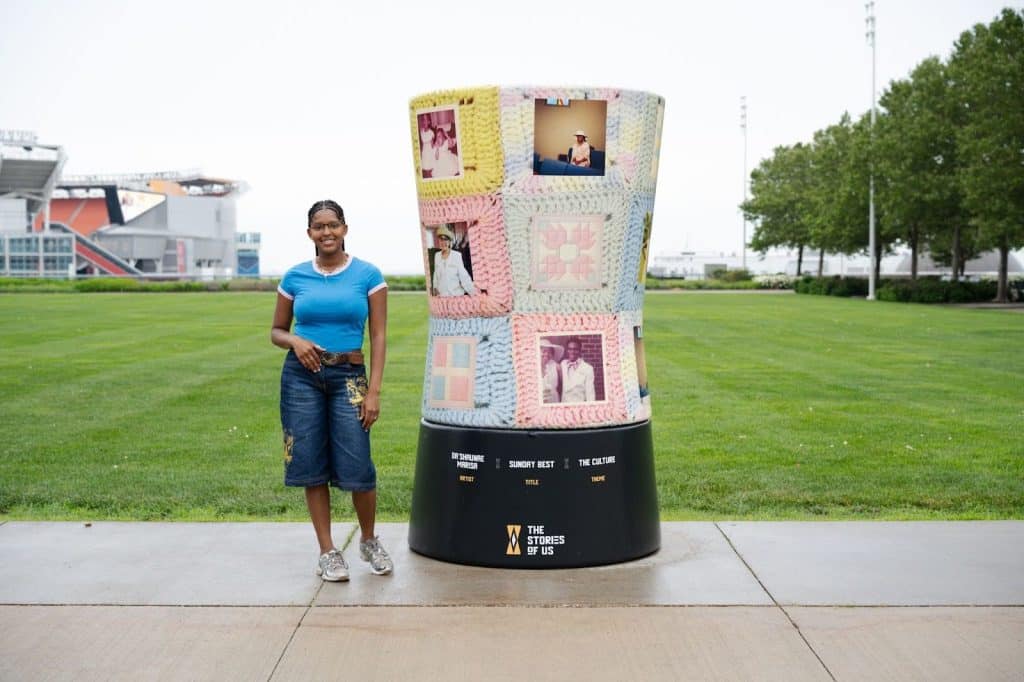
Sunday Best
Artist: Da’Shaunae Marisa
Da’Shaunae Marisa’s grandmother would say she got her start as an artist by sculpting mud pies, cartoons and comic books. It was only in kindergarten when Marisa’s mother started sending her to school with her own disposable Kodak point-and-shoot camera on special days, like the last day of school before summer.
In an interview last year with Voyage Ohio, Marisa says, “I still have those prints that I love and that continue to motivate me on the best and most challenging days in this industry. My mom’s decision to hand me a camera and give me creative control for a day changed my life; it allowed me to capture what was beautiful to me. She didn’t tell me what I could or couldn’t take pictures of, and I filled most of the frames with the people I loved.”
Marisa grew up in the Heights neighborhoods east of Cleveland and started a graphic design degree at Kent State before taking a 2-year hiatus and switching to Photography at Cuyahoga Community College. She received her first big assignment from the New York Times in 2019 and was featured in National Geographic in 2020.
Since 2021, Marisa has been spending more of her time in Los Angeles, enjoying the sunshine, but she is in Cleveland as often as every other month. She enjoys creating public art “for people to see wherever they are.”
Her focus is currently on photojournalism, commercial photography and documenting peoples’ stories in and around Cleveland. Participating in the Stories of Us Exhibition was an opportunity for Marisa to “showcase more of my community in Ohio. No matter where I am in the world I want to show the people here and those who have had a big impact on me.”
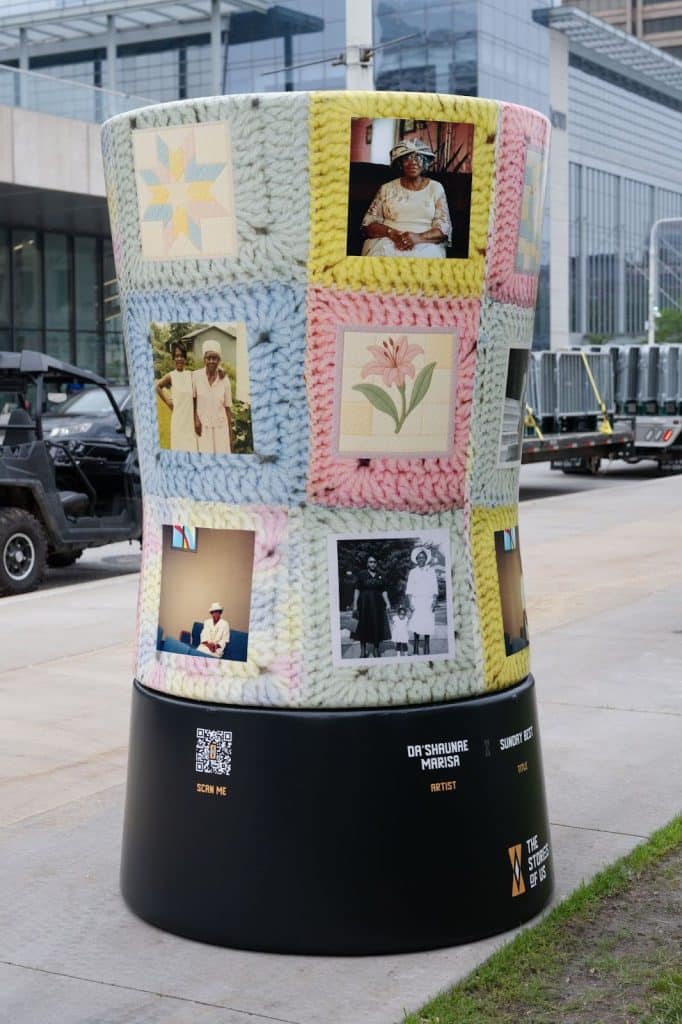
In Sunday Best Marisa portrays a quilt of current and archival portraits of her grandmother’s church friends, friends who, according to her Stories of Us artist statement, “have all been together for 50 years and now also do aqua aerobics together!”
To her, Sunday Best represents “matriarchy, family, family legacy. What is the most important thing to Grandmas? Their grandkids.”
Grandmothers have a lot of influence on us, Marisa explains, and they provide a lot of support.
“Most of us rely on our Grandmas.”
“I personally feel like I have half a dozen grandmothers who have looked out for me, in the spirit of it takes a village to raise a child.” Marisa says in her artist statement.
Her focus for Sunday Best is the role these selfless women have played in the Black community, “as matriarchs, as steadying forces in our lives – always listening to our trials and adventures, offering their wisdom and nurturing to see you through.”
Sundays at church are an opportunity for these women to celebrate themselves, to dress up, “making sure they look cute and taking pride in their appearance is self-love and dignity. It is honoring God by showing their best selves.”
Lizzini connects the influence of grandmothers throughout history by stitching together their portraits with patches representing the underground railroad. The background is made from actual images of a quilt given to Lizzini by her God Grandmother.
“There is a long history of Black women quilting, weaving artistry and stories for future generations, even helping enslaved people to reach freedom” she discusses in her artist statement.
The quilt patches are styled after the stained glass windows of the churches and feature historical symbols of the Underground Railroad, like the north star and cross roads symbol that represented Cleveland.
“Cleveland was the last stop to Lake Erie on to Canada on the railroad. It was called Station Hope and so many of Cleveland’s churches housed families fleeing enslavement. That tradition of community and solidarity has endured, as shown in this incredible sisterhood.”
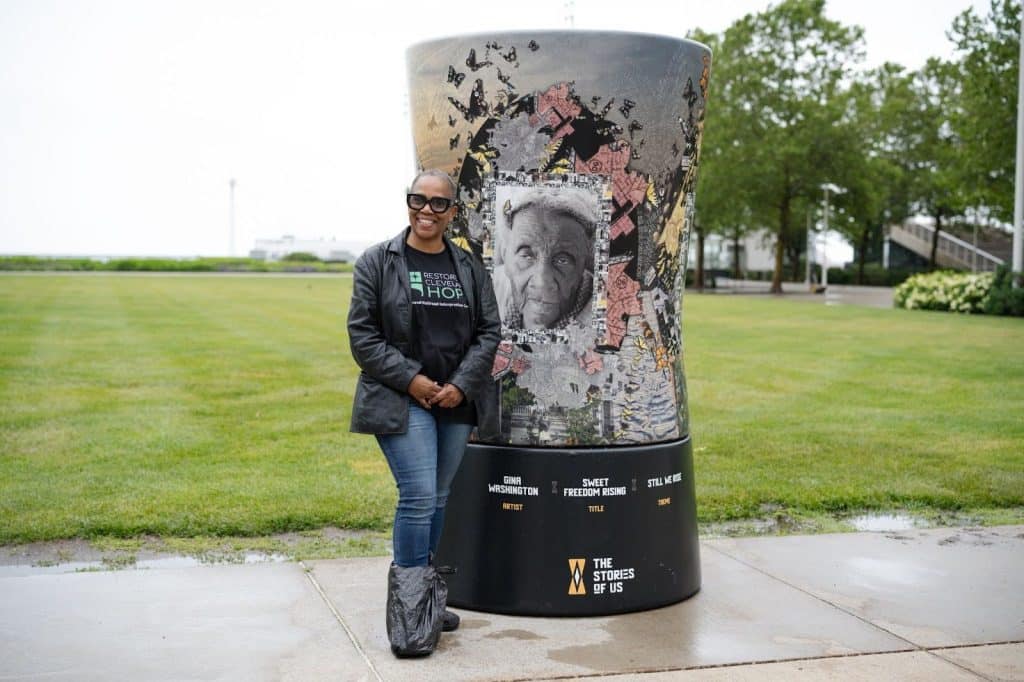
Sweet Freedom Rising
Artist: Gina Washington
Gina Washington’s piece is personal.
“The picture you see is of my great-grandmother – Harriet Hewlett Poteate, who is surrounded by images of her nine children. She was not enslaved, but her people were, – so her life speaks of a great transformation.” Washington says in her artist statement.
“I come from a long line of people who, with their hands and hearts, nurtured a family of artists – whose creativity was a form of survival, dreaming beyond their conditions. The truth of the theme ‘Still We Rise’ for me is that I stand on the shoulders of my ancestors.” Washington was born and raised in East Cleveland and currently lives in her grandparents’ old family home. She received her bachelor of arts in film studies at the University of Rochester and her master of fine arts in photography at Ohio University. She is the co-founder of The Visit Arts Collective and teaches art in Cleveland area schools. She serves as a board member or volunteer at various other area institutions, including the Cleveland International Film Festival and the artist archives at Case Western Reserve University.
Her goal, she says, is to “connect and collaborate” with other artists.
Washington’s piece, Sweet Freedom Rising, connects people and places, beginning in Hanover County, Virginia in the 1700s at the Wickham Plantation.
“We trace the beginning of our family as we know it now –- on my mother’s side – to Vivianna Hewlett, who was enslaved on this estate.”
The story continues with Washington’s ancestors’ first steps towards freedom – becoming homeowners in Richmond, Virginia, despite the discrimination the family faced.
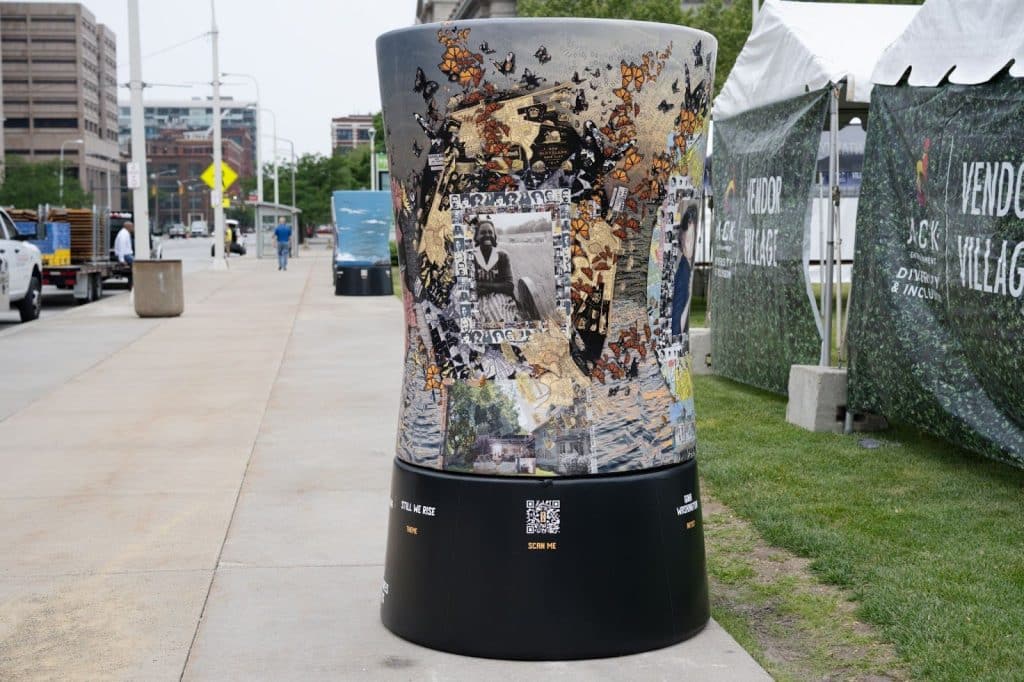
The family migrated north and eventually settled in Cleveland in the 1950s. Sweet Freedom Rising depicts an image of Washington’s Great Aunt Pearl with redlining maps of Cleveland, maps that deemed the spaces in yellow as for “respectable people, but homes are too near negro area.”
Washington’s artist statement ends with a prayer.
“With Sweet Freedom Rising, I offer this simple prayer to my ancestors (seen in binary code on the sculpture):
“To my ancestors and angels, I pray for your guidance from the wisdom of the ages that humanity finds its way through the madness of scarcity. I am because of you; I am grateful to you. I will do my best to remember before the book and before hate ruled each land, creating walls. I am love, rising.”
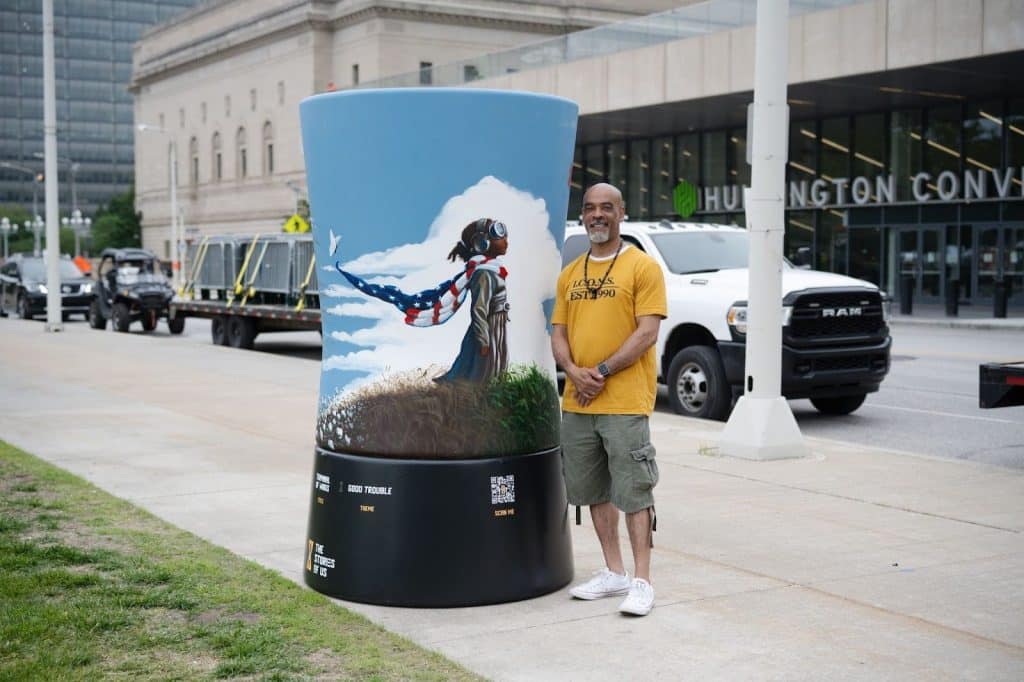
Terminal of Wings
Artist: Jerome T. White
Jerome White is in his 32nd year of teaching at Monticello Middle School in the Cleveland Heights-University Heights Schools. He was born and raised in Cleveland and Cleveland Heights and graduated from Heights High in 1988. His educational journey started in architecture at Tuskegee University in Alabama, but he quickly switched to Baldwin Wallace to pursue a degree in studio art. Then he attended the Cleveland Institute of Art for medical illustration and eventually switched to Case Western, where he received a Master’s Degree in Art Education.
He started teaching in Norfolk Public Schools, moved to his alma mater and taught in the Heights schools for nearly 20 years. While teaching, White has also pursued opportunities to create his own art and has painted multiple murals throughout Cleveland, including in the Glenville and Miles neighborhoods. He also contributed to The Black Experience: From Then and Now, which was exhibited at the Cleveland Hopkins International Airport through June 2023. He is currently participating in a mural project with All Our Babies, a Cleveland-based initiative whose mission is “to advocate for health equity, cultural celebration, and the well-being of Black mothers and children.”
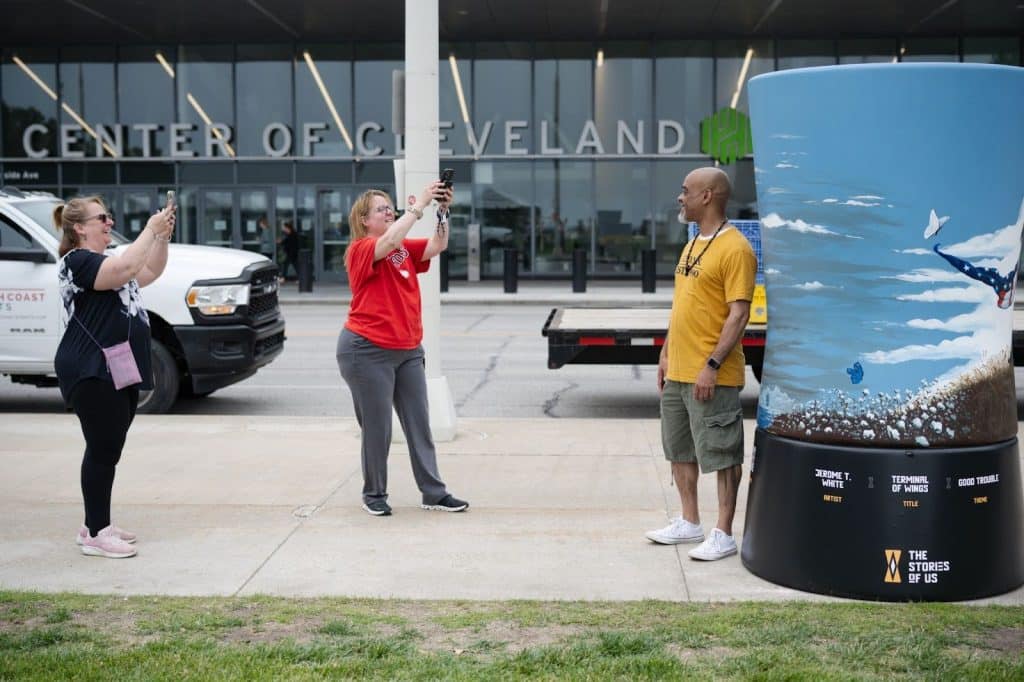
White’s piece, Terminal of Wings, was inspired by a quote by John Lewis.
“Speak up, speak out, get in the way. Get in good trouble, necessary trouble, and help redeem the soul of America.”
It fits into the Stories of Us theme, Good Trouble, which “charts the long march towards racial equity since Emancipation, with the Civil Rights Movement in the United States at its heart.”
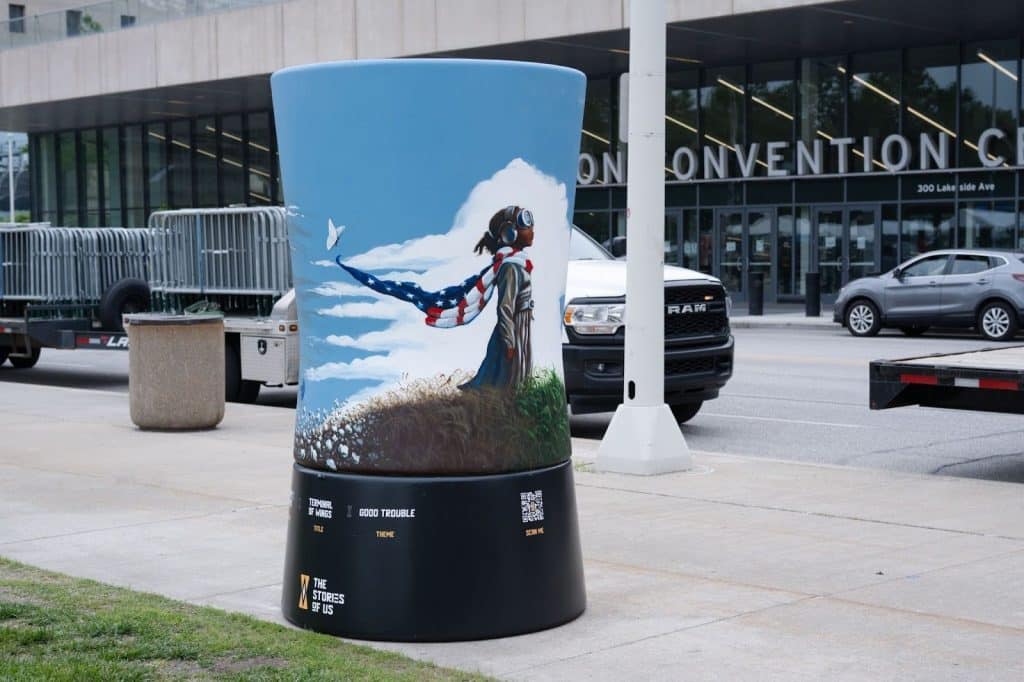
White’s piece also takes inspiration from his own children’s book, Red Tail Dreamer, “a tribute to dreaming and chasing those dreams,” only this time, he paints a young girl as the hero of the story. She stands on the edge of a cliff, looking to the sky. Wrapped around her like a scarf is the American flag, “blowing against the wind of resistance.”
“She’s daydreaming about what she wants to do with her future and how she will fly,” says White in his artist statement.
The flag blowing backwards represents “the reality that so much of this county has been designed to hold people back.”
The scene depicts a slave ship in a storm- “The beginning,” says White.
Out of the water, a cotton field rises, symbolizing enslaved Africans and forced labor. A blue butterfly rises from the fields, bringing spiritual renewal, growth, and transformation. A white butterfly hovers, released from the American flag, symbolizing new beginnings, and the ground changes from brown to green, a promise of better things to come.
A red butterfly offers a symbol of passion, drive, and in the sky – five red, white, and blue planes – the Tuskegee Airmen.
“My grandfather, Fred Brown, was a PE Coach in Alabama,” White explains his family connection to the Tuskegee Airmen and how their story inspired him.
His grandfather taught physical education to the Tuskegee Airmen, the first African American military aviators in the US Armed Forces, who fought in WWII.
“Their story is one of the simple extraordinary acts of ordinary people, determined to dream big, assert their dignity – and fight for a country better than the one they knew. For me, they were the definition of patriots.” Despite the trials and tribulations of history, the girl in Terminal of Wings “stands resolutely looking towards the future. Because she knows transformation is possible.”
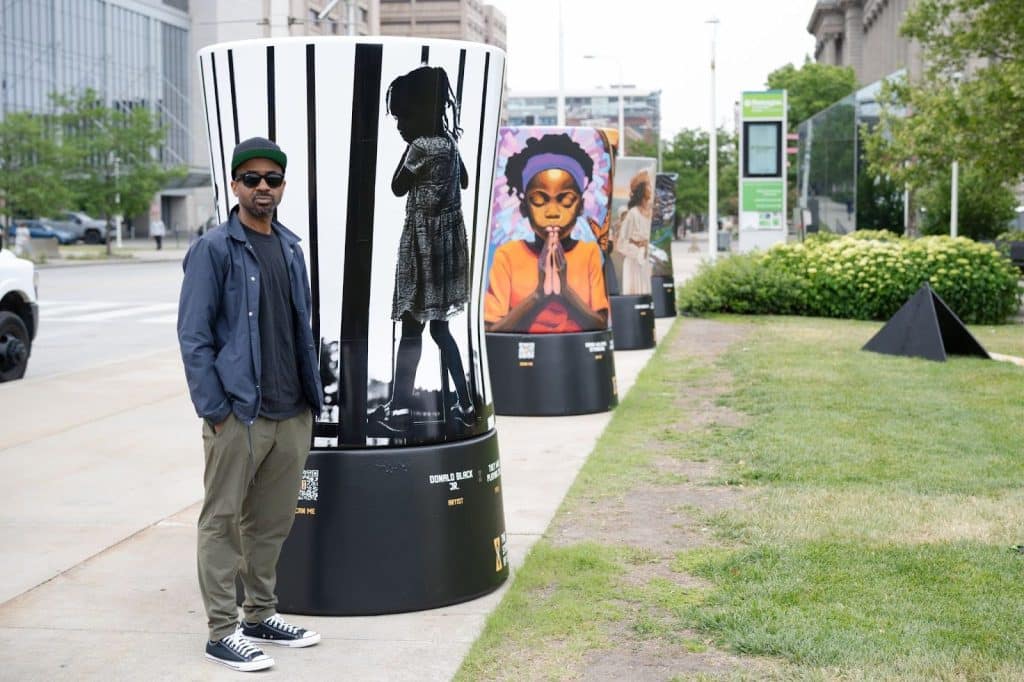
They Was Playing Jail
Artist: Donald Black, Jr.
Donald Black, Jr. started drawing at age 2 and began photography by age 4. Growing up on the south side of Cleveland, Black experienced a traumatic childhood that has impacted his art.
“I was born in the projects,” he says, “Mom made it ‘up the way’.”
But before the end of elementary school, he had moved more than 30 times and personally experienced violence and crime. Despite his rough start, Black always knew he was an artist. He took an interest in drawing early on and by age 6 or 7 had taken an interest in portrait drawing. His photography journey started at age 4, when his mother enlisted him to take photos of her before she would go out.
“So, her early ‘80s look-book and photo album of her going out with my aunt to Vel’s is me not cutting off her head and not cutting off her feet with a Polaroid camera. That’s my introduction to the camera,” Black said in a 2022 interview with CAN Journal.
It was his acceptance into the Cleveland School of the Arts High School that eventually led him to focus on photography, and he went on to study commercial photography at Ohio University. He lived for a short while in New York City before moving back to his hometown in 2000.
Black’s photography has been featured in various exhibitions throughout Cleveland, and his work “captures childhood play, imagination, creative expression and the loss of innocence due to society and community circumstances” according to a 2022 article by Scene.

“Jail as a form of play exists very close to the truth about prison and enslavement in America. Oppression is enforced, internalized, expressed and perpetuated by age of 3 in America,” writes Black in his artist statement.
The profound message behind They Was Playing Jail speaks for itself.
“I can sit here and pretend that I need to say all this sophisticated, profound stuff, but I feel like I’ve already said it in the work,” Black said in an interview with Ideastream Public Media.
The black and white photograph in the piece shows his cousins after a football game in 2018. Black says watching the kids, aged 5 and 3, playing jail had a profound impact on him, and he knew this piece would fit into the Stories of Us theme, Ripples Across Generations, as it shows how oppression and racism have made their way into his little cousins’ childhood games.
“She already knew at 3 – ‘You bein’ bad so you gotta be on the other side,’ she said,” Black recounts his experience watching them balancing on the fence and pretending to break out of jail.
“This system works so well the children play jail.”
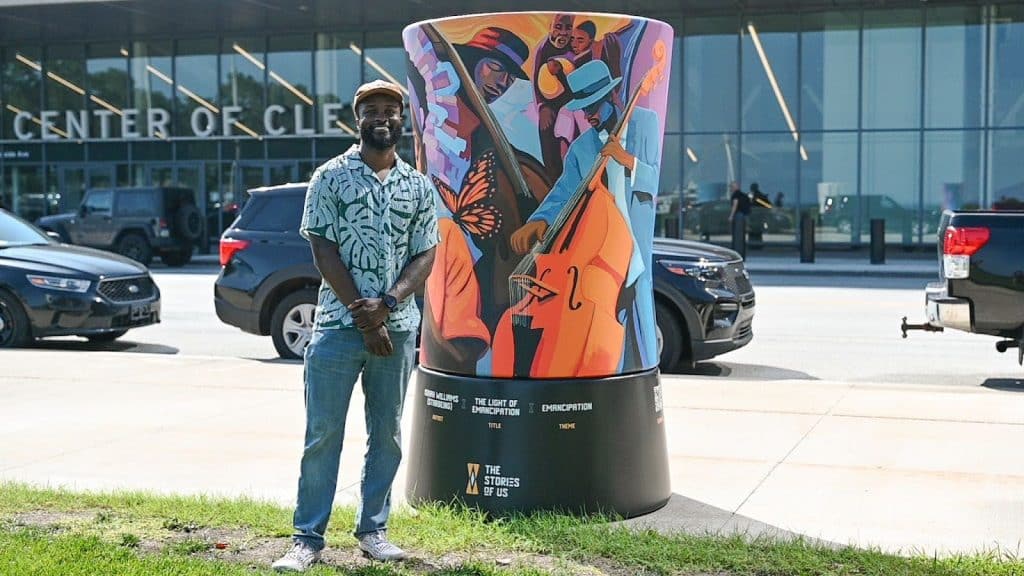
The Light of Emancipation
Artist: Isaiah Williams
If you have seen Isaiah Williams’ work before, you may know him by the name “Starbeing.”
Williams, a self-taught artist, grew up in Beachwood, lived in Lakewood, and is now in Midtown. With an estimated 40 or more murals painted in the area, Williams’ art can be found in many places around Cleveland. One of the largest pieces is a 300-foot mural across a warehouse in the Flats titled Emerald Necklace which he created with the support of LAND Studio and the Cleveland Metroparks.
For the 2020 election, Williams was commissioned by the Joe Biden-Kamala Harris campaign to create a mural of Kamala Harris to encourage the vote in Old Brooklyn. And in 2021 Williams participated in the Cleveland Walls! International Mural Program with over 20 other local and national artists to beautify 20 facades of buildings in Midtown and surrounding neighborhoods. Like the mural at 7113 Euclid Avenue, most of Williams’ work bears the signature “Starbeing.”
This name, according to Williams, symbolizes our connection to the universe. All human beings are made from stardust, he says, “We’re all interconnected. We didn’t materialize out of nothing. We’re all part of the stars.” In an interview with Voyage Ohio earlier this year, Williams said, “Art has always been a tool to challenge one’s way of thinking and inspire the next generation.”
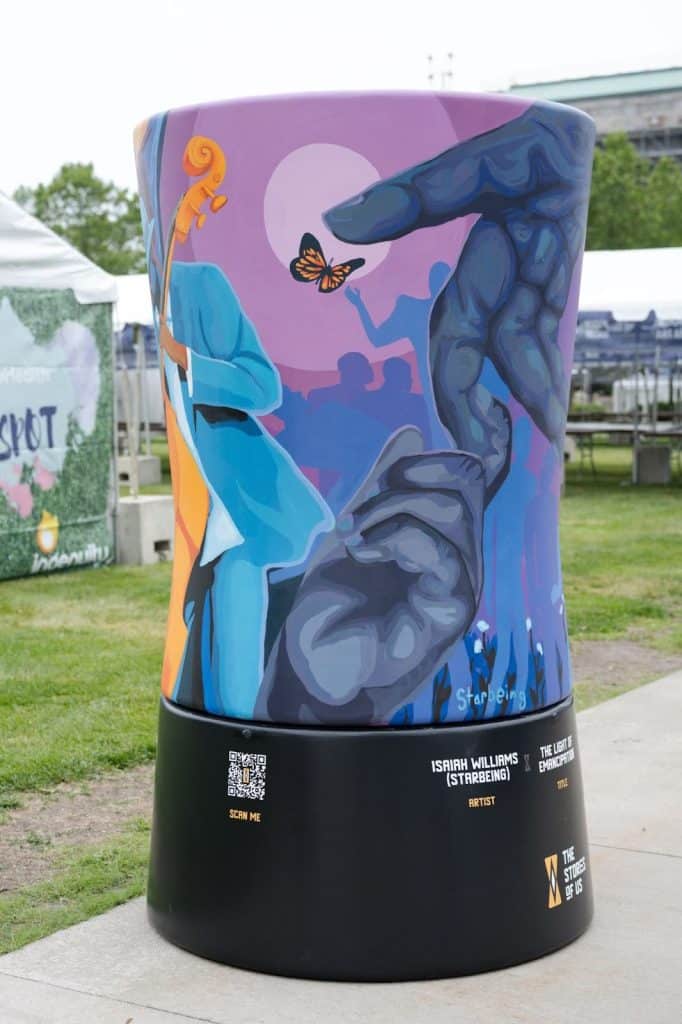
On one side of The Light of Emancipation, a young girl prays.
“Black women have in so many ways been our backbone in a truly remarkable, often undercelebrated way,” says Williams in his Stories of Us artist statement.
On her shoulder rests a monarch butterfly, a symbol of hope and transformation.
The Light of Emancipation utilizes color to indicate emotion, with blues and purples to indicate sadness, dreariness and orange to show joy for “the new dawn of possibility – of a once enslaved people beginning to forge lives of dignity, purpose and possibility from the ashes of bondage.”
In the background, Williams points out symbols of oppression, like cotton representing the work of slaves.
“In that space we’d tell stories, sing, pray together.” Williams points to his piece. “As you move into the light of faith, into the music, it gets brighter.”
A bright band of musicians plays beside the girl.
“Through music we were able to tell our stories.”
On the other side, the gentle guiding hand of an elder shows “youth the way through music, culture, art, faith, positivity, strength of community, and a sense of freedom.”
Working with the youth is important to Williams. He looks for ways to inspire the younger generation through an emphasis on “faith, community, and looking to the sky.”
The Stories of Us theme for Emancipation “examines a key chapter in the story of the United States. It was messy and violent – full of complicated motivations, realities and repercussions – but it shifted the trajectory of a young country towards greater freedom.”
“The work of emancipation is not just a thing of the past, but our work of the present and future,” Williams writes in his artist statement.
Williams says in a 2023 video release by Clockwork 9, “I want to keep pushing to make work that can ignite conversation and change the world.”
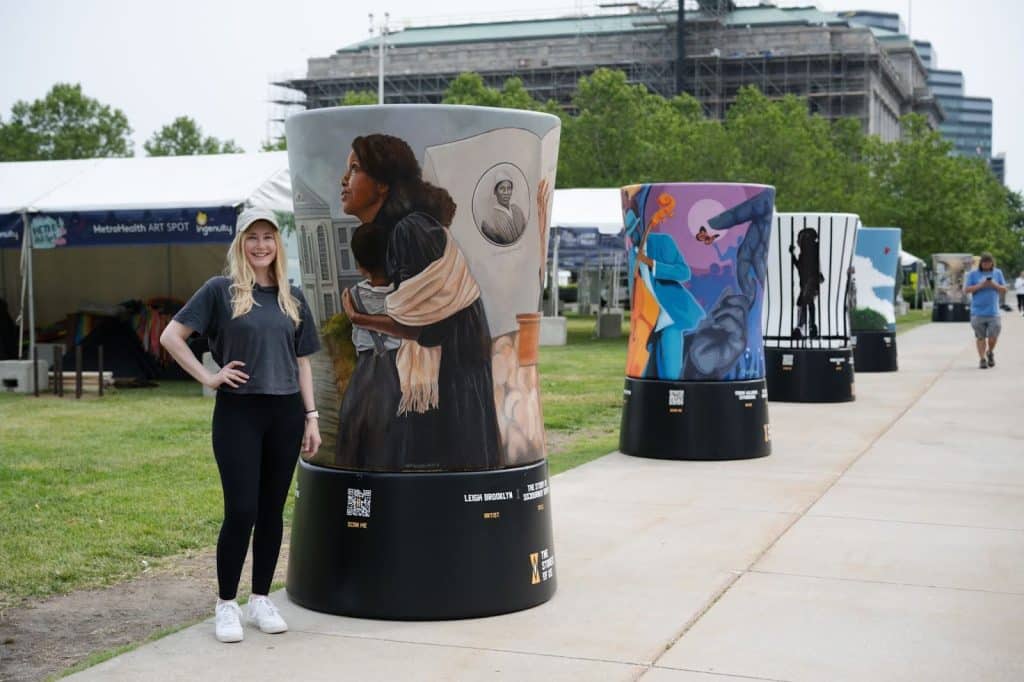
The Story of Sojourner Truth
Artist: Leigh Brooklyn
Leigh Brooklyn grew up in Elyria in a blue collar family. In an interview last year with Voyage Ohio, Brooklyn says “We never went to galleries or museums growing up. All our family vacations were to things like war battlefields and monuments which I absolutely hated at the time, though perhaps that influenced my work today. The only exposure I had to the arts was through art at the local county fair or some kitschy magazine that sold art reprints and garden gnomes. I knew nothing and didn’t think it could be a career.”
It wasn’t until a high school art teacher entered a painting of Brooklyn’s in a Scholastics Art and Writing Awards contest without her knowledge that Brooklyn realized she wanted to be an artist. “I received best of show and won at nationals,” she says in the interview with Voyage Ohio.
Brooklyn began her art education at the Columbus College of Art and Design but switched to studying biomedical illustration at the Cleveland Institute of Art after being inspired by the work of other artists who were doing forensic work to help with a missing person case. She earned her degree in 2011 and traveled around the country doing street photography and gaining inspiration from people she met through her work.
After returning to Ohio, Brooklyn started studying sculpting, welding and stone carving. She was chosen to create her piece for the Stories of Us theme We Hold These Truths, which “asks us to consider the contrasts between the high ideals and the reality of oppression and enslavement of the founding and early formation of the United States.”
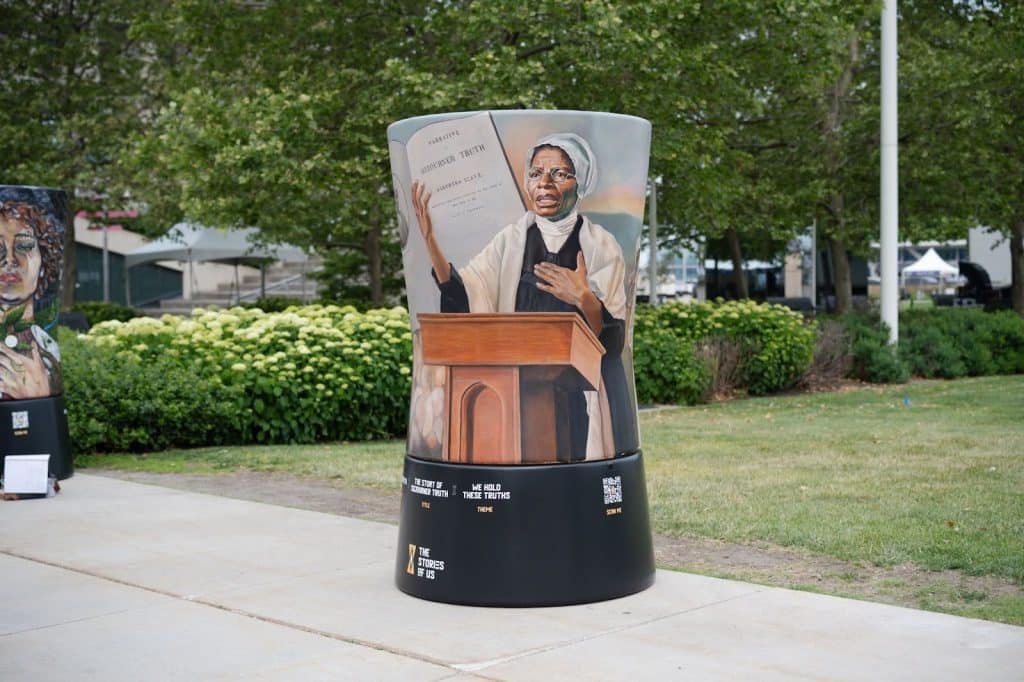
Soujourner Truth was born Isabella Baumfree around 1797 in Swartekill, New York. Born into slavery, Truth endured many abuses from slavers across New York state. She could not read or write, yet she is known for her famous 1851 speech at the Women’s Rights Convention in Akron, Ohio.
The Story of Sojourner Truth begins with her escaping slavery with her infant daughter, Sophia, in New York in late 1826. The New York Gradual Emancipation Law had passed in 1817, declaring all enslaved people born before July 4, 1799 would be freed on July 4, 1827. Truth found that John Dumont, her slaveholder, had plans to keep her enslaved, and so she famously walked away with only her daughter and a handkerchief supply of food and clothing. She came to the home of Isaac and Maria Van Wagenen who took in Truth and her daughter and paid John Dumont for their freedom.
A couple of years later, in 1828, Truth sued her previous slave holder. Her son, Peter, had been illegally sold to a slaver in Alabama. At the time, he was only 5 years old. With the help of the Van Wagenens, Trust won her case, and her son was returned to her. Brooklyn paints this impactful scene beautifully, highlighting one of the first times a Black woman was able to fight a white man in court and win.
By 1843, Truth became an itinerant Methodist preacher and changed her name to Sojourner Truth. At that time, she was heavily involved in the antislavery movement, and by the 1850s she was preaching women’s rights as well.
In 1851, Truth delivered a speech at the Women’s Rights Convention in Akron, Ohio, a speech that is “now recognized as one of the most famous abolitionist and women’s rights speeches in American history,” according to the National Park Service. As Truth was illiterate at the time, the words from her famous “Ain’t I a woman?” speech were not written down in 1851. Historians disagree whether the title, “Ain’t I am woman?” was accurate, as some accounts show this line and others leave it out.
One of the most famous accounts of Truth’s speech was written 12 years after it was given by Frances Dana Gage, an antislavery and women’s rights activist. According to an article by Her Half of History, “Gage wrote her version in a somewhat inconsistent dialect that made Sojourner sound like the slaves in South Carolina that Gage herself was surrounded by at the time she wrote her version. Sojourner, remember, was from New York and her first language was Dutch. It is highly unlikely that her dialect was anything like what Gage wrote down.”
Regardless of the exact words used, Truth spoke from the heart and impacted many, not only those in the audience on that day in Akron in 1851, but even today her words still hold meaning.
“If the first woman God ever made was strong enough to turn the world upside down all alone, these women together ought to be able to turn it back, and get it right side up again! And now they is asking to do it, the men better let them.”
“These are only small snapshots of an incredibly full life,” Brooklyn writes in her artist statement. “There is so much more to discover about this extraordinary woman – I hope you will seek out the full story of her life. The life of Sojourner Truth tells us so clearly that one person – even facing odds we can’t really imagine in the modern world – can grab that arc of history and bend it towards justice. Because after all, the person who said “Ain’t I A Woman?” was just that: not born an icon, but simply a woman, who made decision after courageous decision to bring the world she wanted to see closer to being.”
Honoring My Ancestors
Artist: Alicia Vasquez
Cleveland native Alicia Vasquez knew she wanted to be an artist from age 5 or 6. Her mother was an artist, as was her grandfather.
“It runs in the family,” she says.
Vasquez’s resume is impressive and includes nearly 30 public artworks not including her piece in the Stories of Us exhibition.
She always knew she wanted to go to the Cleveland Institute of Art too, and after receiving her bachelor of arts degree in illustration in 2011, Vasquez “moved around a little” but came back to Cleveland before the beginning of the COVID-19 pandemic. She likes the art atmosphere in Cleveland and finds her community to be very close knit.
Vasquez also loves nature and spends a lot of time in the Metroparks.
“There’s nothing like [the Metroparks] anywhere.”
Nature inspires her work at her studio, the White Lotus Art Gallery and Tattoo, which Vasquez opened in April of last year at the 78th Street Studios in Cleveland. The studio serves as not only a gallery for her art but also a home for her work as a professional tattoo artist.
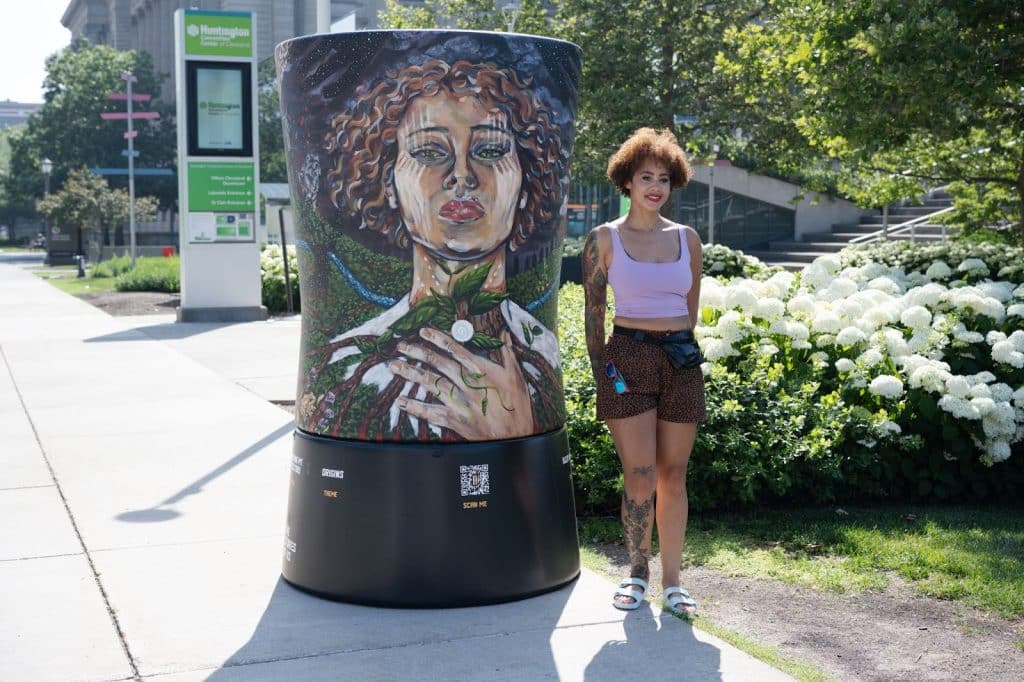
The theme behind Honoring My Ancestors was Origins, which according to Vasquez’s Stories of Us artist statement “explores the principal peoples and cultures that history brought together in the founding evolution of what we now know as the United States.”
Vasquez dug deep into her own ancestry in her research for the Stories of Us project in order to connect the project to her personal life.
“I made a big discovery.”
She explains more in her artist statement. “For the most part, my ancestors are African and from the Taíno people of what is now Puerto Rico.”
Vasquez was researching the side of her family that had been traced back through the 1800s in Ohio. Through connections maintained by a centuries-long history of family reunions, a relative of Vasquez discovered a letter that traced their ancestry back to a member of the Seneca Nation.
“It is from the Seneca word ohi:yo – meaning ‘great river’ that my home state Ohio got its name. And that really sums up what you see: an exploration of the discovery and spirituality that connecting with my ancestry inspired, both looking to the past but giving me great meaning in the present.”
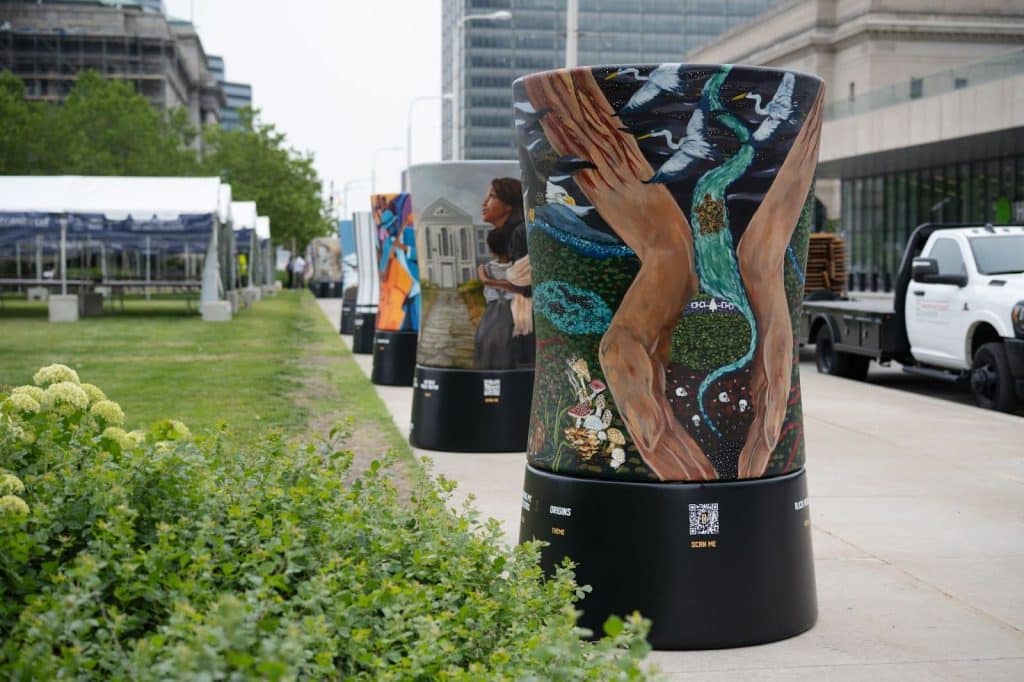
Honoring My Ancestors features a “person whose ethnicity you can’t necessarily identify. It is – in essence- a self-portrait of [Vasquez].” She holds a tobacco plant that grows from her heart, roots connecting both to the earth, a nod to Taíno rituals and ceremonies that used tobacco smoke to help souls transition to the spiritual realm.
Vasquez shows the many other details that surround the drum. On the opposite side, hands reach from the sky, representing the Sky woman from the Iroquois story of creation, mother to two sons who create the world. Symbols of nature’s abundance and renewal abound with illustrations of strawberries, mushrooms, even mole rats, and ants.
“All animals that are important. We don’t necessarily see them as important, but the Native Americans treated everything as equal,” Vasquez says.
Find the Stories of Us exhibit at Skylight Park in Tower City through the end of August. More information is available about this project on the Stories of Us website.
We're celebrating four years of amplifying resident voices from Cleveland's neighborhoods. Will you make a donation to keep our local journalism going?