
Residents lose trust in local government over plan to drain Lower Shaker Lake
Over 4,000 people have signed a petition to save the lakes and stop the Sewer District’s plans.
Editor’s note: This article was originally published on July 7 but was taken down the same day after concerns about several facts were raised by a government agency. This updated version includes corrections and clarifications to avoid any misunderstandings, and additional fact-checking.
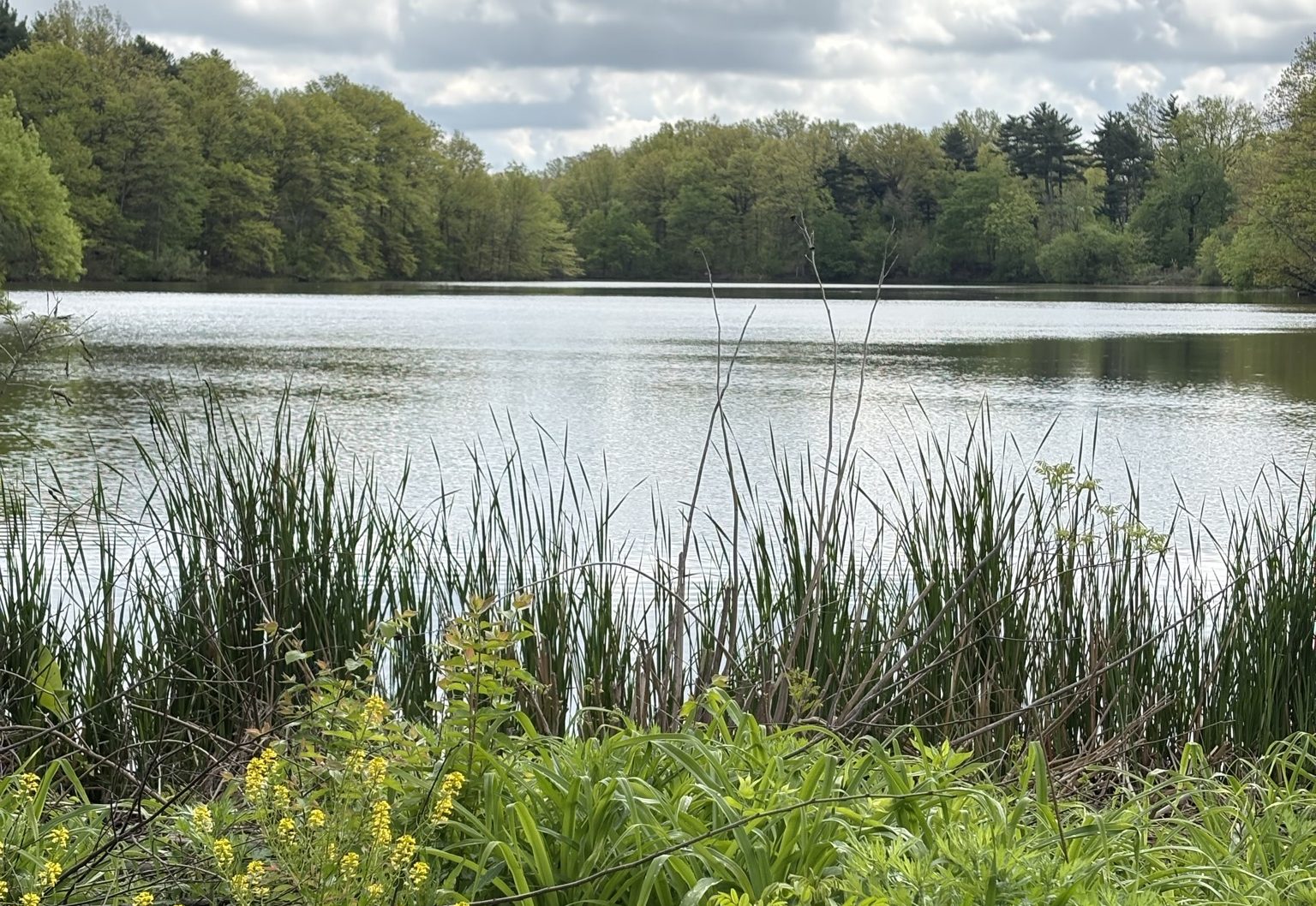
This past Mother’s Day, two mother wood ducks were paddling around on Lower Shaker Lake, one with five recently hatched chicks, the other with nine. A giant snapping turtle was warming its shell in the sun, and half a dozen midland painted turtles were up on a log doing the same. A kingfisher and a green heron flew for cover, startled by a passerby, and an osprey circled and then dove, plucking a large fish out of the water.
All this would be gone if the cities of Shaker Heights and Cleveland Heights accept the Northeast Ohio Regional Sewer District (NEORSD) recommendation to remove the dam and drain the lake. The Sewer District is trying to address a serious concern: dangerous flooding could result downstream if the dam breaks. However, many residents are upset and distrustful toward irregularities with how the NEORSD has approached the Doan Brook watershed as a whole, including their ongoing plan to drain Horseshoe Lake, just upstream from Lower Lake.
“By federal law, by statute, they’re supposed to do alternatives analysis, which they did not do,” says Jim Nemastil. Nemastil is a geographer and Cleveland Heights resident since 1979. He has done alternatives analysis for the RTA and since 2015 he has been “monitoring soil erosion around the cliffs of the Chagrin River.”
Nemastil also argues the Sewer District is noncompliant with the National Historic Preservation Act, which requires any projects subject to federal permitting to undergo a review on possible impacts to historic sites.
The NEORSD contested these claims, and says they’re going through the proper permitting process for Horseshoe Lake. They said they have no “current plan to drain Lower Shaker Lake,” only a recommendation to do so.
However, the Sewer District exercises major leverage through their budget. They have offered to pay $45 million to remove the Lower Lake dam and drain the lake. But if the two cities opt to repair the dam and keep the lake, the Sewer District will leave them to foot the entire bill on their own.
When asked what would happen if the Sewer District completed their Horseshoe Lake plan or drained Lower Shaker Lake, Nemastil replied, “It would permanently alter the historic landscape of the parkland. It would destroy the area as we see it today.”
Lower Lake is one of the four Shaker Lakes, sitting in the middle of an extensive parkland that is a defining feature of the cities of Cleveland Heights and Shaker Heights. The original two lakes, Horseshoe and Lower Lake, were created by dams built by a religious community of Shakers who inhabited the Heights in the 19th century. As the Shakers dwindled, they deeded several hundred acres to be held as parkland in perpetuity. The cities of Cleveland Heights and Shaker Heights sprung up around the lakes and early developers installed Marshall Lake and Green Lake.
Jeff McManus compares the situation to a nearby branch of Dugway Brook now known as Meadowbrook. Residents will know Meadowbrook as a road, not a stream, because it has been entirely disappeared into a culvert. McManus is a Cleveland Heights resident, biologist and professional researcher. “That whole brook was wiped out from an ecological perspective,” he explains. “If the lakes didn’t exist, that same thing would have happened to Doan Brook.”
Horseshoe Lake was drained in 2019 after a recommendation from the Sewer District, which promised at the time to preserve Lower Lake. Lower Lake is the most accessible of the four Shaker Lakes, with walking trails and easy access by car or by foot. This is a stark contrast to Marshall Lake and Green Lake, which are each surrounded by private residences and largely cut off to the public.
“We need a place like this after the stress of working all week,” says William Maul. He and his friend Lamont Edwards have made the trek from Noble Road, at the other end of Cleveland Heights. The two are relaxing on the banks of Lower Lake at a spot where many neighbors go fishing. Mr. Edwards agrees. “It’s so important to have places where you can come out into nature.” The two are distressed to learn of NEORSD’s recommendations to drain the lake.
In 2020, after draining Horseshoe Lake, the Sewer District spent several million dollars dredging and repairing the dam at Green Lake, according to reporting from Cleveland.com. Then in July 2025, they suddenly announced that Lower Shaker Lake would have to be permanently drained. Their estimate for repairing the lower dam had jumped to $55 million.
Peter Bode, president and CEO of the Nature Center at Shaker Lakes, wrote in fall 2025 that “Our team has brought thoughtful alternatives to the table, which have a very real path forward to fruition. One of these – to take advantage of the NEORSD storm-water program money and still preserve a Lower Lake— includes the development of an offline lake in parallel to a stream restoration and dam removal. Feasibility still needs done, but this option may yield up to a 10–12-acre lake while still removing the liability of the class 1 dam. This would fit the NEORSD recommendation without losing the lake.” The Nature Center does not exert land control and was not contacted for this article.
There’s no doubt that the Doan Brook watershed is facing a number of problems. Given the increasing severity of storms caused by climate change, as well as sinkholes and the buildup of sediment, the lower dam is “at risk of catastrophic failure,” says Dr. Brice Grunert. Dr. Grunert is a limnologist at Cleveland State University who has been involved in studying the Doan Brook watershed and Lake Erie.
There’s also a problem with water quality due to algae. “In the current watershed configuration of Doan Brook, the lakes act as a major source of algal biomass,” according to Grunert. Thanks to the forested areas along the riparian corridor, he adds, Doan Brook has better water quality than other streams in the area like the nearby Dugway Brook.
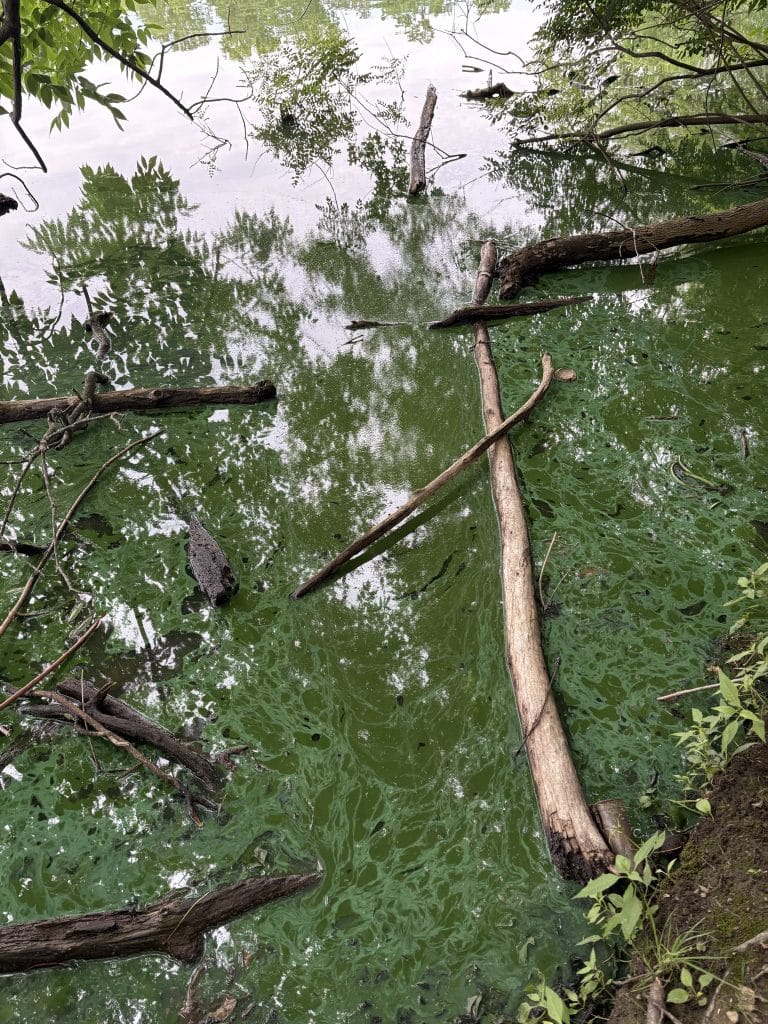
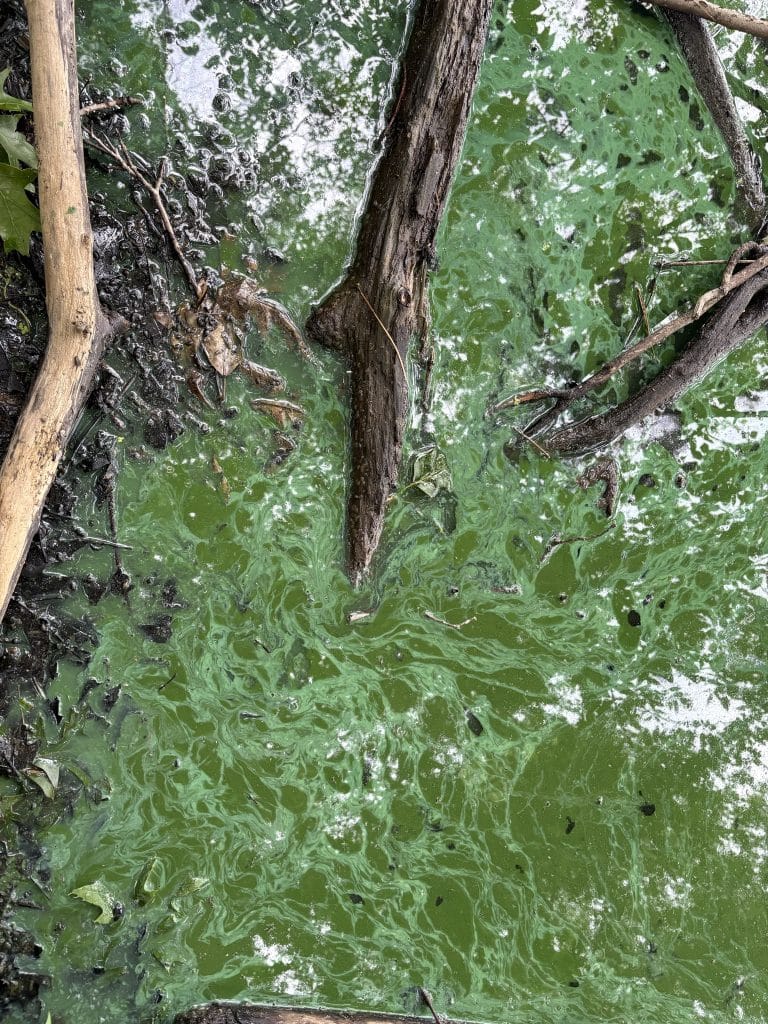
An algae bloom caused by summer heat and fertilizer runoff in the watershed. [Photo by Peter Gelderloos]
However, the problems in the watershed go beyond the lakes. “I would not expect that removing Lower Shaker Lake on its own would remove all risk of flooding in the watershed,” Grunert explains. “Flooding occurs at a watershed scale.” And throughout the Doan Brook watershed, impermeable surfaces like paved roads and parking lots, the many culverts and sewer tunnels managed by the Sewer District, suburban lawns, and the three major golf courses all increase runoff and flooding during a storm. And with the runoff come pesticides, fertilizers and sediment.
The conversion of lawns to meadows, food forests and gardens would decrease runoff and sedimentation, reduce pollution and flood risks, and have added benefits for the climate and people’s health, especially for disadvantaged populations with limited access to fresh fruits and vegetables.
Shifting to permeable pavements throughout the watershed would also improve water quality and decrease flooding risks, yet Nemastil and other critics argue that the NEORSD is taking a piecemeal approach to the problem that forecloses on more effective approaches.
Over 4,000 people have signed a petition to save the lakes and stop the Sewer District’s plans. At city council meetings in both Shaker Heights and Cleveland Heights, residents have been all but unanimous in their support of saving Lower Shaker Lake. Many have expressed doubt or distrust over the way the Sewer District has pushed ahead with the recommendation to drain the lake without conducting all the necessary studies or looking into alternatives.
“There were concerns from the beginning,” says Amy Weinfurter, a Shaker Heights resident and member of the Shaker Lakes Conservancy community group, “because of the way Horseshoe Lake was drained without a full analysis of the consequences of draining and breaching the dam.”
Nemastil echoes this lingering distrust of local government and the Sewer District. “You go way back, and they say they’re going to save Horseshoe Lake. Then they say they’re going to save Lower Lake. And now they’re not going to save any of them. They’re doing what they want to do, they don’t care about what the citizenry wants.”
The Sewer District, says Jeff McManus, “did this whole public engagement process. They were working the whole time from a plan that would require cutting down a thousand trees but they never said anything about that until the process was completed. I went to one of the early public engagement events.” McManus describes NEORSD representatives presenting the public with “this list of things we could add to the park: a play area, a sensory garden, different paths. They never asked people, ‘would you prefer that we add various artificial amenities or keep it as a more natural environment?’ Once they made the plans, their presentations to the public were more like PR events than attempts to get meaningful feedback. They never tried to see if the public actually liked their plans.”
The NEORSD used an expedited process with the U.S. Army Corps of Engineers (USACE) known as an NWP 27, which allowed it to bypass impact studies for their ongoing plans to remove Horseshoe Lake. Though the Sewer District has not changed its plans in the face of immense public opposition, in early May the USACE forced the NEORSD to delay construction by at least half a year because the NWP 27 “does not authorize dam removal activities.” The Sewer District claims this was a recent change to USACE policy. However, according to the USACE itself, earlier versions of the NWP 27 also excluded dam removal. The newest version simply clarified that exclusion. In other words, the Sewer District has always been out of compliance in its plans to remove Horseshoe Lake and Lower Shaker Lake.
When asked for comment, a representative of the Sewer District responded with a link to their public relations website, which includes incorrect claims about USACE policy. They did not respond to any of the questions posed by The Land.
After the first edition of this article was already published, Jenn Elting, senior manager of community and media relations for the Sewer District, reached out with several objections, clarifying that the Sewer District does not have an ongoing plan to drain Lower Lake.
“The Cities of Cleveland Heights and Shaker Heights are determining how they would like to address their responsibilities as the permit holders at Lower Shaker Lake dam,” Elting emphasized. “This dam is out of compliance with the Ohio Department of Natural Resources (ODNR) dam safety requirements and is a significant risk to people and property downstream.”
In response to a question about widespread complaints by residents, Elting said, “Our communications process is and always has been timely, truthful, thoughtful and two-way.” She did not provide any documentation for her claims, and continued to make false claims about the NWP 27.
Emily Kao is executive director of the Doan Brook Watershed Partnership (DBWP), a nonprofit that receives funding from the Sewer District, the City of Cleveland, and several private companies. “As a highly modified urban stream, Doan Brook faces three primary, interconnected ecological challenges” Kao explained. These were impervious surfaces, invasive species and artificial impoundments like “dams and culverts” that “break up habitat connectivity, block the natural downstream movement of sediment and nutrients, and stagnate stream flow.” Such impoundments accelerate other problems because they decrease “dissolved oxygen” in the water and “suppress native biodiversity while favoring invasive or generalist species.”
Kao did not reply to questions about public concerns or criticisms of the Sewer District’s plans. In response to a question about problems that the Sewer District is not addressing, like the golf courses impacting the watershed Kao said “the DBWP does not take public positions on specific private or municipal land use designations.”
Cleveland Heights Mayor Jim Petras, who campaigned on a platform to save the lake, declined to comment on any concrete actions he has taken to stand up to the Sewer District. Shaker Heights city council members Kaus and Alvarez did not respond to requests for comment. The office of Shaker Heights Mayor David Weiss referred questions to their Director of Communications/Marketing, Ann McGuire, who also did not respond.
Residents invested in preserving the lakes say there has been an absence of meaningful communication from the various government agencies involved.
“From a climate perspective, we want people to live in walkable inner-ring suburbs like the Heights,” argues Jeff McManus, “not in sprawl suburbs where they have to drive everywhere. Having this beautiful lake people can walk to from their house is really rare and really valuable.”
Dr. Grunert acknowledges that removing the dam is the cheaper option, but as an ideal scenario he imagines preserving at least a part of Lower Lake and allowing the rest to transition to “a wetland complex that focuses on forested wetlands that integrate into an open canopy wetland complex that the brook flows through. This would increase water capacity and mitigate flooding, improve water quality and natural flow, while maintaining a park space.”
Keep our local journalism accessible to all
Reader support is crucial as we continue to shed light on underreported neighborhoods in Cleveland. Will you become a monthly member to help us continue to produce news by, for, and with the community?
P.S. Did you like this story? Take our reader survey!
Author
Related Articles

Cleveland is now a City of Peace but what does that mean?
Last year, this proclamation, which is a symbolic commitment to advancing peace, was announced on the stage of the LatinUs Theater in the Pivot Center located on W. 25th Street.

Northeast Ohio voting advocates: ‘Under no circumstances will we stop’
Despite a push to increase voting restrictions, advocates say they’re “jazzed to do this work.”


