What the Dropkick Murphys see in Cleveland
I almost missed the Dropkick Murphys coming to Cleveland.
Usually, emails from Brian Poindexter land in my spam folder. With Ohio’s midterm election less than a week away, that isn’t exactly unusual. Political emails, campaign appeals and ads have been seemingly everywhere.
But this one slipped out.
I saw two words that immediately caught my attention: Dropkick Murphys.
The Boston Celtic punk band was coming to Brook Park the next day for an Ohio AFL-CIO rally supporting Poindexter, a union ironworker and Brook Park councilman running for Congress in Ohio’s 7th District against Republican incumbent Max Miller.
I told my personal trainer I was going to talk to Murphys frontman Ken Casey, figuring I would gain some more cred since I wasn’t cutting it with my strength training that day.
His reaction was pretty much the same as mine had been when I saw the email.
They were here?
He knew the Dropkick Murphys, being a guy in his twenties who liked metal and harder rock. But mostly for the songs a lot of people know them for: “I’m Shipping Up to Boston” and “Rose Tattoo.” He didn’t realize just how politically active the band had become. He wasn’t as familiar with their more political songs, like the one they would later play acoustically in Brook Park, “Who’ll Stand With Us?”
That reaction stuck with me.
Because later that day, I was standing in front of the Dropkick Murphys at a union rally in Brook Park.
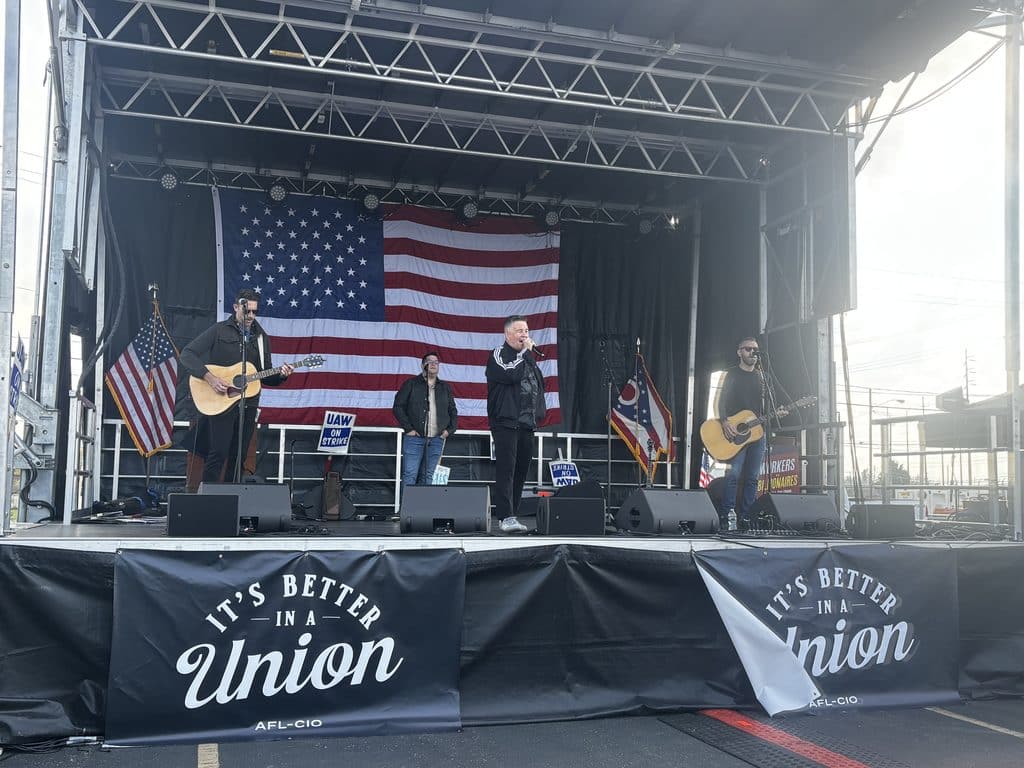
By the time I arrived at UAW Local 1250, the band was onstage for soundcheck.
It was a different scene from when I first saw them a year ago at Riot Fest in Chicago, playing to thousands. That was the first time I decided to brave a pit instead of just debating whether to join from the edges.
During their union show, there were acoustic guitars instead of the wall of amps you might expect from a Dropkick Murphys show. A massive American flag covered the back of the stage. UAW “ON STRIKE” signs stood behind the musicians, while black AFL-CIO banners stretched across the front of the stage with the words, “It’s Better in a Union.”
The band looked a little out of place and completely at home at the same time.
It was an unusual setting for a band better known for packed punk shows, but it didn’t take long for Casey to explain why they were there.
“We’re working with the AFL-CIO, going around swing states,” Casey told me. “Going to where it matters, help rally working people.”
The Dropkick Murphys have spent nearly three decades drawing from the working-class culture of Boston, and their relationship with labor and politics has become part of the band’s identity.
But Casey said Cleveland has something familiar to him.
“Boston is, you know, a little bit bigger of a city than Cleveland,” he said, “but it still gets that kind of small big city vibe.”
He called Clevelanders “salt of the earth” and said the city is “a good representation of America.”
I asked him what he thought politicians were missing about working-class voters.
Casey said Democratic politicians had taken working-class people for granted for a long time, leaving an opening for Donald Trump to present himself as someone who cared about working people.
But he wasn’t arguing that working-class voters all think alike.
People don’t have to agree on everything, he said. They want to be able to afford gas and groceries, raise their families, have a roof over their heads and have health insurance.
That is where music comes in.
“Music is just a rallying cry,” Casey said. “Music is like, especially a band of our nature, it’s like, kick the door open, help wake people up.”
Standing there, that description seemed pretty fitting.
The Dropkick Murphys weren’t surrounded by the elaborate production of a typical concert. They were playing acoustic guitars in front of a giant American flag, with union signs behind them and AFL-CIO banners beneath their feet.
The music was part of the message, but Casey sees it as something more than that. It can be a way of getting people who might otherwise tune out politics to pay attention.
Maybe, he said, someone sees that the Dropkick Murphys flew all the way from Boston to Ohio to take part in a labor event and thinks, “It must be important.”
“It is,” he said.
The performance drew about 1,000 union members and their families, according to Cleveland Scene, which photographed the event. The band played roughly six songs, closing with “The Workers’ Song” and “I’m Shipping Up to Boston.” What began as an afternoon of union speeches and political organizing ended with a Boston punk band giving working-class solidarity a soundtrack.
There is something fitting about a Boston band finding that kind of connection in Cleveland.
Both cities have long histories shaped by immigrants, industry, unions and working-class neighborhoods. They have different accents and different music scenes, but Casey sees a familiar spirit in Cleveland.
“I like people in Cleveland,” he said. “It’s a good representation of America.”
I probably wouldn’t have thought much about that connection before an email from Brian Poindexter slipped out of my spam folder.
But I’m glad this one did.
We're celebrating four years of amplifying resident voices from Cleveland's neighborhoods. Will you make a donation to keep our local journalism going?
Author

Related Articles
The eerie tales of Erie Street Cemetery
These are some of the stories of notable persons buried at Erie Street Cemetery.

The Movie Nerd Report: Spooky movies showing around Northeast Ohio on Halloween weekend
There are plenty of spooky screenings this Halloween weekend.