
Survivor of human trafficking in Elyria now a fierce advocate for other survivors
After enduring multiple human traffickers, Brittany Figlar is now fighting for systemic change to how we approach survivors.
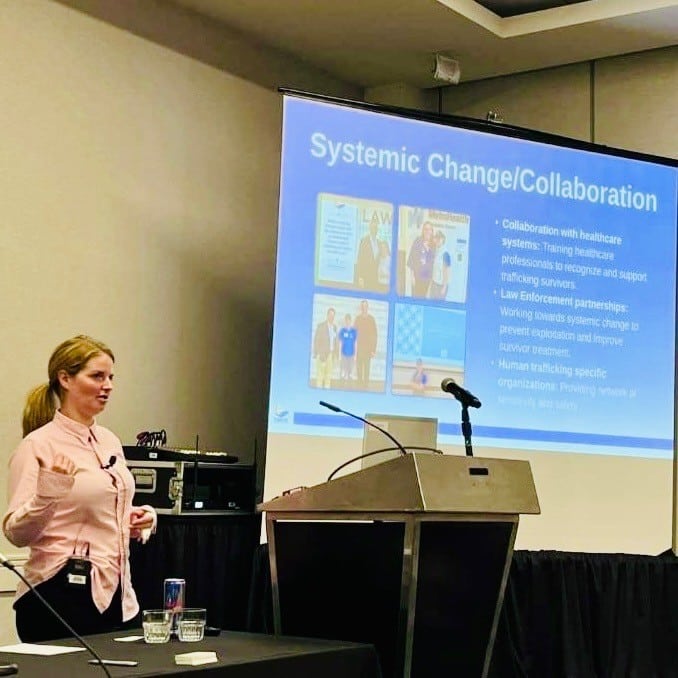
This is part one of a two-part series.
Brittany Figlar’s credentials as an advocate for survivors of human trafficking are unimpeachable.
After a difficult childhood in Elyria, she endured 15 years as a victim of sex trafficking by different men before she was able to escape that life.
“When I’m explaining trafficking I start with my victimology, that I was created to be the perfect victim,” Figlar said.
In 2023, after her third trafficker was sentenced to nearly 200 years with no chance of parole, the longest sentence for trafficking in Ohio, her life turned toward an assiduous commitment to raising awareness of human trafficking in communities throughout Northeast Ohio.
To elevate her platform to tell her story, Figlar recently became a member of the Survivor Advisory Council for the Collaborative to End Human Trafficking and is currently serving as Secretary.
“Brittany’s ability to articulate her story is remarkable, and she represents the example of what we see over and over again with victims of trafficking in Northeast Ohio,” said Kirsti Mouney, CEO, for the Collaborative. “The victims are people who grow up in Northeast Ohio who are trafficked by other people who grow up in Northeast Ohio who exploit them for their vulnerabilities, and it’s the story of system failure after system failure of systems that were supposed to recognize she was a survivor of trafficking and help her but didn’t.”
Mouncey’s comment references a pervasive myth that women who are trafficked in the U.S. are from China, Mexico, Thailand or another country, while the majority are American citizens.
Another common misconception proliferated in films like “Taken” is that the human trafficker abducts women from the street and throws them in a white, windowless van. Typically, victims are gradually groomed by someone they know with gifts, money or drugs and promises of a happy life.
Their trafficker then takes advantage of their vulnerabilities such as poverty, substance use, disability or lack of a loving family before using force, fraud or coercion to compel them into commercial sex acts and other crimes.
Today, Figlar serves as a keynote speaker at public events to inform the public about human trafficking. She also educates healthcare professionals. In 2024, she trained all 13 units of medical-surgical nurses at MetroHealth Medical Center. She also teaches at Kent State University’s College of Nursing and instructs EMS trainees for the Cleveland Clinic Twinsburg campus.
Figlar has taught several first responder training courses using a study of her case with evidence and trial transcripts to show all the times law enforcement/first responders missed human trafficking.
For the past two years, to address systemic failures on the law enforcement level that she experienced, she has worked as an instructor at the police academy at Lorain County Community College, where she handles the human trafficking training for cadets.
For Case Western Reserve University’s Human Trafficking Law Clinic, Figlar helps train law students on interviewing trafficking survivors.
“I have made it my life’s mission to give that voice to all of the other girls that are walking around dealing with the same thing that I have dealt with my whole life and everybody thinking ‘You’re crazy’ and ‘It’s not true,’” said Figlar, fully conscious of the growing awareness raised by the Epstein files. “Everybody’s watching all of these guys with money and power get away with the crime of human trafficking, so I’m doing everything I can to stop it.”
Figlar’s life as the “perfect trafficking victim”
At 12 and 14, while on a sleepover at her cousin’s house, Figlar (nee Oldfield) was raped by her uncle, she said. He threatened to kill her if she said anything.
She tried to avoid her uncle, but her cousin convinced her to stay over one more time two years later, and she said her uncle promised not to touch her.
The second time, Figlar was able to kick him off, lock herself in the bathroom and call her mother to come get her. Her uncle told her no one would believe her anyway.
She did go to the hospital to endure the compassionate but invasive probing of a Sexual Assault Nurse Examiner rape test kit procedure. They cut her bloodied clothes off and bagged them as evidence. They photographed her bruised body.
It took six months to get the DNA results and another three to confirm that the bodily fluids were her uncle’s.
The pretrial hearings started as Figlar began her freshman year of high school, which is tough enough for a teenage girl but doubly so, she recalled, when a newspaper publishes a headline about a teen girl being raped in her town. Her classmates knew that it was her.
During a year of counseling, her court-ordered therapist didn’t offer much solace, Figlar said, as she opened their first session by asking, “How did it feel to have your cousin lying next to you while your uncle was raping you?”
“That shut me down immediately, because I didn’t even know this person,” Figlar said. “I already didn’t have coping skills or know how to talk about it with a stranger, and I definitely didn’t have a voice. So that year of counseling ended with me being released with a guarded diagnosis, meaning there’s nothing they can do for me.”
In May 2005, her uncle pled guilty to two first-degree felony rape counts to include the previous rape when Figlar was 12, two assault counts and one gross sexual imposition charge. He was sentenced to five years in prison.
“I walked out of that courtroom knowing that I would never see that side of my family again, and I haven’t,” Figlar recalled. “Nobody has tried to reconcile. It was awful, because I felt so alone, and at that point I had the lowest self-esteem on Earth, and I blamed myself for my family falling apart.”
Tough teen years
Figlar claims that she came out as a lesbian in 2006 when she was 15, and her father asked her to leave their home. Her father did not respond to repeated calls to obtain his response.
“I became the perfect prey, and of course, the only person who offered me a place to stay was my friend’s uncle, a 32-year-old tattoo artist who had just gotten out of prison,” she said.
She moved into a party house filled with drugs and alcohol. Feeling “mature for her age” Figlar thought it was a “perfect setting to heal” a confused teenage girl and “fill all of the voids” in her life. Although she was surrounded by adults, not one bothered to tell her this was not a safe or healthy situation for a child.
Two years later, the Elyria Police Department raided the house, treating the 17-year-old clad only in a T-shirt as an adult. She said she was thrown to the ground and handcuffed, but they only arrested the tattoo artist.
A week later, she learned she was pregnant, and the paternity revealed the father was the former convict who had been charged with a long list of crimes, including burglary, receiving stolen property and drug possession. He later signed away any parental rights to the child.
“I weighed whether or not I was going to keep my baby, and it was a very hard decision, but I decided to keep William,” she said. “He’s 16 now. He’s an amazing young man. The best thing I’ve ever done in my life was to have and raise that boy.”
Still struggling
Knowing she wanted to keep her baby, Figlar, having completed her high school diploma when she was 8-months pregnant, enrolled in the Ohio Business College to become a medical assistant.
Figlar finally thought she was on her way in life with a job and a baby almost due. In her naivete, however, she thought it would be best to reveal her past to Polito.
Intimidated by the wealthy, accredited surgeon who was well-liked in the community and believing she was an unwed mother with a blighted background who needed the job to raise her son, she recalled, she agreed to do whatever he demanded. Polito hired a new office manager who laid off Figlar in January 2015. In 2017, another assistant reported him for gross sexual imposition and sexual assault, but the doctor was found not guilty due to lack of evidence.
In 2021, Polito died of ALS.
Figlar’s life didn’t improve after leaving that job. She began visiting another doctor for her personal care, Aly Zewail, whom Polito had referred her to. In May 2015, the Medical Board of Ohio suspended Zewail’s medical license based on his admission that his ability to practice was impaired because of his “habitual or excessive use of drugs, alcohol or other substances.” In 2016, Zewail’s suspension was extended “based on doctor’s admission that he set up surveillance equipment in his office including public common areas and patient exam rooms which violated the AMA Principles of Medical Ethics.”
Zewail’s license was reinstated in May 2018, and he continues to practice today in Northeast Ohio. Several calls to Zewail at his office were unreturned.
Figlar said she refused to testify before the state medical board about Zewail for fear of never being able to get another job in the medical field if she did.
In July 2017, Figlar was sentenced to a mandatory rehab. While completing the program at the Key, a woman’s residential treatment facility operated by the Lorain County Alcohol and Drug Abuse Services, her parents surprised her by taking her to court to obtain custody of William. She had no attorney. They claimed she was a drug addict and neglected her son. They won. (Today, Figlar enjoys regular visitations with Will.)
“When I lost Will, I lost every bit of hope and fight that I had left in me,” Figlar said. “There had been so many times where I had been beaten and gotten back up and tried, but I was just done.”
Two days later, the rehab facility evicted Figlar, and the Elyria Municipal Court issued a warrant for her arrest. She was homeless without a cellphone. The only place she could stay was a tool shed in a friend’s backyard with a five-gallon paint bucket for a bathroom.
In complete despair, Figlar didn’t think things could get any worse. They did.
Part two of this article coming later this week.
Keep our local journalism accessible to all
Reader support is crucial as we continue to shed light on underreported neighborhoods in Cleveland. Will you become a monthly member to help us continue to produce news by, for, and with the community?
P.S. Did you like this story? Take our reader survey!
Author

Related Articles
A battle with scars: Ronald Kisner’s long road back
Kisner, 77, was in the midst of planning a celebration of his kidney transplant, he said, when he was attacked outside of his church.
After series of deaths, Cuyahoga County Jail struggles to implement new CPR policy
Jail officials updated an employee handbook in January to require CPR in medical emergencies, but they haven’t informed most corrections officers yet.
National expert, trafficking survivor, leader Alia Azariah to keynote event in Cleveland
A California native, Azariah serves as director of collective impact for Safe House Project (SHP) in Ventura, a national nonprofit organization, and advocate to prevent human trafficking that provides aftercare for victims and helps them transition into safe, restorative care.


