
Crowdfunding has become a lifeline for LGBTQ+ Ohioans of color
Community members say online fundraisers and mutual aid are filling gaps left by housing, healthcare and employment systems.
Republished with permission from The Buckeye Flame. Follow The Buckeye Flame on Facebook, Instagram, LinkedIn, Twitter, TikTok and more.
“There was a moment where I ran out of food, and not just nothing I wanted to eat, but nothing,” said Zuggie Tate. “I had to ask myself, was I too proud to beg?”
Soon after she was evicted.
Tate, a Black trans woman living in Cleveland, turned to crowdfunding, carefully itemizing her needs on social media because she believed people were more likely to donate if they could see exactly what the money would cover. Friends contributed what they could, but it wasn’t enough. Eventually, she reached out to TransOhio, which provided $500 toward moving expenses, which included transportation and storage.
For years while working on her first poetry manuscript, Tate was the person helping others.
In 2016, she founded Black Space, a Cleveland organization created to center Black queer life through community events and activism. Through the organization, Tate helped raise money for Black transgender women across Northeast Ohio seeking housing, surgery and help with other basic needs.
In 2023, Black Space began their first big crowdfunding campaign in honor of Trans Day Of Remembrance. “We raised $2,000 in our first month and that was distributed amongst so many trans women in need, and that felt like discovering a really important tool,” she said.
That same year, Tate received Margie’s Hope’s Living Heritage Award for her advocacy and service to Northeast Ohio’s transgender community.
Then, in the winter of 2025, she became the one asking for help.
“Being a Black trans woman in Ohio, it’s so hard to find jobs, so easy to become homeless and so hard to find affirming housing where landlords aren’t giving you grief for merely being who you are,” Tate said.
According to the Williams Institute, intersectional discrimination contributes to a 37% poverty rate among LGBTQ+ Ohioans of color, leaving many vulnerable to food and housing insecurity.
As housing, employment and healthcare systems continue to fail many LGBTQ+ Ohioans of color, crowdfunding (typically responding to an immediate financial emergency) and mutual aid (built on long-term community care) have become everyday survival strategies.
A 2024 medRxiv study examining transgender crowdfunding campaigns on GoFundMe found that 61% originated in states with hostile anti-trans legislation, like Ohio. Housing accounted for 44.7% of campaigns, followed by daily living expenses (35.5%) and gender-affirming medical care (28.1%), showing that many fundraisers focus on basic survival rather than extraordinary expenses.
Even as those community networks continue to fill the gaps, institutional support has continued to decline.
According to the 2024 Resource Tracking Report by Funders for LGBTQ Issues, foundation funding specifically for LGBTQ+ communities of color fell by 12%, while funding for Black LGBTQ+ communities declined by 8%, extending a multi-year downward trend.
Struggling to find help
Having recently left a $15/hour part time job and facing eviction, Tate said she reached a point where there was nothing left to eat.
“I could not even make a struggle meal, that’s how bad I was struggling.”
She said even when assistance exists, it often falls short.
“If you do get help from some of the organizations, especially in regards to food offerings, it’s often subpar and lackluster,” Tate said. “Yes, it’s appreciated, but quality does matter. If the help is not helpful, it’s not help.”
Asking publicly for support carried another burden.
“As a Black trans woman, I feel that society often views Black trans women as sheisty scammers,” she said. “So of course there is hesitancy and shame in asking. If you overshare, people think you’re trying to manipulate them, and if you underdo it, you lose the advantage of being seen.”
Ashley Duncan, a Black queer therapist with Angel Eyes of Ohio and Stella Luna Counseling & Wellness, said Tate’s experience reflects something larger: a public health crisis.
“Repeated financial insecurity activates chronic stress responses that influence mental health, decision-making and long-term wellbeing,” Duncan said. “LGBTQ+ people of color often navigate multiple systems of discrimination simultaneously, making access to stable housing, employment, healthcare and other resources even more difficult.”
That uncertainty is compounded by crowdfunding itself.
Because access to financial support often depends on visibility, storytelling and online engagement, Duncan said people are left competing for empathy while already navigating crises.
Williams Institute data show that people of color make up roughly 30% of Ohio’s LGBTQ+ adult population yet experience disproportionately high rates of poverty, housing instability and food insecurity. More than half of LGBTQ+ Ohioans report having been diagnosed with depression, while many continue to face financial barriers to healthcare
Safety net is disappearing
Those financial pressures are familiar to A.S. Green, a non-binary, queer, Columbus comedian and self-described “semi-retired activist.” They said economic instability has become routine.
“I don’t say this lightly,” said Green. “Me and everyone I know are living the same episode of Good Times over and over, but instead of 30 minutes, this is for however long.”
After leaving a nonprofit job where they felt targeted because of race and sex, Green relied increasingly on mutual aid as grocery prices climbed and public assistance declined.
“More people are relying on mutual aid because a lot of the failsafes and other resources have fallen due to loss of funding and resources,” they said. “I went from $200 a month on SNAP to $24 a month.”
After unsuccessfully appealing the reduction, Green turned to food pantries.
“Sometimes we find a good one, and by ‘good one,’ that means they have some kind of meat,” they said. “A lot of them it’s mostly just veggies and bread, sometimes fruit if you’re lucky.”
The largest crowdfunding campaign Green created sought $1,000, but raised only between $100 and $200.
“Anytime I go to the grocery store, it’s like a profile in courage,” they said.
When food pantries and donations weren’t enough, Green even attempted to donate plasma to cover food and gas expenses, only to learn they had been deferred for a week.
“I hate asking for money,” they said. “I come from a long line of blue-collar, working-class people. The idea of pulling oneself up was firmly enforced. I get tired of asking.”
Their experience reflects broader statewide trends. According to the Williams Institute, roughly one-third of LGBTQ+ adults in Ohio live on annual household incomes below $24,000. Among LGBTQ+ people of color, estimates then range from 42% to 59% of household incomes below $24,000. The Center for Community Solutions also reports disproportionately high rates of housing instability among LGBTQ+ Ohioans of color, driven by discrimination, underemployment and a shortage of affordable housing.
For Puerto Rican queer poet and Cleveland-based arts educator Eric Odum, those statistics are frustratingly personal.
After being laid off from an arts organization in 2024, Odum cycled through temporary jobs before finding himself unable to maintain housing despite working full time.
“For me, it’s survival,” he said. “It’s not my first resort or my second resort. I’m on my last resort.”
As founder of Cleveland’s longtime poetry series One Mic Open, Odum said many people assume community leaders are financially secure.
“Y’all think I make money from One Mic Open,” he said. “I wish.”
Instead, survival often takes precedence over creativity.
“It’s really hard to sit down and be creative when the questions are, ‘What am I going to eat today? How am I going to survive until the first paycheck?’”
Odum said he now relies on crowdfunding almost weekly but has raised little while racing to secure housing before a looming deadline.
Ironically, he said, crowdfunding requires many of the same skills artists already possess.
“You’re trying to move people,” he said. “The narrative leads them into a place where you hope you can secure a donation.”
Living with bipolar disorder has made navigating public assistance even more difficult.
“There is a whole application you can do when your gas is behind, but it is so long and difficult. It took me about three days to complete,” Odum said. “Getting any sort of accommodations with a mental illness is unanswered.”
Building relationships
Karen Hewitt, a Columbus-based queer multidisciplinary artist and longtime community organizer, highlighted the importance of communities shifting to a model of mutual aid, but stressed that individuals need to understand that mutual aid is fundamentally different from charity.
“Power is access to resources and opportunities,” said Hewitt, currently serving as president of the board of The Buckeye Flame. “Mutual aid is shared access to resources and opportunities.”
Rather than simply responding to emergencies, Hewitt said mutual aid is about building relationships strong enough that people receive support before reaching crisis. Those networks require consistency, trust and a willingness to invest in one another beyond a single fundraiser or social media post.
“The goal isn’t just to help someone survive today,” Hewitt said. “It’s to build communities where fewer people reach crisis tomorrow.”
Stability and freedom
When asked what life would look like if crowdfunding were no longer necessary, none of the interviewees described wealth.
They described stability.
“I would just be working on my art,” Tate said. “Really embracing my other artistic endeavors—not even to make a livelihood out of it, but to enjoy it.”
Odum and Green imagined artists creating without wondering where their next meal would come from.
Until stronger systems exist, many LGBTQ+ Ohioans of color say they will continue relying on one another not because crowdfunding is an ideal solution, but because community has become the safety net institutions have yet to build.
Hewitt envisioned communities where resources circulate before people reach crisis. She acknowledged that although that is not currently the system of support LGBTQ+ Ohioans of color experience, it is within reach.
“I long for miracles; I’m like a kid,” she said. “I know it’s more than this, and I believe we can do it.”
Keep our local journalism accessible to all
Reader support is crucial as we continue to shed light on underreported neighborhoods in Cleveland. Will you become a monthly member to help us continue to produce news by, for, and with the community?
P.S. Did you like this story? Take our reader survey!
Authors

Related Articles
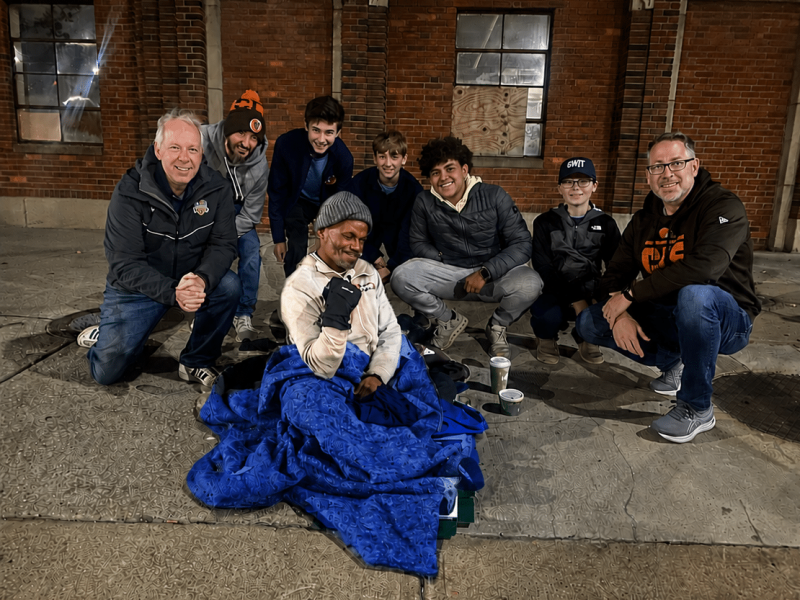
Blanket Sunday celebrates 40th anniversary of bringing blankets, essentials to Northeast Ohioans
As its name implies, “Blanket Sunday” also serves the unhoused. What began as a large donation of blankets to SVDP by an employee at the former O’Neil’s department store in Akron has blossomed into an enduring and regionwide effort to keep those unable or unwilling to stay in shelters warm at night.
Black LGBTQ+ women aren’t safe in Cleveland, but they’re finding ways to thrive
In 2020, an analysis by Bloomberg CityLab ranked Cleveland as the worst city for Black women to live. For Black LGBTQ+ women, the struggles are real.

Mx. Juneteenth celebrates six years of Black, LGBTQ+ and drag liberation
Mx. Juneteenth kicks off with its pre-party on Friday, June 19, 2026, from 9 p.m. until 1 a.m. at Cocktails Cleveland. Then, the festival starts on June 20, 2026, from 11 a.m. to 6 p.m. at North Coast Yard.


