
Northeast Ohio voting advocates: ‘Under no circumstances will we stop’
Despite a push to increase voting restrictions, advocates say they’re “jazzed to do this work.”
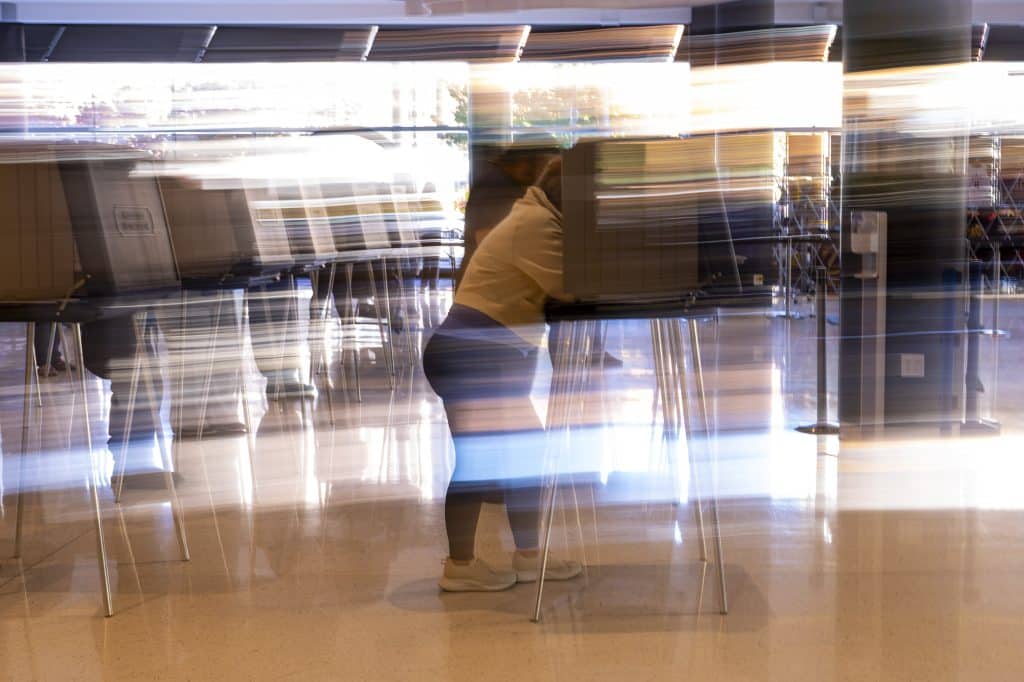
With more and more proposed restrictions on voting and investigations of voters and their advocates, you might expect the targets to lay low.
Instead, with a potentially pivotal election looming, voting rights advocates vow to press ahead, and they say most voters will do so too.
“You’re making me more jazzed to do this work,” says Erika Anthony, head of Cleveland Votes.
“I hear some folks feeling a little more nervous,” says Jen Miller, head of the League of Women Voters of Ohio. But “the only way to protect democracy is to participate … Under no circumstances will we stop.”
“People I know in that field have not been intimidated,” says Cleveland Ward 4 Councilman Kris Harsh, who witnessed an FBI raid in the 2000s as an employee in the Cleveland office of ACORN (Association of Community Organizations for Reform Now). “They’re doubling down on their efforts to help people vote.”
Federal and state officials say recent rules and investigations will stop fraudulent registrations and votes, which they partly blame for President Donald Trump’s 2020 presidential election defeat. But many experts call such fraud far too rare to flip national outcomes. Critics say Republican leaders are really trying to obstruct, confuse and intimidate voting rights activists, elections workers and voters.
“They’re afraid of a fair fight,” says Evelyn Rivera, co-founder of LatinOHs, which promotes the vote.
“They’ve really been using every tool at their disposal to try to change who has a say in our democracy,” says Tessa Xuan, co-director of Ohio Progressive Asian Women’s Leadership.
In June, the Ohio Organizing Collaborative, a liberal group registering voters, said that FBI agents raided and seized equipment in its Cleveland office and volunteers’ homes statewide. “We have done nothing wrong,” the announcement said. “They want to scare people from volunteering, donating and participating in our democracy. We won’t let them win.”
The FBI has not confirmed or denied the raids. But, according to Signal Ohio, the Department of Homeland Security acknowledged “providing support for an active FBI investigation in Ohio.”
Spokesman Mike West of the Cuyahoga County Board of Elections says the board alerted the state in 2023 and 2024 to some invalid registration applications among thousands submitted by Black Fork Strategies, which is owned by an OOC founder and employed by an OOC affiliate. For example, five supposed applicants were dead, and some voters’ addresses were wrongly changed.
According to Signal, three other Ohio county elections boards reported similar problems with Black Fork.
U.S. Rep. Shontel Brown of Warrensville Heights and her four fellow Democratic representatives from Ohio have demanded information about the raids and blasted other federal measures about elections. “This Administration continues to take unprecedented actions to restrict access to the ballot, weaken voting-rights protections, and to cast doubt on our election administration.”
Mike Kirchner, Brown’s Republican opponent in the Nov. 3 election, says he hasn’t seen either the voter suppression claimed by advocates or the invalid votes claimed by President Trump. “I do not understand what the president’s itching about with the past elections. That’s a distraction.”
Politicians and advocates call Ohio election boards diligent and fair. Each board is run by two Republicans and two Democrats. Each publicly tests equipment and audits results.
Cuyahoga’s registration rolls are keeping nearly abreast of past years, with 869,619 voters on Aug. 3. And Jacob Shanklin of Northeast Ohio Voter Advocates says, “The voters are more fired up.”
2020 plus 6
President Trump’s 2020 defeat was confirmed by judges and elections officials from both parties and by independent researchers. In six purple states, for instance, The Associated Press found fewer than 475 questionable votes, mostly rejected.
Weeks later, Trump asked Georgia Secretary of State Brad Raffensperger to “find 11,780 votes” for him. The president also promoted and keynoted what became a deadly attack on Congress to block his defeat. He was indicted for these actions, but the cases were dropped after the U.S. Supreme Court gave presidents broad immunity.
Backers of Trump’s claim settled libel lawsuits by poll workers and Dominion Voting Systems. But now, according to The New York Times, at least 94 election deniers oversee elections in several states.
Last year, on his first day back in office, Trump granted clemency to the Capitol attack’s more than 1,500 convicted participants. Since then, he keeps disparaging elections.
In prime time last month, he said, “For years Americans were blatantly lied to about the security of our election infrastructure … Our elections were left vulnerable to being rigged and stolen and the trust of the American people was lost.”
Critics say it’s the president who’s destroying that trust to discourage turnouts and flip outcomes. “You’re seeing a concerted effort by the Trump administration to sow doubt about elections so they can throw out results they don’t like and consolidate power for themselves,” says Stephen David, Ohio director of All Voting Is Local.
Trump claimed that China compromised voter data in 2020, partly in Ohio, which he won. He released documents that analysts say don’t support that claim. A leading advisor admitted finding “zero evidence” for foreign sabotage of U.S. elections.
A spokesman for Ohio’s secretary of state, Republican Frank LaRose, denied that China breached the state’s elections system.
Trump has called voting by mail “inherently corrupt.” But the Brookings Institute found fraud in about four per 10 million mail ballots in general elections from 2016 through 2022.
No matter the method, analysts call invalid registrations rare and, invalid votes much rarer, with both usually resulting from clerical or software errors. For instance, New Jersey, Texas and Oregon have wrongly registered several thousand people who hadn’t claimed citizenship, and a few hundred voted with permission. The Times says the federal government is working to arrest and deport them.
Other federal actions
Since regaining office, Trump has done many things about elections. Some actions have been ignored by states or blocked by courts, who’ve long held that only Congress can regulate elections and states administer them. But appeals and new actions continue.
–The FBI seized 2020 ballots in Georgia’s Fulton County, which was pivotal to Trump’s defeat in the state.
–Trump called for ending mail ballots.
–He ordered the U.S. Postal Service to check mail voters’ eligibility, using personal data from the states such as birthdates and partial Social Security numbers. Ohio complied while most states refused. Trump sued holdout states and ordered the U.S. Postal Service not to deliver mail ballots there.
–Trump ordered that ballot machines give voters paper records of their secret choices. Advocates say families or bosses might demand a look.
–He pressed Congress to pass the Safeguard American Voter Eligibility (SAVE) Act. It would require proof of citizenship, such as birth certificates or passports, plus proof of name changes. Most mail voters would have to enclose copies of their proof. Critics call such IDs costly and inconvenient and call mailed copies unsafe. The act passed the House but seems unlikely to pass in the Senate.
— The administration emptied the board of the Election Assistance Commission and gutted the Cybersecurity and Infrastructure Security Agency, which helps secure elections. Trump ordered an investigation of the agency’s former director for defending 2020’s results.
–He ordered an investigation of ActBlue, which collects donations for Democratic candidates.
–Prosecutors won two indictments, one since dismissed, against former FBI Director James Comey. Comey’s investigation had led to convictions of Trump’s allies over Russian influence in the 2016 election. Trump has pardoned them.
–With Trump’s encouragement, 10 Republican states will have more favorable Congressional districts for this election. California is the only blue state reciprocating in time for it.
–The administration cancelled grants and threatened to withhold funds from states opposing Trump.
— The U.S. Supreme Court blocked much of 1965’s Voting Rights Act, which boosted minority representation.
Ohio actions
Secretary of State LaRose has shopped hundreds of cases of allegedly illegal voting to county, state and federal prosecutors. During 2024’s early voting period, Dave Yost, then Ohio’s attorney general, announced six indictments.
One case was dismissed. One continues. One no longer appears in Summit County’s records. One defendant was acquitted. One was convicted and given probation. A Cuyahoga man turned out to have been indicted after his death.
Spokesmen for LaRose and the current attorney general, Andy Wilson, have not met requests for comment.
In other state measures:
—A 2023 law requires most people voting in person to show current photo identification, such as a driver’s license or state ID.
—That law also narrows the time from seven days to four for voters to defend provisional ballots in person. Provisionals are cast by voters denied normal ballots.
–In 2024, conservative activists challenged at least 300,000 voters in Ohio and elsewhere. Many Ohio challenges failed, but some voters had to defend themselves at hearings.
— A 2025 law requires absentee ballots to reach election boards by 7:30 p.m. on Election Day.
—That law also requires checks of voter rolls at least monthly against death and citizenship records. Litigants say those records are inaccurate, and voters could be removed too late to register again.
–In 2026, lawmakers passed a bill requiring electronic or paper copies of IDs. Governor Mike DeWine vetoed it, calling it “an additional and significant burden for Ohioans.”
Even before some of these measures, the Cost of Voting Index ranked Ohio as the sixth hardest state for voting. And the advocacy group Demos called Ohio’s purges, which targeted more than 350,000 supposedly inactive, relocated or dead voters last year, the most flawed of 10 states examined.
What should voters do?
At registration tables in Cleveland and Maple Heights, voters objected to rising restrictions.
Joyce Ann Osagie said such “oppression” discourages voters. “It makes you think your vote won’t be counted.”
Pat Tabor criticized calls for mailed copies of IDs. “They might use my ID for anything.”
At a Cleveland Municipal Court event to deal with warrants and fines, a participant said, “They’re trying to take that voice away from us to keep their people in power.”
November’s election will remake Congress, which Republicans narrowly control. Voters will fill all House seats and about a third of Senate seats, including the Ohio one held by Republican Jon Husted and contested by Democrat Sherrod Brown. Buckeye voters will also decide about a governor, many other officials and a constitutional amendment requiring photo ID rules to vote in person, as already required by law.
Ohio’s registration deadline is Oct. 5. Voters must be U.S. citizens, Ohio residents by the deadline, at least age 18 by Nov. 3, and not declared incompetent or ineligible. They must register again after changing names or addresses.
Students may switch to their dorms’ addresses. Homeless people may use the same addresses as for mail or other services. People freed from incarceration for felonies may vote if they register again.
Advocates urge all voters to check their registrations as soon as possible to deal with any problems in time. Voters may register or check with the secretary of state or their county election board. They may get application forms at the board or many other public offices, such as city halls and libraries. Cuyahoga’s board is at 1803 Superior Ave., Cleveland, 216-443-8683(VOTE).
Advocates also urge voters to plan now how to vote: by mail, at their elections board most days starting Oct. 6, or at the polls from 6:30 a.m. to 7:30 p.m. on Election Day. Some people may vote from curbside or a hospital.
Widespread but unequal
Restrictions obstruct many voters in every demographic or political group. For instance, mail ballots are popular with seniors, rural residents and people with disabilities.
But Democrats say that suppression has partisan motives and results. National voter advocate Greg Palast estimates that it cost Vice President Kamala Harris 3.6 million votes and victory in 2024.
David Brock, Cuyahoga County’s Democratic chairman, says “Republicans want fewer Americans to vote, to have rights, to have a voice.” The Republicans’ Cuyahoga office did not answer a request for comment. Trump has said the SAVE bill’s restrictions would “guarantee the midterms” for his party while repeating a false claim that voter fraud is rampant.
Advocates say suppression especially obstructs and intimidates minorities. Lynn Tramonte, head of the Ohio Immigrant Alliance, says some citizens of Latina heritage vote near dawn to avoid harassment.
Advocates say Trump’s election lies are of a piece with his broader, often illegal, sometimes deadly attacks on immigrants and on democracy, such as punishing and prosecuting opponents. “It’s part of the authoritarian playbook,” says All Voting’s David.
Trump has speculated about canceling the election altogether. But Cleveland Votes’ Anthony says, “I want to hold onto the smaller and smaller part of my heart that says we’re going to have an election, and it’s going to be counted.”
Keep our local journalism accessible to all
Reader support is crucial as we continue to shed light on underreported neighborhoods in Cleveland. Will you become a monthly member to help us continue to produce news by, for, and with the community?
P.S. Did you like this story? Take our reader survey!
Related Articles
New Ohio voting rolls part of larger national movement
Voters in more than 20 states will be faced this year with new laws for registering to vote and casting ballots. Nearly 40 laws are taking effect for the first time in this year’s midterms, mostly in Republican-controlled states.
Cleveland is now a City of Peace but what does that mean?
Last year, this proclamation, which is a symbolic commitment to advancing peace, was announced on the stage of the LatinUs Theater in the Pivot Center located on W. 25th Street.


