
Tragedy beneath the waves: Remembering the Lake Erie Tunnel Disaster
On a steamy Monday night in 1916, G.H Fuller of Lake Avenue was disturbed by the sound of whistles drifting across the water of Lake Erie.
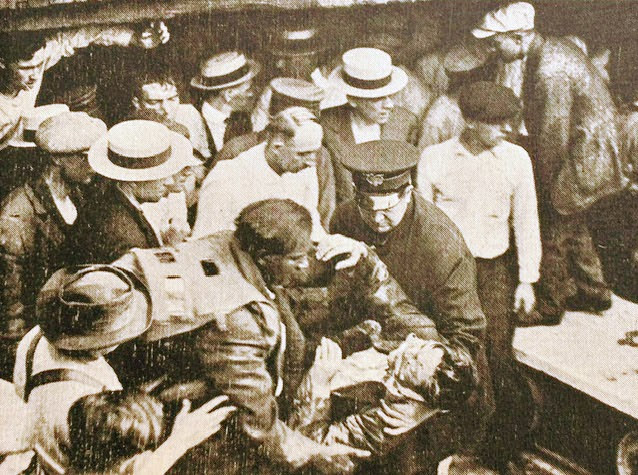
On a steamy Monday night in 1916, G.H Fuller of Lake Avenue was disturbed by the sound of whistles drifting across the water of Lake Erie. According to an article in the Cleveland Leader two days later, Fuller alerted the U.S. Lifesaving Station, which sent a boat to investigate after it received two additional calls. In the ensuing hours, heroes were forged and lives lost in a frantic rescue attempt four miles from shore.
Background
The story of the Waterworks Tunnel Explosion of 1916 began in the early 1800s as Cleveland’s population boomed. According to John Stark Bellamy’s book, “They Died Crawling and Other Tales of Cleveland,” by the mid-1800s, the water along Cleveland’s shoreline was too polluted for human use. To stem water-borne illnesses, the city installed a 300-foot-long cast-iron pipe that could be used to draw clean water into the city from a depth of 12 feet. As the city grew, so did the pollution and additional, longer tunnels were needed. By the time work began on Tunnel #5 in 1914, roughly 70 men had died in Cleveland’s underwater tunnels.
At the time of construction, Tunnel #5, which still provides water for the city of Cleveland today, was a “state-of-the-art” feat of engineering. Bellamy writes that the tunnel itself consisted of a pipe made of interlocking concrete blocks with a diameter of about 10 feet. Above the tunnel rested 40-50 feet of earth and 128 feet of water.
Tunnel workers, known as “sandhogs,” reached the tunnel via an elevator that descended from an island-like crib through a 100×100 square foot steel shaft and deposited them at the entrance to an airlock. While working, 85 men lived on the crib, often for several months at a time. Their lives consisted of eight hours of work, eight hours of sleep, and eight hours of whatever recreation they could find. There was no telephone and, during the winter, the workers were completely cut off from land apart from the occasional arrival of supply ships.
A Dangerous Crack
On July 22, 1916, a sandhog discovered a foot-wide crack in the tunnel. Disturbed by the sound of rushing gas, he notified his superiors, however, work continued on the tunnel. By the end of that day, worker Patrick Delaney quit, saying “there was enough gas in the tunnel to light the city of Cleveland.”
By four o’clock the next morning, it was too dangerous to continue working and, when dawn broke, the next shift refused to enter the tunnel. Cleveland Water Commissioner Charles P. Jaeger ordered Construction Superintendent Gus Van Dusen to keep all workers out of the tunnel until lab results from air samples indicated that it was safe to enter.
In an effort to further address the gas building in the tunnel, Van Dusen ordered that a ventilator be installed in the shaft. Then he returned to shore, failing to pass along Jaeger’s order. That afternoon, he visited the home of Samuel Vokes, one of his gang bosses. Vokes’ wife later told the Cleveland Leader that, due to the gas in the tunnel, her husband was reluctant to work that day but was convinced by Van Dusen’s reassurances.
The Final Descent
With the sun low on the horizon, Vokes gathered his crew at the top of the crib. According to Bellamy, the 11-man gang was short two men that night – miner Flynn refused to enter the tunnel and Patrick Kearns failed to show up at work. Vokes and his men entered the elevator cage at 8 p.m. and descended to the tunnel.
Even without two of its men, the gang on the elevator was a diverse group. City records indicate that hoisting engineer, Thomas Clark, was an immigrant from England and the father of a 9-year-old daughter. Like Vokes, Clark lived on Clinton Avenue. Clark’s wife was later quoted in a Cleveland Leader article saying, “I’ll always have the memory of the big-heartedness of the best man in the world.”
The crew had three muckers, Jack Walsh, John Mackey and Frank Captain. Little is known about the three, though death records indicate that Walsh was from Ireland and Mackey was from Finland. There were also four miners: Steve Hayes was from Ireland; William Lahnstein had immigrated from Germany three years prior and was unmarried; no information was available about the other two miners, but according to Bellamy, they were named Nicola Sampilla and Fred Caplan.
Reaching the entrance to the tunnel, the men moved into the airlock, passing William Dolan, the air lock controller. Dolan was the last person to see them alive.
As they moved into the tunnel, the air lock door closed behind them. According to the Carnegie Hero Fund Commission’s report on the disaster, it was impossible to open the door unless the pressure was the same on both sides.
Explosion and First Rescue Attempt
More than an hour later, a massive explosion occurred at the southernmost end of the tunnel, killing all the men in Vokes’ crew. Its force was so great that it knocked Dolan 20 feet across the airlock. Though Dolan was stunned, he began adjusting the pressure in the tunnel so that the airlock door could be opened and help could get to Vokes’ crew.
Meanwhile, an engineer in the crib above became concerned by gauges monitoring the pressure in the tunnel. He alerted Superintendent Johnston who, unable to contact Vokes, led six men on a rescue mission. In his testimony to a Hero Fund investigator, Johnston said that the men carried a single light and stayed low to the ground, believing that this would protect them from rising gas. However, the men quickly succumbed to the gas that was filling the tunnel. Johnston himself was rescued by air lock controller Dolan who dragged him to the elevator.
Second Rescue Attempt
By this time, Superintendent Van Dusen had been alerted and arrived at Crib #5 accompanied by workers from a different dig site. He and nine men descended into the shaft and entered the tunnel. The doors sealed behind them, trapping them when the men left to operate the airlock succumbed to the gas.
According to Bellamy, trapped rescuers Martin Nelson and Michael Keough later recounted the horror of the moment: “It was awful to see those men at whose side you had worked in there and yet be unable to save them. They lay gasping for air on the floor.” Nelson remembered trying to keep his head out of a puddle while falling unconscious.
Meanwhile, on the crib, the men tried to attract attention from the shore using distress rockets and whistles. However, when a rescue boat finally arrived, it did not carry the supplies that were needed and it took several more hours before such supplies arrived.
Thomas Clancy’s Heroic Attempts
Around 2:30 a.m., Van Dusen’s stepson, 36-year-old Thomas Clancy, arrived at the Crib with his friend, James Keating. Census records and a World War I draft card suggest that Clancy was born in St. Louis, Missouri and had lived in Queens, New York where his biological father was a day laborer.
Determined to rescue his stepfather, Clancy descended into the shaft accompanied by Keating and a third man. According to the Hero Fund Commission investigator, by the time the men were lowered into the shaft, the concentration of gas in the tunnel was so high that people “who leaned over it were made sick and dizzy.” On reaching the airlock, Clancy shattered a window in the locked door, allowing it to open. The men proceeded to rescue two men who they found alive. They also retrieved a body, then ascended in the elevator to the crib.
Despite being ill from his first descent, Clancy insisted on making a second attempt. He and another man descended to the tunnel but, even with damp towels wrapped around their faces, the concentration of gas was too high.
At 5:30 a.m., a boat arrived carrying firefighters equipped with oxygen helmets. The firefighters accompanied Clancy and Keating into the elevator shaft, but they returned to the crib when Clancy fell unconscious. After 15 minutes on a portable ventilator, called a pulmotor, Clancy was revived.
Garrett Morgan and The First Successful Rescue
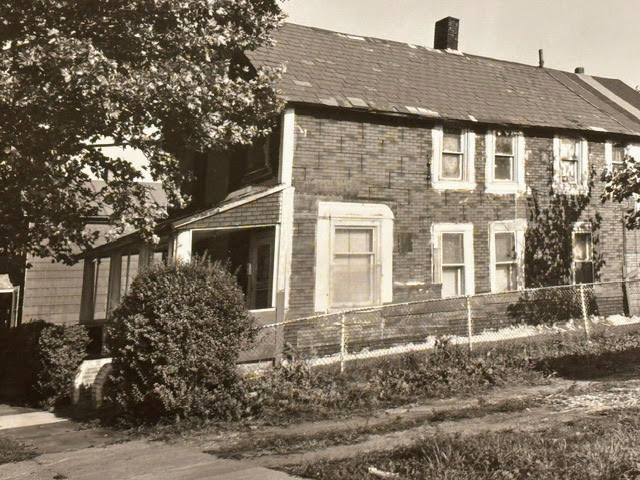
When patrolman John Chafin became aware of the situation at the crib, he recalled seeing a demonstration of Garrett Morgan’s Safety Hoods and suggested that the inventor be called to assist.
According to an exclusive interview with his granddaughter, Mayor of East Cleveland Sandra Morgan, Garrett Morgan was the son of formerly enslaved parents. Born in Paris, Kentucky, he eventually moved to Cleveland and began working in the clothing industry. His job was to sweep the floors which, Mayor Morgan explained, was a critical task, “as you’re sewing, as you’re cutting fabric, it generates a lot of fibers and cotton dust. Well, that was very dangerous because that was extremely flammable. And remember, people could smoke inside, so anything could spark a fire, and so it was imperative that somebody make sure that it was clean at all times.”
Eventually, Morgan began fixing and improving the sewing machines. Mayor Morgan said that this is how Garrett met his wife, Mary Hasek, who was the daughter of Czechoslovakian immigrants and heavily rooted in Czechoslovakian culture. Their interracial relationship cost Morgan his job, so he and Mary opened their own women’s clothing business out of their home in an ethnically diverse Cleveland neighborhood.
Morgan’s entrepreneurial ventures continued to expand and he designed a gas mask which he called the “Safety Hood.” Mayor Morgan noted that, by 1916, the hoods were being used in cities across the nation, however, Cleveland had declined to purchase the hoods due to Morgan’s race. Consequently, the city did not have access to them during the explosion in Waterworks Tunnel #5 until city officials placed a desperate call to Morgan in the early hours of July 24.
Hearing about the disaster, Morgan, his brother, Frank, and neighbor, William Roots, rushed to the crib where they donned the Safety Hoods which consisted of a fabric helmet with two tubes that ran down the wearer’s back. These tubes ended in either a pouch of air or an opening stuffed with a wet sponge. The latter model operated on the principle that air by the ground would be purer since gas and smoke rise.
Accompanied by Clancy and Thomas Castelbery from Pennsylvania, the group entered the tunnel barefoot so that they did not risk igniting a spark with their shoes. They then began to retrieve the victims. According to the Commission’s report, they found two men alive.
From Rescue to Recovery
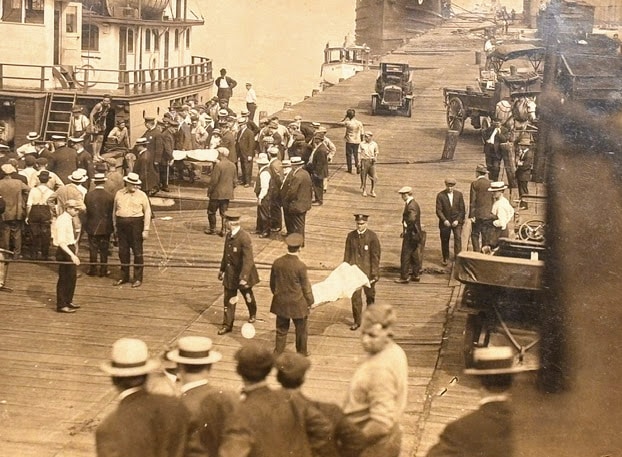
It would take more than a month for all of the bodies to be recovered, many of them by Morgan himself. Consequently, many of the men’s death certificates are from August 1916 and bear his signature. In addition to the men in Vokes’ crew, 10 rescuers died:
- Jesse Hatcher, 22 years old
- Patrick Kearns
- John McCormick, 27 years old from Brooklyn, New York
- J. Patton, Irish immigrant and father of five
- Frank Reep, father of two (Reep’s 10-month-old daughter died four months later from pneumonia)
- Charles Schwind, a Cleveland native
- Archie Turnbull, 22 years old from Pennsylvania
- Clarence Welsh, newly married (Welsh’s bride died five months later from pneumonia)
- J.M. Wood
- W.H. Yeoman, 27 years old and father of two
During the recovery efforts, tunnel man Luigi Bucciarelli fell from the crib and drowned, bringing the disaster’s death toll to 20. According to the Cleveland Leader, the hazards of their work meant that most of the men were uninsured and left their families destitute.
As rescue efforts shifted to recovery and repair of the tunnel, the city conducted investigations into the disaster. While some safety changes were made to better prepare for future disasters, ultimately no one was held responsible.
Controversy Over Honors and Compensation
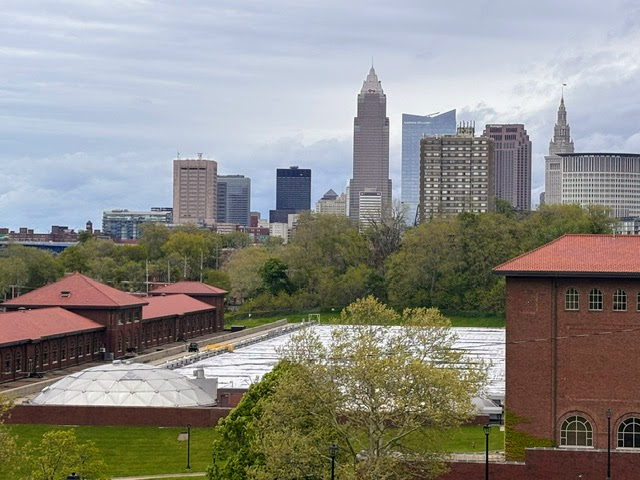
After conducting its own investigation, the Carnegie Hero Fund Commission awarded Carnegie medals to Dolan, Clancy, McGrath and Keating. It declined to award the medal to the 22 other people who were nominated – including the Morgan brothers – because the commission concluded that they did not meet the criteria of acting despite “extraordinary risk” to life since they claimed that Morgan’s Safety Hoods eliminated such risk.
Most recent reporting on the incident has attributed the commission’s decision to racial prejudice, as did several of Morgan’s contemporaries. In fact, when a group of Cleveland businessmen, headed by Victor Sincere of the Baily Co., presented Morgan with a diamond-studded medal honoring him for his bravery, Sincere spoke openly about the perceived racial issues at play and commended Morgan for his courage in the face of racism.
Mayor Morgan agrees, saying that the Commission’s explanation does not adequately account for the dangers her grandfather faced: “Imagine going down there when it’s all just dirt and rocks and there’s gas everywhere that could be ignited.”
Morgan and many of his contemporaries also blamed prejudice for the city’s refusal to compensate him for subsequent long-term health issues. Mayor Morgan noted that her grandfather experienced life-long effects from remaining in the tunnel beyond the time that the Safety Hoods were effective: “In modern firefighting, everyone has their helmets on … They go in, and typically they stay in for no longer than 15 or 20 minutes, and then that squad comes out and the next squad goes in. Why? Because at that point, the breathing device starts to fail, if you will, and the air is no longer pure, right? Toxins can get in. Well, you know, he didn’t necessarily have that knowledge.”
Despite these failures to recognize what Garrett Morgan did and his understandable disappointment, his granddaughter says he did not dwell on resentment: “You know what he said? As we say in my family, ‘I’m gonna pull up my socks and keep it moving.’” He did precisely that and now, 110 years later, his heroism has been memorialized in books, cartoons, films and, appropriately, the name of a Cleveland Water Plant.
We're celebrating four years of amplifying resident voices from Cleveland's neighborhoods. Will you make a donation to keep our local journalism going?
Author

Related Articles

National expert, trafficking survivor, leader Alia Azariah to keynote event in Cleveland
A California native, Azariah serves as director of collective impact for Safe House Project (SHP) in Ventura, a national nonprofit organization, and advocate to prevent human trafficking that provides aftercare for victims and helps them transition into safe, restorative care.

Armed man charged toward Democratic candidate for Ohio governor at fair, law enforcement says
A 38-year-old was taken into custody on Sunday, according to law enforcement.
Teen treatment center CEO accused of unlawful sexual contact with minor in police sting
Police say the head of Fox Run Center for Children and Adolescents drove nearly 200 miles to meet with someone he believed was a 14-year-old girl.


