
Addressing the injustice of Cuyahoga County’s pre-trial detention policy
Faith-based organizations combine research with real-world applications during community discussion aimed at fixing an inconsistent criminal justice system.
Faith-based organizations combine research with real-world applications during community discussion aimed at fixing an inconsistent criminal justice system.

Under the current criminal justice system, the standard practice is for those charged with crimes to be detained in jail facilities while they await trial. A gathering hosted by Greater Cleveland Congregations (GCC) on May 7 challenged that status quo.
Much of last week’s GCC event, “Jail Before Trial: We Can Do Better,” can be understood as focusing on the gap between what researchers know about effective criminal justice reform and how the jail before trial system works in Cuyahoga County.
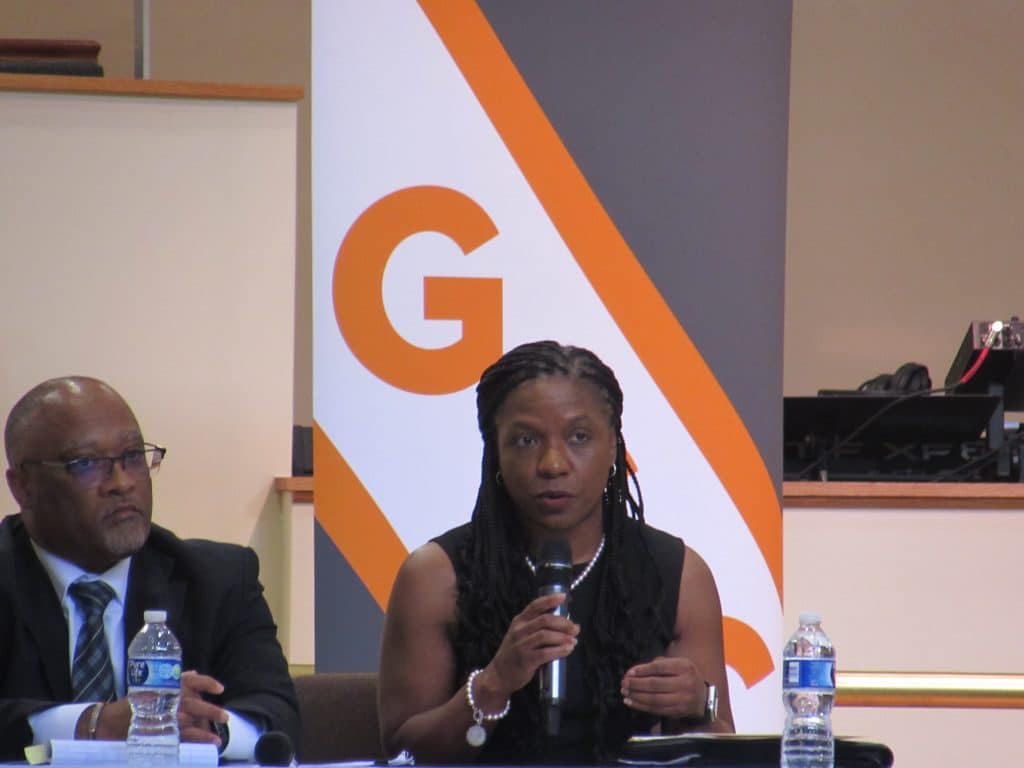
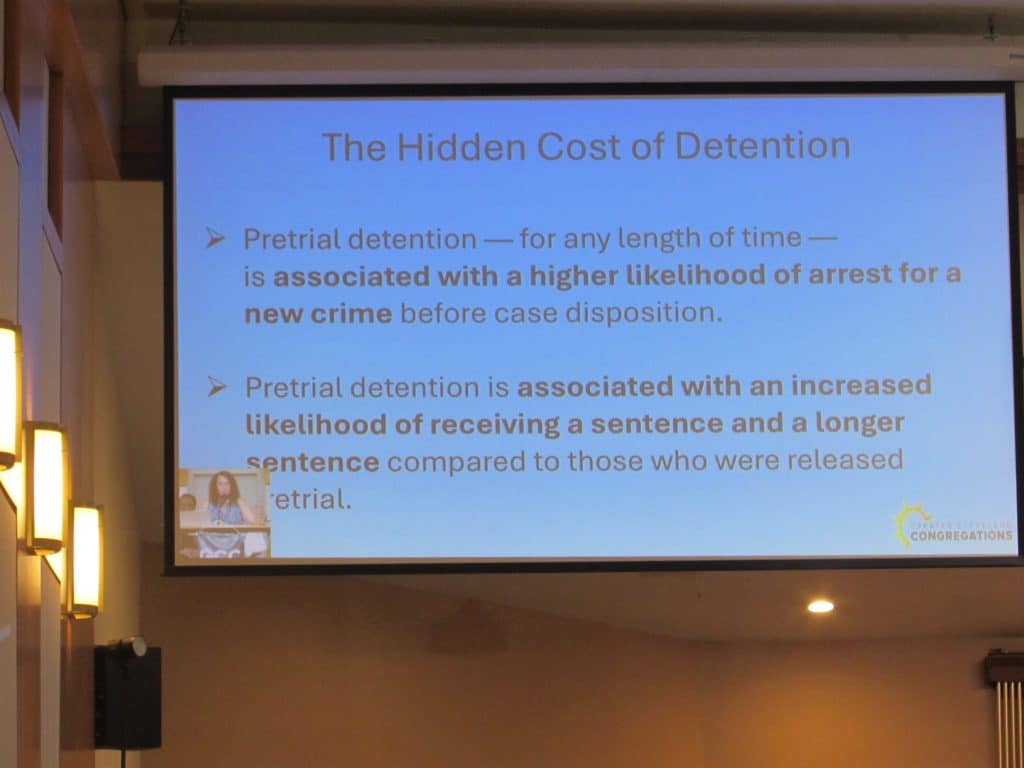
“There is a growing body of research that shows jailing people before trial does not deter future crime and actually may undermine community safety,” Jessica Ireland, senior manager of the Center for Effective Public Policy, told an audience of more than 500 people gathered in Olivet Institutional Baptist Church at GCC’s Pretrial Justice Forum. Although she explicitly referenced studies in her talk (such as “The hidden costs of pretrial detention”), her expertise lies in moving from evidence into the real-world practice of pretrial systems.
GCC organizers invited Ireland to illuminate paths toward best practices in pretrial justice. During the forum, she represented a guide from the way things are – the average pretrial jail time in Cuyahoga County is longer than seven months – toward the way things should be. As examples, Ireland pointed to her efforts to improve the effectiveness of pretrial screening, release, and supervision practices in North Carolnia, among other locations.
The work she contributed to in Mecklenburg County received accreditation from NAPSA, recognition of fully realizing an effective program that meets evidence-based standards for pretrial justice.
However, Cuyahoga County is not Mecklenburg County. There are several common reasons people are in jail before trial in Cuyahoga County, when they might not be in another jurisdiction: they can not afford to pay bail to get out; judges have insufficient information to determine public safety risk; a mental health or substance abuse issue is involved; or the defendant misses a court date.
Ireland told The Land that it is up to county-level “stakeholders to translate data” into practice. She is a national expert on how change can occur, but change must involve local actors moving beyond their isolated roles in the way things are.
“Across all the jurisdictions I’ve worked with, you really do need that collaborative approach with all the stakeholders coming together,” Ireland said. “When everyone’s siloed, you can’t get outside your role, you can’t actively work together. It takes everyone, to an extent, being vulnerable and willing to come together… and really look at what’s going on.”
Rachel Dissell, a journalist with The Marshall Project – Cleveland and Signal Cleveland, told those gathered that studies have been done in Cuyahoga County, but these studies have not fully been realized in practice. Dissell referred to a 2018 report from the Cuyahoga County Bail Task Force (Jonathan P. Witmer-Rich of Cleveland-Marshall College of Law is the principle author), which states that a new system would “lessen collateral consequences for the accused, such as loss of employment or housing while waiting in jail.”
The report also states that “all Cuyahoga County courts should transition from a bail system based on bond schedules, which vary widely from one court to the next, to a centralized, consistent, and comprehensive system of pretrial services initiated immediately after arrest.”
For Dissell, “a few reforms stuck, but larger suggestions for systemic change hasn’t occured. Why is that? I think this is actually the perfect time to ask that question.”
The question of change: The way things are and the way things should be
During the May 7 forum, the seven speakers from GCC and the five invited speakers addressed the question of change, albeit in different ways.
GCC speakers included Rev. Dr. Jawanza Colvin; Rev. James Crews, Antioch Baptist Church; Louise McKinney, St. John African Methodist Episcopal Church; Rev. Dr. Lisa Goods, Shiloh Baptist Church; Sharnell Woods, Antioch Baptist Church; and Pat Dillard, Unitarian Universalist Congregation of Cleveland.
Guest speakers, in addition to Ireland and Dissell, included Michelle D. Earley, Cleveland Municipal Court administrative and presiding Judge; Russell Tye, chief trial counsel at the Cuyahoga County Office of Public Defender; and Tammy Sherman, chief probation officer with Cuyahoga County Comon Pleas Court.
During the introduction, Louise McKinney, a leader of GCC’s pretrial justice work, described GCC as “an organization committed to building community power for change with 39 member institutions across the city of Cleveland and Cuyahoga County.” Although McKinney practiced law for decades, she states that practicing law did not always amount to practicing justice.
“I get to practice justice with GCC.” Mckinney said. “So why are we all here tonight? Because we want to reduce jail before trial in Cuyahoga County. Because jail before trial can equal pretrial injustice.”
Rev. Dr. Colvin said that the goal of the organizers was for everyone in the audience to have something “to take away from this… maybe it’s a statistic… maybe its someone’s story… maybe it’s the community spirit that was present to want to do something about it.”
The event was hosted at Olivet Institutional Baptist Church, a church on Cleveland’s civil rights trail. Since 1931, “Olivet has sought to place itself intentionally on the margins, where the struggle happens, and where the struggling live,” said Colvin. However, that is not the only way the church is positioned near the question of justice.
“Our church, geographically, is here on Quincy (Avenue)… in the footprint of both the justice center and the juvenile justice center,” he added.
While the overall emphasis on the event was on what needs to change regarding the persistence of injustice in jail before trial for low-level and nonviolent offenders, there was some attention paid to what changes have occurred. For example, Judge Earley described the way that many people at Cleveland Municipal Court “agreed that it was important to be able to talk about the number of people that were being held before trial not because they were dangerous, not because they were high risk, but because they were poor.”
Earley, and others in the court, then started a conversation on why change needed to occur.
“Not wanting Cleveland Municipal Court to have people in jail because they could not afford to pay… we all got on the same page there, so that allowed us to push through the how,” Early said.
Ireland believes that this was a brave move on the part of Cleveland Municipal Court judges and other personnel.
“They came to the table and said: ‘we don’t want to be a court system where this is what we are known for,’” Ireland said. “It takes a lot of courage for people to do that… and think: what solutions do we want to put in place?”
From data to practice
At the end of the forum, Rev. Crews of Antioch Baptist Church summarized key points of the event with a “what we heard” segment.
“We have heard that people running Cuyahoga Courts matter because they shape the policies of how people who can not pay to get out of jail are treated,” he said. “The bottom line is it takes judges, prosecutors, private bar, public defenders, bond commissioners, sheriffs, police officers, it will take all of us to create a criminal justice that sets people up for the success.”
Crews closed his remarks with a call to action.
“Your presence tonight… leads us to believe that you want pretrial services to get better,” Crews said. “We can do together what we can not do alone.”
Colvin then ended the event with a call to move from education to action in creating a more just and humane judicial system.
“Our system is a reflection of generations of indifference and outright disregard to those who are poor… those who aren’t well connected… those who don’t know someone… or know someone who knows someone who can help them avoid the jagged edges of the system,” Colvin said.
We're celebrating four years of amplifying resident voices from Cleveland's neighborhoods. Will you make a donation to keep our local journalism going?
Author

Related Articles

Blanket Sunday celebrates 40th anniversary of bringing blankets, essentials to Northeast Ohioans
As its name implies, “Blanket Sunday” also serves the unhoused. What began as a large donation of blankets to SVDP by an employee at the former O’Neil’s department store in Akron has blossomed into an enduring and regionwide effort to keep those unable or unwilling to stay in shelters warm at night.

Black LGBTQ+ women aren’t safe in Cleveland, but they’re finding ways to thrive
In 2020, an analysis by Bloomberg CityLab ranked Cleveland as the worst city for Black women to live. For Black LGBTQ+ women, the struggles are real.

Crowdfunding has become a lifeline for LGBTQ+ Ohioans of color
Community members say online fundraisers and mutual aid are filling gaps left by housing, healthcare and employment systems.


