
Former horse blanket factory transformed into affordable housing in Clark-Fulton neighborhood
What was once the nation’s largest maker of woolen horse blankets is now 60 affordable housing units and a hub for social services on Cleveland’s West Side.
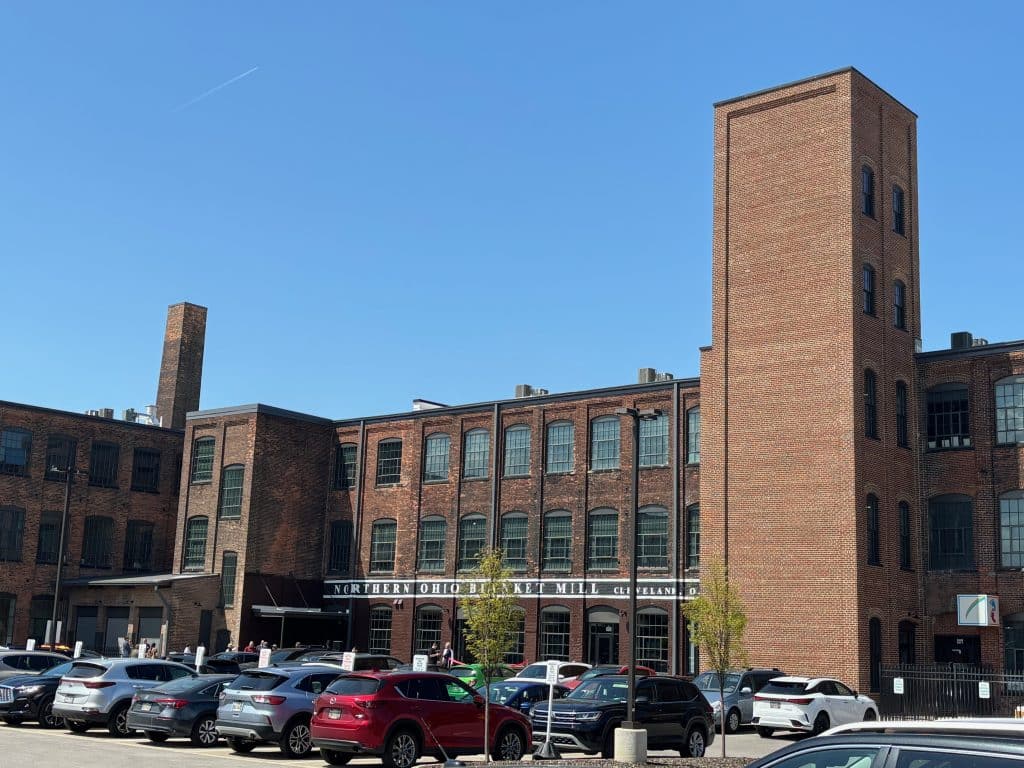
The historic Northern Ohio Blanket Mills property could have ended up as a pile of rubble. Instead, the building in Cleveland’s Clark-Fulton neighborhood – which once housed the nation’s largest manufacturer of woolen horse blankets and carriage robes – has been transformed into 60 affordable apartments as well as a hub for social services, including health care and child care.
That outcome, project leaders say, reflects years of persistence, coordination and investment from community partners and funders. They marked the achievement with a ribbon-cutting and open house on Thursday, April 23, celebrating the building’s grand opening at 3466 St. Rocco’s Court, between Fulton Road and West 25th Street.
The redevelopment includes 60 one-, two- and three-bedroom apartments on the upper floors. The first floor houses the Cleveland Department of Public Health, Neighborhood Family Practice, Metro West Community Development Organization and Little Footsteps Bilingual Child Enrichment Center, creating a one-stop center for residents and the surrounding community.
The $41 million project was made possible through a layered financing package that combined Low-Income Housing Tax Credits, state and federal historic tax credits and New Markets Tax Credits, along with support from a range of public and private partners. Those partners include the city of Cleveland, Cuyahoga County, Cleveland Development Advisors, Village Capital Corporation, the Cleveland Foundation, U.S. Bank, Citizens Bank, Foss & Company and PNC Bank.
Chris Ronayne, county executive for Cuyahoga County, said the development is a model other communities should seek to replicate.
“The model of bringing healthcare, childcare and affordable, accessible housing together is a winning model and we really ought to bring that to our neighborhoods and our communities,” said Ronayne. “We do have health care deserts and we do have child care deserts. Right here in Clark-Fulton, this is pretty special – because this is a neighborhood that needs this and deserves this and now has access to it.”
“You can’t necessarily build another horse blanket factory, but you can put health care in neighborhoods, you can put child care in neighborhoods, you can put more accessible housing in neighborhoods, and you can get it done,” he added.
Kevin Hudson, director of development for the Levin Group – which codeveloped the project with Metro West Community Development Organization – said the project wouldn’t have happened without its many partners. Hudson said the Levin Group, which specializes in community development projects like this one, owns 1,400 affordable housing units in Ohio.
“This project represents more than the redevelopment of a historic building,” he said. “It’s the result of strong partnerships, persistent and shared commitment, and investing in the community, housing and services right here in Cleveland.”
Jasmin Santana, the council person for Ward 14, said she pushed for a women’s health center at the property, and in response the Levin Group worked to bring in the Cleveland Department of Public Health and Neighborhood Family Practice.
“The Northern Ohio Blanket Mills is more than just a development – it’s something very personal to me,” she said. “It’s the kind of project that stays with you, the kind you remember long after your time in office. In many ways, it’s a dream realized for our community. What makes it special is not just the beautiful space, but the heart behind it: the commitment to affordability, partnering with CMHA when others said it couldn’t be done and an understanding that development must serve the people who are ready to call this neighborhood home.”
For all its eventual success, the project almost didn’t happen. Mort Levin, president of the Levin Group, called it an “unbelievably complicated project,” pointing to years of setbacks since the group got involved in 2013. Developers encountered many problems, including a collapsed outbuilding, major structural issues and holes in the floor so large you could see straight through the building.
Hudson said the team also encountered people living in the abandoned structure before renovations began. “There were times when we’d come through, early on before construction started, and there were people living there,” he said. “You turn a corner and there someone is.”
After years of work, the project hit another major hurdle when costs surged during and after the COVID-19 pandemic, nearly derailing it. The team was just weeks away from abandoning the effort when a final round of financing came together.
Hudson said the timing was critical. “With COVID, it was kind of like we got to the point where we either push this across the line or it’s not happening,” he said. “We were able to push it across the line. If we’d gotten delayed another six weeks, it would have gone on the shelf and it wouldn’t have happened.”
“A lot of the easy projects have been done,” Hudson said of adaptive reuse projects in Cleveland. “What remains are the projects that are hard and take significant resources, significant time and creative thinking.”
The project is part of a broader wave of investment reshaping Cleveland’s Clark-Fulton neighborhood. Alongside MetroHealth’s redevelopment of its main campus and the CentroVilla25 project, officials say roughly $1 billion has been either planned or invested in the area in recent years to drive revitalization.
The Northern Ohio Blanket Mills redevelopment was also spurred in part by support from the Ohio Housing Finance Agency, which launched the FHAct50 program – a pilot initiative with Cleveland, Cincinnati and Columbus to provide larger subsidies for transformational neighborhood projects.
During a tour, a guide highlighted lofted ceilings, large windows that fill the apartments with natural light and spacious kitchens, bedrooms and bathrooms.
Property manager Dolores Lozada told The Land that most residents are single women with children, and the units are designed for family living. Many residents later move on to rent or buy larger homes after their time at the property, she said, noting that vouchers from the Cleveland Metropolitan Housing Authority help provide a pathway to greater financial stability.
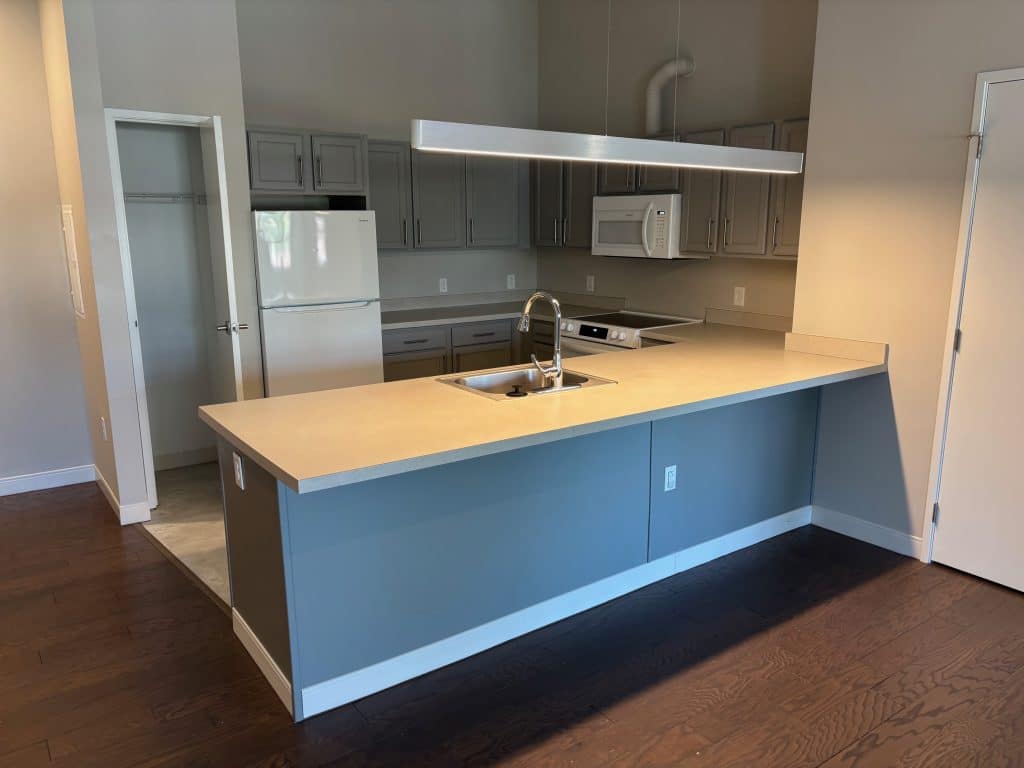
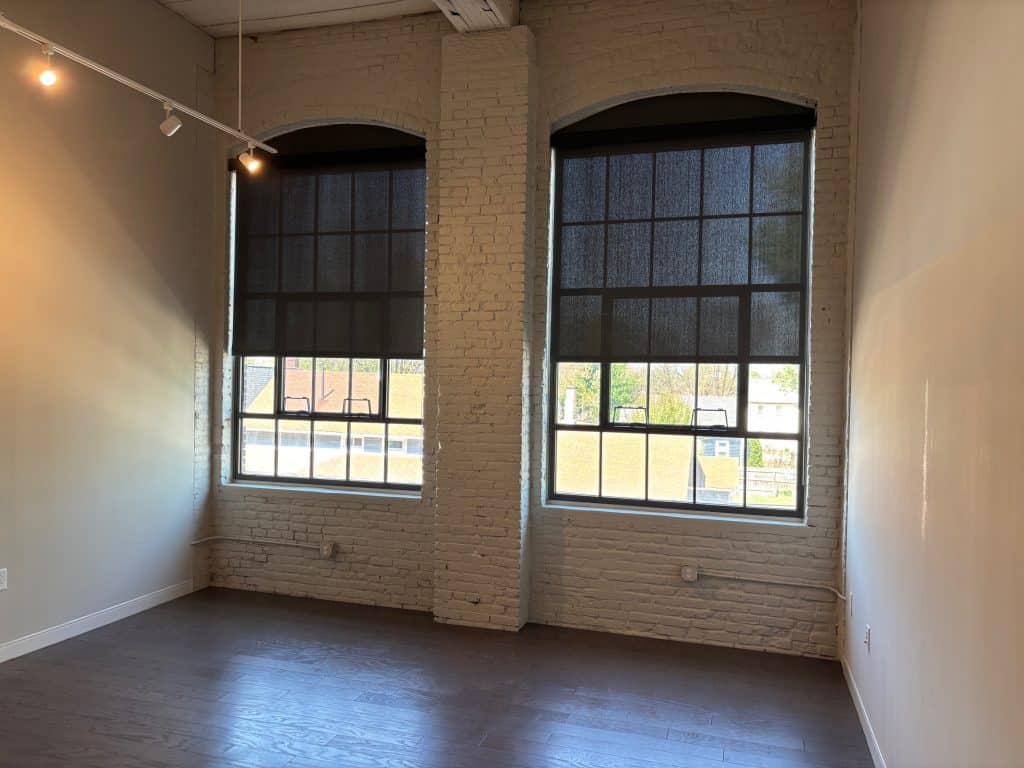
To qualify, residents must earn no more than 60% of the area median income and pay no more than 30% of their income on rent, which is set on a sliding scale. Lozada said there are currently five vacant units, though the building is typically fully occupied.
The co-located services – occupying about 40,000 square feet of first-floor commercial space – are a central part of the project.
David Margolius, director of public health for the city of Cleveland, said the development enabled the Cleveland Department of Public Health to relocate its west side clinic from the aging McCafferty Health Center in Ohio City to a modern facility in a neighborhood with significant health care needs.
Clark-Fulton, one of the city’s most diverse neighborhoods and home to the highest density of Latino residents in the state, is a key location for that work. The clinic operated by the Cleveland Department of Public Health at the site provides reproductive health care and childhood immunizations.
“The unique niche we fill is that we’re one of the places where it’s same-day, walk-in, walk-out, low-cost, limited-barriers-to-care type of thing,” said Margolius. “Being here in a space where there are so many other services, in a neighborhood that needs us more, it’s a perfect, perfect mix.”
Ronayne told The Land the project offers one solution to the national and regional shortage of affordable housing and the need for more units.
“We are bringing, in a holistic way, wellness to the neighborhood,” he said. “Housing is health care. Affordable, accessible housing is health care. But to also have onsite a neighborhood-based health care provider and childcare – it’s a one-stop shop and an incredible anchor for this neighborhood, all within walking distance.”
Keep our local journalism accessible to all
Reader support is crucial as we continue to shed light on underreported neighborhoods in Cleveland. Will you become a monthly member to help us continue to produce news by, for, and with the community?
P.S. Did you like this story? Take our reader survey!
Author

Related Articles
Irishtown Bend is a window to Cleveland’s past — and future: Opinion
With the coming of Cleveland Metroparks’ Irishtown Bend Park, this historic turn of riverfront is about to become a shining example of a new era for Cleveland: less populous but greener; freshly forward-looking, but ever mindful of its past.
Gateway North set to open fall 2027
Trader Joe’s is currently targeting an opening between mid-October and November of this year.
Planned Euclid soundstage aims to bring Hollywood-scale production indoors
“The big picture is to create a sustainable, economically smart center for films to work in.”


