
Smokey air continues to smother Cleveland
We’ve got tips for protecting yourself and your family.
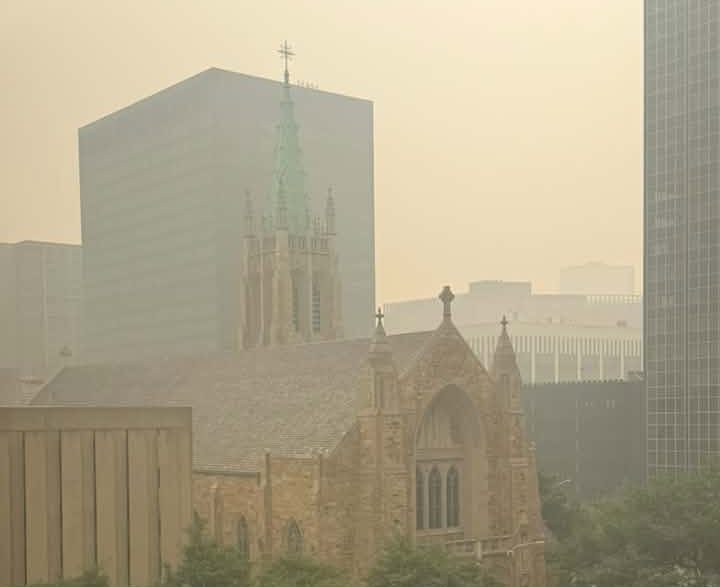
Heavy smoke from Canadian wildfires continues to drift south into Northeast Ohio and the Great Lakes region, choking the area with dangerous, particulate-heavy air. Dangerous air conditions could persist into the weekend.
The National Weather Service issued another air quality alert for much of Ohio on Friday. The alert warns that a “maroon” air quality alert is likely throughout Friday, meaning “air pollution concentrations within the local region are extremely hazardous for the general population.” Northeast Ohioans are urged to stay indoors, avoid idling their car, avoid driving as much as possible and to hold off on mowing their lawn. As of 9 a.m., AirNow.gov reported a regional AQI of “264,” outside of the “hazardous” range, but firmly in the “very unhealthy” range. Conditions are expected to worse throughout the day.
As The Land reported yesterday, Cleveland is extending the hours of select community centers to offer shelter to residents. Cuyahoga County has also shared a list of resources available to Northeast Ohioans. Cleveland City Hall, Public Auditorium and Erieview are all closed Friday due to the air quality. The following facilities will be open from 11:30 a.m. until 10 p.m.
- Zelma George: 3155 Martin L. King Blvd.
- Collinwood: 16300 Lakeshore Blvd.
- Gunning: 16700 Puritas Ave.
- Kovacic: 6250 St. Clair Ave.
- Frederick Douglass: 15401 Miles Ave.
- Michael Zone: 6301 Lorain Ave.
Greater Clevelanders should limit their time outdoors and, if they need to venture outside, consider donning an N95 protective mask, according to health experts. Additionally, while indoors, keep your windows shut.
“Make sure your windows are closed and your air conditioning is on. HEPA filters do a reasonably good job, as well, if you have access to that. Those are all those things you should be prepared with. And if you do already have a diagnosis of a respiratory illness like asthma, COPD, or emphysema, have a rescue plan in place,” said Dr. Samuel Gurevich, pulmonologist at Cleveland Clinic.
What counts as bad air?
The Environmental Protection Agency’s Air Quality Index converts all pollutant levels into a single number. The lower the number, the better.
Anything below 50 is classified as “healthy.” Fifty to 100 is “moderate,” while 100 to 150 is unhealthy for “sensitive groups,” and anything above 150 is bad for everyone.
Sensitive groups include people with asthma, lung disease or chronic obstructive pulmonary disease, said Dr. Sanjay Sethi, chief of the division of pulmonary, critical care and sleep medicine at the University at Buffalo medical school.
“If you have heart or lung problems, then you’ve got to be definitely more careful,” Sethi said. “I would either avoid going outside or wear an N95 or at least a dust mask.”
What if I have to go outside?
For most people, going outside for just a short time won’t have a negative long-term impact, said Sethi.
Wearing an N95 mask, which became common during the coronavirus pandemic, will help filter out the pollution.
“N95 is going to get rid of 90-95% of the particles,” said Jennifer Stowell, a research scientist at Boston University’s Center for Climate and Health. “If you have access to a mask that has a respirator-type attachment to it, then that’s the very best.”
If you must be outside and you experience symptoms, experts say you should head indoors or elsewhere with better air quality. Even if you are healthy, it’s good to take precautions.
“If you start wheezing, which is like this whistling sound of the chest, or if you’re feeling short of breath, that’s definitely more concerning,” Sethi said.
How do I make my air cleaner?
Close the windows and turn on the air conditioner, if you have one, setting it to circulate the indoor air. Use blankets to cover cracks that allow outside air into your home, such as under doors.
Finally, swapping the air conditioner’s filter for a MERV 13 filter can help, but ensure it’s installed correctly.
“If you happen to have access to an air purifier, even if it’s just a room air purifier, try to keep it running and in the room that you’re doing most of your activities in,” said Stowell.
This story also features reporting from Caleigh Wells, Associated Press
Keep our local journalism accessible to all
Reader support is crucial as we continue to shed light on underreported neighborhoods in Cleveland. Will you become a monthly member to help us continue to produce news by, for, and with the community?
P.S. Did you like this story? Take our reader survey!
Authors

Related Articles

Ohio voters rejected Sherrod Brown. Two years later, are they ready to give him a second chance?
The 73-year-old Democrat will need to win back voters in places that have increasingly turned Republican in recent years.
Cleveland to host public hearings on data centers, potential impacts
“We’ve worked with data center experts, compiled research, and visited data centers. Knowing what residents think about data centers is a critical part of what we need to understand.”

There’s one issue where Republicans and Democrats are unified before the midterms, a new poll finds
A new AP-NORC poll shows Americans are growing more concerned about the environmental impacts of AI.


