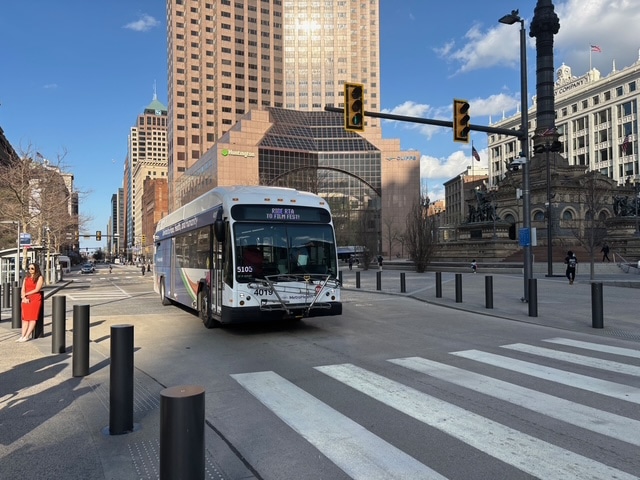
Beginning in August, the Greater Cleveland Regional Transit Authority is proposing 3% service cuts that would save about $2.5 million per year. Under the plan, RTA would eliminate the downtown B-Line trolley and limit the Waterfront Line to special events only. Additionally, the agency would reduce weekday and weekend service on several routes across the city.
RTA ridership increased for the second straight year in 2024, according to the agency, but it dipped in 2025. RTA carried 24.9 million passengers in 2024, generating $32.9 million in fares, up from 22.1 million rides and $29.9 million in fares in 2023. Data shows ridership slipped 1.6% down to 24.5 million rides in 2025.
Although the transit cuts may seem like a fait accompli given RTA’s tenuous budget situation – projections show a $48.3 million budget gap in 2028, and the agency is not ruling out further cuts – public transit advocates in Cleveland are not going down without a fight.

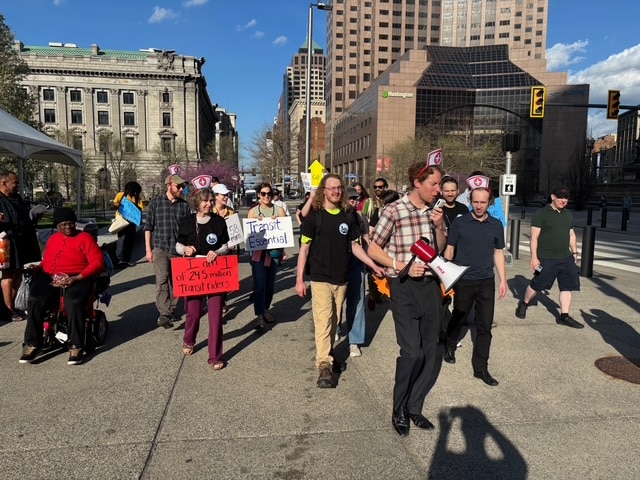
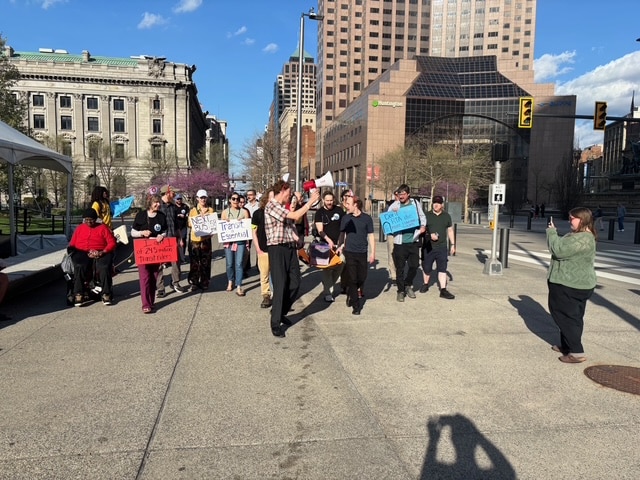
This past Monday, about 40 people gathered at Public Square in downtown Cleveland to protest the cuts and call on RTA to pass a levy. With loud chants of “Fund transit now!” and “What do we want? Public transit! When do we want it? Now!” They marched, carrying signs and a model of an RTA bus on a stretcher, to a public hearing at the RTA headquarters on W. 6th St.
Jenna Thomas, co-chair of Clevelanders for Public Transit, said the group was calling on Cleveland leaders to fund public transit and stop the service cuts that have plagued RTA since 2020, when ridership reached a low of 17.7 million annually, a number that has slowly increased over time but has never returned to pre-pandemic levels. RTA is partially funded by a 1% sales tax in Cuyahoga County, a rate that has not increased since the agency was started in 1975.
“We’re here to demand that RTA find a consistent, reliable funding stream so that we aren’t seeing continued service cuts year after year,” Thomas said. “We’ve gathered riders to show our love for public transit.”
The public has until April 27 to comment on the proposed cuts, which would go into effect in August if approved. About 25% of Cleveland residents do not have a car and rely on public transit, according to U.S. Census data. Thomas said car ownership is getting more expensive due to rising gas prices and other factors, making funding public transit even more important for people who rely on it to get around.
RTA scheduled three public hearings this week to gather feedback from the public about the proposed cuts. Comments can be submitted by attending a public meeting, completing the Public Comment Hearing Form, calling 216-621-9500, or mailing a statement to GCRTA Public Hearing Comment, 1240 West Sixth Street, Cleveland, 44113.
At Monday’s hearing, the room was full. Dozens of Cleveland residents took to the microphone, urging RTA not to cut service and to consider a levy increase to address its budget shortfall and expand service in the future. They also argued that ridership numbers could increase if RTA expands service and would continue to decline if it continues to cut service.
“It saddens me that we’re cutting service when if we actually invest in transit and pass a transit levy, we can make transit great,” said Richard Pryor III, a downtown resident. “Cleveland is a world class city and deserves world class transit.”
Another speaker, Chris Martin of Clevelanders for Public Transit, asked agency leaders, “What is RTA’s plan to get out of the transit death spiral and fund transit?” He cited the fact that Columbus passed a major transit levy in 2024, increasing the Central Ohio Transit Authority’s share of the sales tax in Franklin County from .5% to 1% and raising the overall sales tax to 8%. “When will RTA decide to fund itself?” he asked.
Cuyahoga County’s sales tax is already at 8% and RTA’s share is currently 1%. RTA has not pursued placing a levy on the ballot in the past. The agency has been managing its funding shortfall through grants, state funding and bond financing, while also weighing the risks of service cuts and layoffs.
Another speaker, a physician named Cecilia Rossi, stated that she takes care of patients who use RTA, and the service cuts being proposed negatively impact them. “Our clinics are built on transit lines and patients need transit to get there,” she said. “Our patients have enough obstacles. They don’t need more barriers to care.”
According to its website, RTA has proposed the following service reductions:
- Weekday frequency reductions
- #78: West 117th – Puritas from every 15 minutes to every 30 minutes
- #86: Rocky River Dr. – Bagley from every 30 minutes to every 60 minutes
- Weekend frequency reductions
- #3: Superior from every 15 minutes to every 30 minutes
- #10: East 105 – Lakeshore from every 15 minutes to every 30 minutes
- Route discontinuation
- B-Line Trolley
- #19B Broadway: Fargo branch
- Waterfront Line will operate for special events only
- Route realignment
- #77: Brecksville, discontinue service west of I-77, extend service to Columbia Rd
The service cuts being proposed are more modest than those initially outlined by RTA. The agency had previously proposed 12% service cuts, which was expected to save about $10 million annually. RTA found additional savings through hiring freezes, eliminating vacant positions, changing operator hiring from full time to part time and renegotiating its para transit contract.
Joel Freilich , director of service management with RTA, told the board at its March 24 meeting that the proposed changes focused on routes where ridership was relatively low and riders would be less impacted. “Geography is extremely important in how we make decisions,” he said. “It’s not just the numbers. It’s the question of, ‘If this route were not running or running less frequently, are there other alternatives nearby?’ ‘And how nearby?’ So, it’s very geographically based.”
For example, Freilich argued that eliminating the B-Line trolley downtown is being proposed not only because of lower ridership numbers, but also because removing it would have minimal impact on riders because the area is served by other nearby routes that run frequently.
He also told the board that while RTA leadership is recommending that the Waterfront Line service be eliminated except for major event days, that doesn’t mean it’s being mothballed forever. “It doesn’t mean the Waterfront Line won’t ever run,” he said. “The Waterfront Line is a tool – it’s a development tool. Cleveland leaders have been working on development plans for the lakefront. The Waterfront Line makes this more likely to occur and will service it once it opens. There’s no need to spend money now until that happens.”
RTA needs to reduce service to balance its budget and give the board time to evaluate sources of revenue, Raj Gautam, deputy general manager of finance and secretary-treasurer to the RTA board, told an RTA committee on April 7. He stated that if the board did not accept these recommendations, the agency would be faced with a much larger gap in 2028, which could then only be filled with further service reductions.
After Monday’s meeting, Frielich told reporters that the RTA board is discussing plans to place a new levy on the ballot, though no decision has been made. “It’s never been as strong a discussion as today,” he said. “There’s a debate over should we or shouldn’t we, how much and when. I’ve been here since 1991, and this is the first time I’ve seen this.”
Keep our local journalism accessible to all
Reader support is crucial as we continue to shed light on underreported neighborhoods in Cleveland. Will you become a monthly member to help us continue to produce news by, for, and with the community?
P.S. Did you like this story? Take our reader survey!