
Know Before You Vote series educates Cuyahoga County residents on how to cast a ballot this year
“There’s been a lot of chatter in this election cycle from various levels of the federal government and different organizations,” leaving voters unsure about the rules and the tallies. “We want the chatter, the chaotic conversation, to be put aside.”
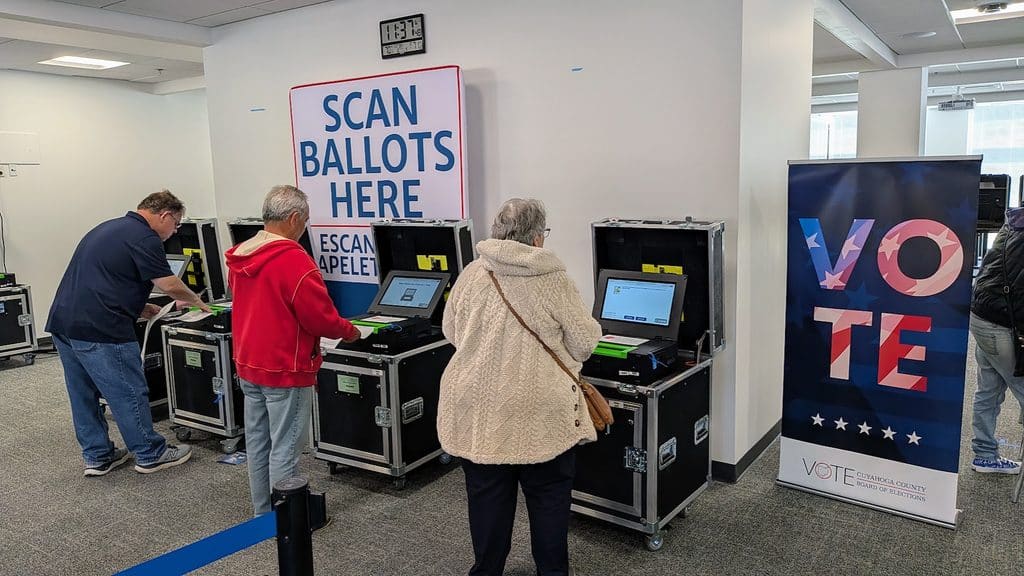
The Cuyahoga County Board of Elections is trying to cut through the confusion.
Anthony Perlatti, the board’s director, said Friday, “There’s been a lot of chatter in this election cycle from various levels of the federal government and different organizations,” leaving voters unsure about the rules and the tallies. “We want the chatter, the chaotic conversation, to be put aside.”
So the board has started a “Know Before You Vote” series of events this year, telling qualified residents how to cast ballots and reassuring them that those ballots will be securely and accurately counted.
“The more the public knows about election administration,” Perlatti said, “the more confident they are in our system of democracy.”
Since President Donald Trump’s defeat in 2020, he and supporters have falsely claimed that many votes and vote counts are fraudulent. Since returning to office last year, he has tried to impose several new requirements on voters, such as proof of citizenship, and on elections officials. But lawmakers and courts have thwarted him so far, and voting has already begun in Ohio and elsewhere for this fall’s general election under the same rules as this spring’s.
Still, Ohio has made several changes in recent years to its rules for registering and voting. Among the ones for voting are requirements for one of several kinds of unexpired photo identification cards to vote early at county elections boards or on Nov. 3, Election Day, at local polls: an Ohio driver license, Ohio ID card, interim ID form from the Ohio Bureau of Motor Vehicles, U.S passport or passport card, U.S. military ID. U.S. military dependent ID, Ohio National Guard ID, or U.S. Veterans Affairs ID. There are procedures for religious objectors to photos.
In another change, mail ballots must now reach boards by 7:30 p.m. on Election Day, no matter when postmarked.
Coping with the crush
Turnout is expected to be high this fall, with contests in Cuyahoga County for governor, U.S. senator, other statewide offices, a state amendment, county issues, judges, local measures and more. Through Monday, 8,044 people had voted at the board and 7,025 had returned mail ballots, nearly three times more than the 5,196 who’d voted through the comparable date in 2022, the last election held midway through a presidential term.
Cuyahoga’s ballots are long this year, ranging for different communities from three to four double-sided pages. So it will take longer to make and mark your choices.
“Come early,” said Perlatti. “Come prepared.” You could print a sample ballot elsewhere, fill it out, bring it to the board or the polls and copy it there. Or you could email a copy to yourself and consult it on your phone.
Peeks behind the scenes
The board staged about 10 voter education programs last month around the county. This month, it’s hosting the public four times at board facilities, showing them how ballots and mail ballot applications are processed. The first session, held Oct. 2 at the board’s 1803 Superior Ave. headquarters, focused on voting at Cuyahoga’s 269 polling sites. The second, held last Friday, focused on voting by mail and voting early at headquarters.
The third session, to be held at 10 a.m. on Friday, Oct. 23, at the board’s tabulation center, 1890 E. 40th St., is called, “What Happens When the Polls Close on Election Night.” The fourth, at 10 a.m. on Tuesday, Oct. 27, back at 1803 Superior, will be a news conference honoring National Vote Early Day.
Visitors are seeing that the board does much of its work in secure rooms, which can be entered only by a Democrat and a Republican using separate locks and keys within 10 seconds of each other. Machines do much of the work, and bipartisan staffers review it. The board has about 100 year-round workers, 300 seasonal ones and 4,000 poll workers.
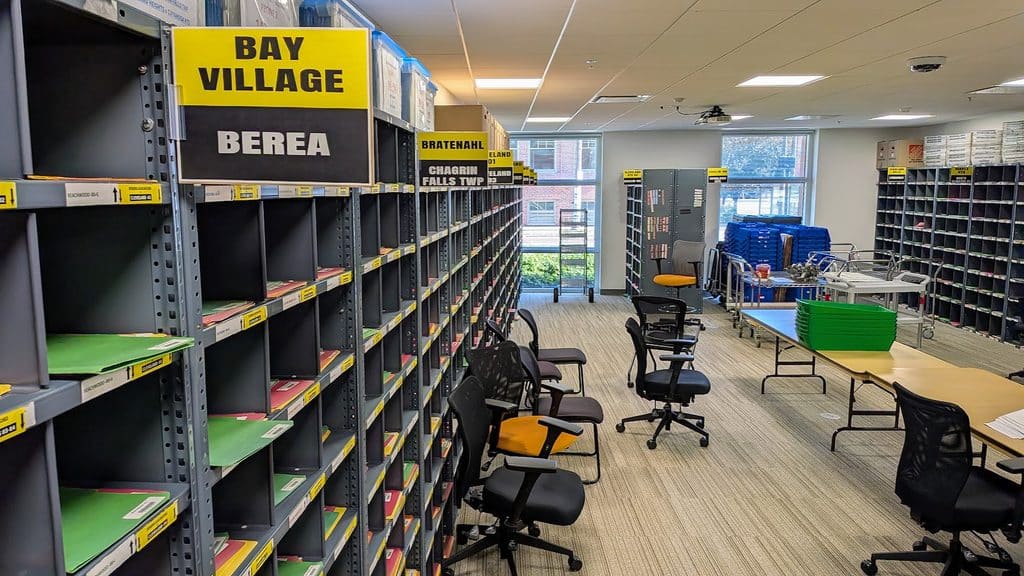
After elections, bipartisan teams audit the results. Cuyahoga has reported no mistakes since 2016, when one ballot was miscounted and another uncounted.
Last year, the board moved its headquarters to Superior from its longtime site at 2925 Euclid Ave. Perlatti said there’s much more room at Superior for early voters to line up indoors. They may enter up to 15 minutes before the day’s voting begins. Superior also has more room for staff to help voters, including a dedicated area for voters with disabilities.
Outside, between East 18th Street and East 21st Street, there are hundreds more parking spaces than before. They’re in a surface lot off Rockwell Avenue and on the second floor of a garage off St. Clair Avenue.
The board has moved its ballot drop box to that surface lot and given it a second opening on the opposite side from the first, so two cars can pull up at once. The box is available around the clock until 7:30 p.m. on Election Day. It is under constant video surveillance that the public can watch. A bipartisan team empties the box at least daily.
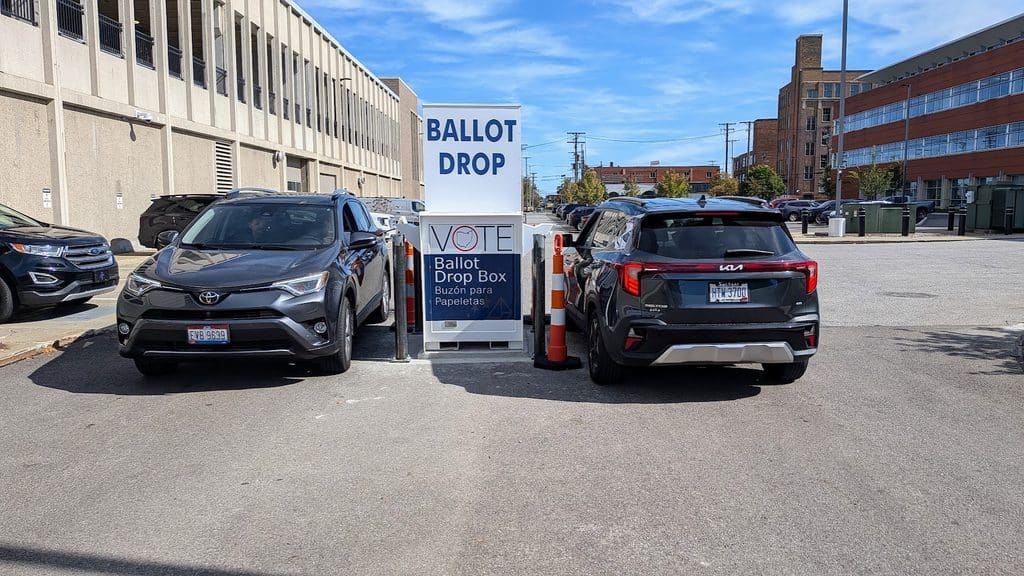
“It’s a tank,” Perlatti said. “It’s a quarter inch of steel. If a car hits it, the box is staying and the car’s getting towed away.”
That video camera and others around board properties alert county deputies to any problems. There’s also somewhat inconspicuous security at the properties, Perlatti said. “We don’t want people to be intimidated, but we want them to be safe.”
Asked about Cuyahoga’s public events, Jen Miller, head of the League of Women Voters of Ohio, said, “I love it when boards of elections conduct voter education, because confusion is the number one deterrent to turnout.” She thinks Ohio should fund more such work.
Jacob Shanklin of Northeast Ohio Voter Advocates, wrote in a message, “Cuyahoga County BOE has done an excellent job of preparing and will ensure this election is safe and secure. Voters should feel confident in casting their ballot in whichever method they choose.”
When and where to vote
The registration deadline for this election has passed. If you’ve changed your name or address but not yet updated your registration, you may vote a regular or provisional ballot early at the board or on Election Day at the polls with certain documents.
Your application for a mail ballot must reach your board by 8:30 p.m. on Oct. 27. Perlatti urges you to apply as soon as possible. You can print an application form from the Ohio Secretary of State’s website, or get one from your county board. You can return it by mail or in person.
If you can’t be sure that your mail ballot will reach your board by the close of Election Day, you may vote provisionally at your polling place that day. You may also vote provisionally there and then if you fail to bring the required identification, but you’ll have to bring it to your board from 8 a.m. to 5 p.m. during the following Wednesday through Saturday.
You can use Track My Ballot to check on your mail ballot application, that ballot itself or your early vote in person. The site shows when applications and ballots have been received, and whether there’s any problem with them. The board will also notify voters by mail of such problems.
This fall’s early voting at boards is continuing from 8 a.m. to 5 p.m. on weekdays this week and next. It will also take place from 8 a.m. to 4 p.m. on Saturday, Oct. 24; from 7:30 a.m. to 7:30 p.m. on Monday, Oct. 26, through Friday, Oct. 30; from 8 a.m. to 4 p.m. on Saturday, Oct. 3; and 1 p.m. to 5 p.m. on Sunday, Nov. 1.
On Election Day, as always, neighborhood polls will be open from 6:30 a.m. to 7:30 p.m.
Voters with questions or problems may contact their elections board. Cuyahoga’s is at 216-443-8683(-VOTE). They may also call the nonpartisan Election Protection hotline, 866-687-8683 (OUR-VOTE).
Will the election be held and honored?
In 2020, Trump promoted and keynoted an election protest that became a deadly attempt at a coup. This year, many critics worry that the president has hinted about interfering again.
But the League’s Miller said, “I don’t think the federal government will interfere. If it does, the courts and grass roots groups will defend the rights of the people.”
Keep our local journalism accessible to all
Reader support is crucial as we continue to shed light on underreported neighborhoods in Cleveland. Will you become a monthly member to help us continue to produce news by, for, and with the community?
P.S. Did you like this story? Take our reader survey!
Related Articles


The cost of drugs from Canada is set to soar for millions of Americans because of a federal rule
Millions of Americans who buy cheap drugs from Canada could soon lose access due to a new customs rule.
A gut punch in Ohio: Nearly 1,400 laid off at truck factory just days before Trump rally
The November midterms are a test for the working-class coalition that lifted Trump into the White House and gave Republicans control of Congress. The outcome will be decided in places like Ohio.


