The eerie tales of Erie Street Cemetery
These are some of the stories of notable persons buried at Erie Street Cemetery.
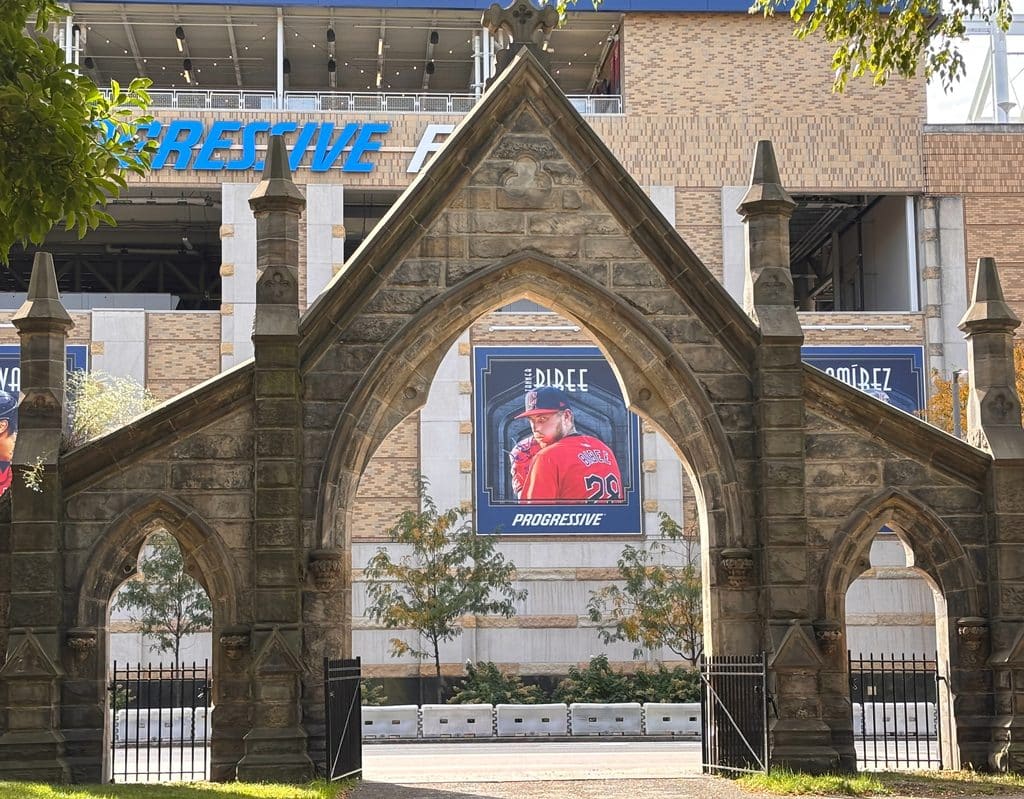
The Cleveland Guardians were a rightful focus of local news coverage in October. However, as daylight fades away and we embrace the spookiest time of year, it is the team’s unassuming neighbor that deserves attention. Directly across East 9th Street from Progressive Stadium lies Erie Street Cemetery, the oldest remaining cemetery in the city of Cleveland. Do a little digging into the cemetery’s (pun intended) history and you will find a host of macabre and ghastly stories to fill your darkening autumn evenings.
The History of the Burial Ground
Prior to 1826, Cleveland’s deceased were buried in an informal burial ground just south of Public Square. Eventually, in response to the Cleveland’s growth, the city entered into an agreement with Leonard Case to purchase an 8-acre plot of land along Erie Street (now called 9th Street) for $1 with the agreement that the land would be used solely as a burial ground.
Four-year-old Minerva White was the first to be buried in Erie Street Cemetery. Little Minerva’s father, Deacon Moses White, was influential in the early religious life of Cleveland and helped to found the city’s first religious school. Minerva was White’s third child, and the second to die – more would follow her to the grave.
By 1836, the use of the land bought from Leonard Case had expanded and the city erected a gunpowder magazine, poorhouse and hospital on the grounds. This breach of contract resulted in legal battles with Case’s heirs.
If history truly repeats itself, then the story of Erie Street Cemetery is unmistakable evidence of this: as Cleveland grew, the relatively short distance between the cemetery and the city center again became an issue.
In 1904, Mayor Tom L. Johnson directed the exhumation and reinterment of many of the graves to accommodate the construction of more city streets. A report from 1918 documented that 3,757 bodies were removed to other local cemeteries, primarily Woodland Cemetery. In response to this assault on the peaceful rest of the city’s dead, a group of Clevelanders formed the Pioneers’ Memorial Association which worked to protect the historical burying ground that remains today. Their work was responsible for the wide curving highway bridge that bypasses the cemetery – the original plans would have involved building right through it, which would have paved the way for witty comments about Proverbs 7:27 (the “highway to the grave, leading down to the chambers of death”) and cringy jokes about which part of the highway is the real Deadman’s Curve. Alas, it was not to be.
The Carters
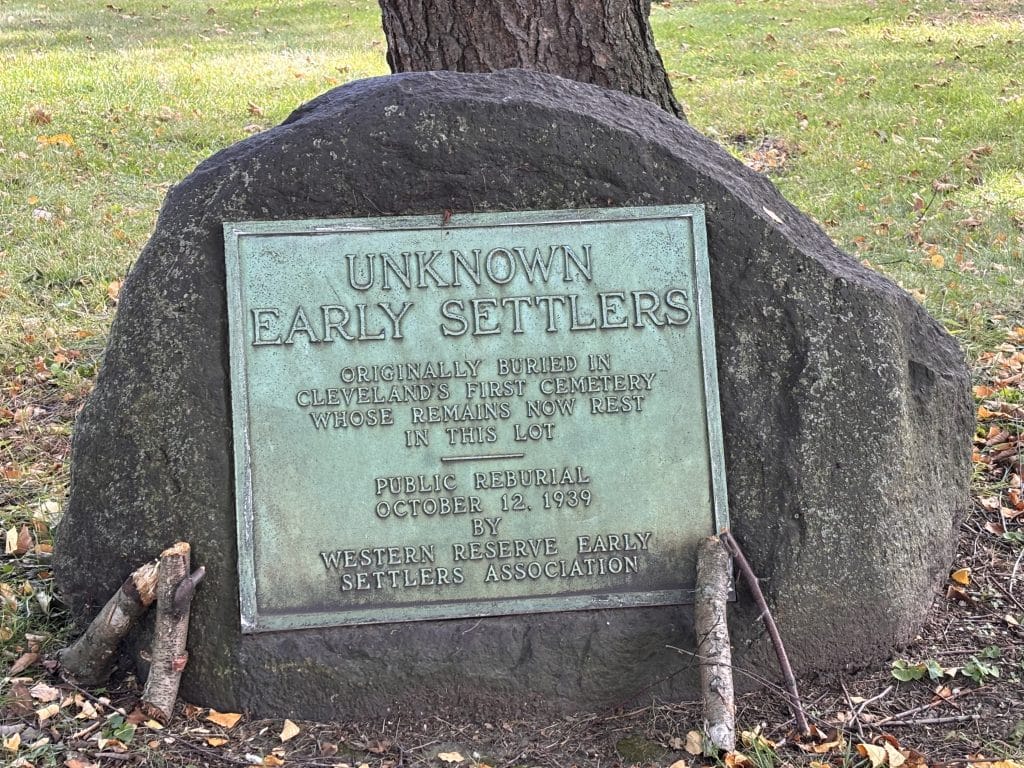
Because many of the first burials in the cemetery were reinterments of remains that had been moved from Cleveland’s earlier burial ground, the Erie St. Cemetery became the final resting place for many of Cleveland’s earliest non-native residents. Most of these have unmarked graves but are honored by plaques dedicated to “Those Whose Bodies Were Moved From Ontario Street Cemetery to Erie Street Cemetery” and the “Unknown Early Settlers.”
The first permanent white settlers in Cleveland do have marked graves, however. Lorenzo and Rebecca Carter left Vermont and arrived in Cleveland the year after Moses Cleaveland surveyed the city. The couple built a log cabin which they used as an inn and, eventually, a jail because sleeping among criminals is always a guarantee for a good night’s sleep.
It is not clear why the Carter family decided to brave the mosquito ridden, swampy Cleveland that other families quickly fled; however, their time in the city was a full one. Lorenzo operated the Superior St. ferry across the Cuyahoga, establishing the first tavern in the city, hosted Cleveland’s first social dance, owned a 30-ton Lake Erie schooner for commercial purposes, farmed a large plot of land west of the Cuyahoga River, ran the first log warehouse in the city, and served as a constable and a major in the state militia.
Together, Lorenzo and Rebecca had three boys and six girls. They lost two children as infants and suffered the tragic drowning of their son, Henry, in the Cuyahoga River when he was just 10 years old.
Chief Joc-O-Sot
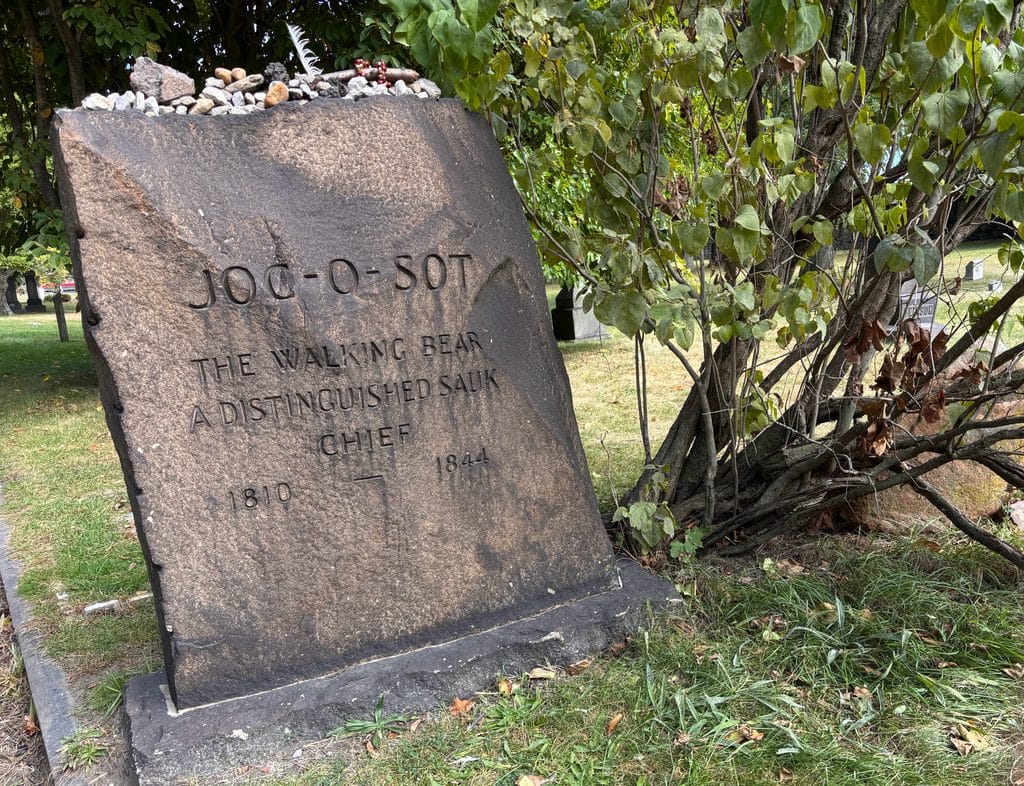
Perhaps the most famous resident of Erie Street Cemetery is the Mesquakie Chief Joc-O-Sot who journeyed to Cleveland in the 1830s after fighting in the Black Hawk War with his tribe. However, Chief Joc-O-Sot was not ready to settle down here and instead joined a touring theater troupe. The troupe’s patron convinced Joc-O-Sot to travel to England where he made such an impression on Queen Victoria that she commissioned the painting of his portrait. Shortly after this coup, he became ill – likely with tuberculosis – and returned to Cleveland where he died in 1844.
Local lore says that his restless soul cannot rest even in death, as is evidenced by his split gravestone. It also suggests the Chief has been instrumental in the disappointments that have plagued the Guardian’s baseball fans.
More chilling than these ghost tales, however, is this statement in the Encyclopedia of Cleveland History: “… although the record is unclear, it is probable that Joc-O-Sot’s remains were taken from his grave and used for medical experimentation, a practice that was all too common during the 1840s.” This theory seems to be based upon an 1848 article in the Cincinnati Enquirer which claimed that Joc-O-Sot’s remains were brought to Cincinnati by a medical student. Admittedly, this is a morbidly plausible tale, not just because his grave was erected with the help of “a friend of Cincinnati.”
In early Cleveland, bodies were a coveted – and poorly regulated – commodity. According to the Dittrick Medical History Center at Case Western, bodysnatching was unavoidable in the early medical field. Untrained medical students needed hands-on experience and no one wanted to be the recipient of their surgeon’s very first incision. The logical solution was – and is – to allow medical trainees to “practice” and “explore” using deceased bodies.
Problematically, the loved ones of the newly deceased were rarely willing donors of these much-needed bodies. Bodysnatching provided a viable source of inviable bodies.
Of course, when family members discovered that their dead were no longer resting peacefully in their family plots, they were outraged. In fact, riots broke out in cities across the nation, including Cleveland, targeting medical students, instructors and participants in the lucrative bodysnatching industry.
In between these protests, however, it seems that bodysnatching continued. To minimize potential backlash, snatchers (also called resurrectionists), targeted the bodies of the poor and ethnic minorities, which aligns with rumors about the snatching of Chief Joc-O-Sot’s body.
Gamaliel Fenton
A little more than 50 years after the founding of Cleveland, a lesser-known character, Gamaliel Fenton, arrived. Fortunately for inquiring historical minds, his story was inscribed on his gravestone. Though he was 70 at the time of his arrival in the city, in his younger years, Fenton had served in the Revolutionary War and the War of 1812.
Unfortunately for Fenton, during the early days of Cleveland, cholera was a recurring and disgusting problem. In Ohio, the disease tended to spread along the canals, though at least one outbreak began on a military ship docked in Cleveland.
The disease was fatal in up to 50% of cases and death was swift but brutal. Victims died of dehydration resulting from profuse diarrhea (incidentally, like the Guardians, diarrhea has required significant news coverage this year). Those sick with cholera experienced vomiting, muscle cramps and dangerous drops in blood pressure.
In 1849, Fenton contracted the disease and died a horrible, but hopefully rapid, death during an epidemic in the city. At the time, medical professionals were still trying to figure out what caused the illness, which had historically been attributed to bad air or vapors caused by decaying matter. The latter of these two theories makes a lot of sense when you consider how much time doctors were spending with decaying matter due to the aforementioned bodysnatching networks they created.
Tragically for Fenton and countless others, the theories of free black Cincinnatian, Henry Boyd, were ignored: 17 years before Fenton’s death, Boyd proposed that cholera was spread through unclean drinking water and suggested it could be avoided by boiling the water.
Thankfully, ignoring a Black man who could have helped to avert tragedy is a mistake that Clevelanders would never make again, right? Wrong and, like Fenton, some of the victims impacted by another such blunder – the failure of the city to stock Garrett Morgan’s gas masks prior to the 1916 Cleveland Waterworks Tunnel Disaster – were also buried in Erie Street Cemetery.
Victims of the Griffith Disaster
A year after Fenton’s death, a mass casualty event rocked the northern coast of Ohio when, on June 17, the steamship G.P. Griffith went down in what was one of the worst disasters in Lake Erie history.
The boat, which launched in 1847 and primarily served as transportation for immigrants seeking their fortunes in the west, caught fire while seven miles from the shores of Lake Erie. The burning ship tried to sail to safety but struck a shoal about half-a-mile from the Willoughby shoreline.
Desperate and unable to reach land, the passengers flung themselves into the water, trying to escape the flames. Tragically, many were unable to swim and those that could are believed to have been weighed down by coins that were sown into the hems of their clothes for safekeeping.
The victims’ bodies eventually washed up on the shores of the lake – many were never identified. The disaster cost the lives of at least 250 people, though recent estimates place the number of dead at 286.
According to an article published by the Lake County Genealogical Society, at the time of the tragedy, an intense period of heat made it necessary to hastily bury the bodies. Thus, many of the poor souls (including 25 children) were buried in a mass grave at Willoughby which was eventually reclaimed by the lake.
Other victims were transported to Cleveland on rescue vessels and later buried in a mass grave in the Erie Street Cemetery.
The Melvins
At the time the G.P. Griffith sunk, Cleveland was a hotbed of abolitionist activity. In fact, several residents of Erie Street Cemetery are thought to have taken part in the Underground Railroad since Cleveland, code named “Station Hope,” was a major stop on the escape route. According to Cleveland Historical, escaping enslaved people who reached Cleveland were transported east toward Buffalo, west toward Sandusky, or picked up by Lake Erie steamers and ferried across the lake to freedom.
John Malvin is one of Erie Street Cemetery’s residents who is thought to have worked on the Underground Railroad. Malvin was born in Virginia in 1795 to an enslaved father and a free mother. He trained as a carpenter and settled in Cleveland where he worked as a Baptist preacher, cook, sawmill operator, carpenter, joiner and canalboat captain.
Malvin and his wife, Harriet, worked with fellow graveyard resident, Moses White, to found the First Baptist Church of Cleveland and their involvement ensured that the church was unsegregated.
Not surprisingly, given his devotion to abolition, John Malvin helped to organize a Black regiment that fought with the legendary 54th and 55th Massachusetts regiments during the Civil War. The 54th regiment, which fought under Col. Robert Gold Shaw and was the first Black unit to be officially recognized, was immortalized in the 1989 film “Glory.”
Malvin, known as “Father John,” is best known for his work in promoting Black Ohioans’ access to education and fighting Ohio’s Black Laws. These laws, which were enacted in the 1800s, barred Black Ohioans from voting, testifying against white defendants in court, holding office, serving in state militias, being assigned jury duty and attending public schools. They also required Black Ohioans to pay a fee to settle in the state and to register a certificate of freedom before legal employment.
Civil War Veterans
Despite the dark history of Ohio’s Black Laws, when war came, only two other states offered more of its men in service to the Union Army.
Erie Street Cemetery records show that 98 Civil War Veterans are buried within its walls. Perhaps this is why some unverifiable websites about Cleveland tell stories about visitors hearing the ghostly sound of marching boots that seem to drown out the noise from the surrounding city.
Among the Union veterans, two stand out: Jabez W. Fitch and Peter Hoffman.
Jabez Fitch was born in 1823. An attorney, he became the Commandant of Camp Taylor which was the first of seven Civil War camps in Cleveland that served as a base for “rendezvous and training.” The camp, which was in the vicinity of what is today the Cuyahoga Community College (Tri-C) Metro Campus, served as a training base for the 107th Ohio Volunteer Infantry Regiment, which was imaginatively called the 5th German Regiment due to the numerous German men enlisted in it.
The 107th had a colorful career during the war, defending the Capital City, destroying the Charleston & Savannah Railroad and participating in the battles of Fredericksburg, Chancellorsville and Gettysburg. In fact, a monument to the regiment was erected on the battlefield at Gettysburg. The regiment lost 57 men in battle and 76 men to disease. This sounds like a poor record until you realize that, until the introduction of vaccination and improved medical technology, in most wars, disease killed more men than combat. During the Spanish-American War, for example, there were nine-times more deaths from disease than from battle wounds.
Dr. Charles Hartman, one of the 107th’s battle casualties, wrote a moving letter to his wife just before his death which offered her advice on financial matters and asked her to “educate our children to be good and useful.” The letter was later published and is still available to read today.
After the war, former Commandant Jabez Fitch sold real estate in Cleveland and became the president of the Cleveland Society for the Prevention of Cruelty to Animals (now the Cleveland Humane Society) in 1873. In 1874, he was named the president of the Ohio Humane Society.
Perhaps it is his legacy of love for animals that contributes to the abundant wildlife in the cemetery: during autumn afternoons, visitors to the graveyard enjoy watching the antics of at least two groundhogs and glimpsing an array of birds resting after their migrating flight across Lake Erie.
In comparison to Jabez Fitch, much less has been recorded about Peter Hoffman. His story is worth telling, however, because of the captivating inscription on his gravestone: “Wounded in Action at Gettysburg.” Hoffman evidently survived his wounds and, according to burial and death records, lived until 1906 when, at the age of 65, he died from “organic heart disease” in Louisville, KY. His body was returned to Cleveland, presumably so that he could be buried with his wife who predeceased him by four years.
Cleveland’s Newsie
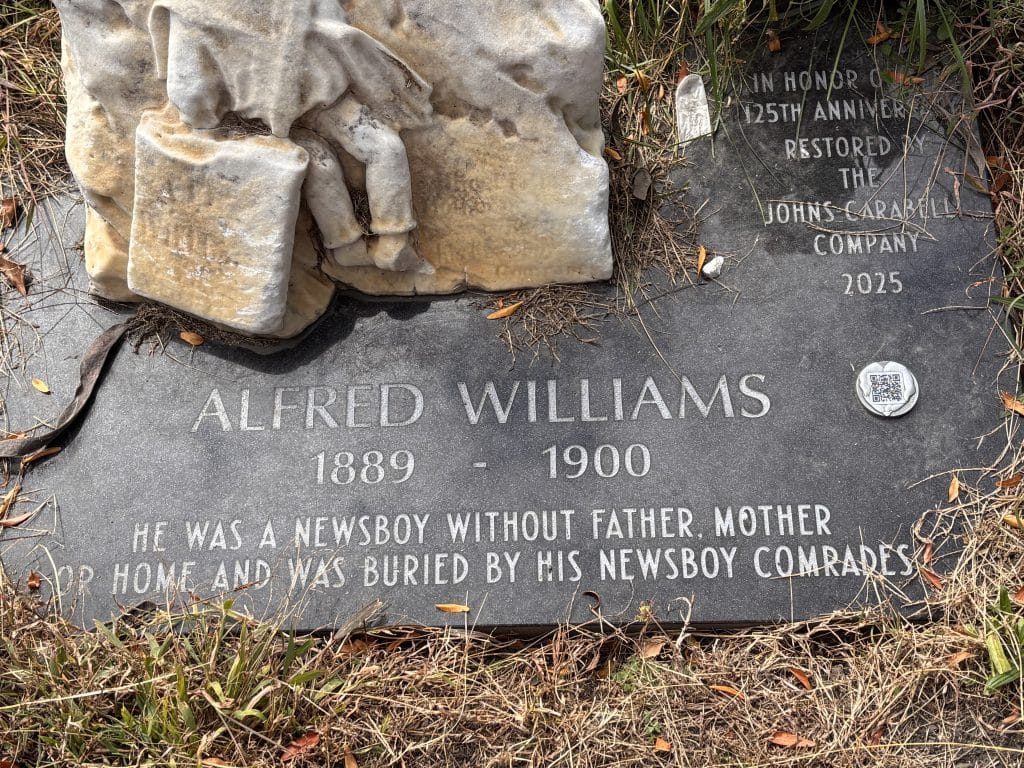
Six years before Peter Hoffman’s death, one hundred “newsies” gathered for the funeral of 11-year-old Alfred Williams.
Starting in the 1830s, news agencies sold copies of their papers to young, impoverished boys – “newsies”– who were tasked with reselling the papers to passersby. When they sold enough to cover the cost of the papers, the boys made a small amount of money. It was an extremely difficult life – many of the boys lived on the streets and worked late into the night.
In the years prior to Williams’ death, newsies in several other cities went on strike in response to the rising cost of newspapers which ate into their already meager earnings.
It was against this backdrop that Williams reportedly took his own life by eating rat poison, though the chaplain who conducted his funeral expressed doubt that the death was self-inflicted. Either way, Williams was poisoned with Rough on Rats, which contained arsenic.
According to a Plain Dealer article, Williams’ fellow newsies raised $105 to cover the cost of his funeral and to erect a gravestone. They escorted his body from the undertaker’s to the grave “their ragged caps were taken off and the body was lowered to its last resting place,” in Erie Street Cemetery.
Last year, the Johns-Carabelli Company restored the stone in honor of the 125th anniversary of Williams’ death. The new stone laid beneath it reads: “He was a newsboy without father, mother or home and was buried by his newsboy comrades.”
Chief Thunderwater
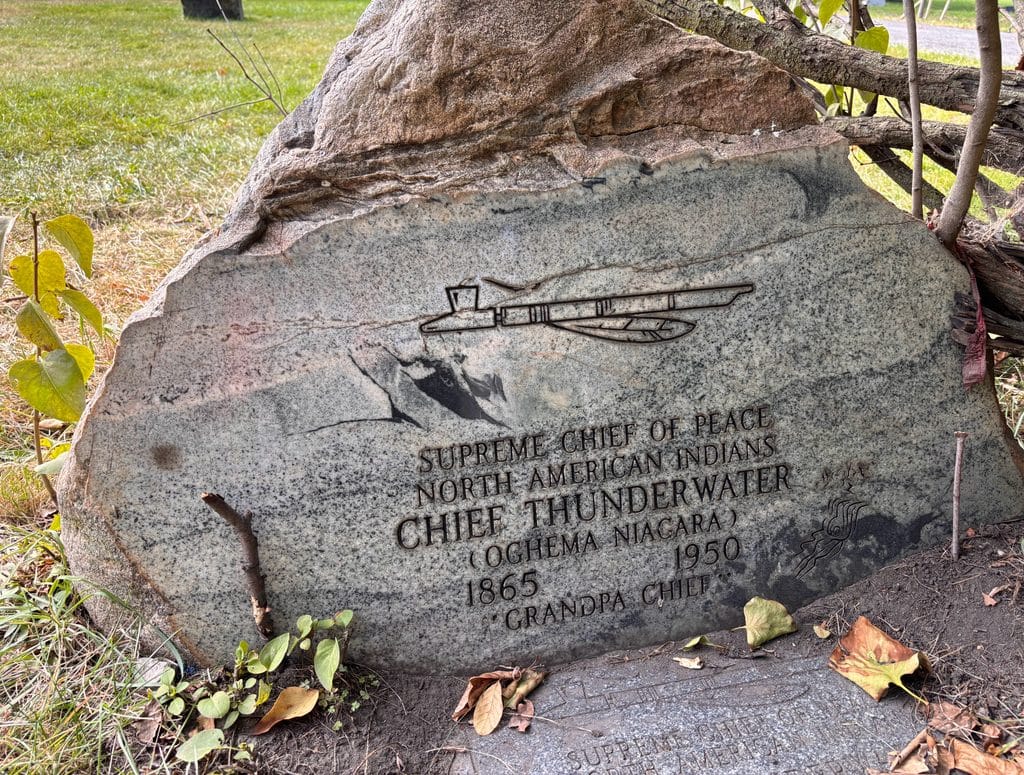
There is one more resident of Erie Street Cemetery who we have space to mention: Oghema Niagara, also called Chief Thunderwater (the Seneca name for Niagara Falls has been translated to “the thunder of the waters”).
According to legend, Chief Thunderwater was born beside the Niagara River in 1865 to a father who was Sauk/Ojibwe and a mother who was the daughter of a chief of the Seneca Nation. His parents were entertainers and Chief Thunderwater himself became a performer in Buffalo Bill Cody’s Wild West Shows.
In 1880s Buffalo, NY, a controversial decision was made to transfer the bodily remains of Seneca orator Red Jacket. This decision and the resulting reinterment spurred Chief Thunderwater’s lifelong interest in activism on behalf of Indigenous people. He settled in Cleveland, where he started a company and founded an amateur baseball team: the Thunderwaters.
The Thunderwater home at 6716 Baden Court became a place of refuge and aid for Indigenous people from all tribes. To protect the rights of the Seneca and Tuscarora people and to push back against assimilation policies, Chief Thunderwater started the Council of Tribes which eventually expanded into Canada to support the rights of Indigenous people there. As a result of this activism, the Canadian government did what politicians often do and, instead of addressing his concerns, actively worked to defame his character. Similarly, when Chief Thunderwater began work on an educational publication about Indigenous people, opponents in Kentucky spread rumors that he was a fraud. Not one to be deterred, Chief Thunderwater fought this slander with a $250,000 libel lawsuit against the Louisville Times. After two years of fighting in court, the lawsuit was apparently settled out of court.
While Thunderwater’s influence was far reaching, he did much to promote Indigenous rights and culture closer to home. He was an active member of the Early Settlers Association of the Western Reserve and he often dressed in traditional attire when attending events around the city of Cleveland. He was also a passionate protector of the Erie Street Cemetery, in a large part because he wanted to preserve Chief Joc-O-Sot’s grave. In fact, he held an annual ceremony by Chief Joc-O-Sot’s graveside.
As previously mentioned, Cleveland legend holds that Chief Joc-O-Sot’s influence has hindered the Guardians’ performance in years past. Perhaps this legend is missing an important protagonist given Thunderwater’s interest in baseball during his lifetime and his vocal support of the team that we now call the Guardians. A new legend could be told of two great chiefs who are locked in an eternal battle beside Progressive Field: Chief Joc-O-Sot thwarts the Guardians at every turn and Chief Thunderwater does his best to aid them. According to this telling of the story, this year the chiefs’ contest was a close call.
We're celebrating four years of amplifying resident voices from Cleveland's neighborhoods. Will you make a donation to keep our local journalism going?
Author

Related Articles

The Movie Nerd Report: Spooky movies showing around Northeast Ohio on Halloween weekend
There are plenty of spooky screenings this Halloween weekend.

The Movie Nerd Report: 3 film festivals this week in Northeast Ohio
Plus, see what other new releases and classics are playing at independent theaters around you!
Walking Cleveland’s past, one story at a time
“How much of Cleveland do I pass by without knowing the story?”