
City council candidates make the most of low, but better than usual, voter turnout
As election day voters headed to their polling locations, The Land caught up with city council candidates in four of the city’s hotly contested council races. Here’s what we saw.
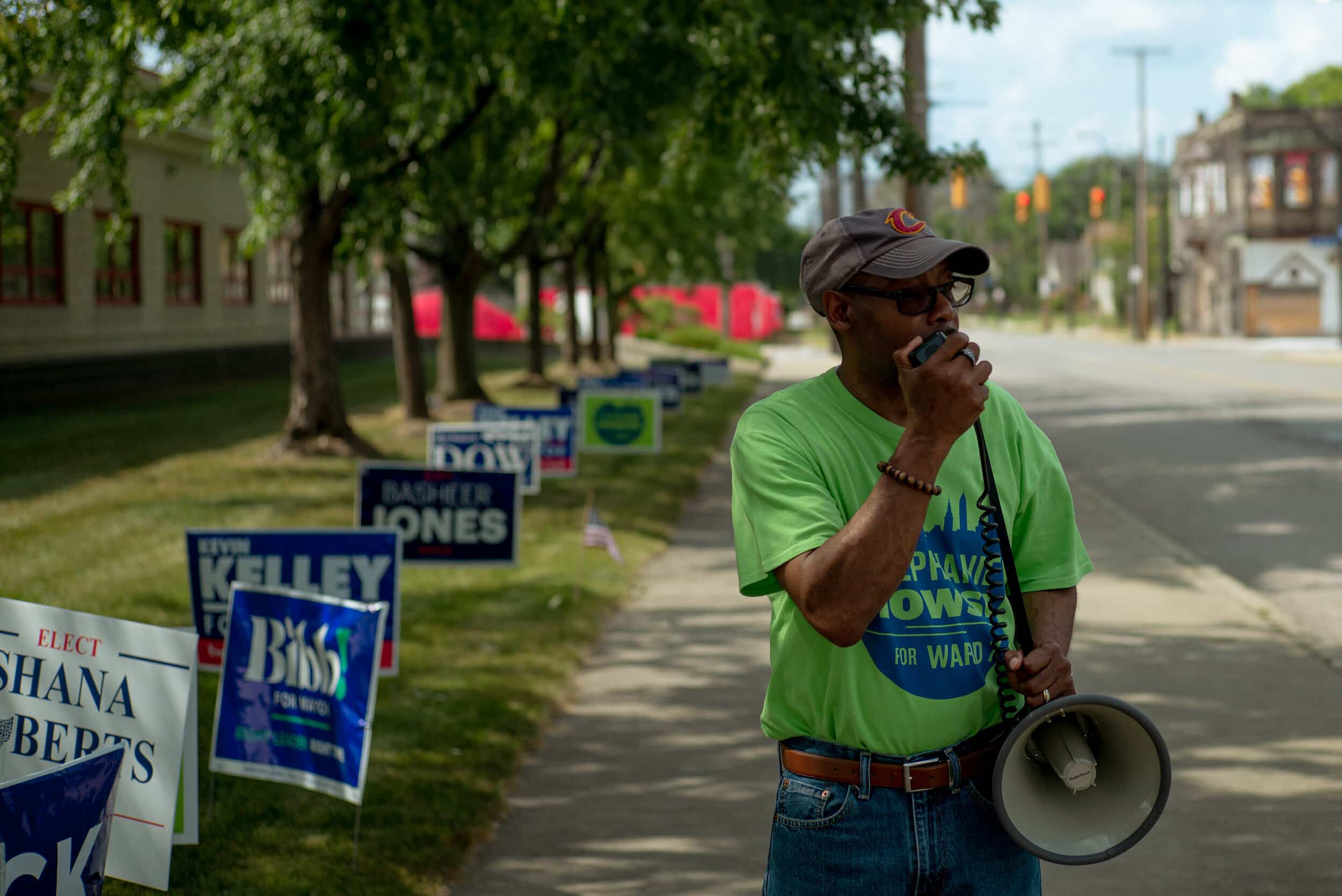
Clark Nelson calls out, “Vote for Stephanie Howse” in his megaphone at the Fatima Family Center in Ward 7 on Tuesday, Sept. 14, 2021. Photo by Michael Indriolo
Mail ballot counts may have soared past where they lagged in 2017, but in-person voters on primary day seemed scarce. Candidates, however, remained active as ever.
Although the spotlight has shined on Cleveland’s mayoral election, several city council races have garnered competition rarely seen in our local elections. The Land caught up with some of the city council candidates in those competitive races as they bounced around polling stations.
All turnout percentages were taken at this article’s publication. Check out live vote counts at the Cuyahoga County Board of Elections website. And check here for the board’s unofficial results.
Ward 4 | 17.7% turnout | Unofficial winners: Deborah Gray and Erick Walker
Ward 4’s city council seat, which represents Shaker Square and portions of Buckeye-Shaker, Woodland Hills, and Mount Pleasant, was left open after veteran council member Ken Johnson’s flurry of legal trouble earlier this year. His name remains on the ballot, but 10 other candidates rose up to challenge him.
Four of those challengers, Erick Walker, Deborah Gray, Mario Snowden and Cecil Ekechukwu, all gathered at the Zelma George Recreation Center in the early afternoon to talk to prospective voters as they gradually but steadily streamed in. One volunteer who had been at the polls since the early morning said that he’d only seen about 50 voters as of 11:30 a.m.
Ekechukwu said that, although in-person turnout had been “dismal” throughout the morning and early afternoon on primary day, he felt good about his campaign. He made sure to personally knock on every single door in the ward, he said.
“When I ran in 2017, I didn’t do that,” he said. “I said, ‘This time, I’m gonna leave everything on the table.’”
For Snowden, the spotty turnout meant more time to sway voters. He spent the better part of a half hour listening to Ken Bender as he voiced frustration at how systemic racism has played a fundamental role in leaving his ward and the entire east side in the dust.
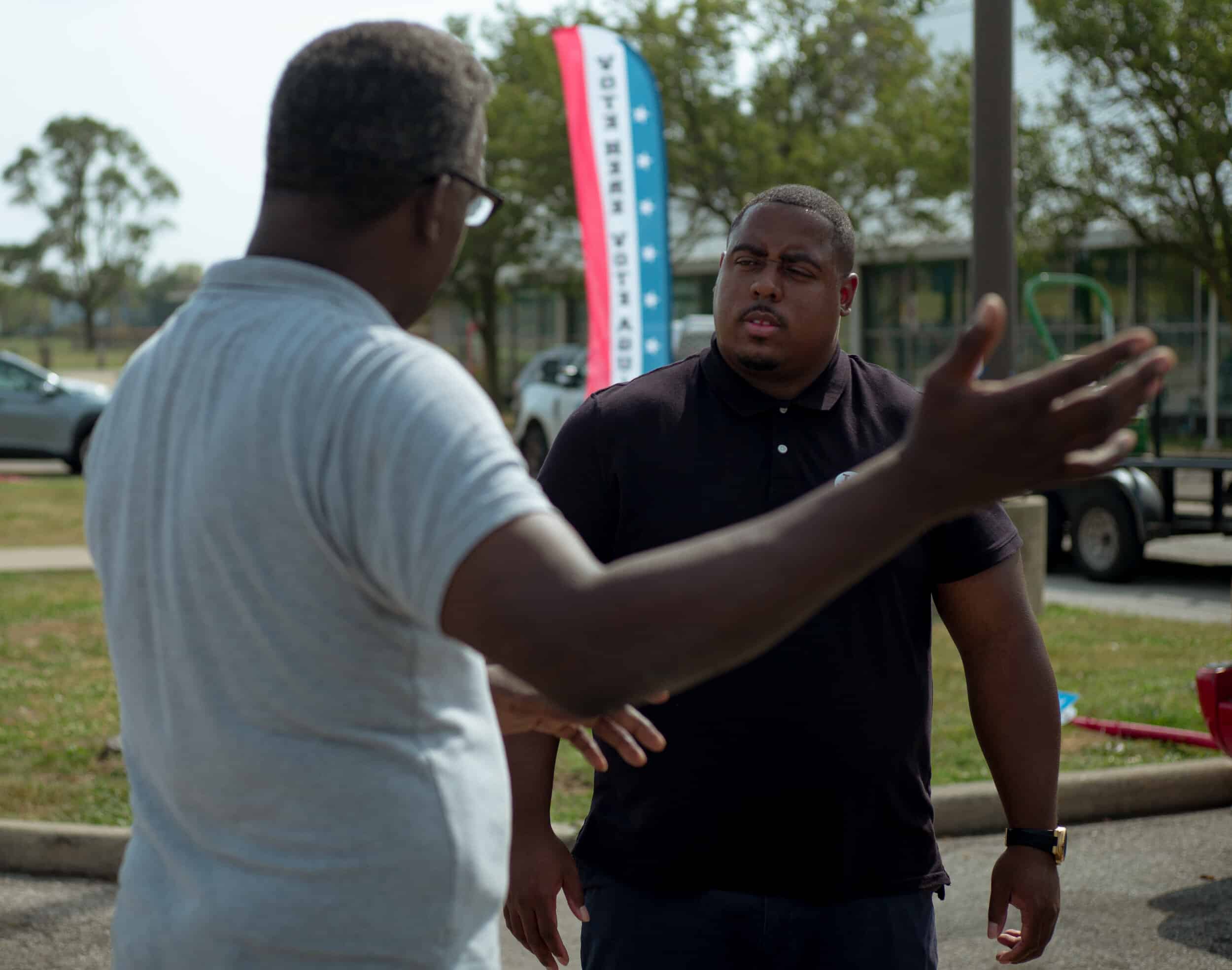
Ken Bender speaks with Ward 4 city council candidate Mario Snowden in the parking lot of the Zelma George Recreation Center in Ward 4 on Tuesday, Sept. 14, 2021. Photo by Michael Indriolo
“Racism has denied us the opportunity of having a nice neighborhood,” Bender said. “This community right now has put probably $20 million in these banks. How many loans have these banks gave to people in this community?”
Snowden listened so intently that, at one point, he let a bee land on his face without so much as flinching.
“The residents and citizens who really engage with you, who really go back and forth and talk to you, those are the ones that are here right now,” Snowden said. “So it just lets me know that we have to make sure that we reach those residents who aren’t as engaged or who feel something, but they don’t know the outlets to be able to speak to.”
That seemed to be the common thread among the four candidates at the rec center in the afternoon: None shied away from long conversations that many times proliferated into what seemed more like listening sessions. Ward 4’s residents raised a litany of concerns from drug dealing and gang activity to lackluster schools and a need for job training programs.
“If you look around this neighborhood, it looks like somebody done dropped a bomb down here,” said David Brewton, an assistant pastor at Golgotha Baptist Church in Kinsman. He said that, in his ward, Gray stood out as the only candidate “worthy” of public office.
“The unemployment rate is high. The crime rate is high. I’m one of the few people that’s in Zelma George [Recreation Center] every day working with the youth, making a difference with the youth.”
Johnson took advantage of his name recognition, and as the years went on, he and other establishment politicians in Cleveland who once championed for-the-people tenors grew shrewdly selfish, said one volunteer for candidate Mike Shomo. Now, the volunteer said, the challenge is getting Ward 4’s young people engaged in politics and hopeful for the future.
Regardless of whether Ward 4 elects a young newcomer like Walker or an older, more experienced candidate like Gray, replacing Johnson after his more-than-40 year tenure won’t be easy for whoever takes the reins.
Ward 7 | 12.8% turnout |Unofficial winners: Stephanie Howse and TJ Dow
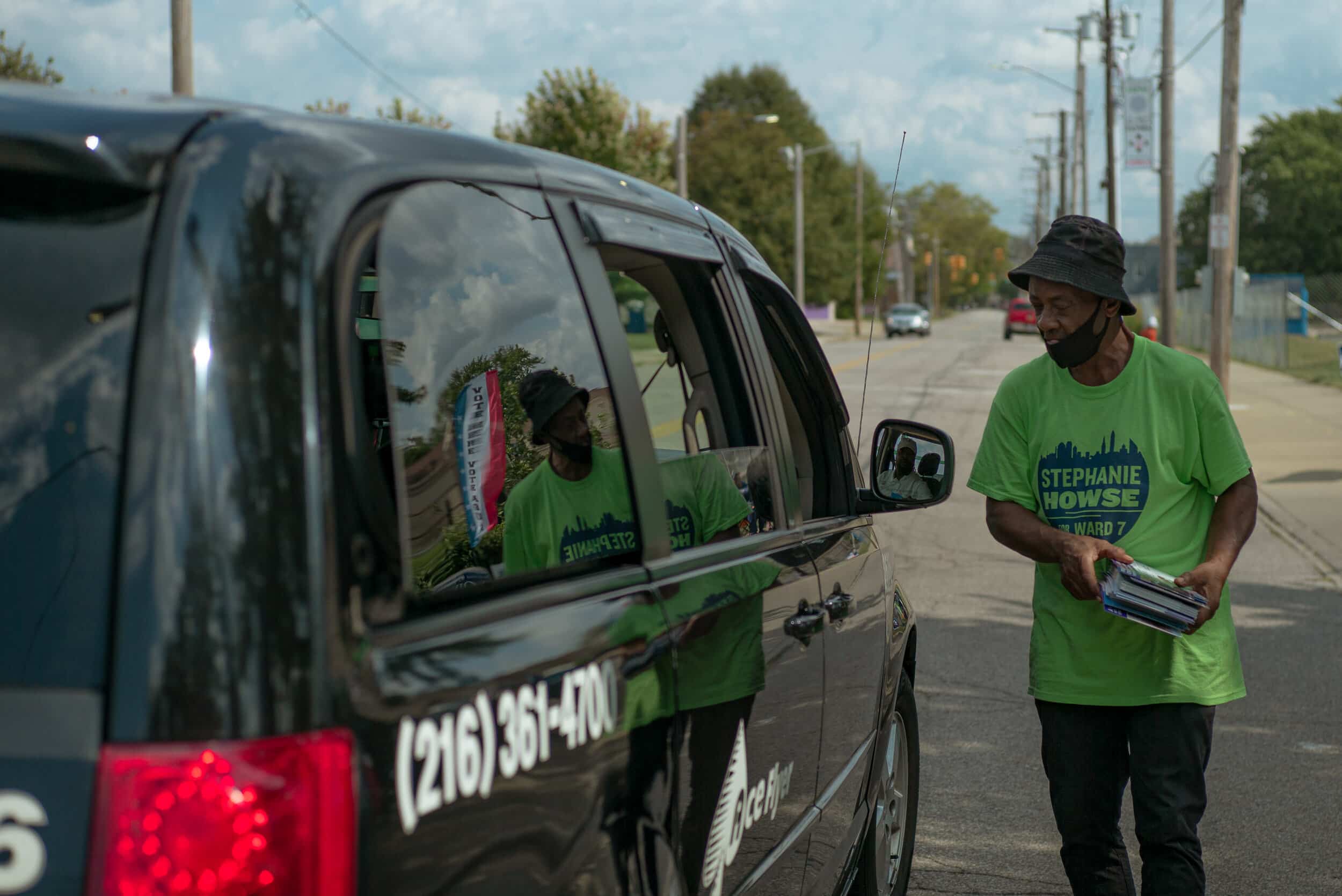
Delvin (Curtis) Brantly hands out Stephanie Howse flyers to passersby outside the Fatima Family Center on Tuesday, Sept. 14, 2021. Photo by Michael Indriolo
The city council race in Ward 7, which comprises the Hough district as well as neighborhoods in St. Clair-Superior, Midtown and Asia Town, also features an open and crowded race of 11 candidates vying for the seat Basheer Jones vacated when he pivoted toward a mayoral bid.
Candidates popped in and out at the Fatima Family Center which has stood out as a popular Ward 7 polling location for years. Dozens of campaigns colored the treelawn in blues, purples and reds as the recurring chorus, “Vote for Stephanie Howse,” rang out through the only megaphone there.
Yet even at what was known as the place to vote in Ward 7, turnout felt thin throughout the afternoon. Campaign volunteers swarmed passersby with pamphlets and postcards. The center’s parking lot was nearly always full, and plenty of community members came and went, but voters coming out consistently said they’d seen almost no other voters at the polls inside.
Ward 7 city council candidate Daniel Graves, a returning challenger, showed up at the center in the afternoon. He started his day at 4:30 a.m., he said, with meditation and prayer. As he worked the polls throughout the morning and afternoon, the number of voters who recognized him had been encouraging, he said (as he said that, a voter walking by dapped him up and said he’s got his vote).
His campaign had knocked on 3,000 doors of those in his ward with voting records. Like many new candidates, he focused on fostering the kind of quality one-on-one conversations that sway reliable voters. He also aimed to get millennials and other younger generations engaged in politics.
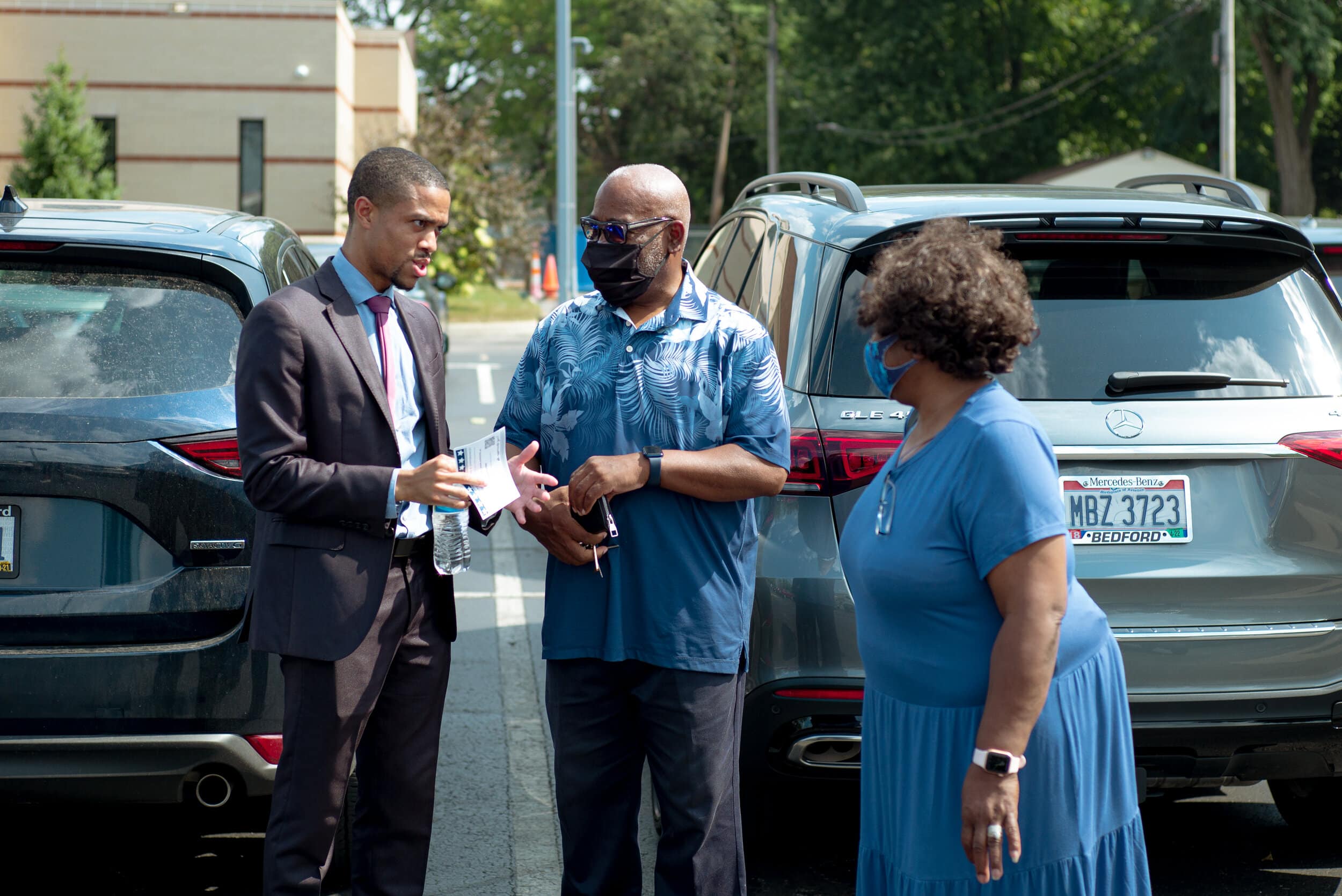
Ward 7 city council candidate Daniel Graves greets Steven and Wanda Best and they head into the Fatima Family Center to vote on Tuesday, Sept. 14, 2021. Photo by Michael Indriolo
“It’s also looking at it from a perspective of: We’re interconnected,” Graves said. “Generation Z and Millennials need to depend and connect and can learn from and be supportive of Baby Boomers, but Baby Boomers and older generations also can connect and learn from younger generations. That’s how we can build and foster community.”
Stephanie Howse, with her “straight-no-chaser” style and unabashed callouts of political shortcomings, seemed to get both those younger and older generations fired up in the leadup to this election. She ran around to different precincts and phone banked all day, but the presence of her campaigners never thinned at Fatima.
One of those campaigners, Kanisha Jackson, said she has long known Howse as a mentor to young women in her community. Unlike many Clevlenad politicians, she actually responds to concerns and questions residents raise to her.
“I know the local community is where her heart is at,” Jackson said. “I just believe in her ability to impact this community.”
Ward 8 | 17.2% turnout | Unofficial winners: Mike Polensek and Aisia Jones
Ward 8’s city council primary race comprises notably less candidates, but it’s competition has been nonetheless tense. Incumbent Mike Polensek seems a shoo-in, but BLM Cleveland activist-turned-political newcomer Aisia Jones has enjoyed grassroots support among progressives seeking new leadership for the ward’s neighborhoods: North and South Collinwood, along with the eastern section of Glenville.
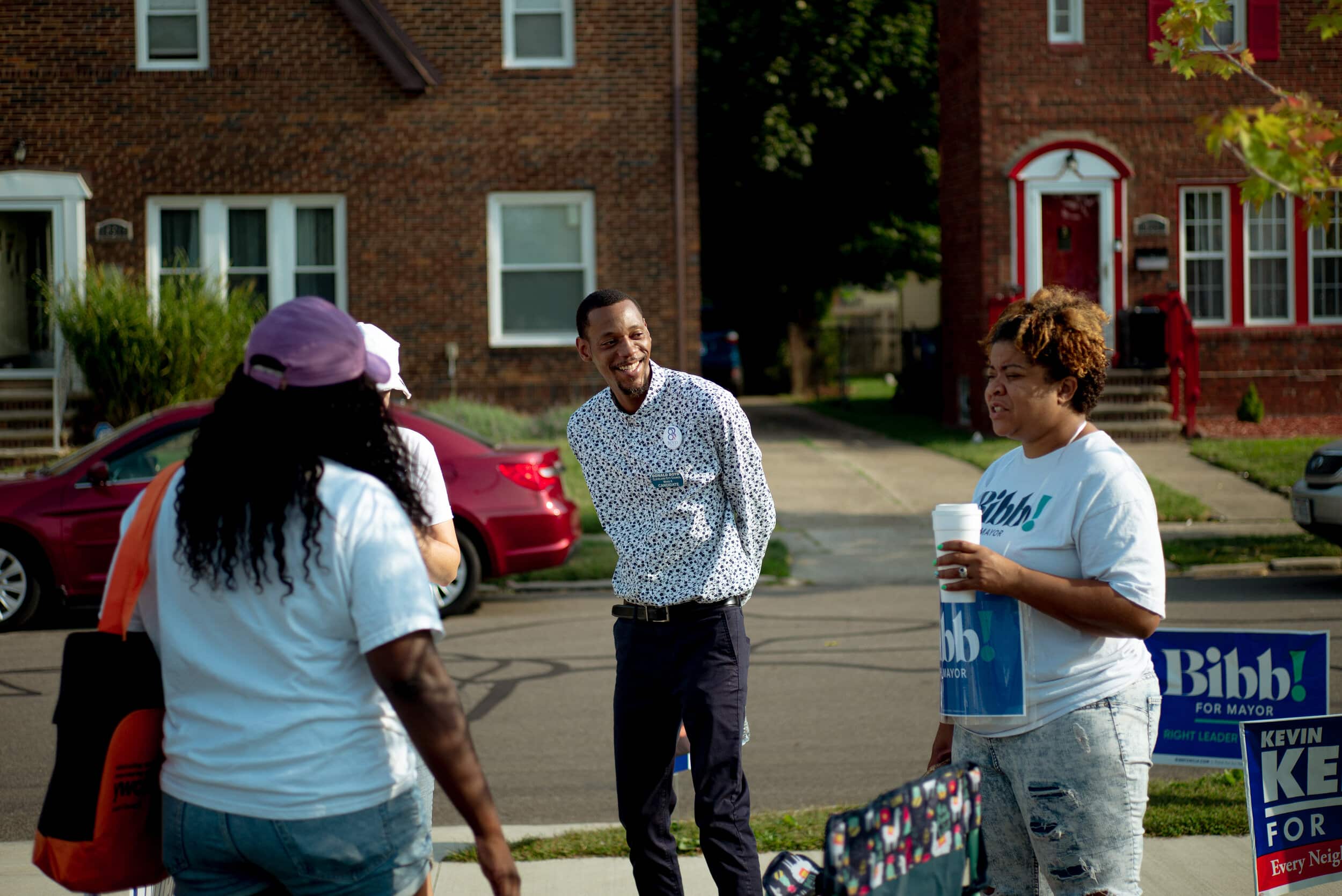
Ward 8 city council candidate Donald Boyd chats with his campaigners during a lull in voters at the Oliver Hazard Perry elementary school on Tuesday, Sept. 14, 2021. Photo by Michael Indriolo
Returning challenger Donald Boyd and Jones, along with their campaigners, both showed up at Oliver Hazard Perry Elementary School in the morning to greet the few-and-far-between voters as they entered the parking lot. Jones said turnout at other polling locations had been slow even in the pre-work hours, and that trend seemed to continue throughout the morning.
Although the address listed for the polling location there directed voters to the school’s parking lot, the poll entrance was placed on the back side of the school facing opposite the lot. Voters complained, and some campaigners suggested the placement of the polling entrance somehow could have been an intentional effort to discourage or confuse voters. One campaigner said that a voter told her she wouldn’t have voted if she had known she’d have to walk that far.
As far as walking, Jones is used to it. She reminisced on a frigid day she’d spent canvassing for a few hours back in February, noting that she has been out door-knocking for the better part of this last year. It feels surreal, she said, that the primary election has finally come.
“I’ve been anxious for this day,” she said. “I’m trying to be intentional throughout this day to kind of say, wow, I’ve done the work thus far. There’s still work to be done, but we made it to the primary.”
Jones got into the race in the first place as a way to affect change more directly than her work in activism could. Protests undoubtedly work, she said, but serving on city council would open up new avenues.
“We can protest about an issue, but if the policies aren’t changing, we’re just going to continue to have that same vicious cycle of processing for the same thing,” she said. “Taking the next step of activism for me was making legislative change.”
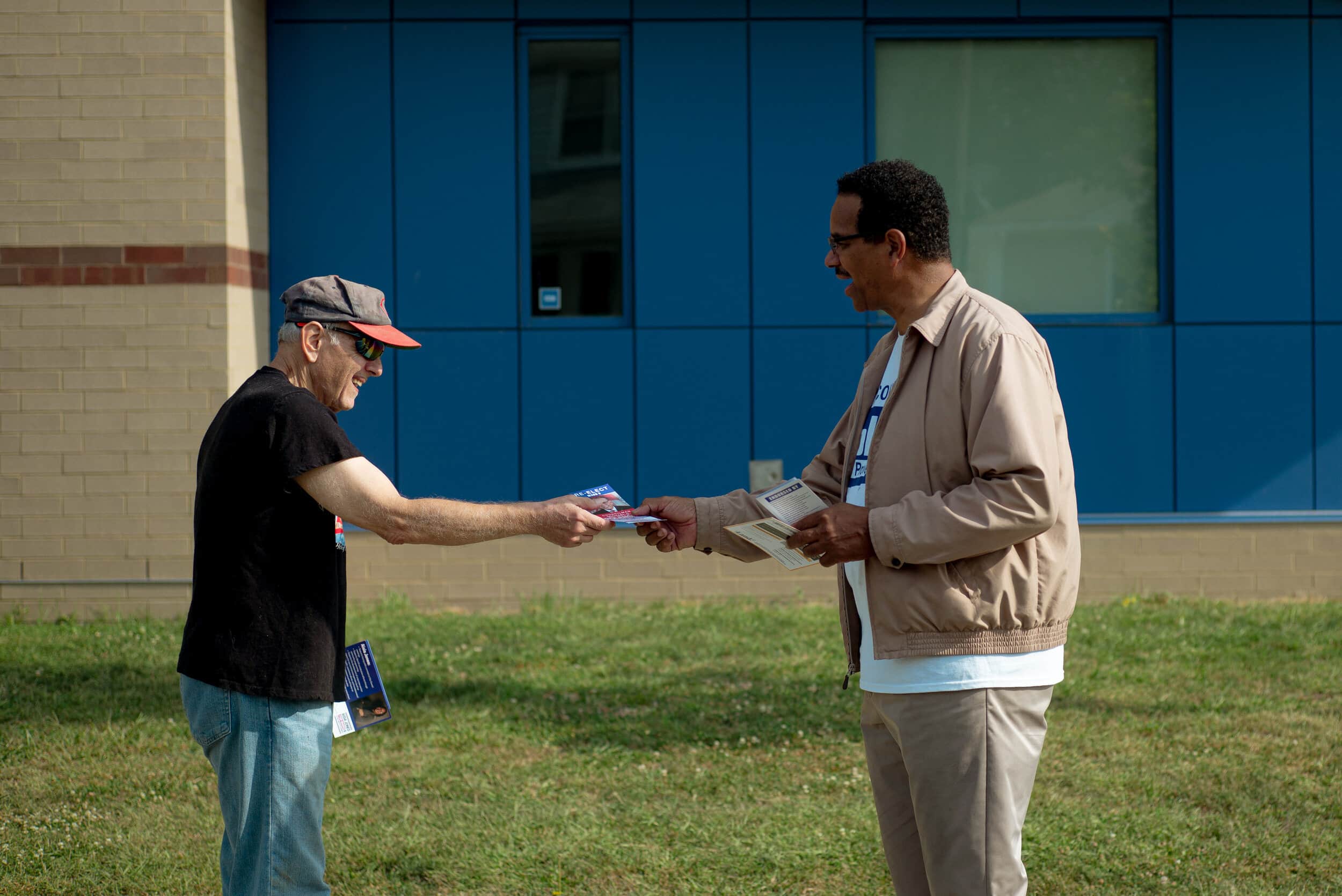
Campaigning for Ward 8 city council incumbent Mike Polensek, Lawrence Hill hands a flier to Ward 8 voter George Kovacs at the Oliver Hazard Perry elementary school on Tuesday, Sept. 14, 2021. Photo by Michael Indriolo
But not all in Ward 8 see a need for change. Lawrence Hill, a campaigner for Polensek who served as the homeowners association president in South Collinwood for six years, said Polensek stuck by his neighborhood, constantly attending community meetings (that ran well into the night, he noted) and helping to oust crime when it arose. He said he hasn’t seen Boyd or Jones in his neighborhood.
The time for change will come four years from now when Polensek plans to step down, he said.
“If the neighborhood believes it’s time for change, they’ll vote for change,” he said. “It’s not for somebody who just came on the scene to determine that. It’s for us as community residents to determine.”
As Hill prepared to head out for the day, he lamented that he’d only seen about 50 voters, at most, during the first four hours of primary day. Turnout “is never where it should be.”
Ward 12 | 15.2% | Unofficial winners: Tony Brancatelli and Rebecca Maurer
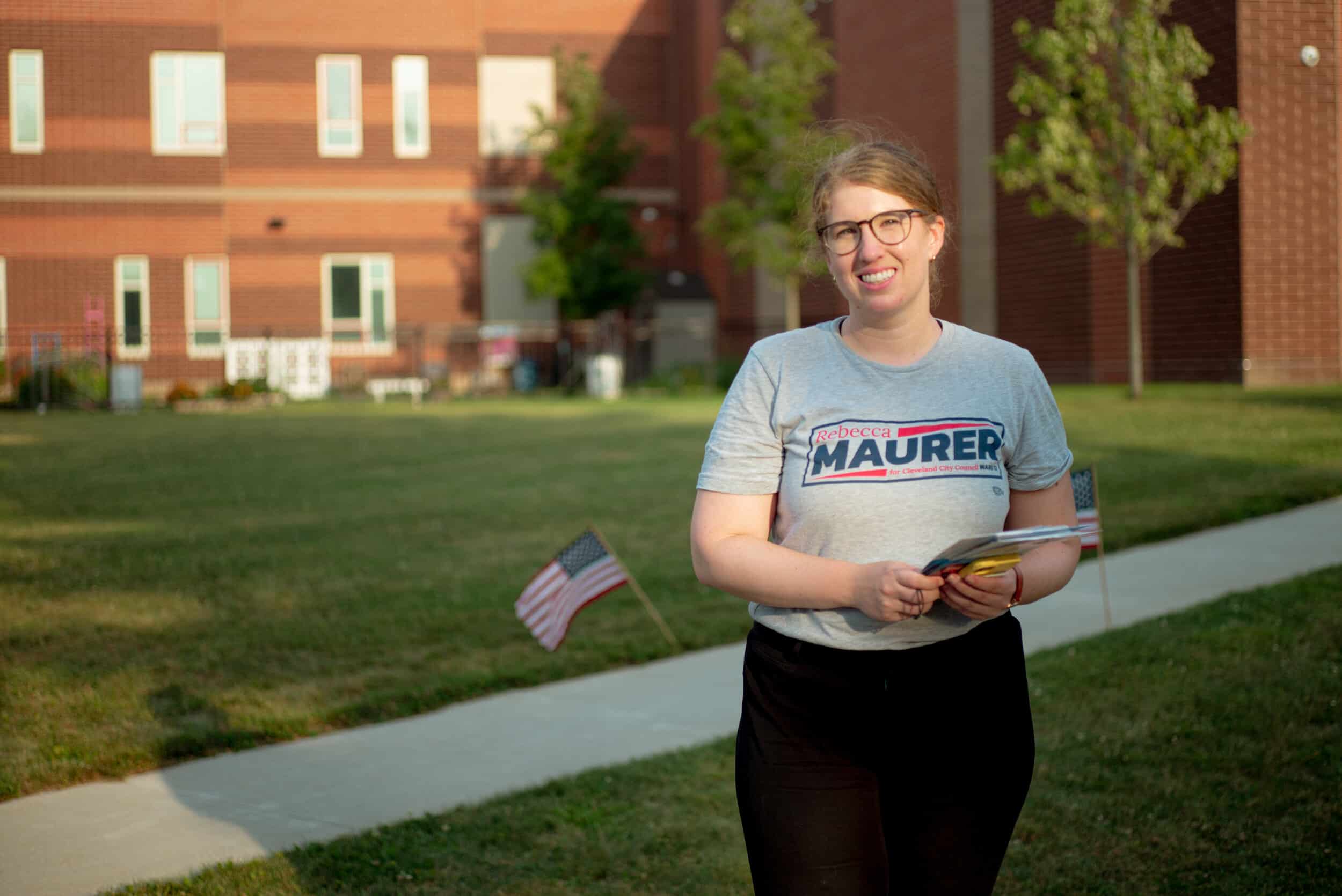
Ward 12 city council candidate Rebecca Maurer poses for a portrait outside the Albert Bushnell Hart Elementary School on Tuesday, Sept. 14, 2021. Photo by Michael Indriolo
The primary in Ward 12 will be the first incumbent Tony Brancatelli has faced in his 14 years serving Slavic Village and parts of Tremont, Brooklyn Center and Old Brooklyn. And it’s already shaped up to be a primary for the books with progressive newcomer Rebecca Maurer running a grassroots campaign that’s garnered populace support across the ward.
“I feel extremely grateful for the community that has come out to support me,” Maurer said. “I’ve personally knocked 3,000 doors at least, and we’ve knocked 1,000s more as a campaign. So just in terms of seeing that come to life with voters at the polls, that makes me feel really good.”
As the sun began to set on primary day, Maurer, newcomer Tawayne McGee and returning challenger — one of few conservatives running for any office in Cleveland — Shalira Taylor descended on Albert Bushnell Hart Elementary School.
Candidates all over the city had remained confident that turnout could pick up after voters got off work, but at this polling location, voters seemed sparse even after 5 p.m.
“These are overall low-voting areas,” Maurer said. “The way our polling locations are set up, it never feels like, wow, there’s an influx of people.”
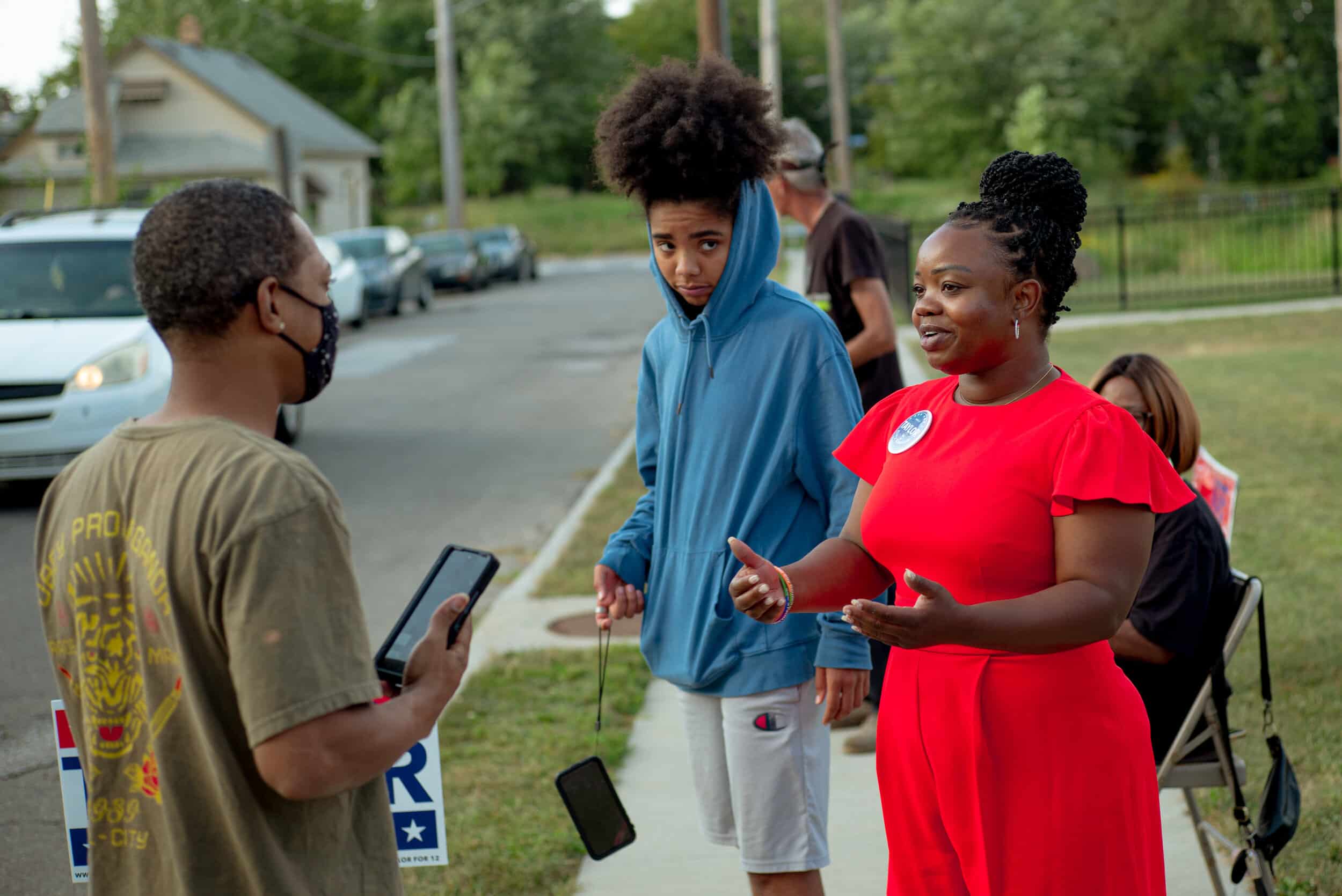
Ward 12 city council candidate Shalira Taylor talks to a voter outside the Albert Bushnell Hart Elementary School on Tuesday, Sept. 14, 2021. Photo by Michael Indriolo
Yet still, Maurer got to work calling the remaining phone numbers on her list of voters who’d been excited to vote but, at that point, hadn’t yet. She said one voter she called texted back thanking her for the reminder as he had forgotten it was primary day. He voted soon after, she said.
As Maurer and McGee handed out flyers near the polling location’s entrance, Shalira Taylor and her mother Sherron Taylor sipped melted slushies as they spoke with voters a ways down on the sidewalk. The political divide in action.
Taylor said she felt comfortable running in a democrat-dominated city like Cleveland, but the conservatives she talks to often don’t feel like their votes matter. That, along with the economic disenfranchisement holding fast to chunks of Ward 12, as other candidates have noted, make civic engagement a tall ask for many residents.
“I’m nervous like always,” she said when asked how she feels about the primary election coming to a close. “You never know if you’ve done enough or if you’ve done too little.”
For information about the Sept. 14 primary and Nov. 2 general election, including registering to vote, visit boe.cuyahogacounty.gov.
Like this story? Take our community impact survey here and support local journalism by becoming a member of The Land.
Michael Indriolo is a reporting fellow at The Land.
Keep our local journalism accessible to all
Reader support is crucial as we continue to shed light on underreported neighborhoods in Cleveland. Will you become a monthly member to help us continue to produce news by, for, and with the community?
P.S. Did you like this story? Take our reader survey!
Author

Related Articles
The Movie Nerd Report: 3 film festivals this week in Northeast Ohio
Plus, see what other new releases and classics are playing at independent theaters around you!
Walking Cleveland’s past, one story at a time
“How much of Cleveland do I pass by without knowing the story?”
More than a card: Why Cleveland Public Library still matters in the digital age
September is National Library Card Signup Month. The Land talked with Cleveland Public Library Executive Director Felton Thomas, Jr. at the Main Library downtown.


