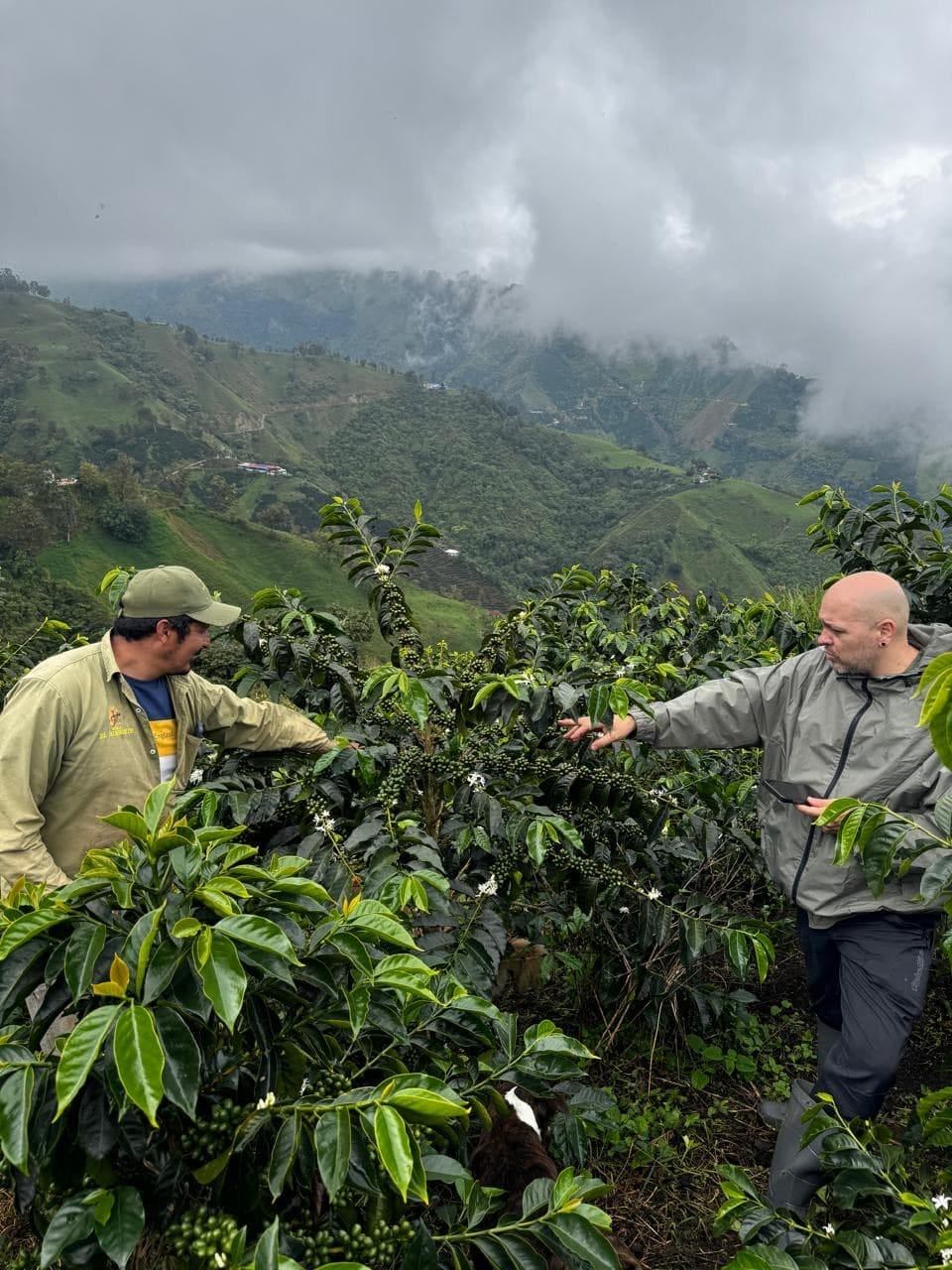
Coffee industry struggles pour into Northeast Ohio
Effects of climate change, civil and international unrest and inflation are driving up production costs, making it especially hard for specialty producers.
About 380 miles north of the equator in Betania, Colombia, fourth-generation coffee farmer Juan Medina spent his holidays as a kid on the farms helping with smaller tasks like picking defects in parchment coffee.
In the 1990s, a wave of violence in Colombia kept him and his family away. When they came back, he initially had reservations.
“To be honest, I didn’t want to [return],” Medina said. “I was a bit scared.”
But after a few years, he got more involved with the business. Now, coffee is his world.
“It means everything because it is all about my family, heritage, my grandparents and my mom,” he said.
Medina fell in love with the farm, walking between the trees and working with the lovely and honest people who live in the countryside. But volatile conditions are threatening his world.
Effects of climate change, civil and international unrest and inflation are driving up production costs, making it especially hard for specialty producers like Medina.
Coffee’s Growing Value
Cleveland-based Lekko Coffee owner Matt Ashton said that as an industry and as consumers we’ve been underpaying for the commodity when you consider labor and production costs.
“Coffee as a product has been underpriced forever,” he said. “We have paid way less money for coffee than what we should have.”
That is starting to change. According to Toast data, almost every coffee drink has seen an increase in price, including barista-made coffee drinks.
From 2023 to 2024, lattes increased 3.8%, from $5.39 to $5.60, followed by another 4% increase the next year.
Kent’s Bent Tree Coffee Roasters opened a cafe in 2017 and charged $3.50 for a latte. The price increased by a quarter a few times over the years and currently sits at $4.25.
A 16-oz bag of Guatemalan coffee at Bent Tree went from $12.50 in 2011 to $16 in 2026.
“Everytime we raise prices, people are asking questions on why we are doing it,” said Bent Tree co-owner Mike Mistur.
For the most part, Mistur said people come back after price increases, but there are a couple who don’t.
Roasters like Bent Tree and Lekko sell “specialty” arabica beans, which have an international quality score of 80 or above. Coffea arabica only grows in the “coffee belt,” a narrow strip of countries surrounding the equator including Brazil, Colombia and others.
Effects of Climate Change
These countries have the perfect growing conditions for the arabica plant, but the climate is changing.
A couple decades ago, Medina knew when it was dry or rainy season in Colombia.
But nowadays, the seasons are unreliable.
“Three or four years ago, I remember we only have one month with no rain, but the rest [of the] 11 months, the whole year was pouring and pouring every day,” Medina said. “So, the coffee production goes very low in quantities, and the prices are going up.”
In some areas of the country, they’ve lost the second harvest of the year.
More rain in Colombia means higher quality coffee for Medina.
“It’s tricky because sometimes it’s good money, even if you don’t have enough quantity,” he said. “It’s not very productive, but I do prefer when it’s raining more because my quality is going up and that’s what I’m working on.”
Other countries like Brazil and Vietnam are experiencing temperamental weather too, from storms to inconsistent rainfall. Ashton recalled reports of bad rainfall and growing conditions for a few years, resulting in lacking quantity and quality exports.
Since Brazil and Vietnam are the two largest coffee producers in the world, they set the tone for prices.
“Even if they don’t produce all the specialty coffee, the base price for coffees is based on the commodity market,” Mistur said. “So if it doesn’t rain in Brazil for two weeks, the commodity market will go up 10%.”
Medina said Brazil production decreasing allows Colombian coffee prices to increase.
Outside of precipitation, Medina noticed some birds that used to migrate to Colombia are no longer making the journey, and certain species of trees and microorganisms are disappearing.
“It changed everything because the whole population of microorganisms is changing a lot, and it influences the coffee flavors because this population takes part on the coffee fermentation,” Medina said.
While farmers try to deal with climate change, they also need to navigate the political climate.
Governments Creating More Obstacles
In Medina’s personal experience, working on your own farm in Colombia is becoming difficult, even dangerous.
“There are safety issues because of the current government we have,” he said. “[We] had been trying to negotiate with armed groups. It is not working, and they have become more powerful now, and they are present all around where the coffee is grown.”
Sometimes they have to pay extra illegal taxes to the paramilitary groups just to move the coffee off the farm.
U.S. roasters like Lekko and Bent Tree also pay extra taxes from Trump’s tariff campaign that began in early 2025.
From April to October, Bent Tree continued to purchase specialty-grade coffee and “just ate that cost” hoping the tariffs would go away. Eventually, they had to split the surcharge with customers by adding a temporary service fee instead of raising menu prices permanently.
“We hate raising prices, but we, at the end of the day, we wouldn’t buy a coffee that was inferior just to keep a price at a certain level,” Mistur said. “We’re just trying to focus on high quality coffee.”
Mistur estimated the tariffs resulted in a dollar per pound increase for Bent Tree’s imports.
Tariffs currently sit at a 10% global import surcharge but reached a 50%-high for Brazil last year.
Brazilian coffee, which has notes of chocolate, nuts and dried fruit, is the base of Lekko’s espresso drinks and its largest percentage seller.
“We had a blanket 10% [tariff], which is already an issue because, since when I opened in 2021 to when that came down in 2025, my base Brazilian coffee had already gone up 70% in costs to buy,” Ashton said.
In August, Trump added an additional 40% tariff on Brazilian imports on top of the base 10% for a few months.
“[Donald Trump] was mad that Jair Bolsonaro was not treated the way he wanted Jair Bolsonaro to be treated in his trials,” Ashton said. “So then, overnight, actually, the price for buying Brazilian coffee goes up 50%. So by fall of 2025, my cost for buying Brazilian coffee had actually tripled from when I opened.”
(Infogram of Arabica Brazilian unit price)
The end customer ultimately pays the tariff since local coffee roasters lose money with each bag of coffee they buy.
Coffee producers like Medina were caught in the crossfire of volatile international relations.
“I had these exportations coming to the United States at the moment President Trump and President Petro from Colombia had a kind of personal fight,” Medina said.
Trump threatened Colombia with a 25% tariff after Petro denied repatriation flights from landing in the country. While their dispute lasted a day or so, the uncertainty affects business between coffee exporters and U.S. importers.
“At any moment, we’re still scared of Petro and Trump having another fight because that’s always going to bring the tariffs back on the table,” Medina said.
Some of his partner coffee roasters reassured him and said “Juan, no worries. This is not your fault. I will pay for the taxes.”
Others asked him to find cheaper coffee or provide a discount because they couldn’t afford it.
What it all comes down to: Money
There are moments where having direct trade with U.S. coffee roasters is difficult for Medina.
“Sometimes it’s not fair,” he said. “They don’t understand all the work we have to do as producers back in Colombia, and sometimes they just don’t want to pay what it really costs.”
If Medina sold all his coffee locally, he wouldn’t make enough money to keep his farm. Profits from exports, however marginal, help keep his farm going.
“If you can earn an extra few cents, it will be okay,” Medina said. “But if you lose those extra cents, it can be so hard.”
Ashton and Medina agree inflation and tariffs are hitting everyone hard and increasing petrol prices are adding an extra punch.
When negotiating producers and roasters keep an eye on Brazilian prices since it’s a good reflection of the market.
Roasters need to evaluate the cost-to-quality ratio when they are making a purchase.
“We have to balance what we think our customers will pay for the coffee,” Mistur said. “We just have to be mindful of that because we could buy a really expensive coffee, we roast it, and then it sits on the shelf for too long.”
He mentioned people often want to try Kona coffee from Hawaii, the only coffee-producing place in the United States, but it can be four to five times more expensive than the average price of coffee from any other region.
The times Bent Tree offered Kona coffee, it didn’t sell well.
If the price is too high, roasters pass on the coffee and try to find something similar at a reasonable cost.
“I’ve seen some, I mean really cool-looking Yemeni coffees, but when I’ve seen that, I’ve seen a lot of them at like $13-14 a pound raw,” Ashton said. “That’s not necessarily something we can go for right now, but I can get something of an equivalent quality from maybe Colombia for seven.”
Ashton buys most of his Colombian coffee from Medina. Overall, he buys from farmers who treat their soil well and supports a living wage throughout the supply chain.
“You have a lot of people working on these farms who are not getting paid well for the hard labor that they are doing in third world countries,” Ashton said.
Bent Tree’s wholesale offers six to seven fair trade organic coffees, which tend to come from Latin countries like Guatemala, Mexico and Peru. Their café in Kent sells 12-14 coffees, including Papa New Guinean, Rwandan and Ethiopian.
“A lot of the farms in Ethiopia, they’re smaller family farms that have been around for centuries,” Mistur said.
The Community Behind the Coffee
One of the great things about coffee and cafés for Mistur is the ability to have conversations about coffees with the community and helping people find the best choice for them.
Ashton said specialty roasters are more ingrained and have an outsized influence in their communities than bigger corporations like Starbucks.
Medina enjoys being hands on with his customers too by visiting café locations and serving pour overs himself.
“At the same time I’m doing the percolation of the coffee you are going to drink as a customer, maybe we are talking about what happened with this coffee while it was in the tree, in the farm or in the middle of the process that we normally do,” he said.
Outside of his own farm, Medina helps other farms improve their quality scores, efficiency and have a cleaner production. Afterwards, he helps them sell coffee in the United States through his company The Coffee Five Project.
Despite the challenges, Medina wants customers to know the producers love what they do.
“We are happy working with coffee,” he said. “We are very happy just touching coffee cherries every day, processing the coffee, doing the fermentation, doing the washing, the drying process. This is something that makes us happy, and with the support of them paying a fair price for the coffee we are producing, it will be more than enough.”
Keep our local journalism accessible to all
Reader support is crucial as we continue to shed light on underreported neighborhoods in Cleveland. Will you become a monthly member to help us continue to produce news by, for, and with the community?
P.S. Did you like this story? Take our reader survey!
Author

Related Articles
Federal Reserve votes 9-3 to leave key rate unchanged despite persistently high inflation
Dissenting in favor of a quarter-point interest rate hike were Beth Hammack, president of the Federal Reserve Bank of Cleveland; Neel Kashkari, president of the Minneapolis Fed; and Lorie Logan, president of the Dallas Fed.
Will tough talk be enough? Fed Chair Warsh faces pressure to combat inflation
Beth Hammack, president of the Cleveland Fed, said in a post on LinkedIn earlier this month that for the first time she is hearing business leaders call for higher rates.
Memorial Day: Higher fuel prices have some Americans scaling back their travel plans
The nonprofit Institute on Taxation and Economic Policy estimates that Americans will collectively spend an extra $3.5 billion on gasoline this long weekend. The latest consumer price index showed airfares were 20.7% higher in April than a year earlier. Some travelers are opting for shorter getaways, closer destinations and low-cost activities like hiking.